 Lifetime VPS Europe
 Lifetime VPS Asia
 Lifetime WooCommerce Hosting
 Lifetime Hosting
 Lifetime Game Dedicated Servers
 Chicago, US
 Tokyo, Japan
 Singapore
 Hong Kong
 Seoul, South Korea
 Amsterdem, Netherlands
 London, UK
 Stockholm, Sweden
 Oslo, Norway
 Vienna, Austria
 Zurich, Switzerland
 Sydney, Australia
 Wordpress Hosting
 VPS Hosting
 DDOS Protection
 Submit Ticket
 Full Management
 Guides
 Videos and Podcasts
 Discover Creative Ideas
 Cybersecurity Services
 Voxfor Mega Menu
 Voxfor Advanced Price Management For WooCommerce
 Voxfor Secure Live Chat and AI Support
 Voxfor Multilanguage
 Voxfor AI Content Summary
 Voxfor Autopilot

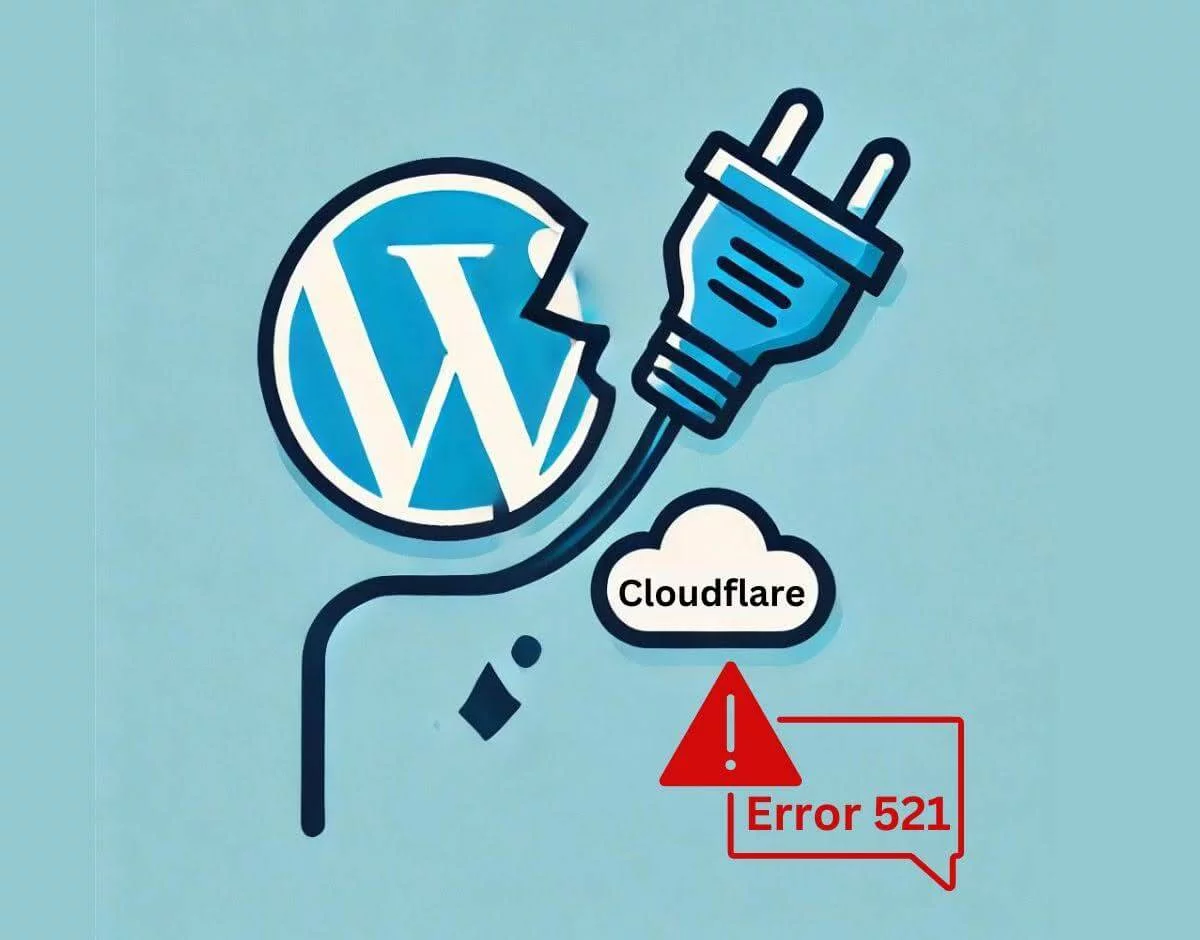
If you manage a WordPress website using Cloudflare, you might have seen Error 521. Checking error logs can help diagnose the issue. This error can be extremely frustrating, disrupting your website’s performance and leaving visitors staring at a blank screen. Check the error code to diagnose the issue. Website owners and developers need to resolve error messages quickly to maintain an uninterrupted online presence.
The Cloudflare Error 521 Usually indicates an issue with the connection between your website host and the reverse proxy web server, which could lead to error code 521 in WordPress. There are several reasons why this may occur, from server overload to hosting issues. To ensure that your website remains accessible and performs optimally, you must understand and resolve this error as soon as possible.
What Does Cloudflare Error 521 Mean?
Companion discussion topic: If the server hosting your website refuses to connect to Cloudflare, you will receive Cloudflare Error 521. Visitors cannot access your site due to this connection refusal, adversely affecting your website’s performance and user experience.
In most cases, Error 521 indicates a server-side issue, indicating the problem lies with your hosting provider. With a suitable plugin, you can easily manage your WordPress site, even if the IP is from Cloudflare. A WordPress hosting plan has reliable performance and simple management.
Causes of Cloudflare Error 521
Cloudflare Error 521 means the origin web server refused a connection from Cloudflare. The two main causes in Cloudflare’s official 521 documentation are an offline origin web-server application and blocked Cloudflare requests. A stopped listener, the wrong origin address or port, or an origin firewall/rate limit can produce this refusal. Resource pressure is relevant when logs show it stopped the service or exhausted its connection capacity; traffic volume alone is not a diagnosis.
A visitor’s VPN and the WordPress page cache are not the origin-to-Cloudflare TCP connection. Disabling a browser VPN or clearing cached pages is therefore not a general repair for a confirmed Cloudflare Error 521. Likewise, distinguish a refused HTTPS connection from a TLS handshake failure or an invalid origin certificate: those are different failure stages and can produce different Cloudflare error codes.
5 Effective Methods to Fix Cloudflare Error 521
Record the affected hostname, URL, UTC time and Cloudflare error details before changing settings. Check origin service and security logs for that same window. Keep an independent hosting-console access path available and make one targeted change at a time, so the result can be attributed to a specific cause.
Method 1 | Check the Origin Web-Server Listener
Use the hosting dashboard or an authorized server session to check whether the web-server process is running and listening on the origin address and expected port. On a Linux server you administer, a read-only listener check such as ss -ltn shows active TCP listening sockets; the correct service name and service-management command depend on the installed web stack. Review its recent error log and service status before restarting a failed service. A running virtual machine does not prove its web-server application is accepting connections.
A failed ping does not establish that the server is down: ICMP Echo can be blocked while HTTP works. Conversely, a successful ping does not prove that port 80 or 443 is listening. Test the actual origin web service with the intended hostname and, for HTTPS, correct SNI. A direct test must come from an authorized source; an origin intentionally restricted to Cloudflare may correctly refuse an unrelated tester.
Method 2 | Check Origin Firewall and Rate-Limit Decisions
Inspect the origin firewall, security plugin, intrusion-prevention system, load balancer and hosting protection logs for rejected Cloudflare connections. Many visitors can arrive at the origin through Cloudflare IP addresses, so a per-source-IP limit may reject legitimate proxied requests. Compare the recorded connecting address with the current official Cloudflare IP ranges, including the address families used by your deployment.
Allow the required Cloudflare ranges on the web-service ports in the appropriate security layer and correct a demonstrated rate-limit or block rule. Do not disable the entire firewall, open administration ports, trust arbitrary forwarded-IP headers, or replace the official address list with a guessed single IP. Preserve your other access controls and verify the exact rule change against new origin connections. If the hosting provider owns this layer, give support the hostname, UTC window and relevant refusal evidence.
Method 3 | Verify the Configured Origin Address
Compare the proxied hostname’s configured A/AAAA records and any load-balancer origin settings with the actual origin endpoints supplied by the host. A public DNS lookup for an orange-cloud record normally returns Cloudflare edge addresses; it does not reveal which origin IP Cloudflare has been configured to contact. Check the configuration in the Cloudflare dashboard and the hosting control panel rather than assuming those public DNS answers are the origin.
If an origin IPv4 or IPv6 address changed during migration, update only the incorrect origin configuration after confirming ownership and the correct hostname routing. Verify every origin that can receive the request, not just one healthy backend. Avoid disabling the proxy simply to make the error disappear: that changes the network path and may expose an origin that was deliberately protected.
Method 4 | Match the SSL/TLS Mode to the Listening Port
Cloudflare documents port 80 for an origin connection in Flexible mode and port 443 for Full or Full (strict). Confirm that the origin actively listens on the port required by the current mode. A closed HTTPS listener can cause Cloudflare Error 521 even when HTTP responds. In Full or Full (strict), configure HTTPS at the origin and satisfy the certificate requirements of the chosen mode; preserve certificate validation and the intended secure architecture.
Do not weaken TLS validation or disable HTTPS redirects as a routine Cloudflare Error 521 fix. If the connection reaches the listener but the TLS handshake fails, investigate SSL handshake error 525; an invalid origin certificate can instead require a certificate-specific investigation. Keep the observed error code and logs aligned with the failure stage, and check the currently configured mode before making any change.
Method 5 | Resolve Proven Resource or Service Failures
Correlate the error window with web-server crashes, connection limits, memory exhaustion, disk capacity and relevant system or application logs. If a worker or service failed, resolve the recorded cause and restore the listener. If load tests and production measurements show capacity exhaustion, consider a scoped configuration change or additional resources. A hosting upgrade is not a guaranteed cure for a wrong origin IP, closed port or firewall rule.
After repairing Cloudflare Error 521, request the affected public URL through Cloudflare again and confirm that the origin accepts the expected Cloudflare connections. Check both service logs and the visitor-visible response, then repeat a representative application request. Record which setting changed and the evidence that the refusal stopped. If failures remain intermittent, capture another precise UTC window instead of clearing unrelated caches or applying several speculative fixes together.
Preventive Measures to Avoid Cloudflare Error 521
Maintaining a seamless user experience on your WordPress website depends on preventing Cloudflare Error 521 while allowing legitimate Cloudflare requests at the origin. Find the best hosting plan to manage traffic and run your website reliably. Choose any hosting change from measured application and capacity requirements; a Windows VPS is not inherently required to resolve this connection error. By implementing the following preventive measures, you can significantly decrease this error, and your website continues to be available and efficient.
Regular Server Maintenance
Regular server maintenance is essential for the smooth operation of your website; it is recommended to review the error logs periodically. Keeping your server in good condition helps reduce many issues that would have caused Cloudflare Error 521.
- Perform Routine Server Updates:
Make sure to keep your server’s software and operating system up to date; because of this, you are now getting the latest additions related to security patches and performance improvements. Keep your WordPress installation and plugins updated to ensure that your WordPress installation and plugins don’t cause any compatibility issues affecting your server’s performance.
- Monitor Server Health:
Server monitoring tools can help you monitor your server’s health and performance metrics, such as CPU, memory usage, and disk space. You can set alerts whenever strange server activity or performance deteriorates and take immediate action before problems escalate.
- Schedule Regular Backups:
Back up your site’s data and configs regularly so that you can restore your site quickly if any server issues or the like happen. Keep backups in a secure, far-distant location to get backups if you lose data.
Optimizing Website Performance

Providing a better user experience on an optimal website also reduces the load on your server, reducing the chance of Cloudflare Errors. Cloudflare IP ranges management will prevent Cloudflare Error 521 and help you optimize websites in Cloudflare.
- Implement Caching Solutions:
Utilize caching plugins such as W3 Total Cache or WP Super Cache to create static versions of your pages for your server to load, reducing your server strain and making your load times faster. Ensure returning visitors don’t need to download your site from the Origin web server but rather load cached versions from the Cache webserver.

- Optimize Images and Media:
Compress images using tools like TinyPNG or ShortPixel to reduce their file size without compromising quality and ensure that your Origin web server handles fewer data requests. Reduce your initial page load times with lazy loading offscreen images and videos until users reach them by using lazy loading.

- Minimize HTTP Requests:
CSS and JS combine and minify (reduces the number of HTTP requests) and help speed up page load time. Remove any unnecessary plugins and scripts that may be acting as bloated and affect website performance — such as removing them may fix error 521.

If your site has many visitors, switch to a server with a more powerful hosting solution and the ability to take on higher loads.
Choosing the Right Hosting Plan

Choosing the proper plan for your website’s traffic and efficient performance is critical.
- Assess Your Hosting Needs:
It will help evaluate your website’s current and future traffic patterns and resource needs to choose a hosting plan that can adapt to present and future demands. When selecting the host plan, you must address bandwidth, storage, and the server resources needed.
- Opt for Scalable Solutions:
Look for hosting plans that offer scalability, meaning you can upgrade the resources without a headache as your website grows. Consider cloud hosting solutions, which provide flexible resource allocation and high availability.
- Prioritize Reliable Hosting Providers:
Research and select hosting providers known for their reliability, performance, and customer support, especially ones experienced in handling content delivery networks. Find yourself hosting providers with automatic backups, DDoS protection, correctly maintaining Cloudflare IP allowlists, and 24/7 technical support.
Final Words
Cloudflare is not always to blame for Error 521, but it’s a frustrating thing to deal with. The good news is that you can have a minor issue with a bit of knowledge and the right approach. Knowing why the error happens and what solutions are effective, such as adjusting Cloudflare IP ranges, will help you quickly solve the error and keep your WordPress website available.
In addition, prevention methods, including regular server maintenance, a well-optimized website, choosing the right hosting package, and excellent security practices, can drastically decrease the error rate in the future.
Maintaining an interruption-free website is critical for providing a seamless user experience and ensuring your business runs smoothly. Fix errors promptly to avoid disruptions. Following the configuration steps described in this blog will allow you to keep your website running and provide visitors with a reliable and secure browsing experience.