
 Lifetime VPS Europe
 Lifetime VPS Asia
 Lifetime WooCommerce Hosting
 Lifetime Hosting
 Lifetime Game Dedicated Servers
 Chicago, US
 Tokyo, Japan
 Singapore
 Hong Kong
 Seoul, South Korea
 Amsterdem, Netherlands
 London, UK
 Stockholm, Sweden
 Oslo, Norway
 Vienna, Austria
 Zurich, Switzerland
 Sydney, Australia
 Wordpress Hosting
 VPS Hosting
 DDOS Protection
 Submit Ticket
 Full Management
 Guides
 Videos and Podcasts
 Discover Creative Ideas
 Voxfor Autonomous AI Workers
 Voxfor Mega Menu
 Voxfor Advanced Price Management For WooCommerce
 Voxfor Secure Live Chat and AI Support
 Voxfor Multilanguage
 Voxfor AI Content Summary
 Voxfor Autopilot

Strategic internal linking transforms websites from fragmented content into interconnected authority networks. Internal link optimization projects delivered 150,000+ annual visits in three weeks, while topic clusters with structured linking increased organic traffic by 24% and keyword discovery doubled, demonstrating measurable ROI from systematic implementation.
Why Internal Link Mapping Matters
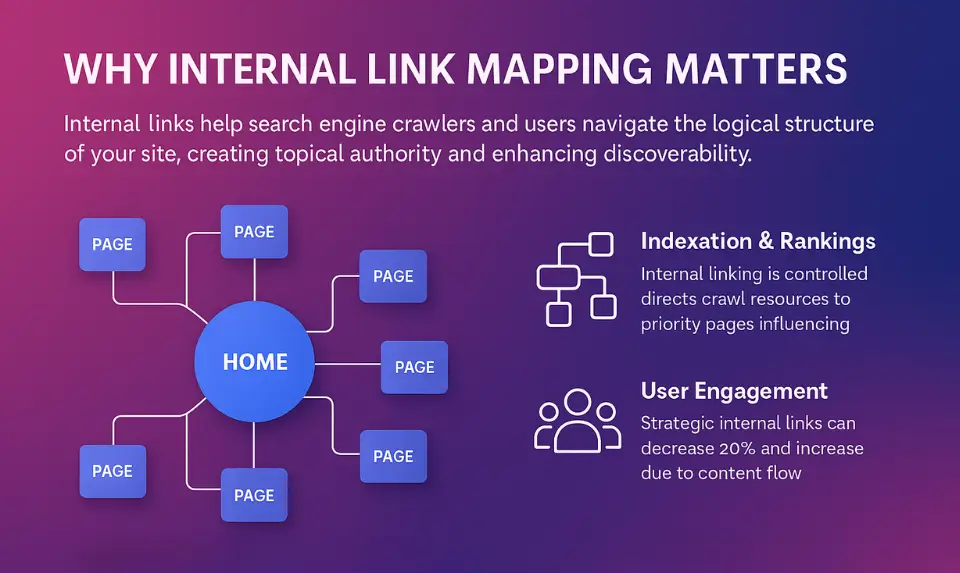
Internal links help search engine crawlers and users navigate the logical structure of your site, creating topical authority and enhancing discoverability. Internal linking is controlled to make sure that the crawl resources are served to which pages, and this has a direct influence on indexation and rankings.
In addition to the SEO practice, strategic internal connections can lower bounce rates up to 20 percent and raise user traffic because of smooth content routes. Internal linking is the basis of optimization with this two-fold advantage, search presence and user experience.
Step 1: Analyze Current Structure
Audit Your Site: Use tools like Screaming Frog or Ahrefs to identify orphaned pages (lacking internal links), broken links, crawl depth issues, and link distribution patterns.
Identify Gaps: Pages ranked 5-20 without internal links represent missed authority opportunities; links from established pages dramatically improve visibility. Pages buried 4+ clicks from the homepage receive 9x less traffic than shallower pages, a critical fix.
Categorize Content: Group pages by theme, identifying topics where you have substantial coverage deserving of pillar-cluster architecture.
Step 2: Plan Site Architecture
Create Hierarchy: Establish clear structure, homepage → broad categories → subcategories → content. This visual map prevents silos (content groups only linking internally) and reveals opportunity clusters.
Build Topic Clusters: Central pillar pages cover broad topics comprehensively (2,000+ words), linking to multiple cluster articles addressing specific subtopics. This structure increases keyword rankings, organic traffic, and topical authority simultaneously.
Define Link Depth: Ensure important pages remain within 3 clicks from the homepage, optimizing crawl efficiency and user navigation. Pages at depth 1-3 generate 9x more SEO traffic than those at depth 4+.
Step 3: Map User Journeys
Prepare user journey maps with detailed steps of how a visitor achieves objectives using content sequences. Attach the internal links in areas that are matters of user intent and content flow. Contextual links placed in the opening paragraphs are more effective as compared to being placed in isolation.
Step 4: Implement Linking Strategy
Distribute Authority: Link from high-authority pages to underperforming ones, strategically passing PageRank to priority content. Pages receiving new internal links from authority sources show an average 7% traffic increase; some achieve 24% gains.
Cluster Connections: Pillar pages link to all cluster articles; clusters link back to the pillar using descriptive anchor text; related clusters link naturally to each other. This interconnected structure signals topical expertise and improves all cluster articles’ rankings.
Hub-and-Spoke Model: Position one authoritative hub page linking to multiple specific spoke pages, with spokes linking back and to each other strategically. This organization maximizes topical authority and user navigation.
Anchor Text Optimization: Use descriptive, keyword-relevant anchors varying types (30% branded, 20% partial-match, 15% generic), preventing over-optimization. Concise anchors (3-5 words) outperform lengthy ones.
Step 5: Measurement & Continuous Optimization
Track KPIs: Keep track of organic traffic increase, improvement of keyword ranking, a decrease in bounces, crawling processing, and indexation rate. Internal link improvements tend to report positive values in 30 120 days.
Use Analytics: Google Analytics reveals user pathways and drop-off points; heatmap tools identify where users actually click links. Adjust underperforming links iteratively based on engagement data.
Regular Audits: Quarterly reviews catch broken links, new orphaned content, and emerging optimization opportunities. Internal linking requires ongoing maintenance, not one-time implementation.
Real-World Results
Enterprise Case Study: After a three-week implementation, the site achieved a 9,500 weekly organic traffic increase (150,000 annual). Authority distribution through topic clusters proved transformative.
eCommerce Success: 24% organic traffic increase from linking level-1 pages to deeper product pages (level 3-4) that previously lacked visibility.
Marketplace Doubling: Semantic linking automation provided a 100 percent improvement in the number of keywords found at the city level, which made category pages more visible.
Advanced Tactics
Crawl Budget Optimization: Maximise connection to pages with low value (archives, thin content), prioritizing crawlers to the high value content. These are efficiency gains of special importance to large sites.
Keyword Cannibalization Fix: Consolidate authority by linking underperforming pages on similar topics to the most comprehensive version, guiding both users and search engines. Strategic linking prevents internal competition.
AI Search Visibility: Hierarchy, topical clusters and context are indicated by well-constructed internal linking, which enhances AI snippet inclusion and SGE visibility. The issue of semantic relationships is gaining momentum in AI search systems.
Common Mistakes
Over-Linking: Once the pages hit 45-50 internal links, the diminishing returns are in place; quality outweighs quantity every time. Delution is avoided by strategic restraint.
Poor Anchor Text: Generic anchors (“click here”) waste SEO potential; descriptive, keyword-relevant anchors signal relevance.
Ignoring User Experience: Such links that do not serve the user’s purpose are confusing and are harming the engagement metrics. SEO optimization with authentic user value.
Conclusion
Mapping and optimization of internal links turn websites with disjointed content into authoritative ecosystems. Having recorded statistics of 150,000+ visits annually, 24 percent traffic benefits, and 100 percent keyword discovery benefits, the systematic implementation gathers quantifiable ROI.



