
 Lifetime VPS Europe
 Lifetime VPS Asia
 Lifetime WooCommerce Hosting
 Lifetime Hosting
 Lifetime Game Dedicated Servers
 Chicago, US
 Tokyo, Japan
 Singapore
 Hong Kong
 Seoul, South Korea
 Amsterdem, Netherlands
 London, UK
 Stockholm, Sweden
 Oslo, Norway
 Vienna, Austria
 Zurich, Switzerland
 Sydney, Australia
 Wordpress Hosting
 VPS Hosting
 DDOS Protection
 Submit Ticket
 Full Management
 Guides
 Videos and Podcasts
 Discover Creative Ideas
 Voxfor Autonomous AI Workers
 Voxfor Mega Menu
 Voxfor Advanced Price Management For WooCommerce
 Voxfor Secure Live Chat and AI Support
 Voxfor Multilanguage
 Voxfor AI Content Summary
 Voxfor Autopilot

Optimizing strategy anchor texts will convert internal linking from passive navigation to a strong ranking signal. The URLs having bigger anchor text differences are associated with much more Google search traffic. Conversely, in surveys that were carried out to the end, diversified websites were ranked 2.7 times higher (1.3 vs 3.5) than low-diversity websites. However, the number of internal links on the page exceeding 45-50 is counterproductive, proving that quality distribution is more important than quantity.
Why Anchor Text Matters for SEO
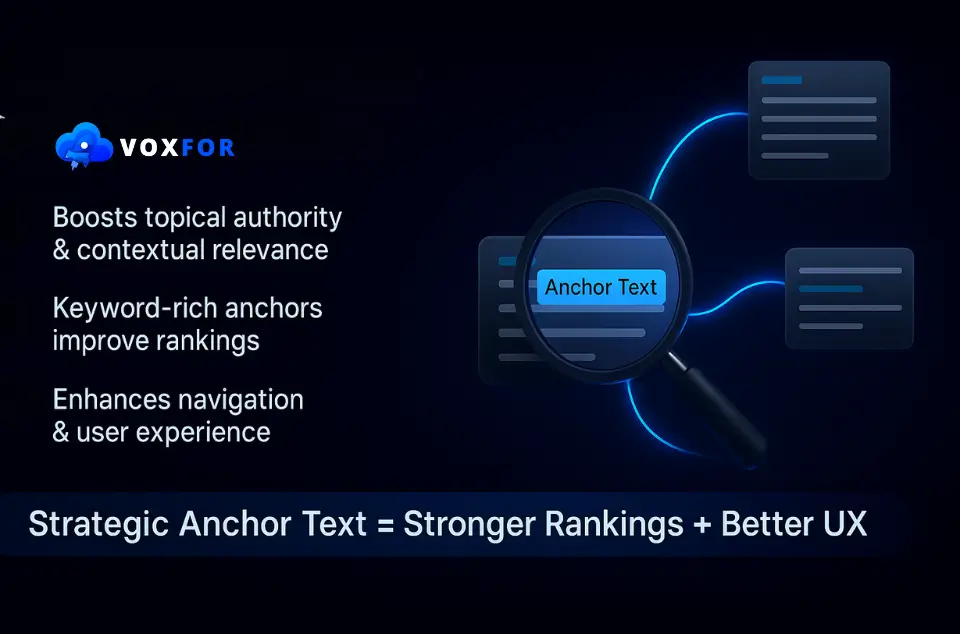
Anchor text helps search engines to obtain topical authority and relevance, as it gives them a contextual clue that other related pages contain. Search engines also view anchor text as a ranking signal, and in direct proportion to the richness of keywords in anchor text, search engines directly correlate the relevance of anchors to high ranks.
In addition to rankings, descriptive anchor text is better for user experience; 70 percent of users found sites with divergent internal linking easier to navigate and more informative. Anchoring text is strategic and forms seamless user experiences as it provides cues to algorithms on the page’s significance.
Understanding Anchor Text Types
Exact Match (5-10% maximum): Uses target keyword precisely, powerful for rankings but dangerous when overused, triggering spam signals. Even definition pages on ultra-authoritative sites like Salesforce (DR 92) limit exact match to 35%. One client with 60% exact-match anchors (“buy backlinks”) hit page 1, then vanished; recovery took 60 days after rebalancing.
Partial Match (20-40%): Includes keywords naturally without appearing spammy. 41.7% of SEO experts prefer this as the top strategy. Most balanced and safe approach for sustainable rankings.
Branded (30-45%): Uses company/brand name, building trust signals while avoiding over-optimization penalties. Branded anchors represent the safest long-term strategy, particularly important for algorithm-resistant profiles.
Generic (“click here,” “read more”): (15-20%): Low SEO value but necessary for natural variation. Supported by real data showing a correlation with better rankings.
Naked URLs (5%): URL as anchor text, doesn’t hurt rankings, and surprisingly correlates with increased traffic**. Particularly effective in reference sections and resource lists.
Real Data on Anchor Text Performance
Diversity Correlation: A Study of 1,000 high-ranking websites revealed that those with high anchor text diversity averaged ranking position 1.3 versus 3.5 for low-diversity sites, a 2.7x difference. Diverse anchor text sites experienced 50% higher user engagement with increased time on site and pages per visit.
Google Study Confirmation: Research on 23 million internal links confirmed URLs with larger anchor text variations receive significantly more Google search traffic, diversity beats optimization every time.
Exact-Match Warning: Sites heavily reliant on exact-match anchors risk penalties from the Penguin algorithm, still actively running in 2025. After 45-50 internal links per page, Google traffic begins declining, and quality distribution becomes critical.
Optimal Anchor Text Distribution
Homepage & Service Pages:
- 80% Branded
- 10% Partial Match
- 5% Generic
- 5% Naked URL
Internal Content Pages:
- 30% Branded
- 20% Title Tag Variations
- 20% Partial Match
- 10% Brand + Keywords
- 10% Generic
- 5% Naked URL
- 5% Exact Match (maximum)
In addition to rankings, descriptive anchor text is better for user experience; 70 percent of users found sites with divergent internal linking easier to navigate and more informative. Anchoring text is strategic and forms seamless user experiences as it provides cues to algorithms on the page’s significance.
Best Practices for Implementation
Keep Anchors Concise: Much shorter anchor text is associated with increased rankings; a small number of words or short phrases is better than long sentences. Google specifically encourages the need not to have too long anchors.
Maintain Relevance: Anchor text should accurately describe linked content so users understand the destination before clicking. Misleading anchors increase bounce rates, damaging engagement metrics.
Avoid Repetition: Using identical anchor text across multiple internal links appears manipulative and reduces effectiveness. Vary phrasing and anchor types throughout your site.
Support With Context: Content surrounding anchor text matters; ensure keyword-rich anchors appear in relevant, editorial-quality content. Contextual relevance improves link quality signals.
Semantic Clustering: Combine group-related keywords into semantic groups as opposed to focusing on a single keyword. The inclusion of links to the SEO strategies, link-building techniques, and optimization best practices is indicative of wider topical authority.
Progressive Building: Begin with branded and generic anchors, then add targeted keywords to replicate the natural pattern of acquiring links. This step-by-step strategy minimizes the risk of penalties.
Emerging Trends 2025
Entity-Based Optimization: Search engines increasingly understand entities beyond keywords; anchor text should align with entity SEO principles, focusing on topics and concepts rather than exact terms.
Voice Search Integration: Conversational search patterns require natural language anchor text aligning with how users speak, rather than traditional keyword optimization.
AI Context Understanding: Google NLP systems are not just about matching keywords to the context; their future direction ought to focus on semantic relevance rather than perfect targeting.
Measurement & Audit
Audit internal anchor text allocation with Screaming Frog, SEMrush or Ahrefs and see trends and rebalancing opportunities. Follow-up ranking gains 3-6 months following anchor text optimization, and detect changes in traffic based on implementation.
Conclusion
Mastering anchor text requires balancing multiple factors: relevancy, naturalness, and algorithm safety. With diversity correlating to 2.7x better rankings, 50% higher engagement, and 23-million-link studies confirming variety’s importance, the evidence is overwhelming.



