
 Lifetime VPS Europe
 Lifetime VPS Asia
 Lifetime WooCommerce Hosting
 Lifetime Hosting
 Lifetime Game Dedicated Servers
 Chicago, US
 Tokyo, Japan
 Singapore
 Hong Kong
 Seoul, South Korea
 Amsterdem, Netherlands
 London, UK
 Stockholm, Sweden
 Oslo, Norway
 Vienna, Austria
 Zurich, Switzerland
 Sydney, Australia
 Wordpress Hosting
 VPS Hosting
 DDOS Protection
 Submit Ticket
 Full Management
 Guides
 Videos and Podcasts
 Discover Creative Ideas
 Voxfor Autonomous AI Workers
 Voxfor Mega Menu
 Voxfor Advanced Price Management For WooCommerce
 Voxfor Secure Live Chat and AI Support
 Voxfor Multilanguage
 Voxfor AI Content Summary
 Voxfor Autopilot

On-page and off-page SEO both move the ranking, but work in fundamentally different ways. On-page SEO emphasizes those aspects that you have direct control over, content, keywords, and technical configuration, whereas off-page SEO creates the outside authority or the backlinking and brand signals. The algorithm of Google incorporates more than 200 ranking factors; the topical coverage indicates the greatest on-page correlation (0.28 with rankings), whereas the backlinks are the highest-correlating off-page indicator. This distinction understanding will allow focusing on strategic optimization to provide sustainable visibility in searches and revenue growth.
What Is On-Page SEO?
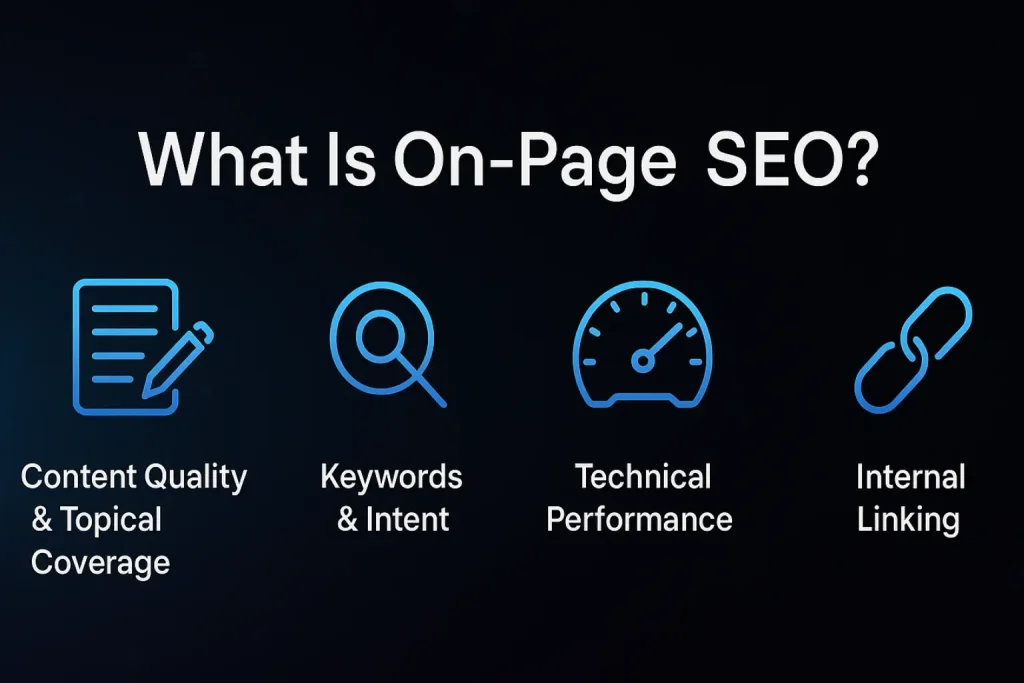
On-page SEO involves optimizing elements directly within your website, content quality, keyword placement, technical performance, and user experience. These are entirely within your control, enabling rapid implementation and immediate measurable results.
Key On-Page Elements:
Content Quality & Topical Coverage: Topical coverage emerged as the most important on-page ranking factor in Surfer 1-million-SERP analysis. Rather than stuffing keywords, comprehensive content addressing topics from multiple angles signals expertise. Long-form content (3,000+ words) attracts 77.2% more backlinks than short articles, indicating quality compounding benefits.
Keywords & Intent: In the current state, Google focuses on semantic search when it is necessary to interpret intent rather than strictly language keywords. Use primary keywords in common words in titles, headings and the first paragraph, but answer the question of the users thoroughly.
Title Tags & Meta Descriptions: Relevant keywords in titles create strong relevancy signals and improve click-through rates, while compelling meta descriptions increase SERP clicks indirectly boosting rankings.
Technical Performance: Page speed (TTFB and load time) shows a strong correlation with rankings, not because speed itself ranks pages but because fast sites reduce bounce rates and increase engagement. Mobile-friendliness is a confirmed ranking factor, especially critical as Google uses mobile-first indexing.
Internal Linking: Logical site structure with strategic internal links distributes authority throughout your site while helping search engines understand content relationships.
What Is Off-Page SEO?
Off-Page SEO encompasses activities outside your website, building authority, trust, and credibility, primarily through backlinks, brand mentions, social signals, and online reputation. These factors are partially influenced but not fully controlled by you, requiring relationship-building and strategic positioning.
Key Off-Page Elements:
Backlinks: Backlinks remain one of Google core ranking systems, with the number of linking domains showing the highest correlation to rankings. Yet quality matters dramatically, a few high-authority backlinks outweigh dozens of low-quality links. 66% of pages have zero backlinks, yet top-ranking pages accumulate 3.8x more backlinks than positions #2-10, demonstrating backlinks’ ranking power.
EEAT Signals: Google now emphasizes Experience, Expertise, Authoritativeness, and Trustworthiness, favoring content from real people with verified credentials and lived experience. Author attribution, case studies, and original research strengthen EEAT signals Google rewards with higher visibility.
Brand Mentions & Citations: Unlinked brand mentions now signal authority and relevance, especially important for AI search systems building entity understanding. Consistent mentions across editorial, social, and review platforms establish your brand as an industry authority.
Social Signals: Social engagement enhances the reach of the content, and high activity on the social platforms sends positive signals to the search engines. Although social shares are not real ranking factors, referral traffic and organic backlinks are created through increased visibility.
Online Reputation: Trustworthiness signals include reviews, ratings and awards. Highly rated profiles of businesses indicate that customers have confidence in them and have an impact on ranking in search engines and trustworthiness on the part of the customer.
The Key Differences
Control: On-page SEO is entirely controllable; you adjust titles, content, and technical elements whenever needed. Off-page SEO requires influencing external parties to link, mention, and recommend you.
Timeline: On-page changes show results in days or weeks; off-page improvements require months of relationship-building and content distribution.
User Experience: On-page optimization directly improves visitor experience through faster loading, better content, and intuitive navigation. Off-page optimization indirectly affects UX by bringing more users to discover your site.
Sustainability: High-quality on-page content provides lasting value if maintained. Off-page signals require ongoing attention, maintaining relationships, adapting to trends, and staying visible within your industry.
How They Work Together
Synergistic Strength: Exceptional on-page content attracts users who stay longer, generating engagement signals. This quality also makes content more shareable, earning social mentions and natural backlinks. Simultaneously, off-page authority through backlinks and brand mentions increases visibility, driving more users to your optimized pages.
Compound Growth: Over time, this creates a positive feedback loop, strong on-page foundations attract off-page signals (links, mentions, reviews), which amplify visibility, attracting more users to your content, further strengthening on-page engagement metrics.
The Infrastructure Effect on Speed: Although optimization of code is important, the raw performance of your server is the boundary to the speed of your site. The shared hosting can be easily overloaded by sites that experience heavy traffic; a dedicated [High-Performance VPS] will remove resource contention, and with consistent load times that stay under one second, Google will reward this with more visitors. Also, network latency is purely physical: you have to have your data where your users are. As an illustration, when your main audience is located in North America, using a physically located [Chicago, USA VPS] automatically reduces the data travel distance, which immediately increases Time to First Byte (TTFB), and On-Page points.
Real-World Impact (2025)
ROI Documentation: Outstanding On-page content will keep the users longer, making them give out engagement signals. It is also a good trait that contributes to more sharing of content and a natural backlink, as well as social mentions. At the same time, off-page authority, with the help of backlinks and brand mentions, will enhance the visibility, and more users will be sent to optimized pages by you.
Ranking Reality: The #1 ranking page accumulates 5-14.5% more dofollow backlinks monthly from new domains, continuously strengthening authority. Pages combining strong on-page signals with quality off-page authority compound advantages.
Strategic Implementation
Immediate Priorities (On-Page):
- Audit content for topical coverage, and address topics comprehensively from multiple angles
- Optimize title tags with primary keywords at the start
- Improve page speed through image compression and caching
- Ensure mobile-responsive design
Long-Term Strategy (Off-Page):
- Produce truly linkable content, self-research, proper guides, and some exclusive knowledge.
- Build verifiable author authority with clear credentials and EEAT signals.
- Pursue strategic guest posting on niche-relevant publications.
- Generate brand mentions through PR, industry engagement, and social visibility.
Conclusion
On-page and off-page SEO represent complementary optimization approaches. With topical coverage showing 0.28 correlation to rankings (one of the strongest controllable signals), backlinks correlating with rankings, 317% ROI for ecommerce, and 1,389% for real estate, investing in both delivers undeniable business value.



