Lifetime VPS Europe
 Lifetime VPS Asia
 Lifetime WooCommerce Hosting
 Lifetime Hosting
 Lifetime Game Dedicated Servers
 Chicago, US
 Tokyo, Japan
 Singapore
 Hong Kong
 Seoul, South Korea
 Amsterdem, Netherlands
 London, UK
 Stockholm, Sweden
 Oslo, Norway
 Vienna, Austria
 Zurich, Switzerland
 Sydney, Australia
 Wordpress Hosting
 VPS Hosting
 DDOS Protection
 Submit Ticket
 Full Management
 Guides
 Videos and Podcasts
 Discover Creative Ideas
 Voxfor Autonomous AI Workers
 Voxfor Mega Menu
 Voxfor Advanced Price Management For WooCommerce
 Voxfor Secure Live Chat and AI Support
 Voxfor Multilanguage
 Voxfor AI Content Summary
 Voxfor Autopilot

PHP has powered the web for over three decades, evolving from a simple set of CGI scripts to one of the most widely used server-side programming languages. As of 2026, PHP powers approximately 77% of all websites with a known server-side language, including major platforms like WordPress, Facebook, and Wikipedia. This comprehensive guide traces PHP complete version history, highlighting the revolutionary features, performance improvements, and security enhancements that have shaped modern web development.
PHP hosting control
Run modern PHP projects on VPS infrastructure you control
PHP has evolved for modern performance, security, and application development. Voxfor VPS gives you control over your hosting environment for PHP websites, APIs, and custom applications.
The Birth of PHP: From Personal Home Page to Professional Hypertext Preprocessor

PHP journey began in 1994 when Danish-Canadian programmer Rasmus Lerdorf created a collection of Common Gateway Interface (CGI) binaries written in C. Originally designed to track visits to his online resume, these scripts quickly evolved into something far more significant.
The acronym PHP initially stood for Personal Home Page, reflecting its humble origins. As the language matured and gained professional adoption, PHP was retroactively renamed to PHP: Hypertext Preprocessor, creating a recursive acronym that developers still appreciate today.
Complete PHP Version Timeline
| PHP Version | Release Date | End of Life | Key Features |
| 1.0 | June 8, 1995 | – | Basic CGI scripting |
| 2.0 (PHP/FI) | November 1, 1997 | – | Form handling, HTML embedding |
| 3.0 | June 6, 1998 | October 20, 2000 | Zend Engine, OOP support |
| 4.0 | May 22, 2000 | June 23, 2001 | Zend Engine 1.0, superglobals |
| 5.0 | July 13, 2004 | September 5, 2005 | Zend Engine II, PDO |
| 5.6 | August 28, 2014 | December 31, 2018 | Constant expressions, phpdbg |
| 7.0 | December 3, 2015 | December 3, 2018 | 2x performance, scalar types |
| 7.4 | November 28, 2019 | November 28, 2022 | Typed properties, arrow functions |
| 8.0 | November 26, 2020 | November 26, 2023 | JIT compilation, union types |
| 8.1 | November 25, 2021 | December 31, 2025 | Enums, fibers, readonly |
| 8.2 | December 8, 2022 | December 31, 2026 | Read-only classes, DNF types |
| 8.3 | November 23, 2023 | December 31, 2027 | Typed class constants, json_validate |
| 8.4 | November 21, 2024 | December 31, 2028 | Property hooks, asymmetric visibility |
| 8.5 | November 20, 2025 | December 31, 2029 | Pipe operator, URI extension |
Early PHP Versions (1995–2000)
PHP/FI 1.0 (June 1995)
The first public release of PHP consisted of CGI tools that Rasmus Lerdorf shared with the developer community. Written entirely in C as a replacement for Perl scripts, PHP/FI 1.0 provided basic functionality for web development:
- Built-in support for mSQL, DBM, and Postgres95 databases
- User-defined functions
- Cookie handling capabilities
- Simple form processing
PHP/FI 2.0 (November 1997)
PHP/FI 2.0 introduced the revolutionary concept of embedding code directly within HTML documents, setting a precedent that would define PHP’s approach to web development:
- Form handling capabilities
- HTML embedding support
- Improved database connectivity
- Basic flow control structures
By 1997, PHP/FI had gained significant traction, with approximately 50,000 domains using the technology.
PHP 3.0 (June 1998)
PHP 3.0 marked a complete rewrite of the language, spearheaded by Andi Gutmans and Zeev Suraski, who would later found Zend Technologies. This version transformed PHP from a simple scripting tool into a legitimate programming language:
Key Features:
- Zend Engine – The first iteration of PHP’s core execution engine
- Object-oriented support – Limited but functional OOP capabilities
- Modular architecture – API extensions allowing third-party development
- Cross-platform compatibility – Support for multiple operating systems and web servers
PHP 3.0’s release coincided with the acronym change from “Personal Home Page” to “PHP: Hypertext Preprocessor.”
PHP 4.0 (May 2000)
PHP 4.0 introduced the Zend Engine 1.0, dramatically improving performance and capabilities:
Key Features:
- Enhanced runtime execution – Significant speed improvements
- Superglobals – Introduction of $_GET, $_POST, $_SESSION, and other superglobal arrays
- Web server abstraction layer – Improved compatibility across different server environments
- Output buffering – Control over when content is sent to the browser
- Object overloading support – Advanced OOP functionality
The PHP 5 Era: Language Maturity (2004–2018)
PHP 5.0 (July 2004)
PHP 5.0 represented the most significant language upgrade since PHP 3.0, introducing features that established PHP as a mature, enterprise-ready language:
Key Features:
- Zend Engine II – Completely rewritten execution engine with improved memory management
- PDO (PHP Data Objects) – Unified database access layer supporting multiple database systems
- Improved object model – Real constructors, destructors, abstract classes, and interfaces
- Exception handling – Try-catch blocks for error management
- SimpleXML – Simplified XML parsing and manipulation
PHP 5.1 (November 2005)
This release focused on stability and refinement:
- Over 400 bug fixes
- Improved date/time handling with DateTimeZone class
- Custom autoloading support via spl_autoload_register()
- PDO is enabled by default
- Significant performance improvements
PHP 5.2 (November 2006)
PHP 5.2 enhanced security and data handling capabilities:
- JSON extension – Native JSON encoding and decoding
- Input filtering extension – filter_var() for data validation and sanitization
- Improved memory manager – Better resource utilization
- Zip extension – Native archive manipulation
- Increased default memory limit
PHP 5.3 (June 2009)
Often considered one of the most feature-rich PHP 5.x releases, PHP 5.3 introduced transformative capabilities:
Key Features:
- Namespaces – Organize code and prevent naming conflicts
- Late static binding – static:: keyword for proper inheritance
- Closures/Anonymous functions – First-class function support
- Nowdoc syntax – Heredoc equivalent without variable parsing
- Goto statement – Jump labels for flow control
- Garbage collection – Automatic memory management for circular references
PHP 5.4 (March 2012)
PHP 5.4 modernized the language syntax and removed legacy features:
Key Features:
- Traits – Horizontal code reuse mechanism
- Short array syntax – [] instead of array()
- Built-in web server – Development server for testing
- Binary number format – 0b prefix for binary literals
- Function array dereferencing – foo() syntax
- Removal of register_globals, magic_quotes, and safe_mode
PHP 5.5 (June 2013)
This release focused on developer productivity and security:
Key Features:
- Generators – Memory-efficient iteration with yield
- finally keyword – Guaranteed cleanup in exception handling
- Password hashing API – Secure password handling with password_hash() and password_verify()
- OPcache – Bundled bytecode caching (formerly Zend Optimizer+)
- Class name resolution – ::class constant for full class names
PHP 5.6 (August 2014)
The final major PHP 5.x release introduced:
Key Features:
- Constant expressions – Use expressions in constant declarations
- Variadic functions – … operator for variable argument lists
- Argument unpacking – Spread operator for function calls
- Exponentiation operator – ** for power calculations
- phpdbg – Interactive debugger bundled with PHP
- use function and use const – Import functions and constants from namespaces
PHP 7: The Performance Revolution (2015–2022)
PHP 6 was famously skipped due to failed Unicode implementation efforts. The jump to PHP 7 signified a fresh start with dramatic improvements.
PHP 7.0 (December 2015)
PHP 7.0 delivered revolutionary performance improvements, running twice as fast as PHP 5.6 while using significantly less memory:
Key Features:
- Zend Engine 3.0 (phpng) – Completely rewritten engine with optimized data structures
- Scalar type declarations – int, float, string, bool for function parameters
- Return type declarations – Specify function return types
- Null coalescing operator – ?? for null checking
- Spaceship operator – <=> for three-way comparison
- Anonymous classes – Inline class definitions
- Group use declarations – Import multiple classes from the same namespace
- Error handling improvements – Error exceptions for fatal errors
Performance Impact:
- WordPress: ~2x faster
- Drupal: ~2x faster
- Magento: ~1.8x faster
PHP 7.1 (December 2016)
PHP 7.1 refined the type system and added practical features:
Key Features:
- Nullable types – ?string syntax for nullable parameters and returns
- Void return type – Explicit declaration of functions returning nothing
- Iterable pseudo-type – Accept arrays and Traversable objects
- Class constant visibility – public, protected, private for constants
- Symmetric array destructuring – [$a, $b] = $array syntax
- Negative string offsets – Access characters from the end of the string
- Multi-catch exception handling – catch (Exception1 | Exception2 $e)
PHP 7.2 (November 2017)
This release focused on security and type system improvements:
Key Features:
- Object type hint – Generic object parameter type
- Argon2 password hashing – More secure password algorithm
- Parameter type widening – Omit parameter types in child classes
- Trailing commas in function calls – Cleaner multi-line calls
- Sodium extension – Modern cryptography library bundled by default
PHP 7.3 (December 2018)
PHP 7.3 introduced syntax improvements and better JSON handling:
Key Features:
- Flexible heredoc/nowdoc syntax – More readable multi-line strings
- Trailing commas in function calls – Allowed in all function calls
- array_key_first() and array_key_last() – Get first/last array keys
- JSON_THROW_ON_ERROR – Exception-based JSON error handling
- PCRE2 migration – Updated regular expression library
- is_countable() function – Check if value can be counted
PHP 7.4 (November 2019)
The final PHP 7.x release brought significant language:
Key Features:
- Typed properties – Declare types for class properties: public int $count;
- Arrow functions – Concise closures: fn($x) => $x * 2
- Null coalescing assignment – ??= operator
- Numeric literal separator – Underscores in numbers: 1_000_000
- Spread operator in arrays – […$arr1, …$arr2]
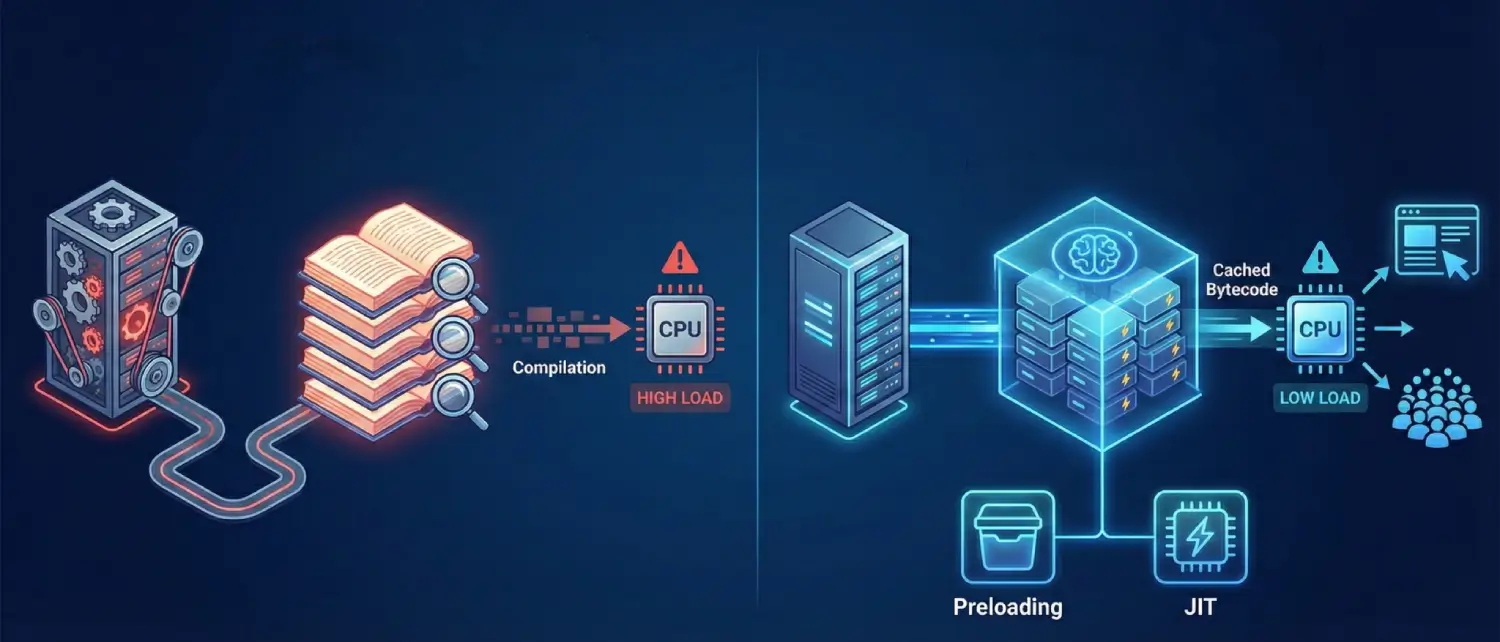
- Preloading – Load PHP files into memory at server startup
- FFI (Foreign Function Interface) – Call C code directly from PHP
PHP 8: Modern PHP (2020–Present)
PHP 8.0 (November 2020)
PHP 8.0 introduced game-changing features, including JIT compilation:
Key Features:
- JIT (Just-In-Time) compilation – Compile PHP code to machine code at runtime for improved performance in CPU-intensive tasks
- Union types – int|float|string for multiple allowed types
- Named arguments – foo(name: ‘value’) for clearer function calls
- Attributes – Native metadata/annotations: #[Route(‘/api’)]
- Constructor property promotion – Shorter constructor syntax
- Match expression – More powerful switch alternative
- Nullsafe operator – ?-> for null-safe method chaining
- str_contains(), str_starts_with(), str_ends_with() – String utility functions
- throw as expression – Use throw in arrow functions and ternaries
- WeakMap – Weak reference key-value storage
PHP 8.1 (November 2021)
PHP 8.1 added powerful new language constructs:
Key Features:
- Enumerations (Enums) – First-class enum support: enum Status { case Active; case Inactive; }
- Fibers – Lightweight concurrency primitives for async programming
- Read-only properties – Immutable properties: public readonly string $name;
- Intersection types – Countable&Iterator for multiple required types
- Never return type – Functions that never return (throw or exit)
- First-class callable syntax – $fn = strlen(…) for closure creation
- new in initializers – Use new in parameter defaults and constants
- array_is_list() function – Check if array is a list
PHP 8.2 (December 2022)
PHP 8.2 refined the type system and added security features:
Key Features:
- Read-only classes – Make entire classes immutable: readonly class User {}
- DNF (Disjunctive Normal Form) types – Complex type expressions: (A&B)|null
- null, false, true as standalone types – More precise type declarations
- Sensitive parameter redaction – Hide sensitive data in stack traces with #[\SensitiveParameter]
- New Random extension – Object-oriented random number generation
- mysqli_execute_query() function – Prepared statement in a single call
- Constants in traits – Define constants within traits
- Dynamic properties deprecated (except with #[AllowDynamicProperties])
PHP 8.3 (November 2023)
PHP 8.3 brought refinements and new utility functions:
Key Features:
- Typed class constants – public const string VERSION = ‘1.0’;
- #[\Override] attribute – Explicit method override indication
- json_validate() function – Validate JSON without parsing
- Dynamic class constant fetch – $class::{$constName}
- mb_str_pad() function – Multibyte-safe string padding
- Read-only property cloning – Deep clone readonly properties
- Granular DateTime exceptions – More specific error handling
- array_sum() and array_product() improvements – Better type handling
- New Randomizer methods – getBytesFromString(), getFloat(), nextFloat()
PHP 8.4 (November 2024)
PHP 8.4 introduced transformative OOP features:
Key Features:
- Property hooks – Define custom get/set logic for properties without explicit methods:
class User {

    public string $fullName {
        get => $this->firstName . ' ' . $this->lastName;
        set => [$this->firstName, $this->lastName] = explode(' ', $value);
    }
}- Asymmetric visibility – Different read/write visibility: public private(set) string $name;
- new without parentheses – $user = new User()->save();
- array_find(), array_find_key(), array_any(), array_all() – Functional array helpers
- HTML5 DOM support – Modern HTML parsing in the DOM extension
- Lazy objects – Deferred object initialization
- Driver-specific PDO subclasses – Access driver-specific features
- Multibyte trim functions – mb_trim(), mb_ltrim(), mb_rtrim()
PHP 8.5 (November 2025)
The latest PHP release focuses on developer experience:
Key Features:
- Pipe operator (|>) – Chain functions left-to-right:
$result = 'hello world'

    |> strtoupper(...)
    |> str_split(...)
|> array_reverse(...);- New URI extension – RFC 3986 and WHATWG compliant URL parsing
- array_first() and array_last() functions – Get first/last array values
- Clone with modifications – Clone objects while modifying properties
- #[\NoDiscard] attribute – Warn when return values are ignored
- Closures in constant expressions – Use closures in attributes and constants
- Stack trace for fatal errors – Better debugging information
- max_memory_limit INI directive – Set ceiling for memory_limit
PHP Support Lifecycle
Understanding PHP’s support lifecycle is crucial for maintaining secure applications. As of 2026, the PHP release cycle provides:
- 2 years of active support – Bug fixes and security patches
- 2 years of security-only support – Critical security fixes only
- End of Life (EOL) – No further updates
Currently Supported Versions (November 2025)
| Version | Active Support Until | Security Support Until | Status |
| PHP 8.5 | December 31, 2027 | December 31, 2029 | Active Support |
| PHP 8.4 | December 31, 2026 | December 31, 2028 | Active Support |
| PHP 8.3 | December 31, 2025 | December 31, 2027 | Security Only |
| PHP 8.2 | December 31, 2024 | December 31, 2026 | Security Only |
| PHP 8.1 | Ended | December 31, 2025 | Security Only |
Unsupported versions (PHP 8.0 and below) should not be used in production as they no longer receive security updates.
Performance Evolution Across PHP Versions
PHP’s performance has improved dramatically across major versions. Benchmark comparisons demonstrate significant gains:
WordPress Performance (Requests per Second)
- PHP 7.4: 147 req/s
- PHP 8.1: 151 req/s
- PHP 8.2: 153 req/s
- PHP 8.3: 165 req/s
Laravel Performance (Requests per Second)
- PHP 8.1: 611 req/s
- PHP 8.2: 670 req/s
- PHP 8.3: 925 req/s (~38% improvement from 8.2)
Key Performance Milestones
- PHP 7.0 – 2x faster than PHP 5.6, 50% less memory usage
- PHP 8.0 – JIT compilation provides additional gains for CPU-intensive tasks
- PHP 8.3 – Up to 52% performance improvement in certain frameworks compared to PHP 8.1
Why Keeping PHP Updated Matters
Security Considerations
Running outdated PHP versions exposes applications to known vulnerabilities. Once a PHP version reaches EOL:
- No security patches are released
- Known exploits remain unpatched
- Compliance requirements may be violated
- Third-party libraries drop support
Performance Benefits
Each PHP version brings optimizations that translate to:
- Faster page load times
- Reduced server resource consumption
- Lower hosting costs
- Better user experience
Access to Modern Features
Staying current enables developers to use:
- Latest language syntax improvements
- Modern frameworks require newer PHP versions
- Up-to-date Composer packages
- Contemporary development practices
How to Check Your PHP Version
Determine your current PHP version using these methods:
Command Line:
php -vPHP Script:
<?php

echo 'PHP Version: ' . phpversion();
// Or more detailed:
phpinfo();
?>WordPress:
Navigate to Tools > Site Health > Info > Server
Upgrading PHP: Best Practices
Before Upgrading
- Review release notes – Check for breaking changes and deprecations
- Test in staging – Never upgrade production first
- Update dependencies – Ensure all packages support the new version
- Run automated tests – Verify application functionality
- Check framework compatibility – Confirm your framework supports the target version
During Upgrade
- Backup everything – Database, files, and configurations
- Use version control – Track all changes
- Monitor error logs – Watch for deprecation warnings
- Test critical paths – Verify core functionality works
After Upgrading
- Monitor performance – Compare metrics before and after
- Review error logs – Address any new warnings
- Update .htaccess or server configs – If needed for new version
- Document the upgrade – Record any issues and solutions
Conclusion
The journey of PHP, from a basic CGI scripting tool to a powerful, high-performance programming language, really showcases its incredible adaptability and the commitment of its community. With each new version, we’ve seen significant enhancements in performance, security, and the overall experience for developers.
PHP 8.x represents the most feature-rich and performant era of PHP development, with innovations like JIT compilation, property hooks, enums, and the pipe operator making PHP more expressive and efficient than ever. The language continues to evolve with annual releases that refine its capabilities while maintaining backward compatibility where possible.
Whether you’re building a small website or an enterprise application, PHP remains a powerful, reliable choice backed by decades of development and a thriving global community.
About the writer

Hassan Tahir wrote this article, drawing on his experience to clarify WordPress concepts and enhance developer understanding. Through his work, he aims to help both beginners and professionals refine their skills and tackle WordPress projects with greater confidence.