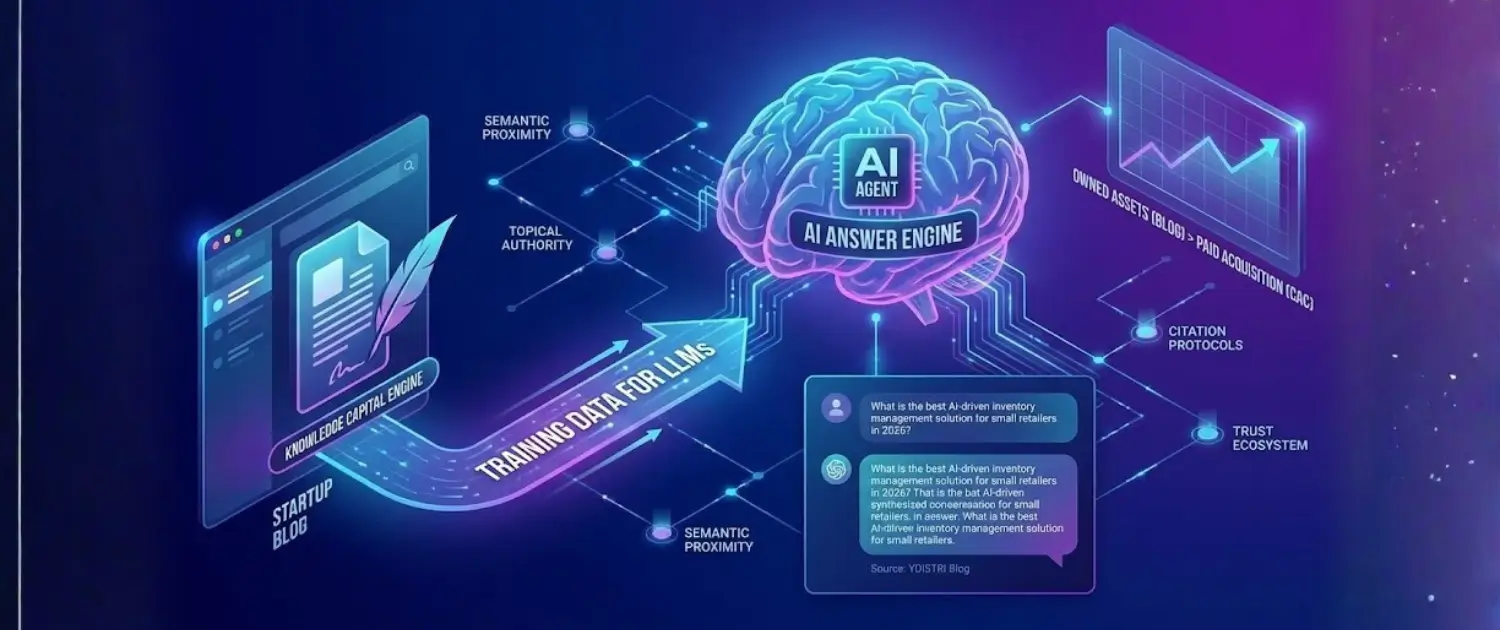
In the digitally developed world of 2026, the role of a startup blog has traditional content marketing. It is no longer just a means of receiving keywords or listing announcements of the company. Rather, the blog has become advanced.
Knowledge Capital Engine. It is a layer in critical infrastructure, which is the main point of contact between an offer of the startup value and the artificial intelligence (AI) agents that currently mediate the largest part of the information discovery and consumer choice. The 2019 line between content and business intelligence has been blurred; in a world where Generative Engine Optimization (GEO), Answer Engine Optimization (AEO) is the new order of things, a startup published text is the training data behind the Large Language Models (LLMs) that search the internet on behalf of people.
In the case of startups in such an environment, it is an existential stake. In this marketplace, a search engine that is able to generate zero-click searches, such that users receive synthesized results on search result pages or through conversational interfaces without going to the underlying websites at all, poses a risk to the survival of such a startup. The blog is the process through which a business brand itself defines its entity status in the Knowledge Graph, signifying that it is relevant both to human consumers and machine agents.
Furthermore, the economic argument for blogging has never been stronger. With Customer Acquisition Costs (CAC) via paid channels rising by over 60% in the last five years due to market saturation and privacy restrictions, 8, the high return on investment (ROI) of owned media, generating three times the leads of outbound marketing at significantly lower costs, provides a lifeline for resource-constrained ventures.9 This report offers an exhaustive analysis of the strategic, technical, and economic necessities of blogging for startups in 2026, delineating how to build a “Trust Ecosystem” that survives the flood of AI-generated noise and secures a lasting competitive advantage.
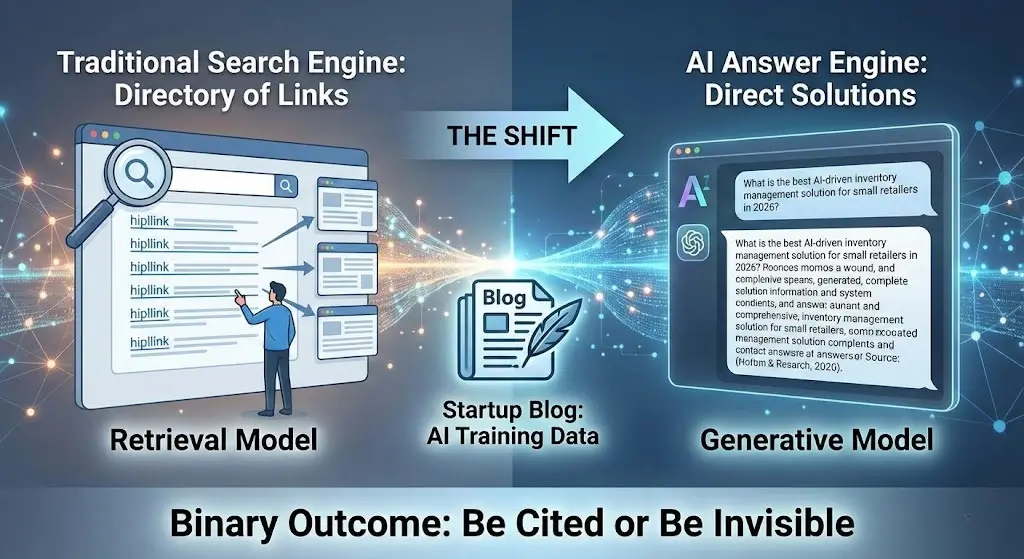
In order to understand the need to blog in 2026, one needs to first dissect the environment where startups currently compete, which has radically changed. Digital physics of the internet have changed away from a retrieval model, in which the search engine would fetch links, and moved to a generative model where the answer engine would generate solutions. The implication of this shift is a redefinition of visibility.
The most profound disruption in the 2026 digital landscape is the migration from Search Engine Optimization (SEO) to Answer Engine Optimization (AEO). Traditional search engines functioned as directories, pointing users toward destinations where they could find information. Answer engines are fed on sophisticated iterations of LLM, including GPT-5, Claude Opus and Google Gemini, which answer complex questions in a direct, conversational way and, as a result, sometimes result in a user experience that starts and ends without a single click to an external site.
For a startup, this creates a binary outcome: Be Cited or Be Invisible.
The blog serves as the source code for these answers. If a startup does not possess a repository of high-quality, text-based content, the AI models have no raw material to process or synthesize. The blog post is effectively the “training data” that informs the AI about the startup’s existence, its specific value proposition, and its area of expertise.3 Without this data, an AI agent cannot recommend the startup product when a user asks, “What is the best AI-driven inventory management solution for small retailers in 2026?”.
The implications of this are that the blog has become an API (Application Programming Interface) for the web’s intelligence layer. It is the primary mechanism by which a startup communicates its relevance to the machines that now control the gateway to consumer attention. A startup without a blog is essentially “offline” to the AI agents that act as gatekeepers for millions of potential customers.
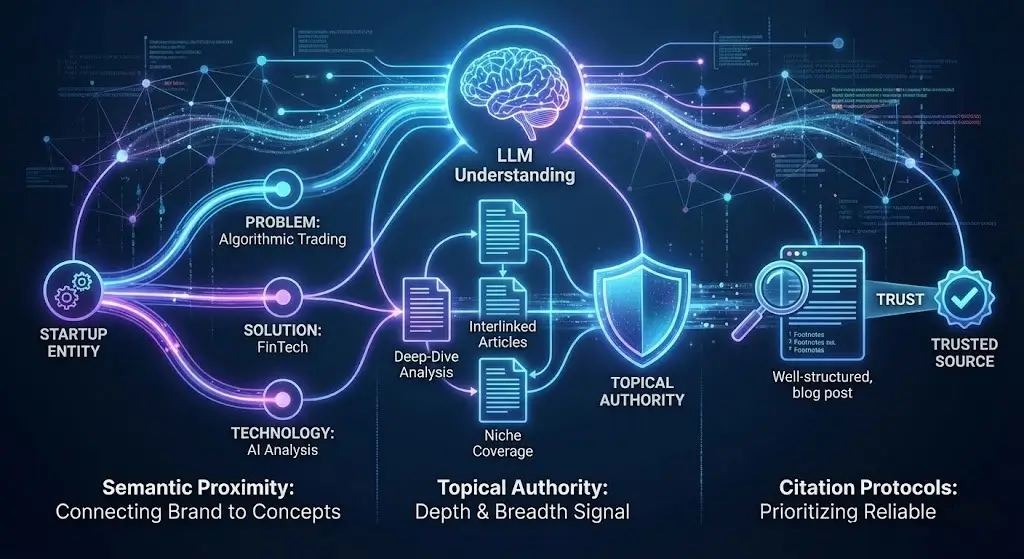
In 2026, optimization strategies have moved beyond keyword density to focus on Entities and Topical Depth. LLMs do not understand the world through strings of text but through the relationships between concepts (entities).2 A blog post allows a startup to define itself as a specific entity within the digital ecosystem and associate itself with other relevant entities (problems, solutions, technologies).
The year 2026 has also seen the proliferation of Agentic AI, autonomous software agents that perform tasks on behalf of users, from researching software vendors to booking travel.13 These agents scan the web not just for keywords, but for structured information that allows them to execute decisions.
Simultaneously, the trend of “vibe coding” using generative AI to create software from natural language prompts means that technical barriers are lower. Still, the need for clear, instructional content is higher.18 Startups that use their blogs to provide clear, step-by-step documentation and “how-to” guides are effectively writing the instructions that these agents and “vibe coders” follow. If an agent is tasked with “Find a CRM that supports API integration with legacy ERP systems,” it will parse the technical blogs of various startups to verify capabilities. A startup with a vague marketing site will be ignored; a startup with a detailed technical blog will be shortlisted.
We have observed a “zero-click” trend where roughly 60% of searches end without a referral to a website.4 This statistic might initially suggest that blogging is less valuable, but the opposite is true. In a zero-click world, the Influence of the content matters more than the traffic it generates.
When a user reads a summary on Google or Perplexity that cites a startup blog as the source of the insight, that startup gains brand equity and trust. This “Citation Economy” means that the goal of blogging is no longer just to get a user to visit a page, but to inject the brand narrative into the answer the user receives. The blog makes it so that by the time the answer is produced, the startup is already the authority, which shapes the perception of the user even before they have an experience with the brand itself.
The addition of “Experience” to Google quality guidelines was a prescient move that has come to define the 2026 content landscape. An AI may process facts (Expertise), but it cannot create an illusion of authentic and lived reality (Experience). It cannot be true-to-life about the pressure of a product failure, the delicacy of a client negotiation, or the precise feel of a supply chain failure.
For startups, the blog is the primary venue to demonstrate this “Experience.”
In 2026, trust is not established by a single asset but by a network of interconnected signals, a Trust Ecosystem. The blog serves as the central hub of this ecosystem, connecting various verification points that prove the startup legitimacy.
The internet is inundated with “clickbait title tags” and synthetic articles designed to game algorithms.20 Startups cannot win by participating in this volume game. The winning strategy in 2026 is “fewer, better. A single, exhaustively researched guide that defines a category is worth more than fifty generic posts.
This “high-density” content signals to both users and ranking algorithms that the domain is a legitimate authority. Content that provides unique value, such as proprietary tools, interactive calculators, or deep investigative analysis, stands out against the background radiation of AI-generated text. This shift toward quality over quantity aligns with the economic reality that 83% of marketers find creating higher quality content less often is more effective than high-frequency, low-quality publishing.
“People not brands” has become a dominant mantra in 2026. Users are increasingly skeptical of faceless corporate entities and prefer to engage with individuals. The “Founder Journal” or “Engineer Notebook” sections of a startup blog allow the human personalities behind the company to shine through.
This personal branding is not vanity; it is a mechanism for building “Authoritativeness.” When a founder consistently writes about a niche topic, they build an individual “Knowledge Graph” entry that lifts the authority of the entire domain. AI algorithms mimic human psychology in this regard, favoring recognized authorities over anonymous sources.
For a blog to function as a growth engine in 2026, it must be technically optimized for machine reading. The days of simple on-page SEO, placing keywords in H1 tags, are long gone. The new standard is Semantic SEO and Structured Data Implementation. The startup blog must be architected as a database of knowledge that machines can easily parse, categorize, and serve.
The code that serves as an interpreter between human and machine-readable data is called schema markup. It is the main method of startups making sure that the AI agents comprehend their content in 2026. A blog post itself is a disorganized lump of text; whereas a blog post with schema is an organized data object.
Startups must implement a rigorous schema strategy:
This technical layer is “invisible” to human users but highly visible to AI crawlers. It is the difference between an AI guessing what a page is about and an AI knowing what a page is about.
The ultimate goal of technical blogging in 2026 is to secure a place in the Knowledge Graph, the brain of the search engine that maps all known entities and their relationships.7 A startup blog contributes to this by becoming a source of “Entity Definitions.”
A new performance metric in 2026 is “Agent Traffic,” the volume of non-human visitors (AI bots) scanning the site to retrieve information for users.12 Startups must ensure their site architecture allows these agents efficient access.
With the ubiquity of smart speakers and voice assistants, queries are becoming longer and more conversational.1 Blogs must be optimized for this “Conversational Search.”
Knowing why to blog is insufficient; startups must know what to blog. The content strategies that succeed in 2026 are highly specific, diverging from the broad “ultimate guide to everything” approach of the 2010. The focus is on Problem-Centricity, Proprietary Data, and Multimedia Integration.
In a world where AI can summarize all existing human knowledge, the only thing it cannot generate is new knowledge. Startups possess a unique asset: their own proprietary data. Publishing insights derived from this data is the single most effective way to earn backlinks and citations.
The 2026 blog post is a multimedia canvas. It is not just text; it is a container for video, audio, and interactive elements that increase engagement and dwell time.
The application of these strategies can be seen in successful startups like Nimble and Omnistream.
Startups should focus on “Problem-Based Queries” rather than generic keywords. These are searches where the user describes a pain point rather than a solution.
The final, and perhaps most compelling, argument for the necessity of blogging is financial. In the high-interest-rate, capital-efficient environment of 2026, the unit economics of content marketing are structurally superior to paid acquisition.
Paid media (PPC, Social Ads) is based on a rented land paradigm. Traffic ceases the moment a startup has ceased paying. What is more is the fact that the price of this rent has gone out of control. The Customer Acquisition Costs (CAC) have increased by 60 percent in the past five years, and in many early-stage startups, the economics of paid acquisition simply do not work; the Lifetime Value (LTV) of a customer is not always able to sustain the acquisition cost demanded by such platforms as Google and Meta.
A blog is, on the contrary, an Owned Asset. An optimized article of January 2026 has a fixed initial investment (cost of time and production). Nevertheless, that asset can keep on attracting qualified leads in December 2029 with no marginal cost. This compounding effect implies that the Cost Per Lead (CPL) to the content marketing declines with time, but the CPL to paid advertisements generally rises or remains constant.
To startups intending to Exit or get subsequent rounds of financing, it is important to know what drives their growth. The quality of revenue is examined by investors in 2026. Organic search-driven revenue is rated more than revenue driven by paid ads since it is more sustainable, predictable, and justifiable. A start-up that has a good Domain Authority and a sustainable influx of organic traffic has an actual asset in its balance sheet. This online real estate portfolio yields dividends in the form of users.
Analyzing real-world applications of these principles highlights how diverse startups leverage blogging to solve specific growth challenges.
YDISTRI, a startup focused on optimizing retail inventory through AI redistribution, faces a complex sales challenge: explaining a novel technical solution to traditional retailers. Their blogging strategy focuses on Problem Awareness.
Nimble, a CRM for small businesses, uses its blog to act as a “Consultant at Scale.”
Omnistream, operating in the live commerce and retail tech space, uses its blog to establish technical credibility in a skeptical market.
In the year 2026, a startup without a blog is a startup without a voice. As the internet transforms into an ecosystem mediated by artificial intelligence, the ability to clearly, authoritatively, and structurally articulate value through text is the single most important factor in digital discoverability.
Startups that embrace this reality, investing in deep, structured, experience-led content, will build the “Knowledge Capital” necessary to thrive. They will not just be found; they will be cited, trusted, and chosen.

Hassan Tahir wrote this article, drawing on his experience to clarify WordPress concepts and enhance developer understanding. Through his work, he aims to help both beginners and professionals refine their skills and tackle WordPress projects with greater confidence.






 Lifetime VPS Europe
 Lifetime VPS Asia
 Lifetime WooCommerce Hosting
 Lifetime Hosting
 France Lifetime Dedicated Servers
 Germany Lifetime dedicated servers
 Lifetime Game Dedicated Servers
 Chicago, US
 Tokyo, Japan
 Singapore
 Hong Kong
 Seoul, South Korea
 Amsterdem, Netherlands
 London, UK
 Stockholm, Sweden
 Oslo, Norway
 Vienna, Austria
 Zurich, Switzerland
 Sydney, Australia
 Wordpress Hosting
 VPS Hosting
 DDOS Protection
 Submit Ticket
 Full Management
 Guides
 Videos and Podcasts
 Discover Creative Ideas
 MetaAgentOS High-Ticket Support System
 Voxfor Mega Menu
 Voxfor Advanced Price Management For WooCommerce
 Voxfor Secure Live Chat and AI Support
 Voxfor Multilanguage
 Voxfor AI Content Summary


