Virtual Private Server (VPS) security has been at critical point. The traditional firewalls are unable to defend against the current day cyber threats since 32 percent of the vulnerabilities are now being exploited as a zero-day or within one day of being disclosed. The most notable innovation in the security of VPSs is AI-controlled firewalls that apply machine learning to identify and eliminate cybercrime that signature systems are completely unaware of.
The numbers tell a stark story. In 2024, 75 zero-day exploits were actively exploited in the wild, with enterprise infrastructure, particularly VPNs and firewalls, accounting for 44% of all attacks. More alarming, the average time-to-exploit collapsed to just five days in 2024, down from 32 days previously. This acceleration renders traditional monthly patch cycles dangerously obsolete.
The costs of data breach have increased significantly. The typical breach has become more expensive to organizations of 9.48 million dollars and 61 percent of firms report malware infiltrations every year. In the case of VPS environments that deal with sensitive data, these statistics drive a point home which is an uncomfortable truth: the traditional approach to security is not working.
They constantly learn and develop, as opposed to the traditional firewalls that depend on the established rules and known threat signatures. They use machine learning functions which study the network traffic patterns and user behavior, as well as system events to set dynamic baselines and identify anomalies in real-time.
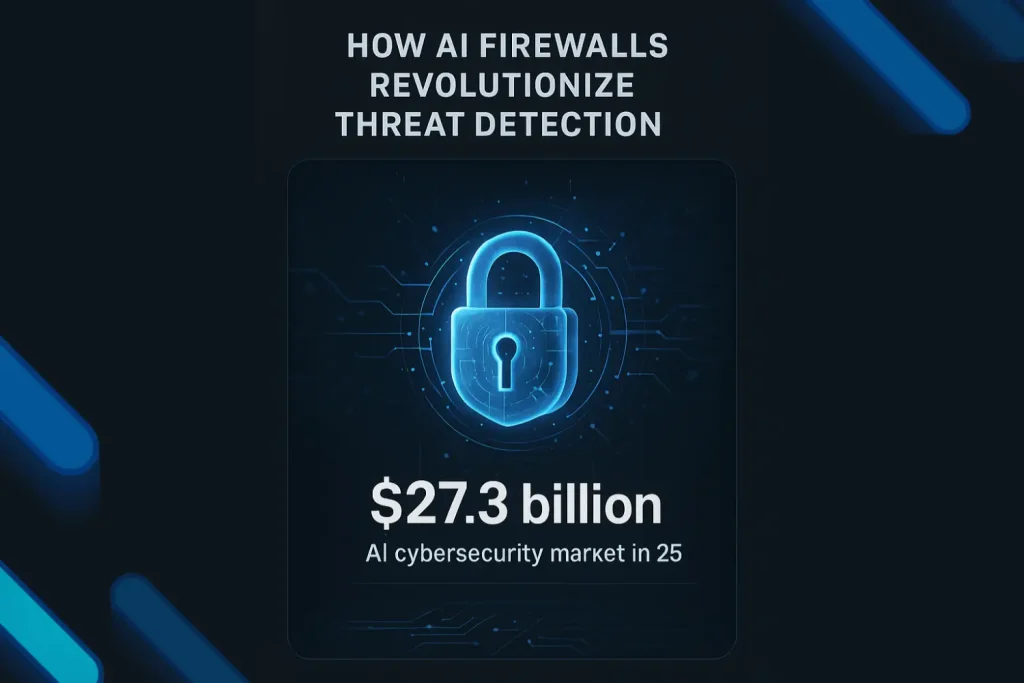
The AI cybersecurity market, valued at $27.3 billion in 2025 and growing at 21.4% annually, reflects widespread industry adoption. Leading solutions like Fortinet’s FortiAI analyze millions of malware samples daily with near-perfect accuracy, achieving sub-second threat detection that enables inline blocking before compromise occurs.
Behavioral Analytics: Machine learning models establish normal patterns for users, applications, and network traffic. Any deviation, unusual login times, suspicious privilege escalation, or abnormal data access, triggers immediate investigation. Research shows organizations using behavioral analytics detect threats 5x faster than those relying solely on traditional methods.
Predictive Threat Intelligence: Instead of responding to the attacks, AI firewalls anticipate and stop intrusion in the early stages of reconnaissance by detecting reconnaissance attempts. They match apparently disconnected events over time to uncover the multi stage Advanced Persistent Threats (APTs) which cannot be detected in traditional ways.
Autonomous Response: When threats are confirmed, AI systems immediately isolate affected segments, block malicious traffic, revoke compromised credentials, and update firewall rules across all protected infrastructure, all without human intervention. This automation proves critical when 42% of ransomware detection systems now achieve under 4-hour response times through AI-driven automation.
Zero-day vulnerabilities, previously unknown software flaws exploited before patches exist, pose exceptional danger to VPS environments. The Cisco firewall zero-days (CVE-2025-20333, CVE-2025-20362) discovered in 2025 demonstrate this threat: attackers exploited these vulnerabilities for months before discovery, bypassing authentication and enabling remote code execution on thousands of internet-facing devices.
AI firewalls excel at zero-day detection because they identify threats based on behavior rather than signatures. By analyzing deviations from established baselines, unusual process execution, abnormal database queries, or suspicious network connections, AI systems catch zero-day exploits that traditional firewalls miss entirely. Organizations implementing AI-driven threat detection reduce zero-day exposure by up to 60%.
Successfully deploying AI firewalls requires methodical planning:
Start with Learning Mode: Give AI system time to monitor traffic and set proper behavioral baselines, (2-4 weeks) and only then can enforcement be implemented. No significant changes in the system.
Integrate with Existing Security: Link AI firewalls to SIEM systems, vulnerability scanners and endpoint protection to defend these fully. According to the guidelines provided by NIST Zero Trust Architecture, one should gather as much information as possible regarding assets and communications and provide adequate levels of privacy.
Maintain Continuous Updates: Keep VPS operating systems, AI firewall software, and threat intelligence feeds current. Even advanced AI systems fail if attackers exploit unpatched vulnerabilities at the OS or hypervisor level.
The convergence of AI firewalls with Zero Trust Architecture represents the next evolution in VPS security. Future systems will provide per-session access evaluation, implement microsegmentation policies automatically, and enable continuous authentication based on behavioral context.
As the network security firewall market grows from $7.4 billion in 2025 to a projected $30 billion by 2035, AI-powered solutions will become standard infrastructure rather than premium features.
As applied to organizations with VPS environments, whether operating a single application or managing multi-cloud infrastructure, deployment of AI firewalls is not only more effective security, but a fundamental change in the direction of proactive and intelligent defense that stays ahead of the competition increasingly weaponizing their own AI.





 Lifetime VPS Europe
 Lifetime VPS Asia
 Lifetime WooCommerce Hosting
 Lifetime Hosting
 France Lifetime Dedicated Servers
 Germany Lifetime dedicated servers
 Lifetime Game Dedicated Servers
 Chicago, US
 Tokyo, Japan
 Singapore
 Hong Kong
 Seoul, South Korea
 Amsterdem, Netherlands
 London, UK
 Stockholm, Sweden
 Oslo, Norway
 Vienna, Austria
 Zurich, Switzerland
 Sydney, Australia
 Wordpress Hosting
 VPS Hosting
 DDOS Protection
 Submit Ticket
 Full Management
 Guides
 Videos and Podcasts
 Discover Creative Ideas
 MetaAgentOS High-Ticket Support System
 Voxfor Mega Menu
 Voxfor Advanced Price Management For WooCommerce
 Voxfor Secure Live Chat and AI Support
 Voxfor Multilanguage
 Voxfor AI Content Summary


