
The problem of virtual private server (VPS) environments is a critical one: it is necessary to distribute traffic among several servers and provide an outstanding performance level, and ensure the lack of failures. Conventional load balancing is based on some rules and fixed thresholds, which do not work when traffic patterns change without prior notice. VPS load balancing is meant to be completely changed by AI-powered VPS load balancing that can intelligently re-distribute traffic in real-time with machine learning to provide better performance and reliability.
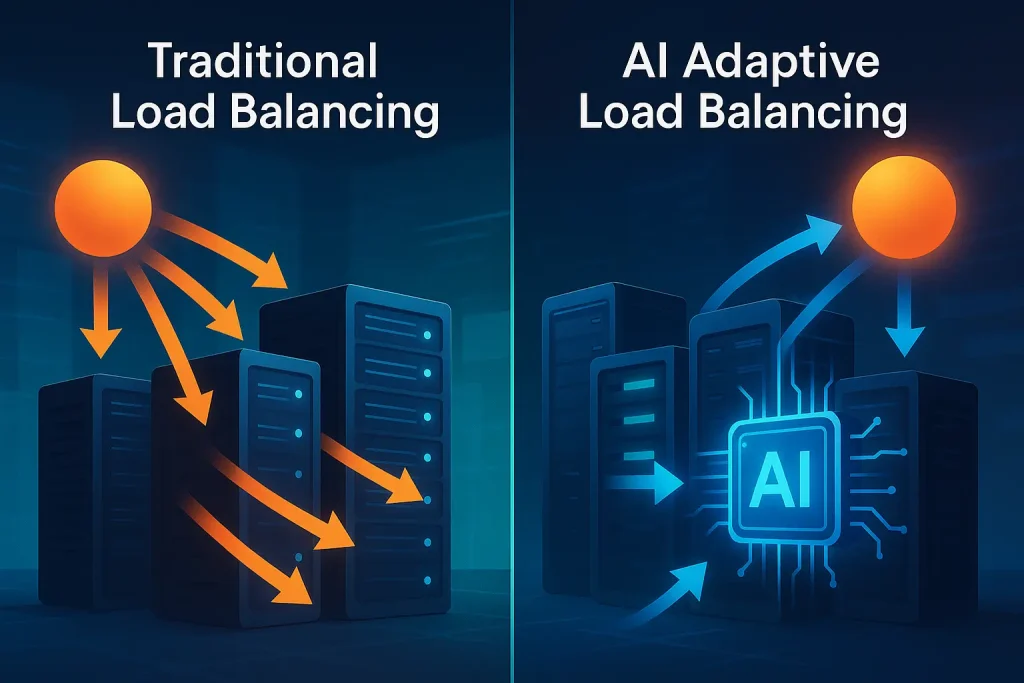
In conventional load balancers, the process is round-robin based or fixed rules established by engineers. These solutions are not able to cope with dynamic traffic, unpredictable spikes, or crashing servers. AI-based systems are continuously learning and adjusting distribution strategies to changing conditions based on real-time data.
Real-Time Traffic Analysis: AI notifies of the incoming traffic patterns, user behavior, and the health of the servers. On a sudden rush, whether caused by viral content, flash sales, or promos, the system is immediately aware of the increase in workloads and workloads are re-allocates to avoid server clogging. It is also vital as it will reduce unneeded expenses by scaling down resources in times of low demand.
Predictive Scaling: Instead of responding once the performance is degraded, AI anticipates the future load and proactively uses resources. Past trends in line with real-time measurements allow proper prediction of high traffic periods, marketing effects, and seasonal changes. The outcome: the users do not get degraded.
Intelligent Server Selection: AI establishes the servers that are most efficient when managing particular workloads. In case the geographical closeness enhances performance, the system routes in such a way. The image requests are sent to servers that are more appropriate to process images. This granular optimization ensures that it has consistent performance under various workloads.
New DDoS attacks flood traditional security systems with advanced patterns that the traditional rule-based systems are unable to detect. AI is capable of differentiating between normal traffic surges and an organized attack.
Research demonstrates AI’s effectiveness:
These measures symbolize a radical change from the old-fashioned methods. Real-time anomaly detection detects suspicious patterns that do not match the usual baselines so that traffic filtering and mitigation can be carried out in real-time. Research indicates that AI-based systems are highly detected and few false positives are generated, with security personnel being able to concentrate on actual threats and not spamming false alarms.
Intelligent load balancing drastically reduces response time delay and computational overhead compared to traditional techniques, according to academic research on heterogeneous server clusters. Key benefits include:
In terms of business organizations, these technical advances can be changed into the business outcomes: a quicker web page will enhance conversion rates, a decreased latency will make users feel more satisfied, and stability will directly affect income and brand image.
Real-Time Traffic Analysis: AI notifies of incoming traffic patterns, user behavior, and server health instantly. On a sudden rush, whether caused by viral content, flash sales, or promos, systems like Voxfor MetaAgentOS immediately detect the workload increase and re-allocate resources to prevent server clogging. This intelligent oversight reduces unneeded expenses by automatically scaling down resources during times of low demand.
In terms of business organizations, these technical advances can be changed into the business outcomes: a quicker web page will enhance conversion rates, a decreased latency will make users feel more satisfied, and stability will directly affect income and brand image.
Monitor Key Metrics:
Start with Non-Critical Systems: Validate AI recommendations on non-production environments before production deployment, ensuring alignment with your specific workload patterns.
Combine AI with Oversight: AI excels at pattern recognition and automation, but experienced administrators should validate critical recommendations before implementation.
The next step is the intersection between edge computing and AI load balancing. Load balancers Edge-native load balancers provide real-time processing at the network edge, minimizing the latency of IoT applications, autonomous systems, and smart city infrastructure. Through intelligent allocation of the traffic among the edge nodes, AI determines the distribution of traffic according to the demand of the region, the type of device, and the network conditions.
Similarly, multi-cloud and hybrid environments require sophisticated workload orchestration that AI provides automatically. The system learns performance characteristics across multiple cloud providers and automatically routes workloads to optimal environments, eliminating vendor lock-in while maintaining the lowest costs and highest reliability.
The next step is the intersection between edge computing and AI load balancing. Load balancers Edge-native load balancers provide real-time processing at the network edge, minimizing the latency of IoT applications, autonomous systems, and smart city infrastructure. Through intelligent allocation of the traffic among the edge nodes, AI determines the distribution of traffic according to the demand of the region, the type of device, and the network conditions.





 Lifetime VPS Europe
 Lifetime VPS Asia
 Lifetime WooCommerce Hosting
 Lifetime Hosting
 France Lifetime Dedicated Servers
 Germany Lifetime dedicated servers
 Lifetime Game Dedicated Servers
 Chicago, US
 Tokyo, Japan
 Singapore
 Hong Kong
 Seoul, South Korea
 Amsterdem, Netherlands
 London, UK
 Stockholm, Sweden
 Oslo, Norway
 Vienna, Austria
 Zurich, Switzerland
 Sydney, Australia
 Wordpress Hosting
 VPS Hosting
 DDOS Protection
 Submit Ticket
 Full Management
 Guides
 Videos and Podcasts
 Discover Creative Ideas
 MetaAgentOS High-Ticket Support System
 Voxfor Mega Menu
 Voxfor Advanced Price Management For WooCommerce
 Voxfor Secure Live Chat and AI Support
 Voxfor Multilanguage
 Voxfor AI Content Summary


