
To incorporate new material into your internal linking, it is important to plan, optimize anchor text, and measure. Already a 25% increase in organic traffic, 15-20 improvement in ranking of well-linked pages and 45-50 penalties per page have already been recorded, and so systematic implementation makes the difference between high-performing sites and average competitors.
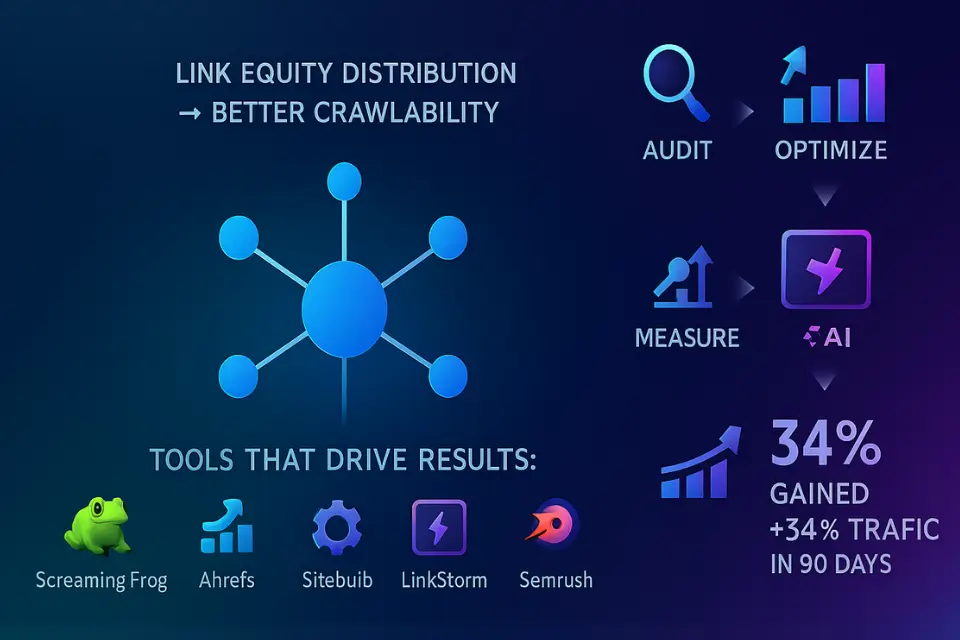
Internal linking spreads the link equity (PageRank) across your site, and the optimization is directly related to better rankings and better crawlability. Websites with various patterns of internal linking increase 25% of the traffic and have better AI search ability.
Screaming Frog SEO Spider
Screaming Frog excels at granular on-site control through local desktop crawling, mimicking Googlebot accurately and bypassing Google’s rate-limiting. It identifies crawl depth issues, tracks internal link counts revealing insufficiently linked pages, and detects broken links with real-time precision.
The free version works well for initial audits, though the paid license ($199/year) unlocks API integrations enabling LLM-powered semantic similarity detection.
Strengths: Granular control, JavaScript rendering, depth analysis of crawls in detail, and broken links. Cons: Technically skilled manual data sorting, no backlink analysis.
Ahrefs Site Audit
Ahrefs provides actionable internal linking reports suggesting new link opportunities while visualizing link flow and equity distribution. The tool highlights which pages need more internal links and suggests relevant linking opportunities based on page relevance.
Unlike Screaming Frog, Ahrefs organizes findings by importance, recommending fixes in priority order. Starting at $99/month with a 7-day $7 trial, it balances price with comprehensive features.
Strengths: Priority-ranked suggestions, user-friendly interface, backlink analysis and competitive research.
Smaller crawl depth control than Screaming Frog, and occasionally recommends linking low-value pages.
Sitebulb
Sitebulb specializes in detailed technical audits with visual reporting that simplifies internal link analysis communication. The tool identifies broken links, orphaned pages, and crawl depth issues with user-friendly visualizations.
Sitebulb, which starts at 15/month with a 14-day free trial, incorporates Google Analytics information to give context to findings during an audit.
Strengths: Visual reporting, user-friendly interface, orphan page detection, and Google Analytics integration. Limitations: Limited competitive analysis, less advanced keyword research
LinkStorm (AI-Powered)
The proprietary web crawlers and AI semantic analysis detected the internal linking gaps and proposed contextually appropriate connections in the form of linking in LinkStorm. The tool also features a special way of implementing suggestions made by users that are accepted and added to content automatically.
Strengths: AI suggestions, automatic link insertion, broken link detection, user-friendly interface. Limitations: Fewer competitive analysis features than Ahrefs
Semrush Site Audit
Semrush emphasizes internal linking architecture health through Internal LinkRank (ILR), a proprietary metric showing approximate link equity passed to each page. The report manages link distribution, identifies errors (broken links, nofollow issues, orphan pages), and suggests optimization priorities.
Strengths: Internal LinkRank statistic, full error discovery, and visualization of link equity.
Disadvantages: A lot more architectural than opportunity identification.
Google Search Console
Google Search Console provides free internal link data, orphan page identification, and crawl statistics. While lacking automation, it remains an essential baseline tool complementing paid platforms.
WordPress Plugins
For WordPress sites, Yoast SEO and AIOSEO offer internal link counters, automatic suggestions, and orphan page detection directly within the editor.
1. Audit Current State: Use Screaming Frog (free) or Ahrefs/Sitebulb trials for baseline analysis, identifying orphaned pages, broken links, and over-linked content.
2. Identify Opportunities: Pages ranked 5-20 for relevant keywords represent high-value internal linking targets receiving strategic authority distribution.
3. Prioritize Fixes: Address broken links first (negative user experience), then rebalance over-linked pages, finally connecting orphaned content.
4. Implement Links: Add 2-3 contextual internal links from relevant high-authority pages to newly optimized pages.
5. Monitor Results: Track keyword rankings, organic traffic, and pages-per-session improvements over 8-12 weeks.
For Technical Deep-Dive: Screaming Frog + free Google Search Console. For Balanced Approach: Ahrefs Site Audit (most comprehensive). For Visual Reporting: Sitebulb (best UI, lowest price). For Budget-Conscious: Google Search Console + WordPress plugins For WordPress Sites: Yoast SEO or AIOSEO plugins
One e-commerce site audited with Ahrefs found 247 orphaned pages and 83 broken links; correcting these issues led to a 34% organic traffic increase within 90 days.
The other case actualized that pages with 1-2 internal links (although those were high-value ranking pages) were not adding 8-12 strategic links, and CTR rose 28% in 60 days.
Analyzing internal links with the right tools drives measurable SEO improvement. With 25% organic traffic increases, 15-20% ranking improvements, and 66% of sites containing orphaned pages, systematic analysis is non-negotiable.



 Lifetime VPS Europe
 Lifetime VPS Asia
 Lifetime WooCommerce Hosting
 Lifetime Hosting
 France Lifetime Dedicated Servers
 Germany Lifetime dedicated servers
 Lifetime Game Dedicated Servers
 Chicago, US
 Tokyo, Japan
 Singapore
 Hong Kong
 Seoul, South Korea
 Amsterdem, Netherlands
 London, UK
 Stockholm, Sweden
 Oslo, Norway
 Vienna, Austria
 Zurich, Switzerland
 Sydney, Australia
 Wordpress Hosting
 VPS Hosting
 DDOS Protection
 Submit Ticket
 Full Management
 Guides
 Videos and Podcasts
 Discover Creative Ideas
 MetaAgentOS High-Ticket Support System
 Voxfor Mega Menu
 Voxfor Advanced Price Management For WooCommerce
 Voxfor Secure Live Chat and AI Support
 Voxfor Multilanguage
 Voxfor AI Content Summary


