A high rate of reduction in the distance between conceptualization and actualization characterizes the technological environment of the early twenty-first century. This contraction is achieved in the particular field of software development by the introduction of integrated generative environments based on large language models (LLM), containerization, and automated infrastructure provisioning.
Code Social AI is a notable addition to this trend, and it operates as a platform aimed to bridge the historical gap between having a technical harmony and the successful implementation of an effective software product. The conventional lifecycle of software development, whereby it is time-consuming and frustrating to assemble the technical parts, to satisfy dependencies, and to configure the environment, is progressively being given way to autonomy agents that manage the complexity of the build process.
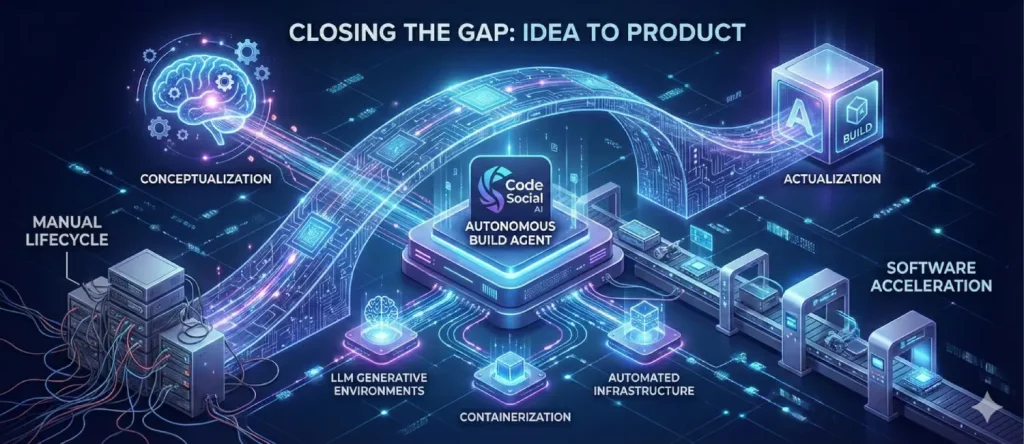
the inherent difficulty in software engineering has been the high cognitive burden and technical debt inherent in the initial setup stage. To lots of the developers and visionaries, the technical headache of creating a development environment, setup of servers and control of build tools is a barrier to entry that kills innovation.
Code Social AI is aimed at removing such intricate procedures by giving a direct interface between human intention and machine action. This is done with the help of a conversational AI agent, which deciphers the requirements of the user and converts them to an operational project structure in real time.
This change is an imperative-to-declarative reorganization between imperative programming, in which the developer needs to provide the specification of how a system will work, and declarative orchestration, in which the user provides the specification of what, and the AI agent provides details of implementation.
The wider scope of this change can be seen in the worldwide process of computer science democratization. The Code.org and CSforAll organizations highlight the necessity of easily accessible tools that allow students and professionals to work on further innovation and are not overloaded with syntax and environment configuration.
Offering a system in which a user can merely outline a project and watch it being constructed, Code Social AI fits the educational programs that have the goal of teaching the strategies of using AI to simplify more complex concepts and lead the problem-solving process.
The Code Social AI dashboard is the central nervous system of the platform that serves as the main point of control over all the deployment and development processes. The philosophy of the design of the dashboard is based on clarity, transparency, and real-time control.
It is designed in a manner that gives a high-level overview of the development lifecycle, whereby users are at liberty to have sovereignty with their digital assets and financial resources.
The dashboard interface consists of separate areas of activity, which makes it easy to switch between the high and low levels of management and technical interaction. The primary navigation menu offers direct and simplified access to the four important sections, including the dashboard overview, the terminal, the Virtual Private Server (VPS) server management, and the system settings.
This is a modular design, so the user does not have to leave the workflow by switching to a conversational interface.
| Dashboard Section | Primary Function | Strategic Importance |
| Main Navigation | Context switching between dev and prod | Facilitates the full lifecycle from prompt to VPS. |
| Account Sessions | Monitoring active Docker environments | Tracks resource allocation and active development streams. |
| Credit Balance | Financial oversight of AI/Dev resources | Prevents project disruption through budget visibility. |
| Subscription Plan | Entitlement and feature access | Defines the limits of the development sandbox. |
| Operational Status | System health and account activity | Ensures backend infrastructure is ready for generation. |
the “session” metric is particularly vital in this architecture. It tracks active chat sessions and the corresponding Docker containers that house the application code.
In a traditional development environment, tracking multiple projects often involves complex local management of environments; within the Code Social AI ecosystem, this is handled through a centralized session tracker that monitors the ongoing state of every project.
One of the most innovative aspects of the dashboard is the detailed user overview, which provides real-time tracking of computational resources. The platform’s commitment to transparency is evidenced by the granular display of AI token consumption, container hours, and total costs.
The current data indicates that users may process significant volumes of data, referenced at 181,000K AI tokens, while maintaining exceptionally low cost-of-entry, with total consumption figures as low as 0.8 cents.
| Resource Metric | Value Example | Implication for Development |
| AI Tokens Processed | 181,000K | Indicates high-volume code generation capability. |
| Container Hours | 0 hours (Initial State) | Tracks the active uptime of development sandboxes. |
| Cumulative Cost | 0.8 cent | Demonstrates the cost-efficiency of generative dev tools. |
| Daily Token Usage | Graphical breakdown | Allows for long-term budget forecasting and optimization. |
This level of detail is crucial for professional developers and businesses who must account for the marginal costs of AI interaction. By providing a visual graph that breaks down daily usage, the platform ensures that the development journey remains within budgetary constraints.
This is a significant departure from many “black-box” AI services that do not offer real-time financial feedback during the generation process.
How well an AI building tool works mostly depends on how smart and specialized its AI “brains” are. Code Social AI uses three different levels, Haiku, Sonnet, and Opus, to help you at different stages of your work.
This variety lets you choose the best tool for the job: you can use the faster, cheaper models for simple tasks or the most powerful ones for complex problem-solving. It’s all about finding the right balance between speed, cost, and brainpower.
When you start a new project, the first thing you do is pick your AI model. The Haiku model is built for fast, easy jobs where you want to save your credits but still get the basics done.
Interestingly, the name “Haiku” (sometimes spelled “Heeku” in research) is also linked to experts like Jin Heeku, who uses data to solve tricky social and physical problems. Whether it’s a coding tool or a research method, the goal is the same: precision and focused results.
The Sonnet 4.5 model is your “middle ground” option. It’s the main tool you’ll use for everyday building and standard coding tasks. It understands your project better than the basic model but doesn’t use up as many resources as the top-tier version.
For the really tough stuff, like complex logic, heavy backend coding, or designing the overall structure of an app, you use Opus. This is the smartest model in the system. It can handle complicated pieces of code and difficult problems that would be too much for the smaller models to manage.
To see how these models work in the real world, let’s look at how they build a professional website for a law firm.
When you give the AI a prompt, it doesn’t just “write text.” It actually starts a deep thinking process to build a complete digital environment. It creates the HTML (the structure), CSS (the styling), and JavaScript (the interactive parts) all at once.
The AI agent acts like a digital architect. It looks at what a law firm needs, like a professional look and a layout that works on phones and computers, and then actively builds those features into the code.
During this phase, the system provides a live URL and a port number, allowing the user to view a visual representation of the project immediately. If the URL is initially inaccessible, a common technical hiccup in automated environments, the AI agent is capable of self-diagnosing the issue.
For instance, if a port number is incorrectly assigned, the user can prompt the AI to fix the access problem, and the agent will independently identify the correct port and provide a new, functional URL. This “self-healing” capability is a cornerstone of the platform’s ability to eliminate technical headaches.
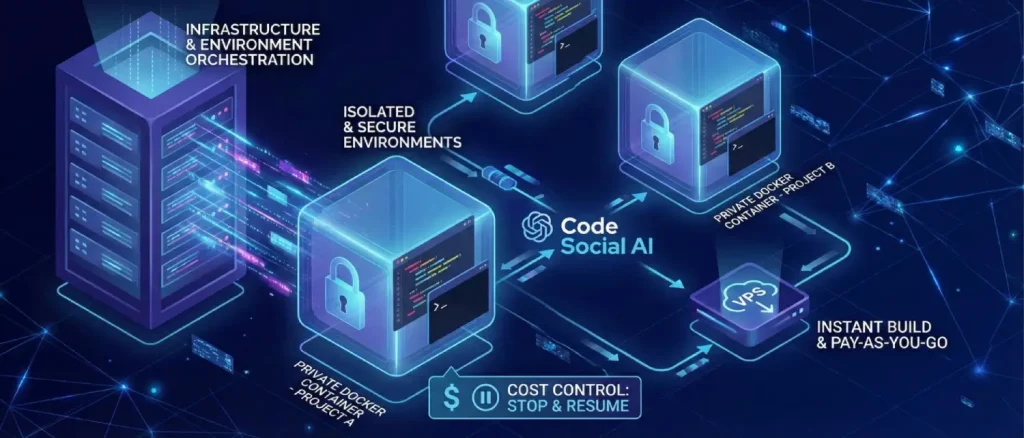
A critical component of the Code Social AI platform is the automatic creation of private, secure Docker containers for every project.
This approach ensures that every user has a dedicated, isolated sandbox for their work, removing the need for manual configuration of local development environments.
The moment a chat session is initiated, the system provisions a Docker container. This container provides a complete, active development environment that is hidden from the user unless they choose to interact with it directly.
This abstraction is what allows for the “instant build” experience. The containerization strategy provides several key benefits:
It is similar to the “Vercel Sandbox” or “Railway Service” models, where compute and memory are billed as actively used. As an example, Railway costs of using the CPU and memory can be paid by the user, with a very fine pay-as-you-go model.
Code Social AI shares this philosophy, where the user can keep working directly from the same point as they had left by merely re-launching the Docker container.
Although most of the heavy lifting is done by the AI agent, the development environment can be accessed in full and without restriction by experienced users.
Going to the terminal tab, one has an opportunity to simply connect to their running Docker container. It is not simulated but a real, live bash.
One of the usual verification processes is the ls command, which allows listing the files generated by the AI. This command shows the internal organization of the site, such as stylesheet, codebase, and asset directories.
Such transparency is an assurance that the system is functioning flawlessly and provides infinite opportunities for manual management. Users are allowed to run their own commands, do file manipulation, and control the project as a professional engineer would in a local environment.
The “files” tab further enhances this freedom by allowing users to see, open, and edit every single file the AI has created. This hybrid workflow, where AI generation and manual editing coexist, is essential for fine-tuning.
For instance, a user might manually change a heading from “Associate” to “Corporation” to match a specific corporate identity, then refresh the page to see the change instantly. This manual override capability ensures that the AI remains a tool for empowerment rather than a source of constraint.
The development process within Code Social AI is not limited to text-based prompts. The platform incorporates multimodal capabilities, allowing users to provide visual feedback to the AI agent.
One of the most powerful features of the environment is the ability to attach screenshots of the project to the chat. If a user is dissatisfied with a specific visual element, such as the color pattern of a website, they can take a screenshot of the relevant section and ask the AI to modify it.
The AI agent analyzes the image, understands the context of the request, and suggests changes.
Imagine a user asks the AI to change the background color of the top “hero” section of their site. Instead of just picking a random color, the AI shows its intelligence by asking for your preference first.
It might suggest professional options like “Forest Green” or “Charcoal,” creating a back-and-forth conversation that feels just like working with a human designer. Once you pick a color, the AI instantly updates the code inside its private workspace (a Docker container). You can then see those changes happen right away in a live preview of your website.
During these iterations, the user can monitor the AI’s “thinking” process and live analytics. This includes tracking how much storage the Docker container is occupying and the real-time cost of the session.
This transparency ensures that the user is always informed of the impact of their design choices on the project’s budget. The ability to see exactly how many AI tokens have been used and the cost spent in real-time eliminates the “hidden fees” that often plague cloud-based development services.
The final stage of the Code Social AI lifecycle is the transition from a development prototype to a live production environment. This is achieved through a “one-click” deployment to a Virtual Private Server (VPS).
When a user is satisfied with their project, they can click “deploy to production,” which opens a configuration model. This model allows the user to select the physical location of the server and the hardware specifications required for the application.
The system offers a variety of configurations, including dedicated CPU options, to ensure that the production environment can handle the expected traffic.
| Deployment Parameter | Options/Considerations | Strategic Value |
| Server Location | Global regions | Minimizes latency for the target audience. |
| CPU Type | Shared vs. Dedicated | Dedicated CPUs provide consistent performance for heavy apps. |
| RAM/Storage | Tiered specs | Balances cost with the application’s memory requirements. |
| Pricing Summary | Dynamic based on selection | Provides a final cost overview before the server is provisioned. |
The deployment process typically takes between five and ten minutes, depending on the chosen server configuration. During this time, the system provisions the VPS, transfers the application code from the Docker sandbox to the production server, and assigns a live IP address.
To understand the value proposition of Code Social AI’s deployment model, it is necessary to compare it with other market leaders in the hosting and deployment space.
Platforms like Netlify and Vercel offer streamlined workflows for frontend applications, while Railway and Heroku provide broader infrastructure-as-a-service (IaaS) solutions.
| Provider | Core Model | Pricing Structure | Deployment Method |
| Netlify | Static/JAMstack | Free tier; $9-$20/member/mo | Git push or AI-driven |
| Vercel | Frontend/Edge | $20/mo + usage credits | CI/CD Integration |
| Railway | General Compute | $5 Hobby; $20 Pro + resource usage | Containers/Templates |
| Code Social AI | Generative Full-stack | Credit-based + VPS tiers | AI Chat to 1-Click VPS |
| Hetzner | Raw VPS | €3.79 – €6.80/mo (Budget VPS) | Manual Setup/Manual VPS |
Code Social AI occupies a unique niche by combining the generative power of an AI coding agent with the raw power of a VPS.
While platforms like Netlify and Vercel are excellent for high-performance frontend delivery, Code Social AI targets the “technical headache” of the entire stack, allowing users who might otherwise use a budget VPS like Hetzner or DigitalOcean to enjoy a managed, AI-driven experience without the manual server management required by traditional providers.
The introduction of AI-based development platforms has major consequences in terms of the teaching and application of technology in the workplace.
The transition to AI-assisted coding is not only a technical transition but a social and educational one.
The future of computer science training is in the age of AI, and educational leaders are starting to realize this fact.
The Code.org courses AI 101 and Coding with AI introduce students and teachers to the idea of using large language models to write stronger code, even as they consider the ethical implications of its use.
This curriculum is reflective of the experience of using Code Social AI, in which the user needs to practice learning how to vibe code or to prompt in a way that would generate desired results.
Furthermore, professional learning series like “AI Essentials for Business” from Harvard Business School demonstrate that AI literacy is now a requirement for business leaders.
These courses teach professionals how to identify AI use cases and streamline data pipelines, skills that are directly applicable to managing projects on platforms like Code Social AI.
The social aspect of coding, the “Social” in Code Social AI, is reinforced by communities dedicated to accessible resources and peer-to-peer knowledge sharing.
Platforms such as codesocial.tech provide learning hubs where individuals can connect with mentors and industry experts to grow their skills. This community support is essential for users of generative platforms, as they transition from being “code-writers” to “system-architects.”
While Code Social AI significantly reduces the friction of software development, several challenges remain inherent in the generative model. These include the accuracy of AI-generated code, the cost of high-level models, and the complexity of managing large-scale production environments.
The “thinking” process of the AI agent, while clever, is not infallible. The platform addresses this by allowing the user to troubleshoot directly with the AI, for instance, by reporting a wrong port number or a visual error.
This iterative debugging process is a vital skill in the AI-native development era. Research into AI/ML accuracy in other fields, such as the classification of spinal function, suggests that while AI can reach high accuracy (e.g., >80%), the consistency and reliability of models remain areas of active study.
In the context of coding, this highlights the importance of the “unrestricted access” provided by the terminal, allowing users to verify and fix AI output manually.
The role of the developer is evolving from a manual builder to a high-level supervisor. As seen in the transcript, the user controls the “forest green” color, the “corporation” heading, and the “Opus” model selection, while the AI manages the Docker containers and server provisioning.
This change is reflected in the technical skills demanded by the industry today. Professionals like Laura Florey, who combine development (HTML/CSS, JavaScript, Python) with design and AI expertise, represent the new archetype of the “Digital Creator”.
The Code Social AI platform represents a compelling vision of the future of software engineering. By centralizing management, automating infrastructure, and providing a tiered intelligence model, it effectively “closes the gap” between the spark of an idea and the deployment of a live product.
The platform’s commitment to transparency, both in terms of cost and system access, ensures that users remain in control of their technological journey.
As generative AI continues to mature, the barriers to creation will continue to fall. The integration of manual terminal access with conversational AI agents suggests a future where the distinction between “coder” and “non-coder” becomes increasingly blurred.
In this new paradigm, the value shifts from the ability to write syntax to the ability to articulate vision and manage complex systems. Code Social AI is a pioneer in this transformation, providing the tools and the environment for anyone to turn their vision into reality without the technical headache.
The success of such platforms will ultimately depend on their ability to maintain reliability while scaling their AI capabilities. As users move beyond single-page layouts into complex, data-driven applications, utilizing models like Snowflake for data management or n8n for automation, the orchestration of these disparate systems will become the next frontier of the technical headache.
Code Social AI current architecture, built on Docker isolation and one-click VPS deployment, provides a robust foundation for this future, ensuring that as the projects grow in complexity, the process of building them remains simple and informative.

Hassan Tahir wrote this article, drawing on his experience to clarify WordPress concepts and enhance developer understanding. Through his work, he aims to help both beginners and professionals refine their skills and tackle WordPress projects with greater confidence.





 Lifetime VPS Europe
 Lifetime VPS Asia
 Lifetime WooCommerce Hosting
 Lifetime Hosting
 France Lifetime Dedicated Servers
 Germany Lifetime dedicated servers
 Lifetime Game Dedicated Servers
 Chicago, US
 Tokyo, Japan
 Singapore
 Hong Kong
 Seoul, South Korea
 Amsterdem, Netherlands
 London, UK
 Stockholm, Sweden
 Oslo, Norway
 Vienna, Austria
 Zurich, Switzerland
 Sydney, Australia
 Wordpress Hosting
 VPS Hosting
 DDOS Protection
 Submit Ticket
 Full Management
 Guides
 Videos and Podcasts
 Discover Creative Ideas
 MetaAgentOS High-Ticket Support System
 Voxfor Mega Menu
 Voxfor Advanced Price Management For WooCommerce
 Voxfor Secure Live Chat and AI Support
 Voxfor Multilanguage
 Voxfor AI Content Summary


