 Lifetime VPS Europe
 Lifetime VPS Asia
 Lifetime WooCommerce Hosting
 Lifetime Hosting
 Lifetime Game Dedicated Servers
 Chicago, US
 Tokyo, Japan
 Singapore
 Hong Kong
 Seoul, South Korea
 Amsterdem, Netherlands
 London, UK
 Stockholm, Sweden
 Oslo, Norway
 Vienna, Austria
 Zurich, Switzerland
 Sydney, Australia
 Wordpress Hosting
 VPS Hosting
 DDOS Protection
 Submit Ticket
 Full Management
 Guides
 Videos and Podcasts
 Discover Creative Ideas
 Voxfor Autonomous AI Workers
 Voxfor Mega Menu
 Voxfor Advanced Price Management For WooCommerce
 Voxfor Secure Live Chat and AI Support
 Voxfor Multilanguage
 Voxfor AI Content Summary
 Voxfor Autopilot
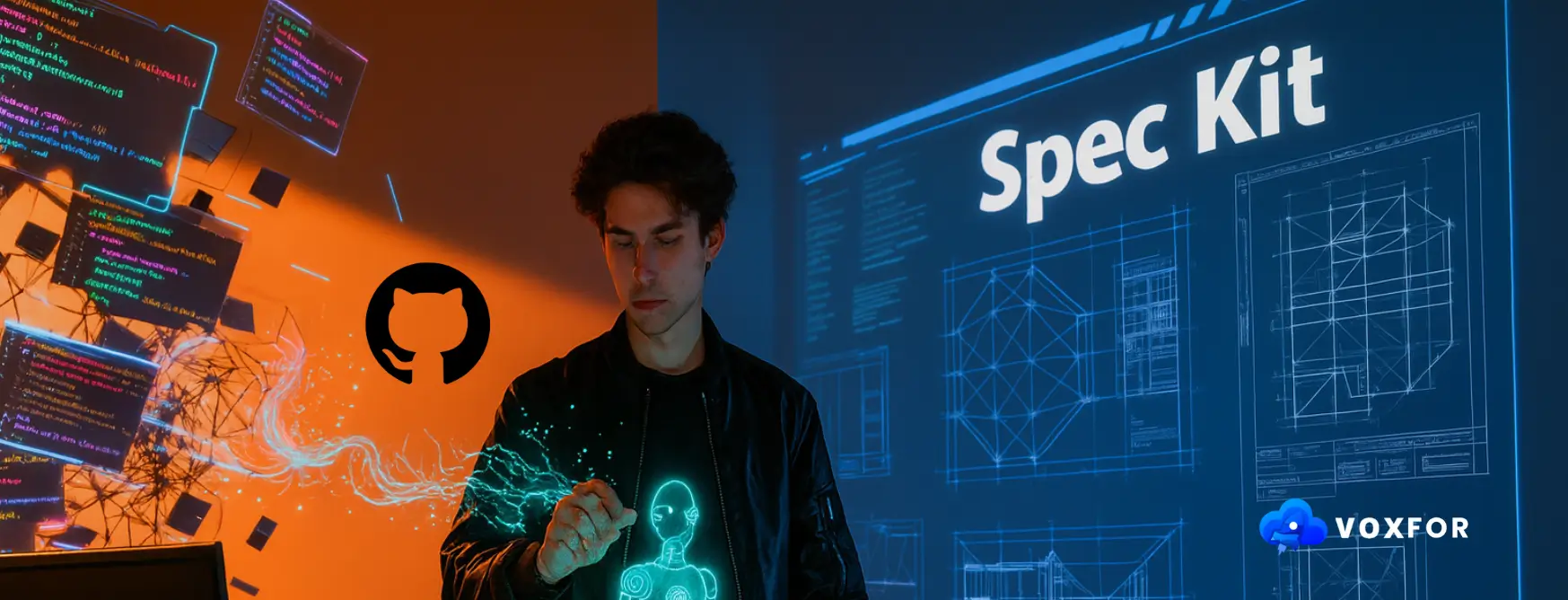
The frustration is real. You feed a coding agent that is an AI with a brilliant idea. It spits out half a thousand lines of code within 30 seconds. You read it and reason. You see that that is not what I meant. The architecture feels off. It lacks a critical edge case. You are now in the position of refactoring what was right the first time, but should have been.
This is the “vibe coding” problem, treating AI agents like search engines instead of literal-minded pair programmers. They’re amazing at pattern completion, but terrible at mind-reading. GitHub Spec Kit flips this entire dynamic by putting specifications, not hunches, at the center of development.
What Makes Spec Kit Different?
At its core, GitHub Spec Kit is an open-source toolkit that operationalizes Spec-Driven Development (SDD) — a structured workflow that turns vague intentions into crystal-clear executable plans before a single line of code gets written. It is not a revolutionary concept (Product Requirements Documents have existed since time immemorial). Nonetheless, it is drastically opposite in implementation: specifications become the Origin of the truth that powers AI implementation, and not an instruction that is followed, ignored.
Think of it this way: traditional development says “write code, then figure out what it does.” Spec Kit says, “figure out what you want, write it down clearly, then let AI build exactly that.” The shift is subtle but transformative.

Structure of a software requirements specification: introduction, overall description, system features, external interface requirements, preliminary schedule and budget
The Four-Phase Workflow That Actually Works
Spec Kit structures development into four deliberate phases, each with its own checkpoint:
Phase 1: Specify — Define the “what” and “why.” You describe requirements, user journeys, and success criteria. The AI agent fills in the details, creating a comprehensive functional specification. This isn’t about technical stacks yet — it’s about business intent. What problem are you solving? For whom? What outcomes matter?
Phase 2: Plan — It is not a revolutionary concept (Product Requirements Documents have existed since time immemorial). Nonetheless, it is drastically opposite in implementation: specifications become the Origin of the truth that powers AI implementation, and not an instruction that is followed, ignored.
Phase 3: Tasks — Break the plan into small, independently testable chunks. Each task is sized so an AI agent (or a human developer) can implement it, test it, and validate it in isolation. This is where test-driven development principles come alive: tasks are specific, ordered by dependency, and marked for parallel execution where applicable.
Phase 4: Implement — The AI agent executes tasks one by one, or in parallel where possible. But here’s the difference: instead of reviewing massive code dumps, you’re reviewing focused changes that solve specific problems. The AI knows what to build (spec), how to build it (plan), and what to work on next (tasks).
The genius is iterative refinement baked into every phase. You don’t move forward until you’re confident the current phase is right. Unlike traditional development, which locks you into early decisions, Spec Kit makes course-correcting simple — just update the spec, regenerate the plan, and move on.

GitHub Spec Kit’s four-phase Spec-Driven Development workflow
Why This Actually Works (The Science Behind It)
The reason Spec Kit succeeds where “just prompting better” fails is fundamental: language models are exceptional at pattern completion but can’t read minds. When you say “add photo sharing to my app,” the AI starts guessing. Thousands of unstated requirements. Different assumptions about UX, performance, security, and data flow. Some guesses will be wrong, and you’ll only discover this after implementation starts.
With a clear specification up front, a detailed technical plan, and focused tasks, the AI doesn’t guess — it executes. The specification captures intent precisely. The plan translates intent into technical decisions. Tasks break those decisions into implementable pieces. The AI handles the actual coding, informed by clarity instead of guesswork.
It works across different tech stacks because the fundamental challenge is universal: translating human intent into working code. Python, JavaScript, Go, C# — the workflow is identical. The specification captures intent clearly. The plan translates it into technical decisions specific to your stack. Tasks break it into implementable pieces. The AI handles the coding.
For larger organizations, Spec Kit solves another critical headache: where do you store all your requirements around security policies, compliance rules, design system constraints, and integration needs? Often, these live in someone’s head, buried in wikis nobody reads, or scattered across Slack threads that are impossible to find later. With Spec Kit, everything lives in the specification and plan, where the AI can actually reference it. Security isn’t an afterthought. Design system compliance isn’t something you bolt on later.
Getting Started Is Dead Simple
Installation takes literally one command. First, grab the Specify CLI:
uv tool install specify-cli --from git+https://github.com/github/spec-kit.gitThen initialize your project:
specify init my-project --ai claude(Replace claude with copilot, gemini, and cursor-agent.)
The CLI scaffolds your project with two key directories: .github/ (containing prompts for your chosen AI agent) and .specify/ (containing templates for specs, plans, tasks, and a constitution — your project’s non-negotiable principles).
Once initialized, you’ve got slash commands in your AI agent:
- /speckit.constitution — Define project principles
- /speckit.specify — Create functional specifications
- /speckit.plan — Generate technical implementation plans
- /speckit.tasks — Break plans into actionable tasks
- /speckit.implement — Execute all tasks
The workflow is collaborative: you guide, the AI generates, you refine. You’re never locked out — every artifact (specs, plans, tasks) is plain Markdown that you can edit directly or ask the AI to refine.
Where Spec Kit Shines (And Where It’s Still Finding Its Way)
Greenfield projects benefit massively from the Spec Kit. That upfront work to create a spec and plan ensures the AI builds what you actually intended, not a generic solution based on common patterns.
Spec Kit portrays the best in feature work in existing systems. It is difficult to add functionality to a complicated codebase. Writing a spec of the feature helps you make up your mind on the interaction of the feature with the existing system. The plan codes the architectural restrictions so that the new code is part of the project rather than being a bolt-on appendix. This is a productivity multiplier.
Legacy modernization gets a second life with Spec Kit. When rebuilding old systems, the original intent is often lost to time. With SDD, you capture the essential business logic in a modern spec, design fresh architecture in the plan, and let the AI rebuild from the ground up without carrying forward technical debt.
On the flip side, small projects or rapid spikes might feel over-engineered by Spec Kit’s structure. Developers report that the process can feel like “extra overhead” for simple features or throwaway prototypes. There’s a learning curve, too — writing quality specs takes practice. Knowing how to break tasks effectively, how to balance detail with flexibility, how to guide an AI agent effectively — these are skills that develop over time, not instinctively.
Spec Kit isn’t a silver bullet for every scenario. It’s a power tool for teams building serious, maintainable software. Use it when clarity and quality matter more than speed. Skip it when you’re spiking ideas or building disposable prototypes.
Real-World Impact: Why Your Development Process Is About to Change
Take the case of a developer experience shift: rather than writing an imprecise prompt and seeing back 2,000 lines of code that you are half-understanding, you are now engaging in a structured conversation. You clarify requirements. You authenticate a technical plan. You go through task breakdowns that are focused. You audit dedicated code corrections. The AI undertakes the great work, implementation, but you never fly blind.
For teams, this means fewer rework cycles. Fewer architectural decisions are made late and regretted later. Fewer “but that’s not what I meant” moments. Fewer late-stage scope creeps because ambiguous requirements got crystallized early.
For organizations, Spec Kit becomes a knowledge management tool. Your specs, plans, and architectural decisions are version-controlled artifacts that live in git alongside your code. New team members can read the specification to understand why the system works this way, not just how. Onboarding gets faster. Maintenance gets easier. Future refactoring becomes safer because the intent is documented and explicit.
Beyond the Toolkit: The Mindset Shift
Here’s the deeper insight: Spec Kit isn’t actually about a CLI tool or Markdown templates. It’s about a fundamental mindset shift — from “code first, figure out what it does later” to “intent first, code second.”
This shift becomes urgent as AI agents get more capable. A mediocre AI agent given vague instructions will produce mediocre code. A brilliant AI agent given vague instructions will still produce mediocre code — just faster. But a mediocre AI agent given crystal-clear specifications and plans? That’s where the magic happens.
The real power comes from understanding how to implement spec-driven development practices effectively, which GitHub documents in extensive detail. The structured thinking required to write a good spec — understanding user journeys, anticipating edge cases, encoding organizational constraints — that’s the work that actually matters. The AI handles the coding. You handle the thinking.
Your Next Move
GitHub Spec Kit is free. It’s open-source. It works with your favorite coding agent. The barrier to entry is literally one command.
If you’re building something serious — a feature for an existing system, a new product, a legacy modernization project — spend two hours experimenting with Spec Kit. Write a spec. Let the AI generate a plan. Review the tasks. See if the clarity it brings changes how you think about the problem.
You’ll probably find that the upfront structure saves you hours of rework. Clarity always does.
Get started with Spec Kit on GitHub and discover how spec-driven development can transform your AI-assisted coding workflow. Because the future of development isn’t faster coding, it’s clearer thinking.
About Author

Netanel Siboni is a technology leader specializing in AI, cloud, and virtualization. As the founder of Voxfor, he has guided hundreds of projects in hosting, SaaS, and e-commerce with proven results. Connect with Netanel Siboni on LinkedIn to learn more or collaborate on future projects.