
The traditional management of Virtual Private Servers has been associated with 24/7 human attention, patching, load balancing, resource allocation, security patches and capacity planning. Manual administration of VPS burns the huge IT resources yet it is still susceptible to human error. This equation is radically changed by AI-powered VPS management, which applies machine learning, predictive analytics, and intelligent automation to manage the complex tasks autonomously to achieve better performance and security as well as cost-efficiency.
Conventional VPS administration operates reactively. Problems emerge, then administrators diagnose and fix them, often after users experience degradation. Resource allocation depends on estimates, not real-time demand. Peak capacity planning requires extensive over-provisioning. Security updates and patches require manual scheduling and testing, consuming IT staff time.
The result: wasted resources, elevated operational costs, and vulnerability windows between threat discovery and patch deployment.
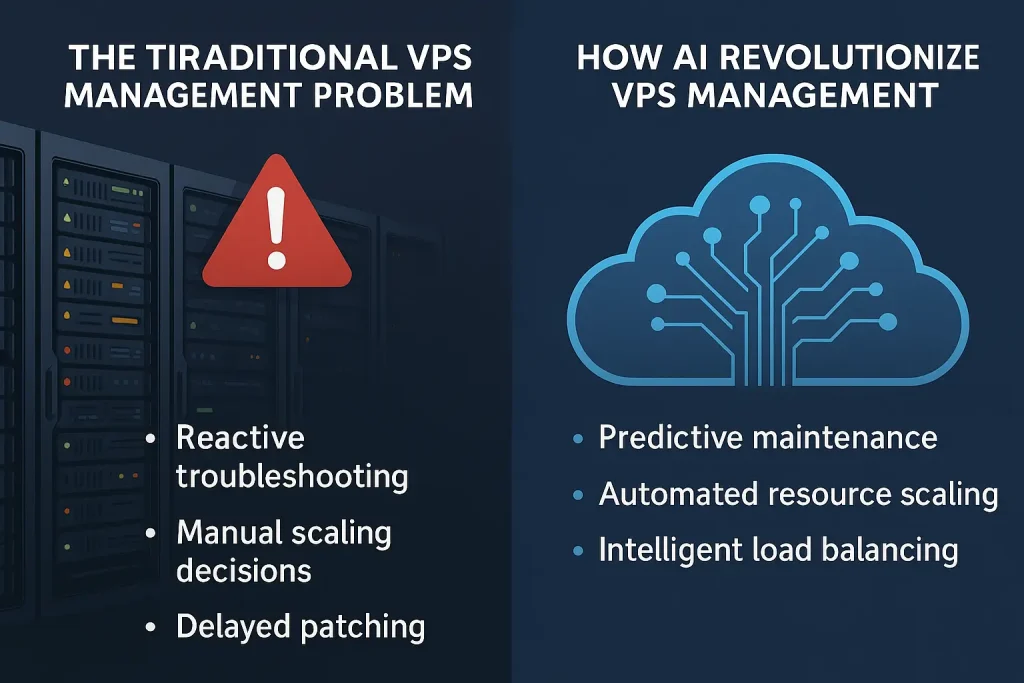
Predictive Maintenance and Failure Prevention: Machine learning algorithms continuously monitor CPU, memory, disk I/O, and network metrics, analyzing historical patterns to predict potential failures before they occur. Rather than reacting to failures, administrators receive early warnings enabling proactive remediation.
Automated Resource Scaling: AI systems learn traffic patterns and automatically adjust CPU, memory, storage, and bandwidth allocation in real-time, eliminating manual scaling decisions. Organizations stop over-provisioning during quiet periods and over-paying for unused capacity.
Intelligent Load Balancing: ML algorithms identify changes in traffic patterns and reassign workloads between servers on their own so that a particular server is not over-utilized while the others do not experience idle time. This maximizes the total performance and maximizes efficiency in resources.
Automated Patch Management: AI systems will scan vendor feeds, detect patches that are relevant, and automatically apply them when there is low traffic to ensure a brief outage time and seal security vulnerabilities before they can be exploited.
Cloudflare’s Argo Smart Routing: AI systems will scan vendor feeds, detect patches that are relevant, and automatically apply them when there is low traffic to ensure a brief outage time and seal security vulnerabilities before they can be exploited:
WordPress VPS Optimization: WordPress AI-powered management allows automated optimization of servers and monitoring, and thus provides an enterprise-level administration to small business owners and bloggers without technical skills. Key capabilities include:
Advanced Resource Allocation: LSTM and reinforcement learning models based on AI reduce latency by 47 percent, reduce the packet loss by 78.8 percent, and improve the bandwidth distribution accuracy by 20.5 percent relative to conventional approaches. These measures show high performance improvement.
Most major cloud vendors are now integrating AI into VPS architecture:
Eliminate Over-Provisioning: AI analyzes actual usage patterns and allocates resources based on demand rather than peak scenarios, reducing operational overhead and unnecessary expenditure.
Energy Efficiency: AI resource management reduces power consumption while maintaining system efficiency and capacity operation, directly lowering energy bills.
Labor Reduction: Automation eliminates manual tasks, patch management, monitoring, and configuration updates, reducing IT staff requirements.
Predictive Spending: AI analyzes usage patterns and billing data to identify cost trends and enable strategic negotiations with hosting providers.
AI-driven systems continuously verify data integrity and detect anomalies indicating intrusion or unauthorized modification. They also automate compliance verification against GDPR, HIPAA, and PCI-DSS standards—eliminating manual audit workload.
To begin with, evaluate your current VPS management workflow, select AI platforms that provide predictive scaling, machine intelligence in threat detection methods, and machine intelligence in load balancing. Move workloads to AI-managed environments gradually and confirm the advantages before committing to it.
AI is the future of the assistant and not the replacement, human beings are in charge of the design decisions and difficult issues, whereas AI is in charge of the routine maintenance and data analysis. This synergy helps human administrators concentrate on strategic initiatives and not firefighting.
AI is essentially changing the management of VPS into an intelligent, labor intensive operation to an operation that is reactive. The results of the adoption of AI-driven solutions have been realized in organizations: 33% TTFB, 40% latency improvement, 47% latency reduction with advanced algorithms, and 5% conversion rate increase, which are achievable, accompanied by operational cost reduction through over-provisioning elimination and labor savings.





 Lifetime VPS Europe
 Lifetime VPS Asia
 Lifetime WooCommerce Hosting
 Lifetime Hosting
 France Lifetime Dedicated Servers
 Germany Lifetime dedicated servers
 Lifetime Game Dedicated Servers
 Chicago, US
 Tokyo, Japan
 Singapore
 Hong Kong
 Seoul, South Korea
 Amsterdem, Netherlands
 London, UK
 Stockholm, Sweden
 Oslo, Norway
 Vienna, Austria
 Zurich, Switzerland
 Sydney, Australia
 Wordpress Hosting
 VPS Hosting
 DDOS Protection
 Submit Ticket
 Full Management
 Guides
 Videos and Podcasts
 Discover Creative Ideas
 MetaAgentOS High-Ticket Support System
 Voxfor Mega Menu
 Voxfor Advanced Price Management For WooCommerce
 Voxfor Secure Live Chat and AI Support
 Voxfor Multilanguage
 Voxfor AI Content Summary


