
Backlinks continue to be among the top-3 ranking factors at Google in 2026, yet quality and relevance have become incredibly important as compared to quantity. Relevant websites having topically matched anchor texts are also significant in increasing rankings, and irrelevant or toxic backlinks have been shown to cause adverse effects on SEO. Remarkably, 66 percent of pages are linked to zero backlinks, but the top position in the ranking pages is an average of 72 Domain Authority and high-quality backlink profiles. To keep the backlinks relevant, one has to continually audit, tactical eliminate the toxic links and engage in outreach in order to get contextually relevant connections.
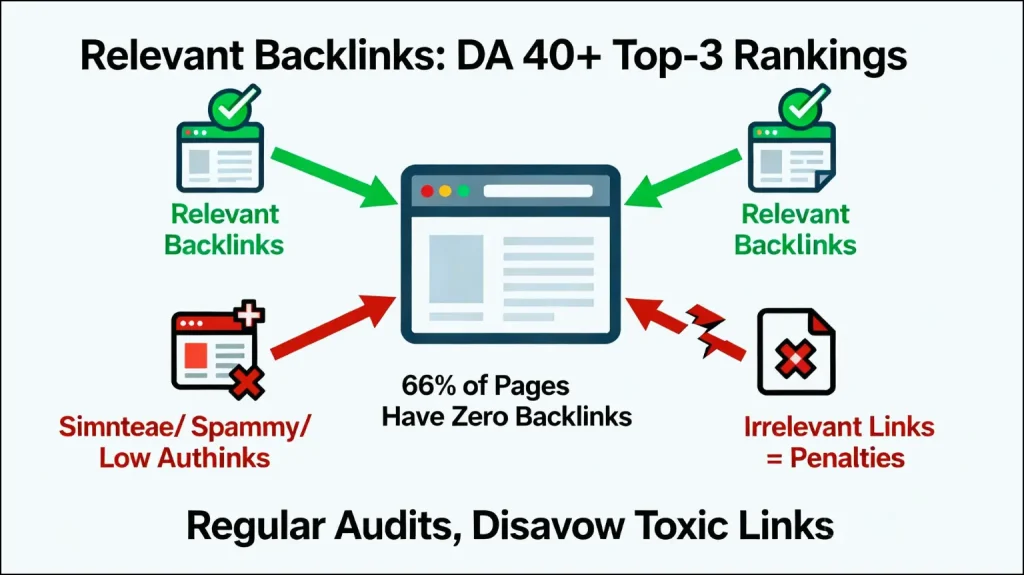
Google algorithms have become more sophisticated in distinguishing high-quality, contextually relevant backlinks from spammy, manipulative ones. A single quality backlink from a topically aligned website delivers far greater ranking power than dozens of irrelevant links from unrelated domains.
The correlation between backlinks and rankings is well-documented: sites with high domain authority (DA 60+) receive 500% more organic traffic than DA 30 sites. However, raw authority matters less than topical alignment; a high-DA tech website linking to your recipe blog provides minimal SEO value compared to a moderately authoritative food blog in your niche.
Topical Alignment: Backlinks from sites squarely within your industry or niche carry stronger relevance signals than random links from domains that match no subject matter. This contextual relevance signals to Google that your content is genuinely valuable within your specific market.
Domain Authority Correlation: While Domain Authority doesn’t directly determine rankings, the correlation between DA and Google rankings is 0.34 (moderate relationship). Most top-3 ranking positions (91%) have Domain Authority above 40, while 92% of top-10 results have a DA of 35 or higher.
Referring Domain Diversity: Google values backlinks from unique, new domains far more than repeated links from the same source. This signals widening recognition across the web rather than concentrated favor from single sources.
Link Velocity: Growth of organic links is preferable to spikes. It seems natural to have relevant links acquired gradually over time, whereas explosive growth, which the questionable sources provide, is rather a warning sign.
Authority Erosion: Unrelevant and poor quality back links undermine the authority of your site in the eyes of the search engines. Consider your backlink profile as a voting system; irrelevant votes by irrelevant sites do not help much to build trust.
Reputation Damage: Beyond algorithmic penalties, irrelevant backlinks harm brand perception. Discovering your site linked from spam or unrelated websites signals unprofessionalism to potential customers and partners.
Manual Penalties: Google can issue manual penalties for unnatural link-building practices, directly damaging rankings and requiring disavowal of toxic links through Google Search Console.
Conduct Comprehensive Backlink Audits: Use tools like Ahrefs, SEMrush, or Moz to export backlink data, then organize URLs in spreadsheets for systematic evaluation, including domain authority, relevance, anchor text, and link context.
Manual Context Review: Beyond automated tools, actually visit referring pages to assess linking context. Look for indicators of poor quality:
Quality Indicators: Ask critical questions:
Contact Site Owners: Your first recourse is courteous outreach requesting removal, explaining why the link doesn’t fit your current website strategy.
Use Google Disavow Tool: If outreach fails, Google Disavow Tool allows formally requesting certain backlinks be ignored when assessing your site. The process requires creating a text file listing URLs or domains to disavow, then uploading it through Google Search Console.
Systematic Approach: For large backlink portfolios, create priority lists focusing first on the highest-toxicity, lowest-relevance links, then work methodically through tiers.
Guest Posting: Publish valuable content on respected industry publications, earning contextually appropriate links from authoritative sources.
Competitor Link Analysis: Analyze where competitors receive backlinks to identify “link gaps”, high-relevance sources linking to competitors but not to you.
Quality Content Creation: Long-form content receives 77.2% more backlinks than short articles, making it naturally attractive to link-building opportunities.
Anchor Text Diversification: Avoid exact-match keyword domination. Balance anchor text distribution across brand names, generic terms, and varied keywords to appear natural.
The relevance of the links that you have will make or break your SEO. As 73.2% of the surveyed SEO professionals think that backlinks affect the artificial intelligence search ranking in addition to the old Google ranking, now more than ever, it is important to keep the backlink profile clean and topically oriented.





 Lifetime VPS Europe
 Lifetime VPS Asia
 Lifetime WooCommerce Hosting
 Lifetime Hosting
 France Lifetime Dedicated Servers
 Germany Lifetime dedicated servers
 Lifetime Game Dedicated Servers
 Chicago, US
 Tokyo, Japan
 Singapore
 Hong Kong
 Seoul, South Korea
 Amsterdem, Netherlands
 London, UK
 Stockholm, Sweden
 Oslo, Norway
 Vienna, Austria
 Zurich, Switzerland
 Sydney, Australia
 Wordpress Hosting
 VPS Hosting
 DDOS Protection
 Submit Ticket
 Full Management
 Guides
 Videos and Podcasts
 Discover Creative Ideas
 MetaAgentOS High-Ticket Support System
 Voxfor Mega Menu
 Voxfor Advanced Price Management For WooCommerce
 Voxfor Secure Live Chat and AI Support
 Voxfor Multilanguage
 Voxfor AI Content Summary


