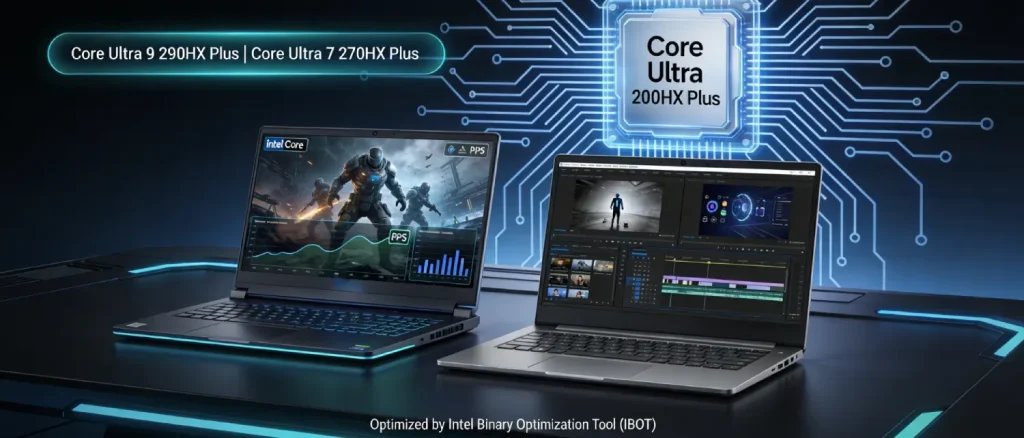
Intel has officially launched its Core Ultra 200HX Plus series mobile processors, marking the latest refresh of its Arrow Lake architecture for high-performance gaming laptops, content creation machines, and mobile workstations. The new lineup, consisting of the Intel Core Ultra 9 290HX Plus and Intel Core Ultra 7 270HX Plus, began shipping in systems from top OEM partners starting March 17, 2026. Alongside tangible hardware improvements, Intel is debuting a landmark software innovation called the Intel Binary Optimization Tool (IBOT), which can squeeze more performance out of games and apps without requiring any developer intervention.
The Core Ultra 200HX Plus series is an evolution of Intel’s existing Arrow Lake HX platform, which was first unveiled at CES 2025 in January of last year. At CES 2025, Intel introduced the original Core Ultra 200HX lineup, including the Core Ultra 9 285HX and Core Ultra 7 265HX, as its high-performance mobile processors designed specifically for gaming laptops paired with discrete GPUs. Those chips offered 24 cores (8 Performance + 16 Efficiency), clocks up to 5.5 GHz, and were fabricated on TSMC cutting-edge 3nm (N3B) node for the compute tile.
Throughout 2025, rumors about an “Arrow Lake Refresh” steadily built. Reports from reliable hardware leakers pointed to a March or April 2026 launch window, and motherboard manufacturers quietly began publishing BIOS updates that referenced “upcoming Core Ultra 2-series processors.” Intel itself confirmed at the Goldman Sachs Technology Conference in 2025 that “we’ll have a refresh of Arrow Lake next year.” Desktop versions of the refresh, branded Core Ultra 200S Plus, were unveiled a week prior, on March 11, 2026, setting the stage for the mobile counterparts.
Intel officially announced the Core Ultra 200HX Plus series on March 16–17, 2026, through its newsroom and a dedicated YouTube presentation. The launch was accompanied by a detailed press deck and product page, confirming availability “starting today, March 17, 2026,” with broader OEM system availability expected throughout the year.
Josh Newman, General Manager and Vice President of Product Marketing for Intel’s Client Computing Group, stated:
“With the introduction of the Intel Core Ultra 200HX Plus series, we’re pushing mobile computing performance even further for the gamers, creators, and professionals who demand the best. With higher die-to-die frequencies and our new Intel Binary Optimization Tool, the new Intel Core Ultra 9 290HX Plus and Ultra 7 270HX Plus deliver meaningful, real-world performance gains.”[1]
The official codenamed for these chips is Arrow Lake HX-R (Refresh), and they operate under the same LGA socket infrastructure as the original Arrow Lake HX chips.
Processor Specifications
Intel introduced two new SKUs under the 200HX Plus banner. Below is a detailed specification breakdown:
Intel Core Ultra 9 290HX Plus
| Specification | Details |
| Codename | Arrow Lake HX-R |
| Architecture | Hybrid (Lion Cove P-cores + Skymont E-cores) |
| Total Cores / Threads | 24 Cores / 24 Threads |
| Performance Cores (P-cores) | 8x Intel Lion Cove |
| Efficiency Cores (E-cores) | 16x Intel Skymont |
| Max Boost Frequency | Up to 5.50 GHz |
| E-core Max Frequency | Up to 4.70 GHz (+100 MHz vs. 285HX) |
| L2 Cache | 40 MB |
| L3 Cache | 36 MB |
| TDP (Base) | 55 Watts |
| TDP Turbo (PL2) | 160 Watts |
| Manufacturing Process | TSMC 3nm (N3B) for Compute Tile |
| Memory Support | Up to 256 GB DDR5-6400 (Dual Channel) |
| NPU (AI Boost) | 13 TOPS (Int8) |
| Integrated GPU | Intel Graphics 4-Core iGPU (300 – 2000 MHz) |
| PCIe Version | PCIe 5.0 and 4.0 |
| Max PCIe Lanes | 24 |
| Thunderbolt | Thunderbolt 5 (80 Gbps bidirectional) |
| Wi-Fi | Intel Wi-Fi 7 (5 Gig) |
| Bluetooth | Bluetooth 5.4 |
| Max Display Resolution (DP) | 7680 x 4320 @ 60Hz |
Intel Core Ultra 7 270HX Plus
| Specification | Details |
| Architecture | Arrow Lake HX-R |
| Total Cores / Threads | 20 Cores / 20 Threads |
| Performance Cores (P-cores) | 8x Intel Lion Cove (up to 5.3 GHz) |
| Efficiency Cores (E-cores) | 12x Intel Skymont (up to 4.7 GHz) |
| L2 Cache | 36 MB |
| L3 Cache | 36 MB |
| TDP (Base) | 55 Watts |
| TDP Turbo (PL2) | 160 Watts |
| Manufacturing Process | TSMC 3nm |
| Integrated GPU | Intel Graphics 4-Core iGPU (300 – 1900 MHz) |
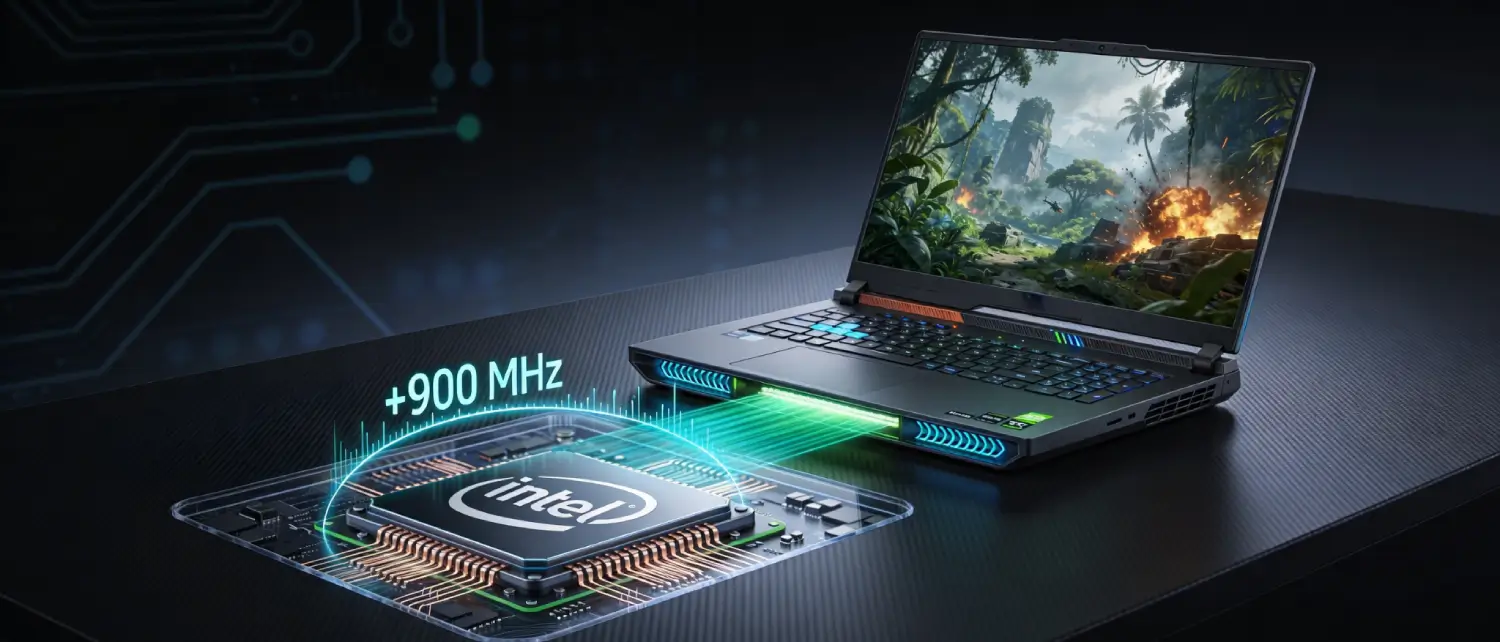
The most significant hardware improvement in the Plus refresh is a 900 MHz boost to the die-to-die frequency — the speed at which the CPU communicates with the memory controller. This nearly one-gigahertz bump improves the CPU-to-memory link, directly reducing system latency and translating into measurably higher gaming frame rates and faster system responsiveness. Both the 290HX Plus and 270HX Plus benefit from this upgrade compared to their predecessors, the 285HX and 265HX, respectively.
In addition to the die-to-die frequency uplift, the Core Ultra 9 290HX Plus features +100 MHz higher E-core clocks (up to 4.7 GHz) compared to the 285HX. The peak P-core boost remains matched at 5.5 GHz, but the combined effect of faster inter-tile communication and slightly higher E-core frequencies contributes to the overall performance gains.[14][16]
One of the most groundbreaking additions accompanying the 200HX Plus launch is the Intel Binary Optimization Tool, which Intel describes as a “first-of-its-kind binary translation layer optimization capability.” IBOT works at runtime, detecting slow or inefficiently compiled code in running applications and replacing those functions in memory with optimized versions tuned for Intel’s current Arrow Lake architecture — all without requiring developers to release new patches.[2][3][4]
The practical implication is substantial: whether a game was originally optimized for an AMD chip, built for a game console like the PlayStation, or compiled for an older Intel architecture, IBOT can transparently improve that game’s instructions-per-cycle (IPC) performance on 200HX Plus hardware. Intel describes this as leveraging its “40-year history in workload optimization.” The tool is available as an optional feature within Intel’s Dynamic Tuning Technology and can be toggled via the Application Optimization settings in the BIOS.
IBOT is part of the broader Intel Platform Performance Package — a unified download bundle that includes Intel Application Performance Optimization (APO) and all drivers needed for optimal platform performance. A caveat is that only select games and applications are currently supported, but Intel has confirmed the supported list will grow over time.[12][2]
The 200HX Plus series also introduces a full suite of next-generation connectivity options:
Performance: How Fast Is It?
According to Intel’s internal benchmarking conducted in March 2026, the Core Ultra 9 290HX Plus delivers:
These tests were conducted on a pre-production OEM system equipped with 64 GB DDR5-6400, paired with an NVIDIA GeForce RTX 5090 (TGP=175W), at 3840×2400 resolution.
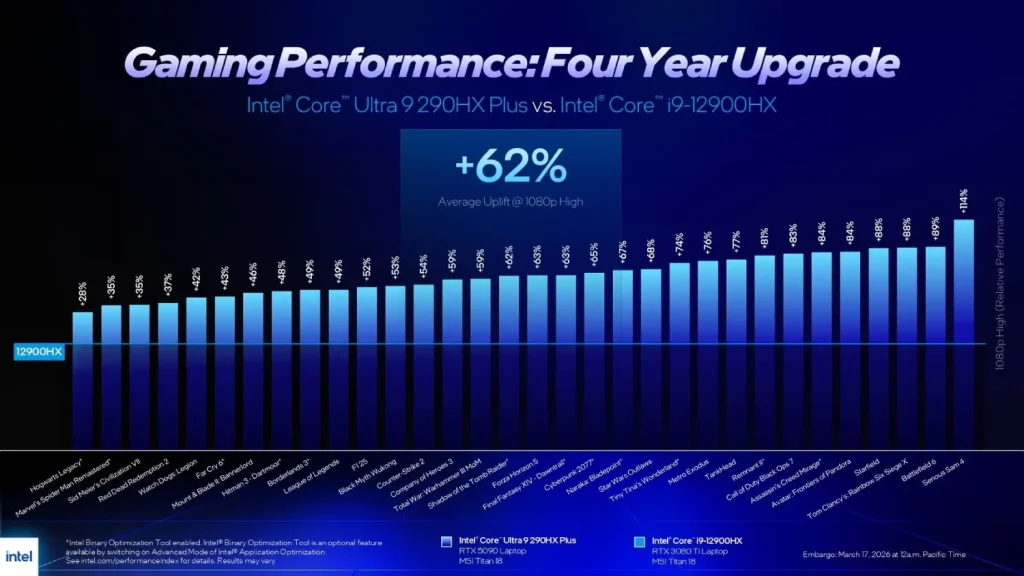
Vs. Older Generation (Core i9-12900HX)
For users still running 12th-gen Intel hardware, the performance leap is far more dramatic:
Even though the 200HX Plus is a power-hungry platform designed for gaming workhorses, Intel claims up to 40% better power efficiency for the Arrow Lake HX generation compared to the older 14th-gen Raptor Lake-H Refresh chips at the same 55W configuration, delivering higher performance at equivalent power budgets.
In workload tests, the Arrow Lake HX architecture showed up to +10% single-threaded and +19% multi-threaded performance over the Core i9-14900HX. Creative workloads saw even bigger gains — Blender and POV-Ray improved by 29% and 31% respectively.
Intel Core Ultra 200HX Plus vs. AMD Ryzen AI Max+ 395
AMD’s rival in the premium mobile space is the Ryzen AI Max+ 395 (Strix Halo), which offers 16 Zen 5 cores and a dramatically more powerful AMD Radeon 8060S integrated GPU with 40 Compute Units.
| Feature | Intel Core Ultra 9 290HX Plus | AMD Ryzen AI Max+ 395 |
| Architecture | Arrow Lake HX (Lion Cove + Skymont) | Strix Halo (Zen 5) |
| Cores / Threads | 24 / 24 | 16 / 32 |
| Max Boost Clock | 5.5 GHz | 5.1 GHz |
| Manufacturing Node | TSMC 3nm | TSMC 4nm |
| L3 Cache | 36 MB | 64 MB |
| NPU AI Performance | 13 TOPS | 50 TOPS |
| Integrated GPU | Intel Graphics 4-Core (~1.9 TFLOPS) | AMD Radeon 8060S (~29.7 TFLOPS) |
| Memory Support | DDR5-6400 (256 GB max) | LPDDR5x-8000 (Quad-Channel) |
| PCIe Support | PCIe 5.0 | PCIe 4.0 |
| Target Use Case | Gaming laptops w/ dGPU | Thin-and-powerful, iGPU-centric devices |
Analysis: The Intel chip holds a clear edge in raw multi-core CPU horsepower — Cinebench 2024 Multi-core scores showed the Intel HX chips outperforming the AMD Ryzen AI Max+ 395 by roughly 20-37% in CPU-bound workloads. However, AMD’s Radeon 8060S integrated graphics are dramatically stronger (approximately 15x the iGPU TFLOPS), making the AMD chip better suited for systems without a dedicated GPU. Intel’s HX is unambiguously designed for pairing with a discrete GPU like the RTX 5090 or similar, not for iGPU gaming. AMD’s AI capabilities also significantly outpace Intel’s with 50 TOPS vs. just 13 TOPS for the NPU — making the Ryzen AI Max+ 395 the clear winner for Microsoft Copilot+ compatibility.
In the mainstream gaming laptop segment, Intel’s HX+ faces AMD Ryzen AI 9 HX 370 (Strix Point, 12 Zen 5 cores).
| Feature | Intel Core Ultra 9 290HX Plus | AMD Ryzen AI 9 HX 370 |
| Cores / Threads | 24 / 24 | 12 / 24 |
| Max Boost Clock | 5.5 GHz | 5.1 GHz |
| NPU Performance | 13 TOPS | 50 TOPS |
| Integrated GPU | Intel Graphics (~1.9 TFLOPS) | AMD Radeon 890M (~5.9 TFLOPS) |
| L3 Cache | 36 MB | 24 MB |
| Overclockable | Yes | No |
| Cinebench R23 Multi-Core (HX 275 ref) | ~35,478 | ~22,746 |
Analysis: Intel 24-core design trounces AMD 12-core Ryzen AI 9 HX 370 in multi-threaded workloads — by around 56% in Cinebench R23 Multi and 71% in Cinebench 2024 Multi. Single-thread performance is roughly comparable. AMD retakes the lead in iGPU performance and NPU AI capabilities (50 TOPS vs. Intel’s 13 TOPS). For dedicated gaming laptop buyers, pairing these chips with an RTX 5090, Intel’s raw core count advantage, and IBOT software edge makes it the stronger performer. For thinner laptops without a dGPU, AMD’s superior iGPU remains the better choice.[22][23]
Intel confirmed that Core Ultra 200HX Plus-powered systems launched on March 17, 2026, from a wide roster of OEM partners. The breadth of the launch lineup reflects strong industry support for the new platform:
| Brand | Models |
| Acer | Predator Helios Neo 16S AI, Predator Helios Neo 16 AI, Predator Helios Neo 18 AI |
| ASUS | ROG Strix SCAR 18 |
| Dell Technologies | Alienware 16 Area-51, Alienware 18 Area-51, Alienware 16X Aurora |
| HP Inc. | HyperX OMEN 15, HyperX OMEN 16, HyperX OMEN MAX 16 |
| Lenovo | Legion 7i (16″, Gen 10), Legion 5i (15″, Gen 11), Legion Pro 7i (16″, Gen 10), Legion Pro 5i (16″, Gen 10) |
| MSI | Raider 16 Max HX |
| Razer | Razer Blade 18 |
| Origin PC | EON18X, EON16X |
| MAINGEAR | Ultima 18 |
| Puget Systems | Mobile C162-G |
| Colorful | iGame M16 Origo |
| Mechrevo | Yaoshi 18 Pro, Yaoshi 16 Ultra |
Beyond IBOT, the 200HX Plus chips continue the Arrow Lake platform’s AI PC designation through its 13 TOPS NPU, branded as Intel AI Boost. While this falls short of the 40 TOPS threshold required for Microsoft’s Copilot+ program, it still enables local AI acceleration for a range of productivity and creative tasks.
Intel has also been developing a Game AI Assistant feature — powered by the CPU’s built-in NPU — that works similarly to NVIDIA’s Project G-Assist. The feature allows users to ask questions about game strategies or mechanics via text or voice, receiving real-time assistance without leaving the game.
The complete software experience for 200HX Plus users is unified through the Intel Platform Performance Package, making it simpler for end users to download APO, IBOT, and all relevant drivers in one go.
The 200HX Plus launch comes at a challenging moment for Intel. The company has faced significant market share losses over the past several years, and the original Arrow Lake desktop lineup failed to generate much excitement against AMD’s Ryzen 9000 series. Industry analysts have been skeptical that incremental refreshes like the 200 Plus family will meaningfully reverse these trends, particularly given competition from AMD’s Zen 5-based chips and Qualcomm’s Snapdragon X Elite in the thin-and-light segment.
However, the mobile HX segment remains a stronghold for Intel, where the platform’s unlocked multiplier, raw multi-core throughput, and deep integration with discrete GPU platforms (particularly NVIDIA) keep it competitive in the high-performance gaming and mobile workstation niches. The introduction of IBOT is Intel’s most differentiated software bet yet — a technology that could quietly deliver compounding performance improvements as more games and applications are added to the supported list.
Looking forward, Intel’s next major architectural leap for laptops will be Panther Lake (Core Ultra 300 series), which has already launched as of January 27, 2026, with full commercial availability. The 200HX Plus series is therefore best understood as an optimized continuation of Arrow Lake while the ecosystem transitions to the next generation.
The Intel Core Ultra 200HX Plus series is a focused, well-targeted refresh that delivers genuine improvements for gaming laptop buyers, particularly through the novel Intel Binary Optimization Tool and the critical +900 MHz die-to-die frequency boost. The 8% gaming uplift over the 285HX is modest for existing owners, but the 62% leap from 12th-gen hardware makes a strong case for upgraders. Paired with NVIDIA RTX 50-series discrete graphics in a premium gaming chassis like the Alienware Area-51, the ROG Strix SCAR 18, or the Razer Blade 18, the Core Ultra 9 290HX Plus represents the pinnacle of Intel’s current mobile performance stack.
For creators who need maximum multi-core CPU throughput with a discrete GPU, this platform remains unmatched in the Intel lineup. For those seeking a thinner form factor or superior AI/iGPU performance, AMD’s Ryzen AI Max+ 395 or Strix Point alternatives present a compelling alternative. Ultimately, Intel’s biggest near-term bet is IBOT. If the tool expands its supported game library rapidly, it could become a meaningful long-term differentiator in an increasingly competitive mobile CPU market.

Hassan Tahir wrote this article, drawing on his experience to clarify WordPress concepts and enhance developer understanding. Through his work, he aims to help both beginners and professionals refine their skills and tackle WordPress projects with greater confidence.





 Lifetime VPS Europe
 Lifetime VPS Asia
 Lifetime WooCommerce Hosting
 Lifetime Hosting
 France Lifetime Dedicated Servers
 Germany Lifetime dedicated servers
 Lifetime Game Dedicated Servers
 Chicago, US
 Tokyo, Japan
 Singapore
 Hong Kong
 Seoul, South Korea
 Amsterdem, Netherlands
 London, UK
 Stockholm, Sweden
 Oslo, Norway
 Vienna, Austria
 Zurich, Switzerland
 Sydney, Australia
 Wordpress Hosting
 VPS Hosting
 DDOS Protection
 Submit Ticket
 Full Management
 Guides
 Videos and Podcasts
 Discover Creative Ideas
 MetaAgentOS High-Ticket Support System
 Voxfor Mega Menu
 Voxfor Advanced Price Management For WooCommerce
 Voxfor Secure Live Chat and AI Support
 Voxfor Multilanguage
 Voxfor AI Content Summary


