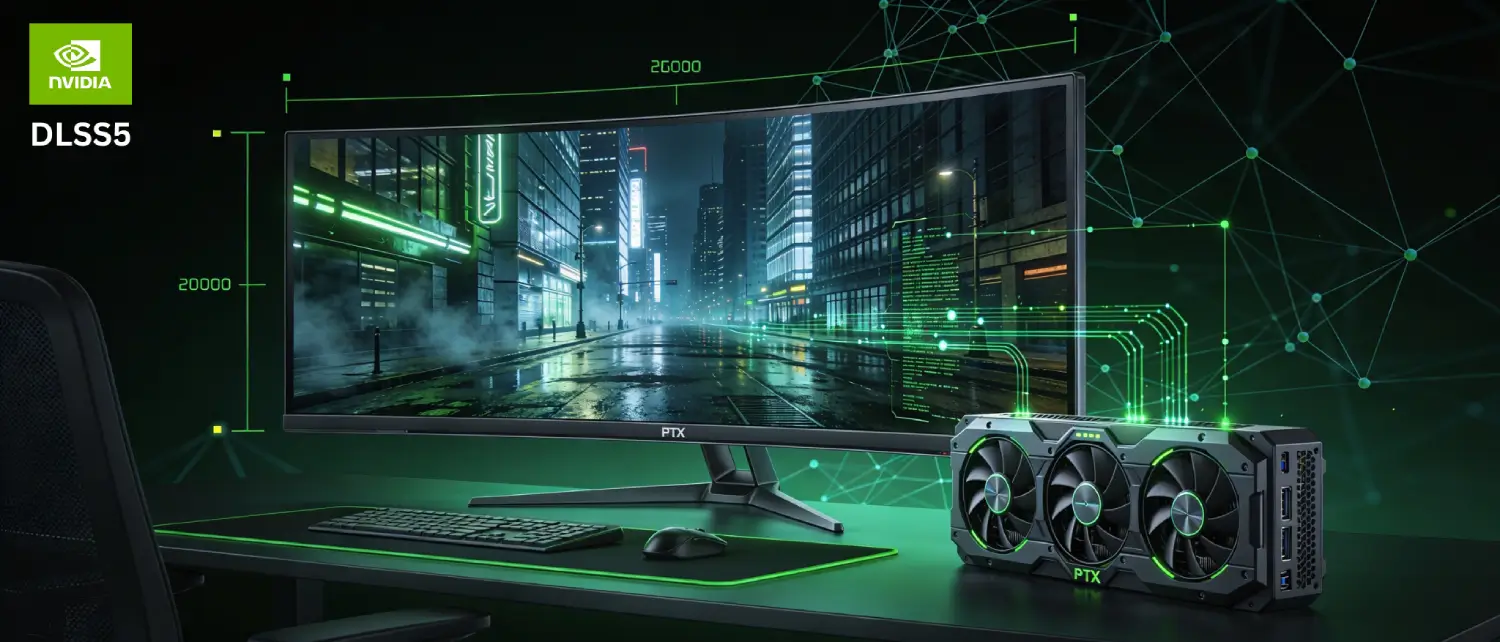
Nvidia has unveiled DLSS 5 (Deep Learning Super Sampling 5) at its GTC 2026 conference, marking what CEO Jensen Huang described as the “GPT moment for graphics.” Announced on March 16, 2026, DLSS 5 is Nvidia’s most significant breakthrough in computer graphics since the debut of real-time ray tracing in 2018. Rather than simply upscaling resolution or generating interpolated frames like its predecessors, DLSS 5 introduces a fundamentally new approach: real-time neural rendering that uses generative AI to infuse entire scenes with photorealistic lighting and materials.
In Huang’s own words: “Twenty-five years after NVIDIA invented the programmable shader, we are reinventing computer graphics once again. DLSS 5 is the GPT moment for graphics, blending hand-crafted rendering with generative AI to deliver a dramatic leap in visual realism while preserving the control artists need for creative expression.”
DLSS 5 is slated for a Fall 2026 release and will target the GeForce RTX 50 Series GPU lineup.
To understand how revolutionary DLSS 5 is, it helps to trace the technology journey over nearly eight years of continuous iteration.
| Version | Year | Key Innovation |
| DLSS 1.0 | 2018 | Upscaling via CNN; required per-game training; often blurry results |
| DLSS 2.0 | 2020 | Generic AI training, used motion vectors, and wider game compatibility |
| DLSS 3.0 | 2022 | AI-powered Frame Generation added; near-doubles frame rates on RTX 40-series |
| DLSS 3.5 | 2023 | Ray Reconstruction: a single AI model replaces multiple denoising algorithms |
| DLSS 4.0 | 2025 | Transformer-based model replacing CNN; Multi-Frame Generation |
| DLSS 4.5 | Jan 2026 | 2nd-gen Transformer; Dynamic Multi Frame Generation; 6x mode; 240+ FPS with path tracing |
| DLSS 5 | Fall 2026 | Real-time Neural Rendering; photorealistic lighting & materials infused into every pixel |
DLSS was first released in 2018 as an AI performance booster, primarily focused on upscaling resolution. It has since been integrated into over 750 games, becoming an industry gold standard. DLSS 4.5, announced at CES 2026, pushed the envelope further by using AI to render 23 out of every 24 pixels visible on screen. DLSS 5 now takes this philosophy to its logical extreme, not just managing pixels, but rewriting the visual quality of entire frames.
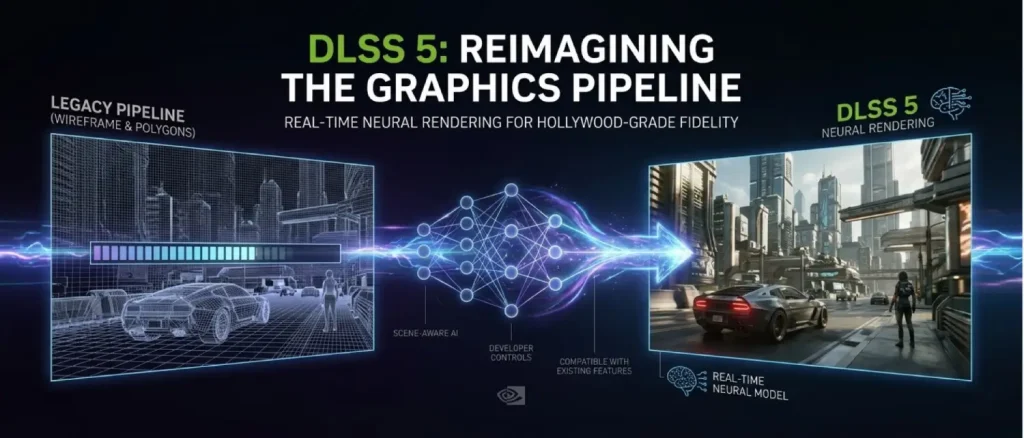
DLSS 5 introduces an architectural approach Nvidia calls “3D-Guided Neural Rendering.” It takes each frame’s color and motion vectors as input — the same structured data that the game engine produces, and uses a powerful AI model to infuse the scene with photoreal lighting and materials.
This approach solves a critical problem with traditional video AI models: unpredictability. Existing video AI models often run offline, are hard to control precisely, and generate bespoke content with every new prompt. For games, pixels must be deterministic, delivered in real time, and tightly grounded in the developer’s 3D world. By anchoring the AI model to color and motion vector data from the game engine, DLSS 5 keeps its output consistent and stable from frame to frame.[12][9]
The result runs in real time at up to 4K resolution for smooth, interactive gameplay.
The AI model at the heart of DLSS 5 is trained end-to-end to understand complex scene semantics, it can identify and differentiate between characters, hair, fabric, translucent skin, and environmental lighting conditions (front-lit, back-lit, or overcast) all from analyzing a single frame.
Using this deep understanding, DLSS 5 generates visually precise images, handling complex real-world rendering challenges:
Importantly, DLSS 5 retains the structure and semantics of the original scene, artistic stylistic choices made by developers are preserved, while the visual fidelity is dramatically elevated.
It is important to note that DLSS 5 is not a fully AI-generated image from scratch. Rather, it is a hybrid overlay, the AI model generates an additional rendering buffer on top of the game engine’s output, adding photorealistic detail without requiring changes to the underlying geometry. The game engine still provides the structural 3D foundation (geometry, depth, physics), while the AI provides the visual fidelity layer on top.
One of DLSS 5 most important features for the game development community is its granular artist controls. Developers receive detailed controls for:
This is critical because different game art styles require very different optimization. A hyper-realistic title like Resident Evil Requiem will need different settings than a cel-shaded or stylized game. DLSS 5 respects these differences and gives developers full creative authority over the final look.
Integration is seamless, DLSS 5 uses the same NVIDIA Streamline framework already used by existing DLSS and Nvidia Reflex technologies, meaning developers can adopt it without overhauling their pipeline.
Nvidia has already secured support from some of the industry’s biggest publishers and studios. DLSS 5 is confirmed for the following games:
| Game | Developer/Publisher |
| Resident Evil Requiem | CAPCOM |
| Hogwarts Legacy | Warner Bros. Games |
| Assassin’s Creed Shadows | Ubisoft |
| Starfield | Bethesda |
| The Elder Scrolls IV: Oblivion Remastered | Bethesda |
| Black State | — |
| CINDER CITY | — |
| Delta Force | — |
| NARAKA: BLADEPOINT | NetEase |
| AION 2 | NCSOFT |
| Phantom Blade Zero | S-GAME |
| Justice | — |
| Where Winds Meet | — |
| NTE: Neverness to Everness | — |
| Sea of Remnants | — |
CAPCOM executive producer Jun Takeuchi expressed enthusiasm: “At CAPCOM, we strive to create experiences that feel cinematic, compelling and deeply believable, where every shadow, texture and ray of light is crafted with intention. DLSS 5 represents another important step in pushing visual fidelity forward.”
At its GTC 2026 debut, the live demonstration of DLSS 5 was powered by two GeForce RTX 5090 GPUs running in parallel — one handling game rendering and the other dedicated to executing the DLSS 5 AI model. However, Nvidia has confirmed that the final shipping version of DLSS 5 will be optimized to run on a single GPU.
Specific GPU requirements are still being finalized and will be announced closer to the Fall 2026 launch date. Given the computational demands of the technology, it is expected to target the GeForce RTX 50 Series as a primary platform, with the RTX 5090 likely delivering the best experience at the high end.
DLSS 5 is also confirmed to be compatible and complementary with existing DLSS technologies: Super Resolution, Ray Reconstruction, Frame Generation, and Multi Frame Generation can all work alongside DLSS 5’s neural rendering layer.
Beyond Gaming: Wider Industry Applications
Nvidia’s vision for DLSS 5 extends well beyond PC gaming. The company intends for the neural rendering approach to be adopted across:
The technology effectively bridges the gap between real-time rendering (constrained to a 16-millisecond frame budget) and offline VFX rendering (which can take minutes to hours per frame). Nvidia argues that brute-force compute alone can never close this gap, but AI neural rendering can.
DLSS 5 represents a fundamental shift in how game visuals are produced. Historically, graphical realism required exponential increases in raw GPU compute, more polygons, more ray-traced light bounces, and higher-resolution textures. DLSS 5 introduces a new axis of improvement: AI-generated visual quality that is decoupled from the raw polygon and rendering budget.
This could democratize high-fidelity visuals. Games that lack full path-tracing support can still achieve substantially improved visual realism simply by leveraging DLSS 5 neural rendering pass.
DLSS 5 puts pressure on AMD’s FidelityFX Super Resolution (FSR) and Intel’s XeSS technologies, which have primarily focused on upscaling and performance, not photorealistic material generation. Nvidia is staking out territory that competitors have not yet entered: generative AI at the rendering level, not just pixel reconstruction.
Some analysts and gamers have flagged legitimate concerns about the technology:[19]
Nvidia acknowledges that DLSS 5 is still a work in progress ahead of its Fall 2026 launch, and early demos are not representative of the final quality and performance.
DLSS 5 is not merely an incremental upgrade; it is a reimagining of the computer graphics pipeline. By injecting a real-time neural rendering model directly into the frame, Nvidia is bringing Hollywood-grade visual fidelity to interactive, real-time gaming for the first time. The technology’s scene-awareness, developer controls, and compatibility with existing DLSS features position it as a potentially transformative standard for the next generation of gaming.
With support from major publishers including Bethesda, CAPCOM, Ubisoft, Tencent, and Warner Bros., and a launch lineup spanning some of gaming’s most visually ambitious titles, DLSS 5 is poised to redefine what photorealism means in interactive entertainment when it arrives in Fall 2026.
This video is sourced from the official IGN YouTube channel.

Hassan Tahir wrote this article, drawing on his experience to clarify WordPress concepts and enhance developer understanding. Through his work, he aims to help both beginners and professionals refine their skills and tackle WordPress projects with greater confidence.





 Lifetime VPS Europe
 Lifetime VPS Asia
 Lifetime WooCommerce Hosting
 Lifetime Hosting
 France Lifetime Dedicated Servers
 Germany Lifetime dedicated servers
 Lifetime Game Dedicated Servers
 Chicago, US
 Tokyo, Japan
 Singapore
 Hong Kong
 Seoul, South Korea
 Amsterdem, Netherlands
 London, UK
 Stockholm, Sweden
 Oslo, Norway
 Vienna, Austria
 Zurich, Switzerland
 Sydney, Australia
 Wordpress Hosting
 VPS Hosting
 DDOS Protection
 Submit Ticket
 Full Management
 Guides
 Videos and Podcasts
 Discover Creative Ideas
 MetaAgentOS High-Ticket Support System
 Voxfor Mega Menu
 Voxfor Advanced Price Management For WooCommerce
 Voxfor Secure Live Chat and AI Support
 Voxfor Multilanguage
 Voxfor AI Content Summary


