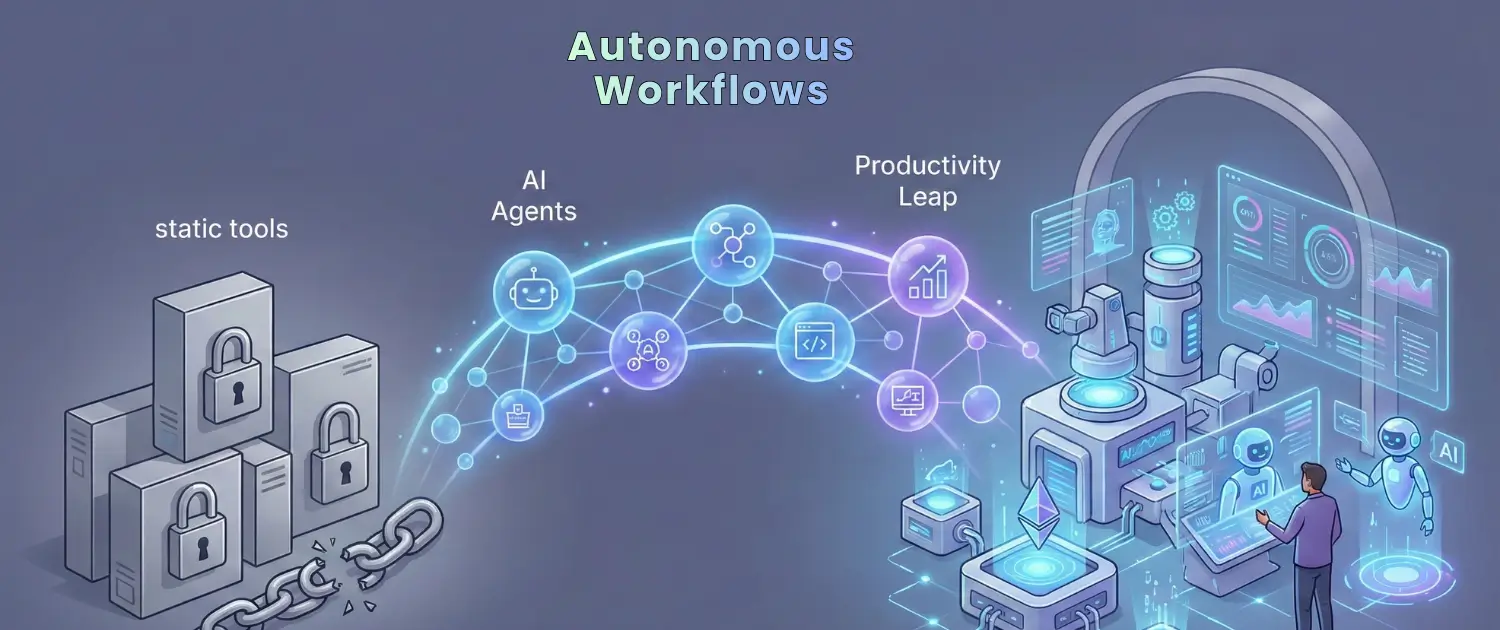
The software industry is going through a massive makeover. For about twenty years, the main way companies bought and used technology was through “Software-as-a-Service” (SaaS).
This setup worked on a simple idea: software was just a tool that sat there until a human used it to get work done. Because of that, companies paid for software based on “seats”, meaning they paid for the number of employees who logged in.
By the start of 2026, this old way of thinking started to fall apart. Experts now believe the entire software business is being completely restarted.
The main reason for this change is that software is moving from simply following orders to actually doing work on its own.
In the past, software was “reactive,” meaning it could only automate small, repetitive tasks. Now, we are entering the era of “autonomous agents.” These are systems that can understand a big goal, figure out the steps needed to reach it, and finish the job without a person watching over their shoulder every minute.
Advanced AI models such as Claude Opus 4.6 marked the peak of this change. This is what AI received that allowed it to act as a teammate rather than merely a helpful assistant. With the swift adoption of these systems by companies in all places, the definition of software is evolving: it is no longer a tool that people use, but a service that does it for them.
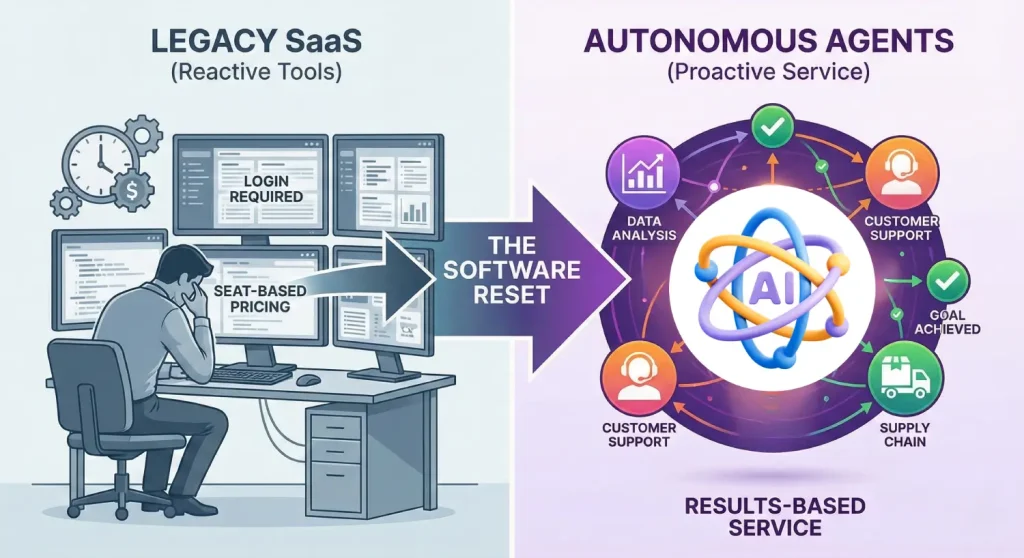
In early February 2026, the stock market sent a clear message: the old way of selling software is over.
In just one day of trading, companies that sell cloud software lost about $300 billion in total value. This wasn’t just a normal dip in the market; it was a specific thumbs-down from investors toward the old “pay-per-seat” business model. Big-name companies like Salesforce, Adobe, and Workday saw their stock prices tumble, and Intuit dropped by almost 11%.
The core of this crisis lies in a phenomenon market analysts call the “Great Unwinding” of software valuations. For years, investors paid high premiums for software companies because their revenue was viewed as durable and recurring. The logic was simple: as a company grew and hired more people, it bought more software licenses. However, the rise of autonomous systems broke this correlation. If an autonomous agent can perform the cognitive labor of five human employees, a company no longer needs five software licenses; it needs one autonomous system and the computing power to run it.
| Metric | Traditional Software Model (Pre-2025) | Autonomous Software Era (2026+) |
| Primary Value Driver | Seat Count / User Licenses | Outcomes / Results Achieved |
| Revenue Growth Engine | Headcount Expansion | Efficiency and Task Volume |
| Switching Costs | High (Due to human training) | Low (Agents adapt to any UI/API) |
| Average Forward Multiple | 39x | 21x |
| Market Focus | Virtualized Workflow | Physical Backbone (Power/Hardware) |
This economic shift is fueled by the realization that “growth durability” is now a liability for legacy vendors. The moats they built, consisting of complex interfaces, proprietary data formats, and steep learning curves, are being bypassed by agents that can navigate any user interface or communicate directly via API. The “app layer” is becoming redundant as users find they can interact with raw data through natural language models rather than specialized, expensive software interfaces.
The transition to autonomous workflows was technically enabled by a series of leaps in artificial intelligence capabilities. The launch of Claude Opus 4.6, represented a defining moment in this progression. Unlike previous models that functioned as reactive chatbots, Opus 4.6 was designed specifically to power “agentic workflows“, complex, long-running processes where the AI acts as an independent decision-maker.
| Benchmark | Capability Measured | Opus 4.6 Score | Previous Model (Opus 4.5) |
| Terminal-Bench 2.0 | Agentic Coding in Terminal | 65.4% | 59.8% |
| OSWorld | Agentic Computer Use | 72.7% | 66.3% |
| SWE-bench Verified | Independent Software Engineering | 80.8% | N/A |
| GDPval-AA | Professional Knowledge Work | +144 Elo Points | Base |
These scores demonstrate that Opus 4.6 is particularly adept at diagnosing complex bugs, navigating real-world interfaces, and performing expert-level reasoning in finance and law. It outperforms competitors such as GPT-5.2 and Gemini 3 Pro in multi-step agentic search and deep reasoning.
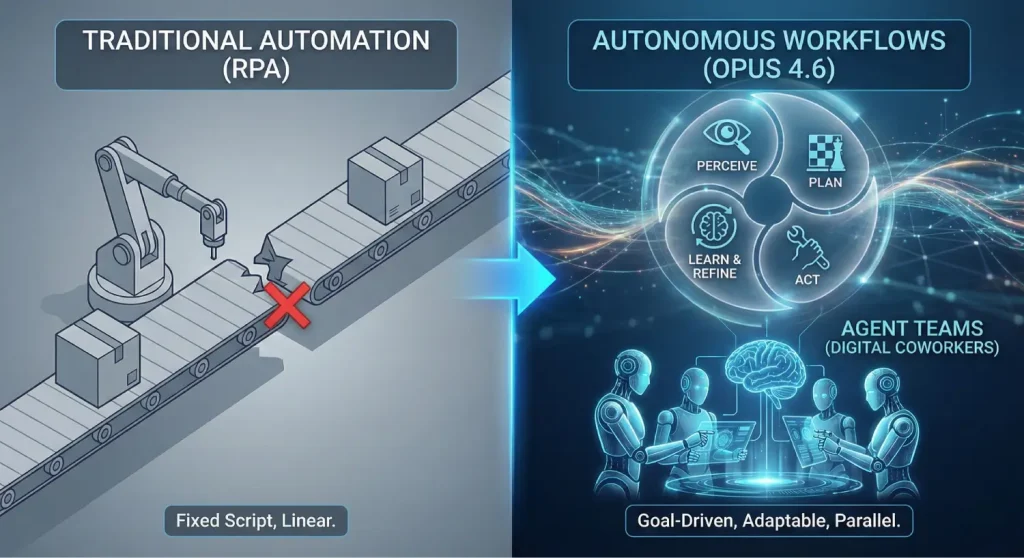
To understand why this is a revolutionary shift rather than just an improvement in automation, one must look at the difference between traditional software automation and autonomous workflows. Traditional automation, often referred to as Robotic Process Automation (RPA), follows a linear, rule-based approach. It is rigid and requires humans to define every “if-this-then-that” scenario upfront. If a website changes its layout or a vendor sends a document in a new format, traditional automation breaks.
Autonomous workflows, by contrast, are goal-driven and adaptable. They do not follow a fixed script; instead, they operate on a continuous loop of perceiving their environment, reasoning through options, and taking action to reach a designated goal.
This loop allows the software to function as a “digital coworker” rather than a passive tool. While traditional automation handles routine tasks, autonomous workflows manage complexity and ambiguity, making decisions that previously required human judgment.
The next important innovation in Opus 4.6 is the support of the so-called Agent Teams. The system will be able to spin up numerous independent agents to work concurrently rather than having one AI attempt to do all the tasks. An example in a software development environment could be the case of one “Lead Agent” managing a “Frontend Agent,” a “Backend Agent,” and a “Database Agent”. These agents not only communicate with one another but also share insights and correct one another, which makes the work much more reliable and quicker.
As the core value of software shifts from providing a tool to performing a service, the way software is sold is undergoing a radical change. This is the transition to “Service-as-Software” (SaS). In this model, the customer pays for the result, not the access.
| Pricing Model | Description | Simple Analogy |
| Seat-Based | Pay per user who has login access. | A gym membership you pay for even if you don’t go. |
| Usage-Based | Pay per action or unit of data (tokens/credits). | A utility bill is based on how much water or electricity you use. |
| Outcome-Based | Pay only for a specific, successful result. | A personal trainer who only gets paid when you lose 10 pounds. |
The “Outcome-Based” model is the ultimate expression of the autonomous era. For example, Intercom “Fin” AI agent charges for every “resolved ticket” rather than charging for a support agent’s license. This model aligns the interests of the vendor and the customer: the vendor is incentivized to make the AI as efficient as possible, while the customer only pays when they see tangible value.
Industry leaders recognize that moving from seat-based pricing to outcome-based pricing is complex. Companies are taking two main paths:
Autonomous workflows are not a hypothetic vision in 2026 but are taking over big companies. The case studies in customer service, finance and operations depict the practical effect of this shift.
In the customer service sector, autonomous agents are moving beyond simple chatbots to handle 80% of common issues without human intervention.
Beyond customer-facing roles, autonomous workflows are optimizing the “back office” of large corporations.
The most surprising disruption is occurring in high-skill fields like law, finance, and engineering. Opus 4.6 ability to “think deeper” allows it to perform research that previously required human analysts.
As businesses delegate more authority to autonomous agents, they face a new set of risks. The very autonomy that makes these systems powerful also makes them difficult to control.
A critical emerging risk is “AI Identity Risk.” Unlike human employees who have clear onboarding and offboarding processes, AI agents are often created for specific tasks and then forgotten. These “orphaned” identities often retain broad permissions to access sensitive company data and systems. If an attacker compromises an AI agent, they can use its legitimate identity to move through the company’s network at machine speed.
Autonomous agents interact with real systems, making them targets for new types of cyberattacks.
The complete dependence on autonomous systems will result in operational dependence. In case the AI system malfunctions or commits a major error, the business might not be in a position to correct the issue by human hands or redundancy. Moreover, agents may sound very confident in cases when they are absolutely wrong, which creates a gap in transparency, such that it is hard to audit why this or that decision was taken by humans.
| Risk Type | Description | Mitigation Strategy |
| Identity Risk | Orphaned agents with active system permissions. | Implement strict AI identity lifecycle management. |
| Security Risk | Prompt injection and data breaches. | Use “Zero Trust” protocols and data encryption. |
| Operational Risk | Total dependence on AI without human backup. | Maintain human-in-the-loop for high-stakes decisions. |
| Governance Risk | Lack of accountability for AI-led errors. | Use platforms that provide a complete audit trail of AI reasoning. |
The transition to autonomous workflows requires more than just new technology; it requires a new way of managing work. To succeed, organizations are adopting a “Hierarchical Orchestration” approach to manage high-intelligence agents like Opus 4.6.
As autonomous agents take over the “doing” of tasks, the value of human employees is moving to “defining and managing.” Skills based on operating complex software (like knowing how to use a specific ERP or CRM system) are losing value. The new premium is on:
The “Big 2026 Sector Rotation” marks a permanent shift in the technological landscape. The era where software was a static tool is ending, replaced by an era of autonomous agency. While this disruption is painful for legacy software companies that rely on seat-based revenue, it represents a massive leap in productivity for the businesses that adopt it.
The launch of Claude Opus 4.6 (released February 5, 2026) has provided the technical foundation for this shift, offering the reasoning depth, memory, and autonomous coordination needed to handle the most complex enterprise workflows. However, the journey to a fully autonomous future requires careful management of security risks and a fundamental rethink of how we value and price software.
The companies in the Post-App Era will be the ones that are most efficient in organizing autonomous agents to provide real-life results, rather than the most complex ones. The next generation of SaaS is no longer the ability to provide a login, but rather provide the service itself, autonomously. The organizations that adjust to this change and see AI not as the new threat to their jobs, but as a worker-less, professional-level partner, will be the ones that will make the decade of digital history.

Hassan Tahir wrote this article, drawing on his experience to clarify WordPress concepts and enhance developer understanding. Through his work, he aims to help both beginners and professionals refine their skills and tackle WordPress projects with greater confidence.





 Lifetime VPS Europe
 Lifetime VPS Asia
 Lifetime WooCommerce Hosting
 Lifetime Hosting
 France Lifetime Dedicated Servers
 Germany Lifetime dedicated servers
 Lifetime Game Dedicated Servers
 Chicago, US
 Tokyo, Japan
 Singapore
 Hong Kong
 Seoul, South Korea
 Amsterdem, Netherlands
 London, UK
 Stockholm, Sweden
 Oslo, Norway
 Vienna, Austria
 Zurich, Switzerland
 Sydney, Australia
 Wordpress Hosting
 VPS Hosting
 DDOS Protection
 Submit Ticket
 Full Management
 Guides
 Videos and Podcasts
 Discover Creative Ideas
 MetaAgentOS High-Ticket Support System
 Voxfor Mega Menu
 Voxfor Advanced Price Management For WooCommerce
 Voxfor Secure Live Chat and AI Support
 Voxfor Multilanguage
 Voxfor AI Content Summary


