
SEO-friendly URLs are foundational to search visibility, yet less than 50% of websites use clean, readable URLs that search engines prefer. URLs containing keywords deliver 45% higher CTR than generic alternatives, while pages with 3-5 word slugs (25-30 characters) rank higher across 11.8 million search results. Understanding URL structure separates high-performing sites from those squandering ranking potential.
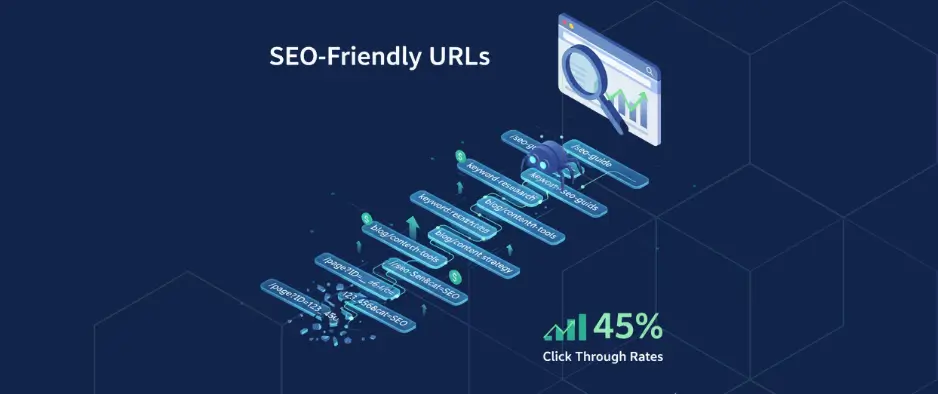
Search engines use URLs to understand page content and context, with well-structured URLs signaling relevance and trustworthiness. URLs matching search queries earn 45% higher CTR, as documented, a direct correlation between URL optimization and user clicks.
Users rely on URLs as trust signals; complex, unclear URLs reduce credibility and sharing likelihood. In 2025, URL clarity matters even more for AI and generative search systems interpreting content relevance.
Keep URLs Short and Descriptive: Aim for 50-60 characters maximum, focusing on clarity over length. Pages with short slugs (3-5 meaningful words, 25-30 characters) rank slightly higher across 11.8 million SERPs.
Example:
Good: /seo-friendly-urls
Avoid: /page?id=12345&category=seo&sort=relevance
Incorporate Relevant Keywords Naturally: Including primary keywords in URLs signals relevance to search engines and improves indexing. Place the most important keywords near the URL beginning for maximum algorithmic emphasis. Yet keyword stuffing—using multiple keyword variations—appears spammy and invites penalties.
Use Hyphens, Not Underscores: Search engines recognize hyphens as word separators; underscores don’t separate words, making URLs harder to parse.
Example:
Good: /digital-marketing-strategy
Avoid: /digital_marketing_strategy
Maintain Lowercase Letters: Standardize URLs to lowercase, preventing case-sensitivity issues and duplicate content complications, as some servers treat uppercase and lowercase URLs differently.
Remove Stop Words: Common words like “and,” “the,” and “of” add minimal value but increase URL length.
Example:
Concise: /seo-guide
Lengthy: /the-complete-guide-to-seo
Follow Consistent Hierarchy: Organize URLs reflecting website structure, using 1-2 subdirectories maximum. Deeper URL structures provide no ranking benefit while cluttering crawl efficiency.
Example:
Structured: /blog/seo-tips
Cluttered: /resources/guides/seo/advanced/technical/implementationMinimize Dynamic Parameters: Static URLs outperform dynamic ones with query parameters. When dynamic URLs are necessary, limit parameters to two or fewer, more triggers warnings and harms crawlability.
Avoid Dates in URLs: Evergreen URLs without date references perform better in AI snippets and retain ranking value longer. Only include dates for time-sensitive content (events, yearly benchmarks) where temporal relevance matters.
Use Canonical Tags for Duplicates: When multiple URLs contain similar content, canonical tags indicate the preferred version, preventing duplicate content penalties. 25% of large sites have duplicate content issues without proper canonical implementation, diluting rankings across variations.
Implement Proper 301 Redirects: When changing URLs, use 301 permanent redirects transferring link equity from old→new URLs. Without proper redirects, sites lose rankings and create frustrating 404 errors for users.
Use HTTPS for Security: Secure HTTPS connections improve trust signals and SEO rankings. Chrome users now spend 93.2% of their browsing time on secure HTTPS sites.
SEMrush analysis of competing sites reveals that precise keyword usage, URL clarity, and content relevance, not just domain authority, determine rankings.
Top Performers:
Lower Performers:
Excessive Subdirectories: Deeper paths confuse both users and crawlers. Stay within 1-2 subfolders maximum.
Missing 301 Redirects: URL changes without redirects lose link equity and create broken links, damaging user experience.
Unoptimized Special Characters: Symbols like &, %, and $ complicate URLs, confusing both users and search engines.
Duplicate Content Without Canonicals: Multiple URL versions dilute authority. Implement canonicals immediately.
Keyword Stuffing: Overloading URLs with keywords appears manipulative, potentially inviting penalties.
Audit your URL structure using Google Search Console and SEO tools, identifying issues like broken redirects, excessive parameters, and keyword opportunities. Track CTR improvements in GSC after URL optimization, monitoring whether keyword-inclusive URLs outperform generic versions.
SEO-friendly URLs are non-negotiable for 2025 success. With keyword-inclusive URLs delivering 45% higher CTR, short slugs ranking higher across 11.8 million SERPs, and less than 50% of sites optimizing properly, the opportunity is enormous.
Create short, descriptive URLs with relevant keywords, use hyphens for word separation, maintain lowercase consistency, remove stop words, and implement proper canonicals and redirects. The URL foundation you build today compounds into sustained ranking advantages and superior user experience.





 Lifetime VPS Europe
 Lifetime VPS Asia
 Lifetime WooCommerce Hosting
 Lifetime Hosting
 France Lifetime Dedicated Servers
 Germany Lifetime dedicated servers
 Lifetime Game Dedicated Servers
 Chicago, US
 Tokyo, Japan
 Singapore
 Hong Kong
 Seoul, South Korea
 Amsterdem, Netherlands
 London, UK
 Stockholm, Sweden
 Oslo, Norway
 Vienna, Austria
 Zurich, Switzerland
 Sydney, Australia
 Wordpress Hosting
 VPS Hosting
 DDOS Protection
 Submit Ticket
 Full Management
 Guides
 Videos and Podcasts
 Discover Creative Ideas
 MetaAgentOS High-Ticket Support System
 Voxfor Mega Menu
 Voxfor Advanced Price Management For WooCommerce
 Voxfor Secure Live Chat and AI Support
 Voxfor Multilanguage
 Voxfor AI Content Summary


