
- Lifetime Solutions
VPS SSD:
Lifetime Hosting:
DEDICATED SERVERS:
- VPS Locations
- Managed Services
- Support
- WP Plugins
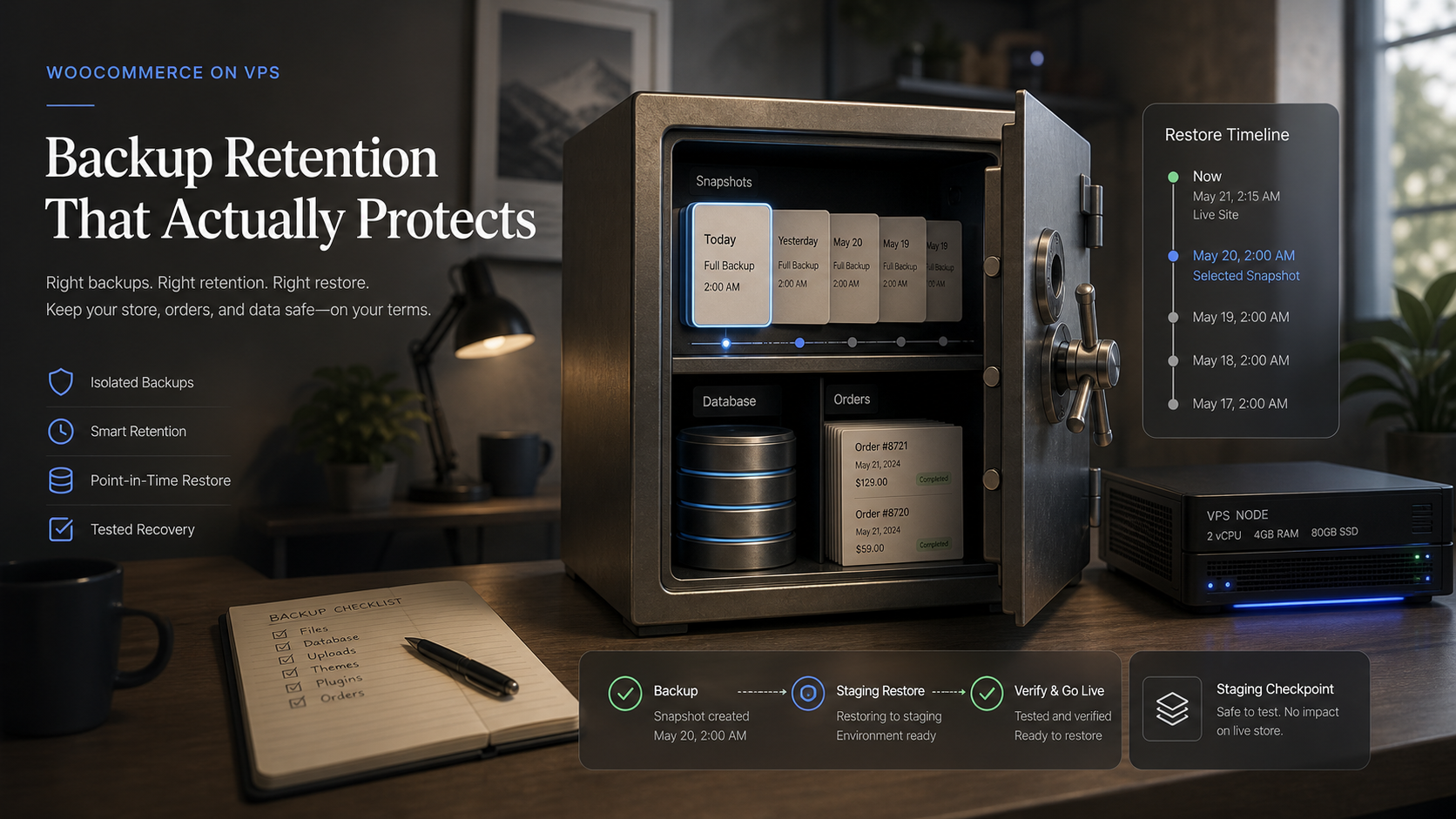
WooCommerce backups need more planning than ordinary WordPress backups because every restore can affect live orders, payments, stock changes, coupons, customer accounts and scheduled actions. A VPS gives a store more control over files, databases, snapshots and off-server copies, but that control only helps when retention and restore rules are written before something breaks.
This guide focuses on a practical backup policy for WooCommerce stores on VPS infrastructure: what to back up, how long to keep it, when snapshots are not enough, and how to test restore without overwriting fresh orders. Retention matters because it defines the store’s real order-loss window.
For WooCommerce on a VPS, keep database backups frequent, file backups separate, and at least one off-server copy outside the VPS. Small stores can start with daily database backups and weekly full-file backups. Busy stores need hourly or real-time order protection. A WooCommerce hosting environment should also include a tested restore path, not only a folder full of backup files.
A brochure WordPress site can often be restored from last night without much business damage. A WooCommerce store is different. New orders, payment status changes, customer registrations, coupon usage, product stock and refunds may arrive after the backup timestamp.
That means a restore is not just a technical action. It is an order-history decision. Restoring an old database over a live store can remove paid orders that already happened. Restoring only files can leave plugin code and database schema out of sync. Restoring only selected tables can break relationships if HPOS order tables, custom checkout plugins or subscription tools are involved.
Good retention answers three questions:
Those questions are the reason this article belongs in WooCommerce and VPS operations, not only in a generic backup category.
Voxfor already has guides around cPanel backup restore, WooCommerce hosting and VPS hosting. This article has a narrower job: build a retention policy for stores where orders matter.
| Existing topic | Main question | This article adds |
|---|---|---|
| cPanel backup restore | How do I restore a backup from the panel? | When restore is risky for WooCommerce orders |
| WooCommerce hosting | What stack supports online stores? | Backup cadence, retention and order-safe recovery |
| VPS hosting | What server gives control? | How snapshots, database exports and off-server copies work together |
| Migration guides | How do I move a site? | Why backup testing is different from migration |
That distinction keeps the article from repeating a generic restore tutorial.
A real backup plan has more than one layer. Each layer solves a different failure.
| Layer | Protects against | Retention starting point |
|---|---|---|
| VPS snapshot | Server-wide failure, bad update, broken packages | 3-7 daily snapshots where available |
| Database export | Lost orders, product edits, settings, HPOS tables | Daily for small stores, hourly for active stores |
| File archive | Uploads, themes, plugins, custom code | Weekly full copy plus daily changed files |
| Off-server copy | VPS disk loss or account-level mistake | Keep at least 2 recent copies outside the VPS |
| Staging restore | Backup corruption or incomplete restore path | Test after major changes and monthly for active stores |
Snapshots are useful, but they should not be the only safety net. A snapshot can restore the entire machine, while a database export can help inspect order tables without rolling back the full server.
Backup frequency should follow business risk, not habit.
| Store activity | Database cadence | File cadence | Notes |
|---|---|---|---|
| Few orders per week | Daily | Weekly full + changed files | Good starting point for small stores |
| Daily orders | Every 6-12 hours | Weekly full + daily changed files | Review order loss window before updates |
| Campaign or sale period | Hourly or real-time | Daily changed files | Do not rely on yesterday’s database |
| Subscription or booking store | Hourly or real-time | Daily changed files | Renewals and bookings change constantly |
| Agency-managed store | Policy per client | Policy per client | Document owner approval and restore contact |
Order volume is only one factor. A low-order store with expensive products may need tighter protection than a high-traffic store with low-value test orders.
Commands below are examples for planning and testing. Adjust paths, database names and users for the real server. Do not paste production credentials into shell history.
Create a dated backup folder:
sudo mkdir -p /opt/store-backups/$(date +%F)
sudo chmod 750 /opt/store-backups
Export the WordPress database with WP-CLI:
cd /home/example/public_html
wp db export /opt/store-backups/$(date +%F)/store-db.sql --add-drop-table
Archive uploads and custom code separately:
tar -czf /opt/store-backups/$(date +%F)/wp-content.tar.gz wp-contentCheck an off-server sync before copying:
rsync -avz --dry-run /opt/store-backups/ backup-user@backup-host:/backups/store/Keep cleanup rules conservative:
find /opt/store-backups -type f -name "*.sql" -mtime +30 -printUse -print first. Delete only after confirming the retention policy and off-server copies.
Restoring WooCommerce is where mistakes happen. A full database restore can remove orders created after the backup. Before any restore, decide whether the problem is a file issue, a plugin issue, a database issue or a full-server issue.
Use this decision path:
| Problem | Safer first move | Why |
|---|---|---|
| Broken plugin update | Restore plugin files or roll back plugin | Avoids touching orders |
| Theme change broke layout | Restore theme files or staging copy | Database may be fine |
| Product data corrupted | Restore selected data on staging first | Product/order links may be affected |
| Malware or unknown compromise | Full investigation and clean restore plan | Fresh orders and backdoors both matter |
| VPS disk failure | Snapshot or full backup restore | Server-level recovery is needed |
For database work, restore into staging first:
mysql staging_db < /opt/store-backups/2026-08-02/store-db.sqlThen inspect orders, HPOS tables, product data and plugin tables before touching production. If the live store accepted orders after the backup, plan how those orders will be preserved, exported, replayed or manually reconciled.
WooCommerce’s own backup guidance is useful because it explains why real-time backups reduce order-loss risk. WordPress.com’s selective restore documentation is also helpful when thinking about WooCommerce tables that should not be overwritten casually.
VPS control matters because the store owner or operator can separate backup jobs from the application itself. A VPS hosting plan can support snapshot scheduling, local staging restores, off-server syncs, log review and isolated backup users.
That does not mean every store should self-manage everything. Stores that cannot test restores, rotate access, monitor disk space or respond during incidents may need managed hosting services instead of a purely DIY setup.
For panel-based restores, Voxfor’s guide on how to restore a backup in cPanel is useful. For WooCommerce, use that path carefully and confirm whether the restore touches the live database.
A backup policy does not guarantee a clean recovery every time. It reduces uncertainty. Payment gateways, subscription plugins, HPOS tables, stock sync tools and shipping integrations can all create extra restore work.
Two limits should stay visible:
Good stores keep restore notes, not only backup files. Record where backups live, who can restore, which tables are sensitive, what the order-loss window is and who approves production recovery.
Start by writing a simple retention rule for the store: database cadence, file cadence, off-server destination, snapshot window, restore test schedule and order-preservation rule. Then test one staging restore before trusting the plan during a real incident.
Small stores can start with daily database backups. Stores with daily orders should consider every 6-12 hours, and busy stores may need hourly or real-time order protection.
Snapshots are useful, but they are not enough by themselves. WooCommerce also needs database exports, file copies, off-server storage and a tested restore path.
Yes. Restoring an older database can remove orders, refunds, stock changes and customer records created after the backup timestamp.
Test the backup on staging, inspect order tables, confirm plugin compatibility, check files and database together, and decide how newer orders will be preserved.
Local backups are convenient for quick restore, but at least one copy should live off-server so a VPS disk or account issue does not remove every backup.
Use managed help when the store cannot safely test restores, monitor backup jobs, protect credentials or recover during a revenue-impacting incident.




 Lifetime VPS Europe
 Lifetime VPS Asia
 Lifetime WooCommerce Hosting
 Lifetime Hosting
 Lifetime Game Dedicated Servers
 Chicago, US
 Tokyo, Japan
 Singapore
 Hong Kong
 Seoul, South Korea
 Amsterdem, Netherlands
 London, UK
 Stockholm, Sweden
 Oslo, Norway
 Vienna, Austria
 Zurich, Switzerland
 Sydney, Australia
 Wordpress Hosting
 VPS Hosting
 DDOS Protection
 Submit Ticket
 Full Management
 Guides
 Videos and Podcasts
 Discover Creative Ideas
 Voxfor Autonomous AI Workers
 Voxfor Mega Menu
 Voxfor Advanced Price Management For WooCommerce
 Voxfor Secure Live Chat and AI Support
 Voxfor Multilanguage
 Voxfor AI Content Summary
 Voxfor Autopilot