 Lifetime VPS Europe
 Lifetime VPS Asia
 Lifetime WooCommerce Hosting
 Lifetime Hosting
 Lifetime Game Dedicated Servers
 Chicago, US
 Tokyo, Japan
 Singapore
 Hong Kong
 Seoul, South Korea
 Amsterdem, Netherlands
 London, UK
 Stockholm, Sweden
 Oslo, Norway
 Vienna, Austria
 Zurich, Switzerland
 Sydney, Australia
 Wordpress Hosting
 VPS Hosting
 DDOS Protection
 Submit Ticket
 Full Management
 Guides
 Videos and Podcasts
 Discover Creative Ideas
 Cybersecurity Services
 Voxfor Mega Menu
 Voxfor Advanced Price Management For WooCommerce
 Voxfor Secure Live Chat and AI Support
 Voxfor Multilanguage
 Voxfor AI Content Summary
 Voxfor Autopilot
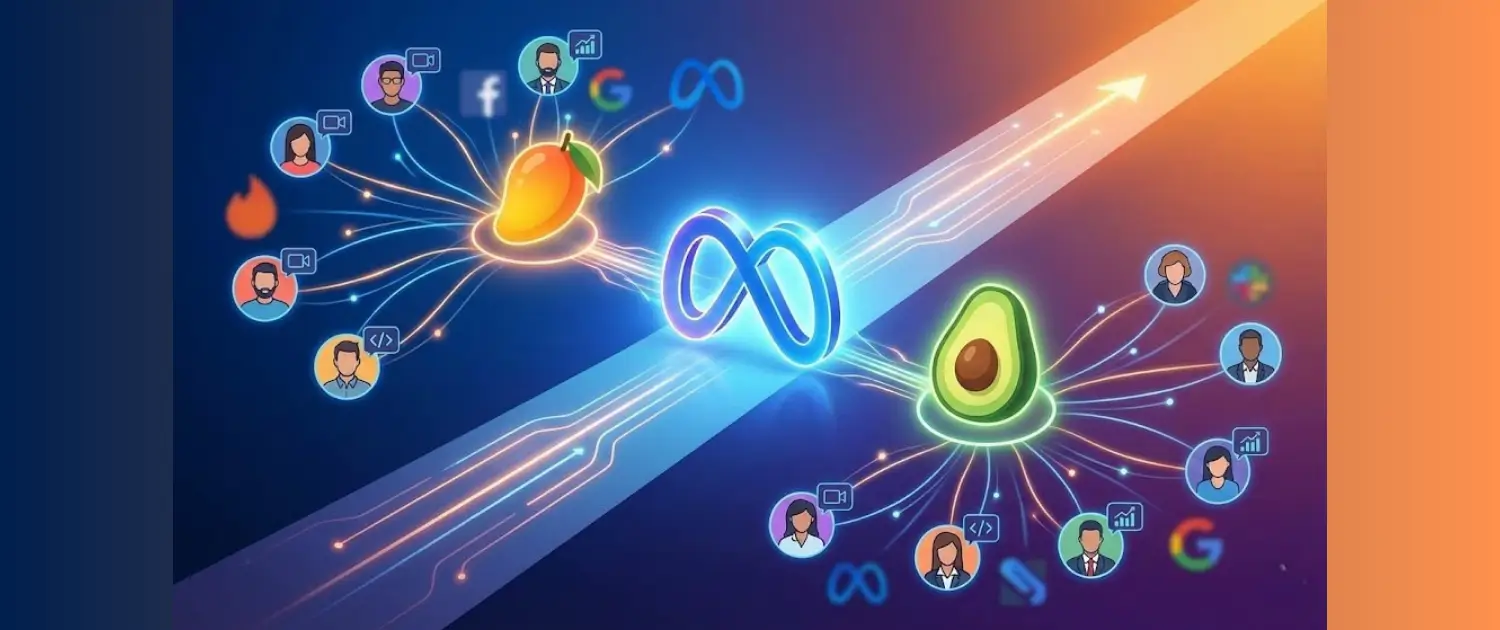
In what it has described as a pivot move to reestablish itself in a competitive AI environment in which it has lost its lead to OpenAI and Google, Meta Platforms has announced plans to roll out two new artificial intelligence models, codenamed “Mango” and “Avocado” during the first half of 2026. The announcement was shared in an internal question-answer session on December 18, 2025, and it indicates that Meta is intent on making an aggressive new direction with advanced multimodal capabilities, world models, and improved coding performance.
AI project hosting
Build and host your next AI-powered web project on Voxfor VPS
AI model news is exciting, but real value comes from testing ideas in live apps. Voxfor VPS gives developers dedicated resources for prototypes, APIs, dashboards, and AI-assisted web projects.
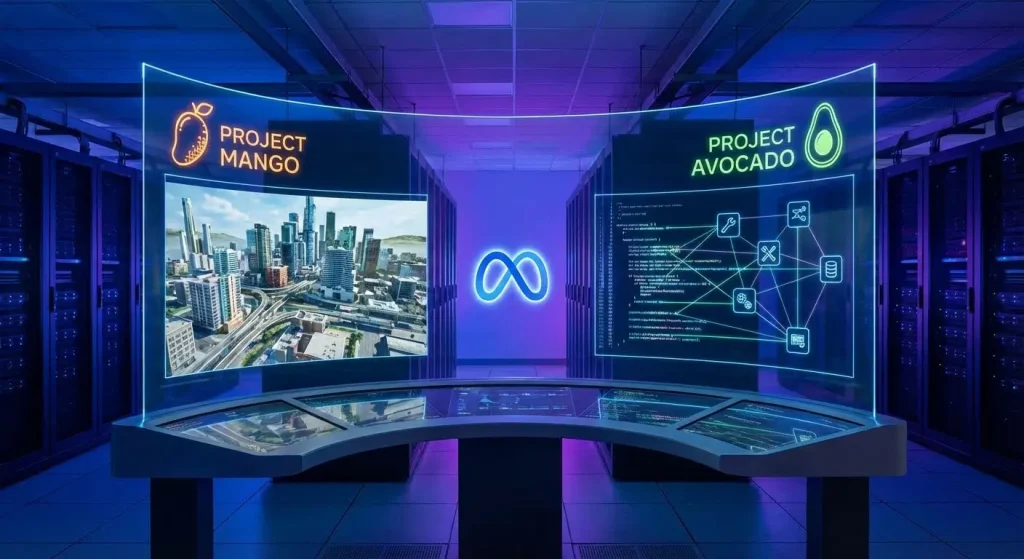
Alexandr Wang, the Meta Chief AI Officer, and Chris Cox, the Chief Product Officer, presented the company’s further roadmap to the staff. As described in various reports based on participants of the internal Q&A, Mango is the next-generation image and video generation model at Meta. In contrast, Avocadofocuses on the code and tool orchestration. This two-model strategy is an indication of the faith that Meta has in an overall AI strategy, aimed at solving multiple fields at once.
The Strategic Necessity Behind Mango and Avocado
Meta announcement arrives at a critical juncture for the company. After years of pouring billions into AI research and infrastructure, the social media giant has struggled to produce commercially viable AI products that can compete with the rapid innovation cycles of OpenAI and Google. The company previous-generation Llama models, while achieving impressive technical benchmarks and garnering over 650 million downloads, failed to capture significant enterprise adoption or establish Meta as a dominant force in consumer-facing AI applications. Meanwhile, OpenAI ChatGPT continues to set the standard for generative AI assistants, and Google’s Gemini family maintains steady improvement across multiple domains.
The move to make Mango and Avocado proprietary and closed-source models is a radical difference from Meta historical releases as open-source. Although Llama was put out in the open to create goodwill with the developers, Mango and Avocado will not be released immediately to the public, and Meta will seek to build competitive advantages before wide distribution.
This pivot coincides with Meta structural reorganization under Meta Superintelligence Labs (MSL), led by Alexandr Wang.Wang joined Meta as Chief AI Officer following Meta unprecedented $14.3 billion investment in Scale AI, repositioning the 28-year-old entrepreneur as the company’s most influential AI figure. According to Zuckerberg’s internal memo, Wang is “the most impressive founder of his generation” with “a clear sense of the historic importance of superintelligence.
Mango: Reimagining Visual Content Generation
Mango is the overall reaction of Meta to the competitive risk that is offered by the OpenAI viral Sora 2 video-generating application, which had exceeded one million iOS downloads in five days after its September 2025 release. Mango has been designed to support high-fidelity image generation, longer video generation and text-to-video synthesis; video-to-video transformation and frame and scene-level fine-grained editing, according to people with knowledge about the model development.
The technical ambitions for Mango extend beyond simple content synthesis. The model is designed to incorporate “world models”, advanced AI systems that develop internal representations of physical environments, object dynamics, and the laws of physics.Meta’s V-JEPA 2 model demonstrated these capabilities, operating30 times faster than Nvidia’s Cosmos, showing Meta has developed efficient approaches suitable for productization at scale.
In contrast to the traditional video generation models, which compose the plausible-looking sequences frame-by-frame, world models hope to comprehend the cause-and-effect relations, gravitational constraints, and persistence of objects in the long sequences. Assuming that they were fully integrated, these capabilities would be a major step forward in terms of what exists in the market today in consumer-facing video creation tools, since they would enable Mango to produce coherent and physically realistic videos of significantly longer length than are already supported by competitors.

In the case of Meta, the strategic effects of Mango go way beyond technological ability. The model will be used to drive more functionalities within the expansive ecosystem of social platforms, including Facebook, Instagram, and the Vibes feed that owns and operates Meta. The content creators will get the advanced video generation and editing features, which may reduce the time of content creation and improve user engagement. The inclusion of Mango as part of the ad platform at Meta may allow its advertisers to produce video content on a large scale, which may present the company with new opportunities to monetize.
Avocado: Advanced Language Models for the Agentic Era
Although Mango focuses on the creation of visual content, Avocado focuses on high-level language comprehension that is specially optimized to compile code and coordinate tools. Avocado is scheduled to reach in Q1 2026, although the model is already experiencing training and performance-testing difficulties.
The decision to create Avocado is a meta decision to develop an AI that would be viewed as having stronger industry acceptance of the next wave of AI capabilities beyond language generation, towards systems that are capable of planning, using tools and making complex multi-modal reasoning. The architecture behind Avocado proposes that it can be integrated with what insiders refer to as an underlying agentic stack, and therefore, the model can act as a planning and reasoning engine to break down complex tasks into subtasks and call on suitable tools.
Avocado focuses on the coding abilities and considers an evident market opportunity. The willingness to use AI-enhanced code generation tools has been extremely high among developers globally; this is shown by the fast adoption of GitHub Copilot. The strategy of specializing in Avocado to code synthesis and solving technical problems means that Meta can compete on mindshare with professional software developers and businesses who want to automate their software development processes.

Moreover, Avocado’s agentic capabilities would allow Meta to build more complex multi-model systems in which Avocado does planning and coordination, Mango deals with visual content generation, and dedicated modules deal with other tasks. Such systems would potentially automate content creation processes, producing storyboards based on a description by a user, visual content synthesis using Mango, and coordinating other secondary processing activities throughout the platform.
Leadership, Talent, and Internal Tensions
Meta’s announcement arrives against a backdrop of significant internal disruption. The company’s restructuring under Meta Superintelligence Labs has shifted organizational priorities toward near-term frontier model development at the expense of long-term exploratory research. The new superintelligence team includesformer GitHub CEO Nat Friedman and researchers poached from OpenAI, Anthropic, Google, and Apple, with compensation packages for some rumored to be north of $100 million.
Meta Avocado model is being worked on inside “TBD,” a smaller group within Meta Superintelligence Labs headed up by Chief AI Officer Alexandr Wang, who apparently favors closed models. This represents a fundamental strategic shift from Meta previous philosophy of open-source AI development.
However, the company has struggled with retention among talented researchers and engineers. Several researchers hired specifically for Meta Superintelligence Labs have departed after brief tenures, citing disagreements with strategic direction or concerns about research culture.According to sources familiar with the project, Avocado is wrestling with training-related performance testing as Meta tries to ensure the system will be competitive when it debuts. These departures raise fundamental questions about whether Meta can execute on its ambitious AI roadmap given ongoing organizational instability.
Competitive Positioning and Market Reality
Although Meta is technologically advanced and has enormous financial resources, the company starts the Mango-Avocado age far behind its main rivals in consumer penetration and business penetration. OpenAI continues to have significant strength in front-end product development, and ChatGPT is the standard of consumer AI assistants. Google has unmatched distribution reach in Search, Gmail, Android and YouTube and therefore is able to guarantee that Gemini gets direct exposure to billions of prospective users. Microsoft has built strong enterprise penetration through its collaboration with OpenAI and the implementation of Copilot into its productivity suite, which could not be easily copied by Meta.
Although open-source AI development has strengths that include using meta historical strength this has not delivered any notable commercial success or competitive edge at the edge. Llama models have been released in the open and have generated impressive download numbers. Nonetheless, these numbers lead one to forget that the particular proprietary models developed by OpenAI and Google are perceived to be of higher quality and gain much stronger mindshare among professional users and businesses.
The six-month development period and vast testing of Mango and Avocado before launching in the first half of 2026 will give Meta a chance to finish the development phase and prepare these two models. This tightened schedule is indicative of the haste and trust in the technical ability of Meta. But the chances of execution are high considering the recent talent loss and the organizational chaos that has typified AI activities at Meta in the course of 2025.
Looking Forward: Implications for Meta Future
The unveiling of Mango and Avocado represents Meta’s most significant strategic AI initiative since the Llama program. Success with these models could genuinely reset competitive dynamics in the industry, positioning Meta as a serious contender for leadership in multimodal AI, video generation, and agentic systems. Failure, by contrast, would likely reinforce perceptions of Meta as a company that, despite enormous financial resources, struggles to achieve technological leadership in rapidly evolving domains.
The ultimate test will not be measured in internal benchmark scores or technical papers, but in whether Mango and Avocado achieve meaningful adoption among creators, developers, and enterprises. Can Meta vast installed base of social platform users be activated to drive engagement with these new AI capabilities? Can Avocado’s coding optimization genuinely compete with GitHub Copilot and emerging alternatives? These questions will determine whether Meta’s Mango-Avocado initiative represents a genuine reset or merely another chapter in a series of ambitious but ultimately unsuccessful AI ventures.
What remains clear is that Meta moment of reckoning approaches. The company has invested extraordinary resources, restructured its entire AI organization, and accepted significant internal disruption to position itself for competitive success. Whether these investments yield the returns Meta seeks will shape not only the company’s future but the broader trajectory of the AI industry itself.
About Author

Netanel Siboni is a technology leader specializing in AI, cloud, and virtualization. As the founder of Voxfor, he has guided hundreds of projects in hosting, SaaS, and e-commerce with proven results. Connect with Netanel Siboni on LinkedIn to learn more or collaborate on future project.