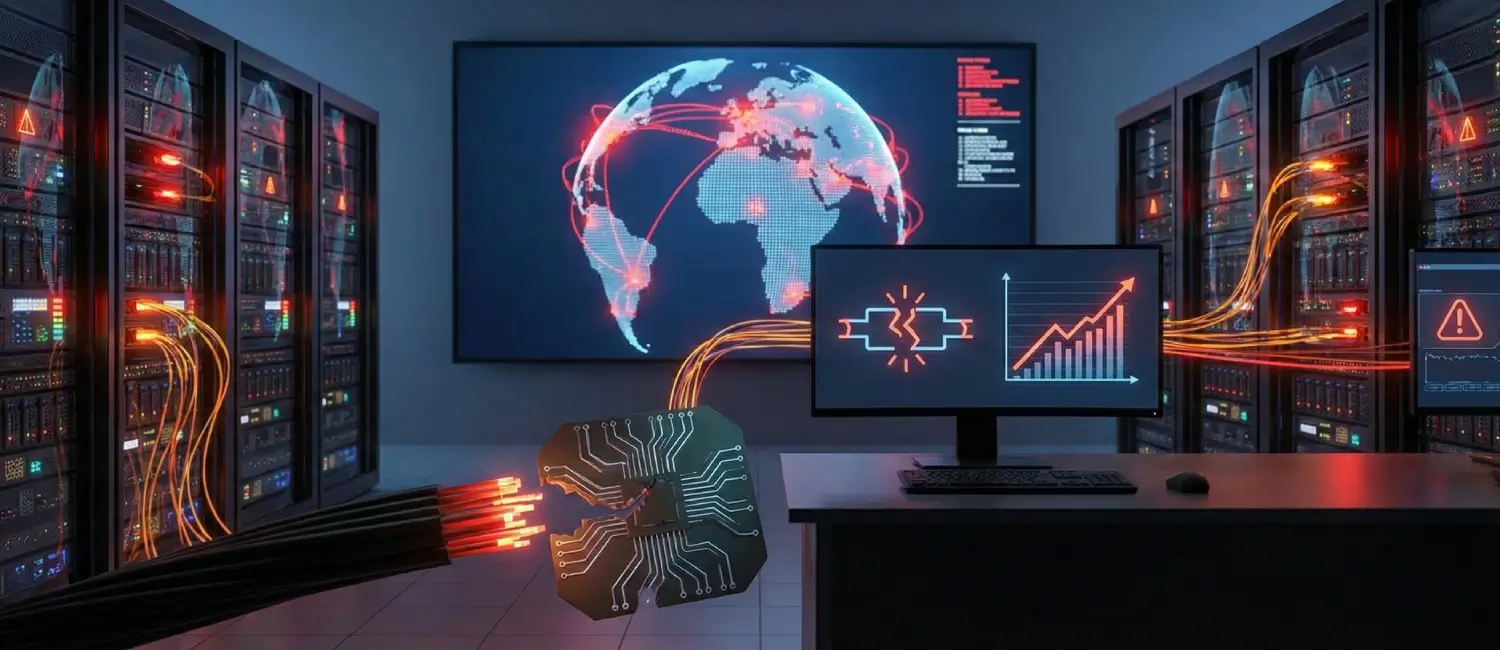
The trillion-dollar meltdown, the insecure vibe coding apps, the weekend MVPs that die on contact with real traffic, they all point to the same truth: generating code was never the hard part. Keeping systems alive in a hostile world is. And that skill just became the most valuable thing in tech.
Inbound Marketing Strategy
Helpful tutorials attract qualified visitors, but reliable hosting keeps those readers engaged. Voxfor VPS gives growing websites the speed, uptime, and control needed to support stronger inbound marketing campaigns.
In early February 2026, the software sector didn’t just wobble, it flinched.
A sharp selloff hit U.S. software and services stocks. In about a week, the S&P 500 Software & Services Index fell roughly 13%, wiping out close to $1 trillion in market value. ServiceNow dropped 7.6%. Salesforce dropped 7%. Intuit dropped 11%. Thomson Reuters dropped 16%. On February 3 alone, Goldman Sachs’ basket of U.S. software stocks fell 6%, their worst single-day decline since the April 2025 tariff crash.
The iShares Expanded Tech-Software ETF (IGV) dropped 19% year-to-date by February 3, declining every single session for over a week straight.
Short sellers made $24 billion betting against the sector. Short interest doubled from 7.6% to 14.3% of float.
The catalyst? Anthropic launched Claude Cowork, a new AI automation platform, and it triggered a $285 billion rout across software, financial services, and asset management in a single session.
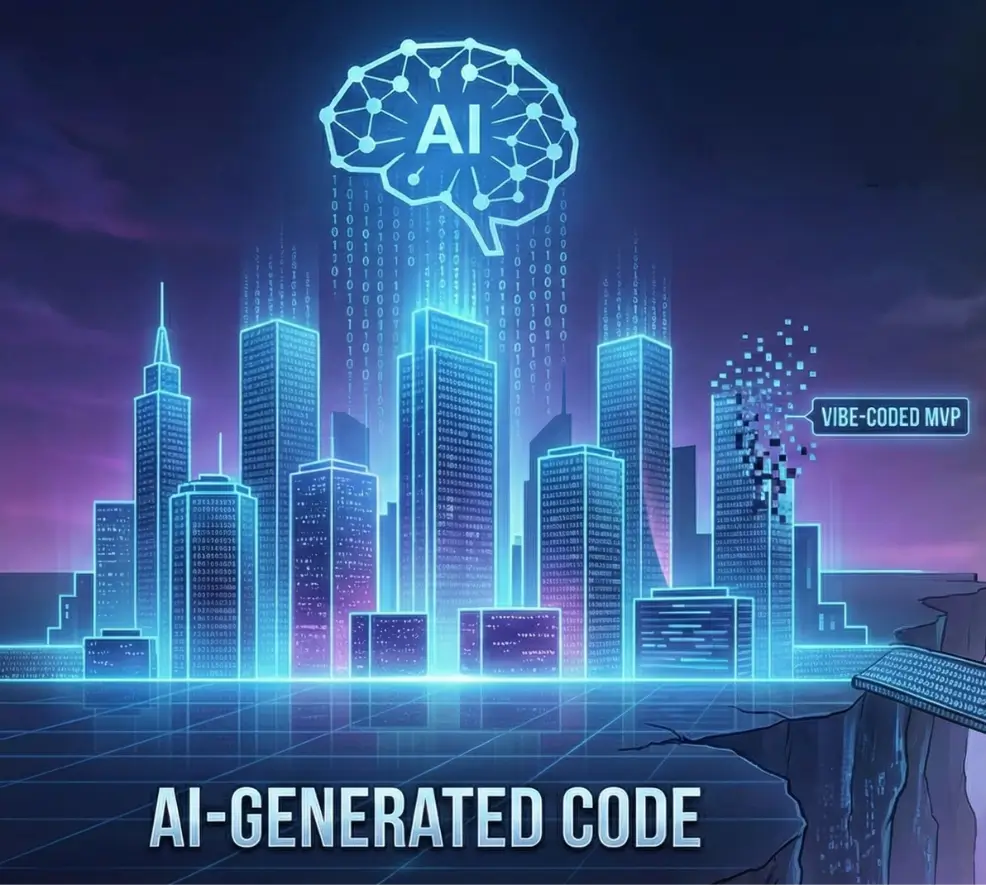
Meanwhile, the internet is filled with weekend-built micro-apps, “vibe-coded” MVP, one-click SaaS clones, and product demos that look like polished companies right up until they hit real users, real traffic, real payments, and real attackers.
So people started asking the wrong question: “Is this the end of expertise?“
No.
AI commoditized building. It did not commoditize operating.
And the more powerful AI becomes, the more brutally that difference shows up. Because code is not the product. A system is the product. And systems live in reality where latency exists, credentials leak, attackers adapt, costs explode, and downtime has consequences.
The next wave of bankruptcies won’t come from AI failing. They’ll come from nobody understanding what they deployed.
The selloff narrative wasn’t “software is bad.” It was something worse:
“Software’s moat is thinner than we thought.”
Investors looked at agentic tools and natural-language workflows and imagined a world where companies stop paying per seat and start paying per outcome. Anthropic’s release reignited the fear that agentic AI could render traditional SaaS obsolete overnight. Salesforce tumbled 26%. Microsoft entered a technical bear market, down 27% from its October 2025 peak.
But that narrative assumes building software is the hard part. It isn’t anymore.
Stack Overflow 2025 Developer Survey tells the story in two numbers: 84% of developers now use AI tools. But only 33% trust what comes out. Just 3% report “high trust”. The top frustration? Solutions that are “almost right, but not quite”.
Adoption is soaring. Confidence is not.
AI doesn’t reduce risk. It redistributes it from the people who write the code to the people who have to keep the system standing after the code is written.
October 20, 2025, AWS DNS Outage.
A latent defect in DynamoDB’s automated DNS management system created an empty DNS record in the US-East-1 region. The bug didn’t self-correct. It needed manual intervention. In the meantime, 113 AWS services cascaded into failure EC2, Lambda, SQS, Load Balancers, all of them. Snapchat, Reddit, Roblox, Fortnite, Slack, Zoom, and Coinbase are all down. Downdetector logged 11 million outage reports globally.
The DNS fix itself took three hours. But cascading failures continued for fifteen hours. Some Redshift clusters didn’t recover until the next day.
One DNS record. One empty field. Fifteen hours of global chaos.
November 18, 2025, Cloudflare Outage.
Not an attack. An automatically generated configuration file grew too large and crashed the traffic management system. ChatGPT went dark. X went dark. Shopify, Uber, and Canva are all unreachable. AI platforms were hit hardest because LLM queries can’t be cached every request requires live routing, and if the first mile of infrastructure collapses, the most powerful model in the world is useless.
Two outages. Zero attacks. Just infrastructure complexity, doing what it does when humans aren’t watching carefully enough.
That is the gap this article is about. No AI model fills it. Only professionals do.
Here’s a story the AI hype cycle doesn’t tell at Demo Day.
A fintech startup launched a conversational AI feature for personal finance analytics. User engagement was off the charts. The team was thrilled. Then the invoice arrived. Inference costs had ballooned tenfold in a single week. What was meant to be a breakthrough became a runaway cost center.
This isn’t rare. It’s structural.
Research shows a 717× scaling factor between proof-of-concept costs ($1,500/month) and production costs ($1,075,786/month). And 88% of AI proofs-of-concept never reach production at all; they die in “PoC purgatory” when real costs become clear.
The economics are brutal even for the biggest players. OpenAI spent $8.67 billion on inference in the first nine months of 2025, nearly double its revenue. Sam Altman admitted they lose money on $200/month ChatGPT Pro subscriptions. Anthropic burns 70% of every dollar they bring in. OpenAI doesn’t expect profitability until 2029 or 2030, with projected cumulative losses of $44 billion through 2028. OpenAI itself could face a $14 billion loss in 2026, raising bankruptcy concerns if spending continues unchecked.
And these are the companies that built the models.
Now imagine a 4-person startup wrapping an API, paying per-token at retail, with no caching strategy, no routing logic, no model optimization, and no cost observability. Every user interaction carries an inference cost. As usage scales, costs don’t decline. Each retry loop, each multi-step reasoning chain, each agent “thinking” adds to the bill.
Growth without cost governance is bankruptcy with users.
Attackers are now using AI to accelerate every phase of their operations. Trend Micro 2026 predictions call out AI-powered living-off-the-land techniques, LLMs generating commands that mimic legitimate behavior. Google Threat Intelligence Group discovered a new breed of malware that uses AI as a runtime weapon:
DDoS attacks on AI companies surged 347% in September 2025. The Aisuru botnet hit 31.4 Tbps the largest disclosed DDoS attack in history, available for hire for a few hundred dollars.
Apiiro research inside Fortune 50 companies: AI-assisted code introduces 10× more security findings. Privilege escalation paths surged 322%. Architectural design flaws rose 153%.
Vibe coding is the new technical debt factory. And the invoices are arriving in the form of breaches.
Most vibe-coded apps have no incident response plan. Here’s what a real production incident looks like and why it can’t be prompted:
| Time | What Happens | What’s Required |
| 00:00 | Monitoring alert fires. PagerDuty wakes someone up. | Automated detection, on-call rotation, alert routing |
| 01:00 | Incident commander assigned. War room channel created. Timeline document started. | Leadership, coordination protocol, and communication tools |
| 02:00 | Initial status posted. Stakeholders notified. Next update time set. | Customer communication skills, stakeholder management |
| 03:00 | Impact assessed: what’s broken, how many users, revenue impact, data risk. | Business context knowledge, real-time metrics |
| 04:00 | Context gathered: when did it start, what changed, and is it worsening? | Deep system knowledge, deployment history, and log analysis |
| 05:00 | Decision: rollback, failover, or containment. Action taken. All changes logged. | Engineering judgment under pressure, risk assessment |
| 15:00 | Services stabilizing. Cascading dependencies verified. Monitoring confirms recovery. | Infrastructure expertise, dependency mapping |
| 48:00 hrs | Blameless post-mortem. Root cause identified. 10+ action items logged. Runbooks updated. | Organizational maturity, learning culture |
None of this is code. All of it is expertise. An AI can help diagnose. It cannot own the outcome at 2:37 AM when the system is hemorrhaging revenue and the CEO is asking for answers.
When money is burning, someone must make the decision.
This is the table that should end the debate. Thirty dimensions where a weekend MVP and a production system are not just different, they’re different species.
| # | Dimension | Vibe-Coded MVP | Production System | What Happens Without It |
| 1 | Server hardening | Default OS, ports open | CIS-benchmarked, minimal attack surface | Compromised in hours by automated scanners |
| 2 | Linux security | Root access everywhere | Least privilege, SELinux/AppArmor enforced | One breach = total system takeover |
| 3 | Docker security | latest tag, root user in container | Pinned images, non-root, read-only filesystem | Supply chain attack via a compromised base image |
| 4 | Kubernetes config | Default namespace, no resource limits | Network policies, RBAC, pod security standards | Noisy neighbor kills your service; lateral movement in breach |
| 5 | Container secrets | Hardcoded in ENV or Dockerfile | External vault (HashiCorp Vault / AWS Secrets Manager), rotated | Credentials leaked in image layers, visible in docker inspect |
| 6 | Network segmentation | Flat network, everything talks to everything | VPCs, subnets, security groups, micro-segmentation | Attacker moves laterally from the web server to the database in seconds |
| 7 | Firewall rules | Allow all inbound on common ports | Whitelist-only, egress filtering, deny by default | Cryptominers, reverse shells, data exfiltration |
| 8 | DNS configuration | Single provider, no failover | Multi-provider, low TTL, DNSSEC | One empty record takes you down for 15 hours (ask AWS) |
| 9 | TLS/SSL | Self-signed or Let’s Encrypt with no rotation plan | Automated certificate management, HSTS, OCSP stapling | Certificate expires on Friday night; entire site untrusted |
| 10 | DDoS protection | None | Anycast, rate limiting, CDN absorption, scrubbing | 31 Tbps botnet takes you offline for $200 |
| 11 | WAF (Web Application Firewall) | None | Tuned rulesets, bot detection, behavioral analysis | SQL injection, XSS, and credential stuffing go undetected |
| 12 | Authentication | Basic JWT, no expiry | OAuth2/OIDC, MFA, token rotation, session management | Account takeover at scale |
| 13 | Authorization | If-else in route handlers | RBAC/ABAC, policy engine, audit trail | Users access other users’ data; compliance violation |
| 14 | Rate limiting | None | Per-user, per-endpoint, per-IP, adaptive | API abuse, scraping, cost explosion, brute force |
| 15 | Input validation | Client-side only | Server-side validation, parameterized queries, CSP | Injection attacks, stored XSS, and data corruption |
| 16 | Logging | console.log to stdout | Structured JSON logs, centralized (ELK/Datadog), retention policy | Can’t diagnose incidents; can’t prove compliance |
| 17 | Monitoring & alerting | “I’ll check the dashboard sometimes.” | SLO-based alerts, anomaly detection, PagerDuty on-call | You find out you’re down from Twitter |
| 18 | Backups | Maybe a cron job; never tested | Automated, encrypted, off-site, verified with restore drills | GitLab scenario 5 backup methods, none worked |
| 19 | Disaster recovery | “We’ll figure it out.” | Documented DR plan, tested RTO/RPO, and rehearsed failover | “15-minute RTO” becomes 72-hour outage |
| 20 | CI/CD pipeline | git push → production | Build, test, scan, stage, canary, approve, deploy, rollback | Bad deploy goes straight to all users; no way back |
| 21 | Rollback capability | Redeploy the previous commit manually | Automated rollback, database migration reversal, feature flags | Corrupted data that can’t be uncorrupted |
| 22 | Infrastructure as Code | Click-ops in the cloud console | Terraform/Pulumi, version-controlled, peer-reviewed | “Works on my cloud account” unreproducible, unauditable |
| 23 | Dependency management | npm install whatever works | Lockfiles, vulnerability scanning, SBOM, update policy | One compromised package = you ship malware |
| 24 | GDPR compliance | “We have a privacy page.” | Data mapping, consent management, DPO, breach notification process, right to deletion | Fines up to 4% of global revenue; lawsuits |
| 25 | Data encryption | In transit only (maybe) | At rest (AES-256), in transit (TLS 1.3), key rotation | Database dump = all customer data exposed in plaintext |
| 26 | Access audit trails | None | Who accessed what, when, from where, immutable logs | Can’t detect insider threat; can’t pass SOC 2 audit |
| 27 | User data isolation | Shared database, filtered by user_id | Tenant isolation, row-level security, and encrypted per-tenant | One API bug exposes all customers’ data to one customer |
| 28 | Cost observability | Check the cloud bill monthly | Per-service cost tagging, budget alerts, and inference cost tracking | Inference costs 10× in a week; you find out on the invoice |
| 29 | Incident response plan | “Call the developer.” | Documented runbook, on-call rotation, war room protocol, post-mortem process | Chaos at 2 AM, nobody knows who’s in charge, customers find out from Twitter |
| 30 | Load testing | “It works for me and 3 beta users.” | Load tests at 2×, 5×, 10× expected traffic; stress tests to failure point | First viral moment = first outage; first outage = last impression |
If you’re missing more than 5 of these, you don’t have a product. You have a liability that happens to have a landing page.
| Builders (Commodity Tier) | Operators (Strategic Tier) | |
| Primary output | Features, screens, endpoints | Reliability, resilience, survivability |
| Win condition | “It runs.” | “It stays up, stays safe, stays affordable.” |
| AI effect | Speeds them up | Amplifies them |
| Risk profile | Hidden until scale or attack | Managed before it matters |
| Competitive moat | Thin anyone can prompt | Deep years of pattern recognition |
The market used to reward builders because building was slow. Now building is fast, and the market is rewarding whoever can run production without bleeding.
The real SaaS meltdown isn’t financial. It’s architectural. The companies evaporating aren’t the ones with bad revenue. They’re the ones with no infrastructure moat.
This isn’t an anti-AI argument. It’s a “stop using it wrong” argument.
AI is excellent at scaffolding internal tools, generating first drafts of configs, accelerating refactors, writing repetitive tests, summarizing logs, and exploring architectures. Claude Opus 4.6 sustains agentic tasks over hundreds of thousands of tokens with a 1M context window and handles multi-million-line codebase migrations. A Google principal engineer said it replicated in one hour what a team built over a year.
But the winning pattern is not “AI replaces the operator.”
It’s:
Operator + AI replaces the operator without AI.
Experienced teams become faster and more correct because they know what questions to ask, what risks to fear, and what failure looks like before it happens. That’s the compounding advantage. And it compounds in one direction only: toward the people who already understand systems.
84% of developers use AI-assisted coding. Only 33% trust it. Only 3% trust it highly.
The codebases are becoming what practitioners call “AI slop”, technically functional but semantically hollow. Variable names are generic. Domain concepts blurred. Business logic lost in translation. Maintenance costs are rising. Feature velocity, the thing AI was supposed to accelerate actually slowing as technical debt compounds.
One developer testing an AI coding agent: “Tasks that seemed straightforward took days. The agent got stuck in dead-ends, produced overly complex implementations, and hallucinated non-existent features”.
By 2026, if your app looks and feels like typical AI output, users notice. They perceive it as low-effort. Trust drops before they click sign-up.
The reckoning isn’t about whether AI can write code. It’s about whether the resulting systems survive contact with reality.
The software sector’s trillion-dollar evaporation isn’t the collapse of opportunity. It’s the collapse of illusion.
Bain & Company confirms net revenue retention across SaaS has stalled. The per-seat model is dying. But the AI infrastructure boom shows no sign of slowing. The best AI-native companies are growing from zero to $100M faster than any previous wave.
The ones winning aren’t the ones with the best models. They’re the ones with the best infrastructure underneath.
Companies that treat AI as infrastructure are thriving. Companies that treat AI as a magic wand are evaporating.
Yes, almost anyone can build now. But building is the beginning.
Operating is the profession.
One empty DNS record took down half the internet for fifteen hours. One misconfigured file crashed Cloudflare and every AI platform that depended on it. One untested backup turned a routine mistake into permanent data loss. One inference feature turned a thriving startup into a cost crisis in seven days.
AI didn’t kill professionals.
It exposed who was building and who was actually running systems.
The future doesn’t belong to those who can generate code. It belongs to those who can operate reality.
Reality, unlike a prompt, does not forgive mistakes.

Netanel Siboni is a technology leader specializing in AI, cloud, and virtualization. As the founder of Voxfor, he has guided hundreds of projects in hosting, SaaS, and e-commerce with proven results. Connect with Netanel Siboni on LinkedIn to learn more or collaborate on future project.






 Lifetime VPS Europe
 Lifetime VPS Asia
 Lifetime WooCommerce Hosting
 Lifetime Hosting
 France Lifetime Dedicated Servers
 Germany Lifetime dedicated servers
 Lifetime Game Dedicated Servers
 Chicago, US
 Tokyo, Japan
 Singapore
 Hong Kong
 Seoul, South Korea
 Amsterdem, Netherlands
 London, UK
 Stockholm, Sweden
 Oslo, Norway
 Vienna, Austria
 Zurich, Switzerland
 Sydney, Australia
 Wordpress Hosting
 VPS Hosting
 DDOS Protection
 Submit Ticket
 Full Management
 Guides
 Videos and Podcasts
 Discover Creative Ideas
 MetaAgentOS High-Ticket Support System
 Voxfor Mega Menu
 Voxfor Advanced Price Management For WooCommerce
 Voxfor Secure Live Chat and AI Support
 Voxfor Multilanguage
 Voxfor AI Content Summary


