Lifetime VPS Europe
 Lifetime VPS Asia
 Lifetime WooCommerce Hosting
 Lifetime Hosting
 Lifetime Game Dedicated Servers
 Chicago, US
 Tokyo, Japan
 Singapore
 Hong Kong
 Seoul, South Korea
 Amsterdem, Netherlands
 London, UK
 Stockholm, Sweden
 Oslo, Norway
 Vienna, Austria
 Zurich, Switzerland
 Sydney, Australia
 Wordpress Hosting
 VPS Hosting
 DDOS Protection
 Submit Ticket
 Full Management
 Guides
 Videos and Podcasts
 Discover Creative Ideas
 Cybersecurity Services
 Voxfor Mega Menu
 Voxfor Advanced Price Management For WooCommerce
 Voxfor Secure Live Chat and AI Support
 Voxfor Multilanguage
 Voxfor AI Content Summary
 Voxfor Autopilot

WordPress powers more than 43% of all websites on the internet, and a big reason for that dominance is its vast plugin ecosystem. With over 50,000 plugins available in the official WordPress directory, choosing the right ones for your site can feel overwhelming. This guide cuts through the noise, covering the best WordPress plugins across every major category, complete with honest descriptions, key features, and detailed pros and cons for each.
Inbound Marketing Strategy
Turn technical readers into inbound marketing growth
Helpful tutorials attract qualified visitors, but reliable hosting keeps those readers engaged. Voxfor VPS gives growing websites the speed, uptime, and control needed to support stronger inbound marketing campaigns.
What Is a WordPress Plugin?
A WordPress plugin is a piece of software that adds specific features or functionality to your website. They allow you to extend and customize your site without needing to write a single line of code or hire a developer. Whether you need a contact form, an SEO suite, an eCommerce store, or a security firewall, there is a plugin for it. Many are free; others offer premium upgrades for advanced features.
Best WordPress Marketing Plugins

Omnisend
Description: Omnisend is a powerful eCommerce marketing platform that integrates effortlessly with WordPress and WooCommerce. It goes beyond email alone, combining email, SMS, and web push notifications into one platform to help store owners connect with their audience across multiple channels. Its automation capabilities, including abandoned cart recovery, welcome series, and post-purchase follow-ups, make it a standout choice for growing online businesses.
Key Features:
- Drag-and-drop email and SMS editor
- 27 pre-built eCommerce automation workflows
- Abandoned cart recovery and welcome series
- Customer segmentation based on purchase history
- Real-time campaign analytics (opens, clicks, sales)
- WooCommerce and Shopify integration
- Custom opt-in forms and popups
✅ Pros:
- All core features, including automations, segmentation, and SMS, are accessible on the free plan
- Extremely easy to use; no technical expertise required
- Excellent customer support with both AI and human representatives
- Competitive pricing that scales well for growing stores
- Strong abandoned cart and eCommerce automation out of the box
❌ Cons:
- Relatively small email template library compared to Mailchimp or Klaviyo
- No multivariate testing or inbox placement tools
- SMS costs can escalate quickly at high volumes
- Limited integrations compared to rival platforms
- Less suitable for B2B or general (non-eCommerce) marketing
Social Media Share Buttons & Social Sharing Icons
Description: This plugin makes it simple to add social sharing buttons and icons for over 200 networks, including Facebook, Twitter, LinkedIn, Instagram, Pinterest, YouTube, and RSS, directly onto your WordPress posts, pages, and custom post types. It offers significant flexibility in terms of icon design, placement, and behavior.
Key Features:
- 16 different icon design styles
- Floating/sticky icon placement options
- Mouse-over and shuffle animations
- GDPR-compliant social sharing
- Popup prompts to encourage follows and shares
✅ Pros:
- Massive library of 200+ supported social networks
- Multiple icon designs for aesthetic flexibility
- Fully GDPR-compliant
- Easy to use for beginners, no coding required
- Sticky floating icons increase share visibility
❌ Cons:
- Advanced design customization is locked behind the premium version
- Can add a slight page load overhead if too many icons are enabled
- Some users find the settings panel cluttered
- Limited analytics on share counts in the free tier
Smash Balloon
Description: Smash Balloon is a WordPress marketing plugin that seamlessly integrates social media feeds, from Facebook, Instagram, Twitter/X, and YouTube, directly into your website. With over 1 million active installations, it is widely trusted for creating beautiful, responsive social walls and individual platform feeds that update automatically.
Key Features:
- Multi-platform social feed support
- Social wall combining multiple platforms
- Extensive layout and filter customization
- Responsive design for all screen sizes
- GDPR-compliant
✅ Pros:
- Polished, highly customizable feed displays that match your branding
- Excellent performance optimization to minimize page load impact
- Supports multiple platforms in one unified social wall
- Regular updates and active developer support
- Responsive and mobile-friendly by default
❌ Cons:
- Each social platform (Facebook, Instagram, Twitter, YouTube) requires a separate plugin/license
- The All Access Bundle is expensive for small or personal websites
- The free version has limited customization options
- Requires API access for some social platforms, which can be tricky to configure
Best WordPress Membership Plugins
MemberMouse
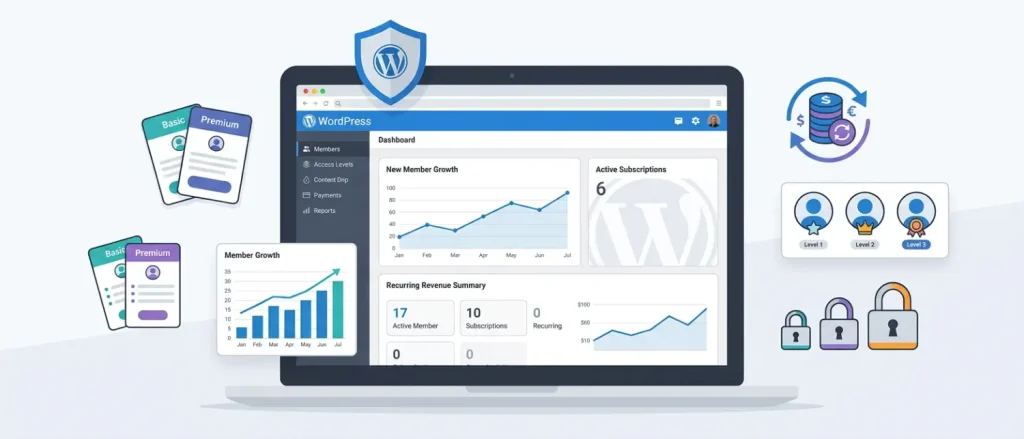
Description: MemberMouse is a feature-rich membership plugin for WordPress that helps website owners manage members, subscriptions, and revenue efficiently. It includes built-in customer management tools that track lifetime value, churn rate, and retention, giving site owners actionable business intelligence. Advanced billing options like upsells, downsells, and discount logic further enhance revenue potential.
Key Features:
- Customizable member dashboards
- Multiple membership tiers and bundles
- Advanced reporting and analytics
- Integration with payment gateways and third-party services
✅ Pros:
- Powerful built-in analytics track member lifetime value and churn
- Supports complex billing scenarios, including upsells and discounts
- Highly flexible membership tier structure
- Integrates with major payment gateways and email marketing platforms
❌ Cons:
- Premium plans are expensive, starting at $199.50/year
- Learning curve can be steep for beginners
- Some advanced features only available in higher-priced plans
- Less visual polish compared to newer membership plugins
Ultimate Member
Description: Ultimate Member is a flexible, user-friendly plugin that simplifies building membership sites and online communities on WordPress. It provides drag-and-drop form builders, customizable user profiles, and content restriction tools, all without requiring any coding knowledge. Its broad integration support with WooCommerce, bbPress, and Mailchimp makes it a versatile choice for community-driven websites.
Key Features:
- Drag-and-drop form builder for registration, login, and profiles
- Content restriction by user role or membership level
- Integration with popular payment gateways
- Drip content functionality
✅ Pros:
- Easy to set up, no coding required
- Generous free version with solid core features
- Highly customizable user profiles and registration forms
- Strong community and developer ecosystem
❌ Cons:
- Some essential features (like WooCommerce integration) require premium add-ons
- Premium cost ($249/year) may be prohibitive for small sites
- Occasional conflicts reported with certain page builder themes
- Support quality varies for free users
Best WordPress SEO Plugins
Yoast SEO
Description: Yoast SEO is one of the most widely used and trusted WordPress SEO plugins, launched in 2010 and now boasting over 27,000 reviews. It provides a comprehensive suite of on-page SEO tools, including content analysis, readability scoring, XML sitemaps, meta tag management, and Schema.org structured data. Its traffic-light (red/orange/green) scoring system makes SEO actionable for users of all experience levels.
Key Features:
- Real-time SEO and readability analysis
- XML sitemaps auto-generation
- Schema.org structured data markup
- SERP preview (desktop and mobile)
- Yoast AI for meta title/description generation
- Google Search Console integration
- Redirect manager (Premium)
- Internal linking suggestions (Premium)
✅ Pros:
- Industry-standard plugin used by millions worldwide; excellent reliability
- Structured data implementation is comprehensive and proven to improve click-through rates
- Beginner-friendly interface with clear visual SEO feedback
- Actively updated to align with Google’s latest guidelines
- GDPR-compliant, does not collect personal data
- Large community for support and troubleshooting
❌ Cons:
- Several advanced features (redirect manager, internal linking, AI suggestions) are locked behind the $99/year Premium tier
- Can add a slight page load overhead, especially on low-resourced hosting
- May overwhelm absolute beginners despite its intuitive interface
- Some users develop an over-reliance on the green light, neglecting a holistic SEO strategy
- Occasional conflicts reported with certain themes and plugins
SEOPress
Description: SEOPress is a comprehensive, white-label SEO plugin that rivals Yoast in features while maintaining a cleaner interface. It supports unlimited keyword optimization per post, Google Analytics and Microsoft Clarity integration, IndexNow API for fast content indexing, and detailed XML/HTML sitemap control, all at a significantly lower price than competitors. Its installation wizard makes initial configuration straightforward for beginners and professionals alike.
Key Features:
- Unlimited keyword optimization per post
- IndexNow API (Bing/Yandex) and Google Indexing API
- Custom XML and HTML sitemaps
- Social media (Open Graph & Twitter/X Cards) preview
- Google Analytics and Microsoft Clarity integration
- White-label option for agencies
✅ Pros:
- Exceptional value, PRO plan at $49/year covers up to 5 sites
- Unlimited keyword tracking per post (Yoast limits this in the free version)
- White-label mode ideal for agencies managing multiple client sites
- Clean, clutter-free interface
- Fast indexing via Google and Bing/Yandex APIs
❌ Cons:
- Smaller community and documentation base compared to Yoast
- Less name recognition, which may matter for client-facing deliverables
- Some advanced features require navigating more menus than Yoast
- Fewer third-party integrations with page builders compared to Yoast
Best WordPress Anti-Malware & Security Plugins
All-In-One Security (AIOS)
Description: All-In-One Security (AIOS) is a comprehensive WordPress security plugin that delivers an impressive suite of protection tools in its free version, including login lockout, forced logouts, content theft protection, 6G blacklist filtering, and an IP blocking system. Upgrading to Premium adds malware scanning, uptime monitoring, and priority support.
Key Features:
- Login security (lockout, forced logout, hidden login page)
- 6G blacklist for known threat filtering
- Country blocking and 404 blocking
- File integrity checks
- Audit logging
- Backup and restore functionality
✅ Pros:
- Extremely feature-rich free version, arguably the most generous of any security plugin
- Easy to configure through a visual security strength meter
- File integrity monitoring alerts to unauthorized changes
- Country blocking helps prevent region-specific attacks
❌ Cons:
- Malware scanning is only available in the Premium version
- The firewall configuration has been criticized as less effective than dedicated firewall plugins
- Login protection features can sometimes trigger false positives
- Interface can feel dated compared to newer security plugins
- Less real-time threat intelligence than Wordfence or MalCare
MalCare
Description: MalCare is a robust cloud-based anti-malware and security plugin developed from an analysis of over 240,000 websites. Its key differentiator is that all scanning happens on MalCare own servers, not yours, meaning zero performance impact on your site during scans. It uses over 100 AI-powered signals to detect even complex, deeply hidden malware, and its one-click cleanup removes threats in under 60 seconds.
Key Features:
- Off-server malware scanning (no site slowdown)
- One-click malware removal
- Cloud-based firewall with 24/7 protection
- Vulnerability scanner for plugins, themes, and core
- Bot protection with smart crawler detection
- CAPTCHA-based login protection
✅ Pros:
- Scans on MalCare’s servers, no CPU spikes or page slowdowns on your site
- One-click malware cleanup is fast and reliable
- AI-based detection catches complex malware missed by traditional scanners
- Excellent real-time firewall protection
- Clean, modern dashboard with centralized management
❌ Cons:
- The free version has a limited scanning depth and no malware removal
- The premium plan at $149/year is expensive for single-site owners
- Fewer login security features compared to AIOS in the free tier
- Some users report that customer support response times could be faster
Best WordPress Migration & Backup Plugins
UpdraftPlus
Description: UpdraftPlus is the most widely used backup and migration plugin for WordPress, with over 3 million active installations. It simplifies the entire backup process, from scheduling to secure cloud storage across 15+ destinations, with an intuitive one-click interface. It supports Google Drive, Dropbox, UpdraftVault, OneDrive, and more, making it the go-to choice for both beginners and advanced users.
Key Features:
- Scheduled and manual backups
- 15+ remote storage options (Google Drive, Dropbox, S3, etc.)
- One-click restore
- Incremental backups
- Database encryption
- Multisite support
- Pre-update backups (Premium)
- WP-CLI support
✅ Pros:
- Powerful free version with restore capability — uncommon among competitors
- Flexible scheduling from every 2 hours to monthly
- Impressive range of cloud storage destinations
- Easy setup and user-friendly interface praised by users across G2[
- Supports non-WordPress file backups
❌ Cons:
- Real-time backups are not offered, which can be problematic for high-traffic eCommerce sites
- Some users report issues restoring very large sites
- Advanced migration features require the paid UpdraftMigrator add-on
- Premium pricing adds up if multiple add-ons are needed
Migrate Guru
Description: Migrate Guru offers zero-downtime WordPress migration by processing the entire transfer through its own secure servers, not yours. It can handle websites up to 200GB in size and automatically deletes all user data immediately after the transfer completes. One-click migration and automated URL replacements make it exceptionally user-friendly.
Key Features:
- Zero-downtime migration
- Handles sites up to 200GB
- Automated URL replacement
- Real-time migration alerts
- Compatible with a wide range of WordPress hosting setups
✅ Pros:
- Completely free with no premium upsell for core features
- Handles extremely large site migrations reliably
- Zero performance impact on your live site during migration
- Automated URL replacements save post-migration cleanup time
- Strong 4.9-star rating reflects high user satisfaction
❌ Cons:
- No dedicated dashboard, migration is managed via email and FTP/cPanel
- Limited to migrations only; no backup functionality
- Less suitable for complex multisite migrations
- Support options are more limited than premium paid tools
Best WordPress Performance & Caching Plugins
LiteSpeed Cache
Description: LiteSpeed Cache (LSCWP) is a free, server-level caching plugin and site acceleration suite that consistently outperforms paid alternatives in benchmarks. Its key advantage is deep integration with LiteSpeed web servers, allowing cached pages to be served without PHP execution, dramatically improving response times. It also includes image optimization, CSS/JS minification, CDN integration, and database optimization.
Key Features:
- Server-level page caching (LiteSpeed servers)
- Image optimization and lazy loading
- CSS/JS/HTML minification and combination
- QUIC.cloud CDN integration
- Object caching (Redis/Memcached)
- Mobile-specific cache
- WordPress Multisite support
✅ Pros:
- Completely free with no premium tier, rare for this level of performance
- Server-level caching far surpasses plugin-only caching solutions
- Comprehensive features typically found only in paid plugins (e.g., WP Rocket)
- Outstanding benchmark performance, frontend execution time of 0.023 seconds in testing
- Active development with regular feature updates
❌ Cons:
- Full benefits require LiteSpeed hosting, on Apache or Nginx; you lose server-level caching
- Configuration can be overwhelming for beginners due to the sheer number of settings
- QUIC.cloud CDN integration requires account registration and API key setup
- Some features (e.g., mobile cache) are not optimized by default and require manual configuration
W3 Total Cache
Description: W3 Total Cache is a veteran WordPress caching plugin trusted by over 1 million users to enhance SEO, Core Web Vitals scores, and overall site performance. It supports page caching, database caching, browser caching, Gzip compression, minification, and WebP image conversion, offering granular control over virtually every aspect of performance optimization.
Key Features:
- Page, database, object, and browser caching
- Gzip compression and minification
- WebP image conversion
- REST API caching
- Lazy loading for Google Maps
- Render-blocking CSS elimination
✅ Pros:
- One of the most configurable caching plugins available, suitable for advanced users
- Works on all major hosting types without server requirements
- REST API caching valuable for dynamic and headless WordPress sites
- Large community with extensive documentation
❌ Cons:
- Highly complex setup, not recommended for beginners without technical knowledge
- Lower rating (4.4) than competitors like LiteSpeed Cache due to configuration difficulty
- Premium features cost $99/year
- Misconfiguration can break your site, so testing in staging is essential
Best WordPress Plugins for Photographers
Responsive Lightbox & Gallery
Description: Responsive Lightbox & Gallery is a drag-and-drop gallery plugin designed specifically for photographers and visual creatives. It allows users to create beautiful, fully responsive image galleries with lightbox functionality that looks great on all screen sizes. It supports WooCommerce product galleries, social sharing integration, and SEO-friendly output.
Key Features:
- Drag-and-drop gallery builder
- Responsive lightbox display
- SEO-friendly gallery structure
- Social sharing icons
- WooCommerce gallery support
- Multisite compatibility
✅ Pros:
- Outstanding 4.9-star rating reflects exceptional user satisfaction
- Intuitive drag-and-drop builder requires no technical skill
- SEO-optimized output helps gallery pages rank in search engines
- Affordable premium tiers starting at just $29
- WooCommerce integration ideal for selling photography products
❌ Cons:
- Some advanced display effects are only in the Premium tier
- Limited built-in watermarking compared to Modula
- Can conflict with certain page builders when using custom layouts
- The free version has fewer style customization options
Modula Image Gallery
Description: Modula is a versatile image gallery plugin that supports masonry, custom grid, and creative layouts for showcasing photography portfolios. It stands out with built-in image watermarking to protect creative work, paginated gallery navigation, gallery sliders, and the ability to combine photos and videos in a single gallery. Resizing images is as simple as dragging the corners.
Key Features:
- Masonry, creative grid, and custom layouts
- Built-in image watermarking
- Paginated galleries and gallery sliders
- Lightbox with customization options
- EXIF metadata display
- Mixed photo and video galleries
- User role management
✅ Pros:
- Image watermarking protects photographers’ intellectual property.
- Flexible layout options (masonry, custom grids) for creative portfolio design
- Intuitive corner-drag resizing for effortless gallery customization
- Ability to mix photos and videos in a single gallery
- Affordable per-site licensing starting at $30
❌ Cons:
- The free version is limited in layout variety
- Some advanced features (sliders, social proof) require a premium
- Fewer reviews than competitors, meaning less community-tested reliability
- EXIF data display can slow down gallery loading on large libraries
Best WordPress Development Plugins
Theme Check
Description: Theme Check is an essential tool for WordPress theme developers, allowing them to test custom themes against the latest review standards set by WordPress.org. It mirrors the automated tests used by WordPress.org for all theme submissions, making it invaluable before distributing a theme publicly or deploying a custom theme on a client site.
Key Features:
- Theme compliance testing against WP.org standards
- Admin panel display for immediate feedback
- Trac formatting support for issue tickets
- Automated testing identical to the WordPress.org submission process
✅ Pros:
- Completely free, an essential no-cost tool for any WordPress developer
- Saves time identifying theme compliance issues before going live
- Uses the same tests as official WordPress.org submissions
- Simple admin panel integration for a fast feedback loop
❌ Cons:
- Only relevant for developers; no value for non-technical users
- Does not check for security vulnerabilities, only standards compliance
- Compatibility listed up to WordPress 6.4.5, verify for newer releases
- Limited to theme testing; cannot check plugin compatibility
WP Crontrol
Description: WP Crontrol provides a user-friendly admin interface for managing the WordPress WP-Cron system. With over 200,000 active installations, it eliminates the need for manual cron job setup by allowing developers to view, add, edit, delete, pause, and resume all scheduled WordPress events directly from the dashboard.
Key Features:
- View all cron events with details (recurrence, next run, callbacks)
- Add, edit, delete, pause, and resume cron events
- Debug scheduled task execution
- Add custom PHP cron events
- Custom cron schedules
✅ Pros:
- Free tool that saves significant development time
- Provides full visibility into all scheduled WordPress tasks
- Allows adding custom PHP cron events without coding in functions.php
- Essential for debugging sites with missed or misfiring scheduled tasks
❌ Cons:
- Not suited for non-developers, misuse can disrupt critical site functions
- No visual scheduler; cron management requires an understanding of time intervals
- Can expose scheduled event details, which may be a minor security consideration
- Does not provide direct server-level cron management
WPCodeBox
Description: WPCodeBox is an advanced WordPress code snippet management plugin designed for developers who need a clean, efficient way to manage custom PHP, JavaScript, CSS, SCSS, and HTML snippets. Its defining feature is cloud-based snippet storage, allowing the same snippet library to be shared and deployed across multiple WordPress websites. An intelligent code editor auto-suggests WordPress actions, hooks, and functions, dramatically speeding up development.
Key Features:
- Cloud storage for snippets (accessible across multiple sites)
- WordPress-specific code auto-complete and syntax highlighting
- CSS live reload for real-time frontend preview
- SCSS/LESS compiler
- Snippet run/test button before deployment
- Auto-disables snippets with errors to protect site stability
- Built-in online snippet library
✅ Pros:
- Cloud snippet storage is a genuine time-saver for multi-site developers
- Auto-error detection disables broken snippets before they cause site damage
- WordPress-aware code editor with hooks and function suggestions
- Keeps sites lean by replacing heavy plugins with lightweight code snippets
- CSS live reload speeds up front-end development significantly
❌ Cons:
- Paid-only plugin, no free version available
- Not listed on the WordPress.org official plugin directory
- Overkill for users who only occasionally add code snippets
- Higher annual cost compared to simpler snippet plugins like WPCode
Post Snippets
Description: Post Snippets allows WordPress users to create reusable blocks of text or code that can be inserted into posts and pages via the block editor or HTML editor. It is particularly useful for sites that frequently reuse elements like affiliate links, shortcodes, custom HTML sections, or contact info. Variables within snippets enable dynamic content reuse; changing the snippet in one place updates it everywhere it is used.
Key Features:
- Reusable text and code snippets with variable support
- Gutenberg block editor and classic editor support
- Snippet duplication and cloud-saving
- Rich text editor for snippet content
- Quick insertion via the editor button
✅ Pros:
- Significant time-saver for sites with repetitive content blocks
- Variable support enables one snippet to serve many use cases
- Compatible with both Gutenberg and classic editors
- Cloud snippet storage for consistent use across multiple sites
❌ Cons:
- Paid-only, with no free version available
- Limited to text and code snippets, no PHP execution like WPCodeBox
- Smaller user base and community compared to alternatives
- The agency plan ($189.99/year) is expensive for independent developers
Best WordPress eCommerce Plugins
WooCommerce
Description: WooCommerce is the world’s most popular eCommerce plugin for WordPress, powering more than 5 million online stores worldwide and representing over 28% of all eCommerce sites globally. The free core plugin enables full-featured online stores supporting physical products, digital downloads, subscriptions, memberships, and affiliate items. Its modular extension architecture allows stores to start lean and scale infinitely.
Key Features:
- Full product management (physical, digital, variable, affiliate)
- Built-in payment gateway integrations
- Tax, coupon, and discount management
- WooCommerce Shipping (free label printing)
- Subscriptions and memberships (via extensions)
- Inventory and sales reporting
- SEO-friendly product structure
- Thousands of third-party extensions
✅ Pros:
- Free to download, the most cost-effective eCommerce foundation available
- Unmatched flexibility — thousands of extensions for any store requirement
- Deep WordPress integration, including full blogging and SEO capabilities
- Massive community with extensive tutorials, themes, and support
- Scalable from a hobby shop to a high-volume enterprise
❌ Cons:
- Setup and configuration can be confusing for complete beginners
- Essential advanced features require paid extensions, which can add up quickly
- Plugin and extension updates can occasionally cause compatibility issues
- Requires self-hosting — you manage security, backups, and maintenance
- Poorly coded third-party extensions can crash or slow down your site
Ecwid
Description: Ecwid (eCommerce Widget) is a versatile plugin that allows you to quickly set up and manage an online store on WordPress while simultaneously selling across web, mobile, and social media channels. Its automatic shipping cost calculations (integrated with FedEx and UPS) and automated tax handling for the US, Canada, and EU VAT streamline store management significantly.
Key Features:
- Multi-platform selling (web, mobile, social media)
- Automatic shipping cost calculations (FedEx, UPS)
- Automated tax calculations for the US, Canada, and EU VAT
- Mobile app for store management on the go
- Easy installation and customization
✅ Pros:
- Free tier provides a genuinely functional store setup
- Multi-channel selling across web, mobile, and social is a standout capability
- Automated tax and shipping calculations reduce manual admin work
- Lightweight and easier to configure than WooCommerce for basic stores
- Mobile management app provides flexibility for store owners on the move
❌ Cons:
- Advanced features (Instagram selling, detailed analytics) require premium plans starting at $21/month
- Less customizable than WooCommerce for complex, large-scale stores
- Smaller extension/integration ecosystem than WooCommerce
- The free plan has a limited product count and features
Best WordPress LMS Plugins
Tutor LMS
Description: Tutor LMS is a beginner-friendly WordPress plugin for creating and managing online learning platforms. It supports unlimited courses, lessons, and quizzes without coding, and offers both frontend and backend course builders. A 2025 update introduced a Content Bank for reusable learning materials, SCORM/H5P support, and native course subscription/membership features, making it a compelling choice for educators and training businesses.
Key Features:
- Frontend and backend drag-and-drop course builder
- Unlimited courses, lessons, and quizzes
- Video lessons from YouTube, Vimeo, and self-hosted sources
- SCORM and H5P support
- Multi-instructor management
- WooCommerce, Stripe, and PayPal payment integration
- Content drip and access control
- Detailed student progress reporting
✅ Pros:
- Intuitive interface, beginners can launch a course platform without code
- Free version covers all essential LMS functionality
- Responsive technical support and comprehensive documentation
- The 2025 Content Bank feature enables efficient multi-course content reuse
- Solid performance for small-to-medium course platforms
❌ Cons:
- Less flexible than LearnDash for highly custom or complex eLearning builds
- Advanced automation features require additional paid extensions
- Scalability limitations for very large educational institutions with thousands of concurrent users
- Agency plan pricing ($799/year) is steep
- Quiz customization lacks some advanced options (polls, ungraded assessments) compared to dedicated quiz tools
19. LifterLMS
Description: LifterLMS transforms any WordPress site into a fully functional Learning Management System, offering tools to create, sell, and protect online courses and training programs. It supports community and social learning features, multiple payment gateways (Stripe and PayPal), content drip scheduling, prerequisite management, and integrations with popular page builders like Elementor, Divi, and Beaver Builder.
Key Features:
- Multimedia course builder (video, audio, text, quizzes, certificates)
- Student progress tracking and quiz analytics
- Built-in eCommerce with Stripe and PayPal
- Community features (discussion areas, course reviews)
- Content drip and prerequisites
- Elementor, Divi, and Gutenberg integration
✅ Pros:
- Strong 4.8-star rating reflects excellent user satisfaction
- Generous free core plugin covers essential LMS needs
- Deep integration with popular page builders for custom course designs
- Social learning features (discussion areas, multiple instructors) build course engagement
- Active development with regular updates
❌ Cons:
- Premium features require individual add-on purchases, which can become expensive
- The bundle ($360/year) is needed for full functionality
- Steeper learning curve than Tutor LMS for complete beginners
- Community features are less polished than dedicated forum plugins like bbPress
Quick Plugin Comparison: At a Glance
| Plugin | Category | Free Version | Starting Premium | Rating |
| Omnisend | Marketing | ✅ | $11.20/mo | 4.9 |
| Smash Balloon | Marketing | ✅ | $299 bundle | 4.8 |
| MemberMouse | Membership | ✅ | $199.50/yr | 4.7 |
| Ultimate Member | Membership | ✅ | $249/yr | 4.3 |
| Yoast SEO | SEO | ✅ | $99/yr | 4.8 |
| SEOPress | SEO | ✅ | $49/yr | 4.8 |
| AIOS | Security | ✅ | $83.30/yr | 4.7 |
| MalCare | Security | ✅ | $149/yr | 4.2 |
| UpdraftPlus | Backup/Migration | ✅ | $70/yr | 4.8 |
| Migrate Guru | Migration | ✅ | Free | 4.9 |
| LiteSpeed Cache | Performance | ✅ | Free | 4.8 |
| W3 Total Cache | Performance | ✅ | $99/yr | 4.4 |
| Responsive Lightbox | Photography | ✅ | $29 | 4.9 |
| Modula Gallery | Photography | ✅ | $30/yr | 4.7 |
| Theme Check | Development | ✅ | Free | 4.8 |
| WP Crontrol | Development | ✅ | Free | 4.5 |
| WPCodeBox | Code Snippets | ❌ | $69/yr | 5.0 |
| Post Snippets | Code Snippets | ❌ | $29.99/yr | 4.6 |
| Tutor LMS | LMS | ✅ | $199/yr | 4.5 |
| LifterLMS | LMS | ✅ | $120/yr | 4.8 |
| WooCommerce | eCommerce | ✅ | Extensions vary | 4.5 |
| Ecwid | eCommerce | ✅ | $21/mo | 4.5 |
How to Choose the Right WordPress Plugin
Selecting the right plugin comes down to several critical factors:
- Compatibility: Verify the plugin works with your current WordPress version, theme, and other installed plugins. Check the “Tested up to” version note in the plugin directory.
- Ratings and Reviews: Look for plugins with a large number of reviews and a high rating. Avoid plugins with poor reviews or infrequent updates.
- Update History: Choose plugins that are updated regularly. Abandoned plugins become security risks as WordPress evolves.
- Performance Impact: Test plugins on a staging environment before production deployment. Some plugins, especially poorly coded ones, can significantly slow your site.
- Support Quality: Check whether the plugin offers email, live chat, or ticket-based support. Free plugins often rely solely on community forums.
- Pricing Transparency: Evaluate whether the free version meets your needs or if premium features justify the cost. Watch out for plugin ecosystems where every feature requires a separate paid add-on.
The best WordPress plugin stack is always the smallest one that fully serves your site’s needs. Every additional plugin adds potential compatibility risk and performance overhead, so choose deliberately, not by default.
About the writer

Hassan Tahir wrote this article, drawing on his experience to clarify WordPress concepts and enhance developer understanding. Through his work, he aims to help both beginners and professionals refine their skills and tackle WordPress projects with greater confidence.