The differing comparison of React Native and native Android development is more delicate than ever, with mobile development itself in continuous development. The scenery has changed greatly with the New Architecture of React Native being production-ready and Android moving to Kotlin Multiplatform and completely new patterns of performance that are breaking the old assumptions.
The revision discusses the assertions in the original article in relation to the current standards, market performance, and innovation that fundamentally change the rationale between the two approaches.
React Native: Matured Structure with Deliberate Patterns
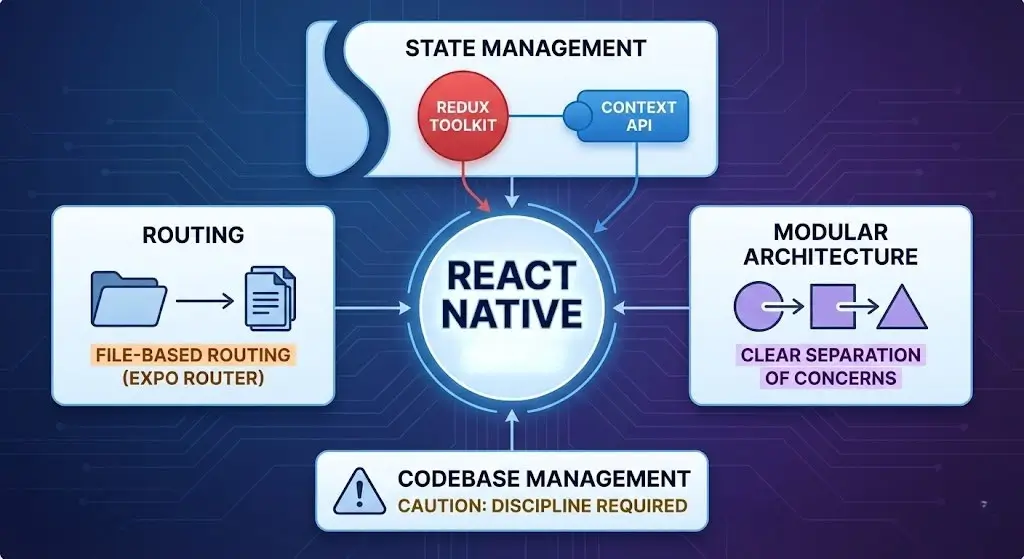
The article in question observed that React Native does not include the strict rules of architecture. This is still technically true, but the actual situation has grown a lot. By the year 2026, the React Native ecosystem will be unified around architectural patterns that are proven to work:
Redux and Context API remain standard for state management, with Redux Toolkit providing opinionated defaults
File-based routing (especially through Expo Router) now brings a familiar Next.js like structure to React Native projects
Modular architecture with clear separation of concerns has become the industry best practice
Nevertheless, the article cautions on codebase management, which is legitimate here, maybe more than before, when there are many people. The distinction is that developers can refer to the existing concrete reference implementations and established patterns of such companies as Spotify, Discord and Shopify.
Android Architecture: Matured Opinionation with Modern Alternatives
This assessment remains accurate, though the context has evolved:
MVVM with Jetpack remains the standard Google-recommended architecture
Clean Architecture and MVI patterns are widely adopted
Jetpack Compose has introduced functional, component-based thinking that mirrors React Native paradigm, blurring traditional differences.
Key shift: In late 2024, Google supports Kotlin Multiplatform, and Android developers can now choose to write common business logic in Kotlin and have native UI, becoming the third option. This wasn’t available in 2023.
Development Environment
React Native: Speed Gains That Change the Equation
The original article praised VS Code’s lightweight nature compared to Android Studio. By 2026, this advantage has become dramatic:
Expo SDK 54 Performance Breakthrough:
iOS build times reduced by 10x through precompiled native code (from ~120 seconds to ~10 seconds)
Hot reloading and Fast Refresh now work seamlessly without the occasional crashes mentioned in the original
File-based routing via Expo Router eliminates manual route management
Firebase Integration Enhanced:
Vertex AI in Firebase now has official React Native support (announced April 2025)
Gemini APIs integrate directly into React Native apps
While still resource-intensive, Android Studio has improved significantly:
Jetpack Compose preview rendering is now near-instantaneous
Gradle incremental builds have improved dramatically
Android Virtual Device performance has been optimized
However, the developer experience gap remains: a developer can set up a React Native project and see live changes in a browser or on a device faster than Android developers can set up their first Android Virtual Device.
Expo Evolution
The original article mentioned Expo limitations with native libraries.
Most popular community libraries now support Expo out of the box
The npx expo prebuild command eliminates the need to check in native iOS/Android directories
CI/CD integration with Expo Cloud Build is now mature and reliable
Important caveat: Even larger projects still sometimes need to be ejected (although Expo now prefers the term to be custom development) in order to reach platform-specific optimisations, but the limit has been increased substantially.
React Native: Component Model Still Superior
The initial evaluation is valid. Through its component-based model, React native is cleaner than the activity lifecycle found in traditional Android:
Everything is a component (functional component model)
TypeScript adoption is now standard, not optional—enabling strong typing across teams
Code sharing between iOS and Android through a single JavaScript codebase still delivers 30-40% faster development cycles
Real Example: Spotify reported in that expanding React Native from their home screen to more of the app resulted in:
35% faster development cycle
4.8-star app rating maintained
40% bug reduction through shared code
Android Catch-Up: Compose Bridging the Gap
Jetpack Compose (now standard in Android development) has narrowed the gap significantly:
Recomposition (Compose’s version of re-rendering) works similarly to React’s reconciliation
State management in Compose follows similar reactive principles
This means the “code reusability advantage” of React Native is now less about the framework and more about cross-platform code sharing vs. platform-specific code.
Package Management
The initial paper referred to the benefits of npm compared to Maven. This is still the case, but with more Gradle enhancements:
The npm ecosystem still offers faster iteration for third-party integrations
Maven Central and Gradle Central repositories have modernized
Kotlin’s official package repositories are now as accessible as npm
Performance: The Most Significant Update
React Native New Architecture: Game Changer
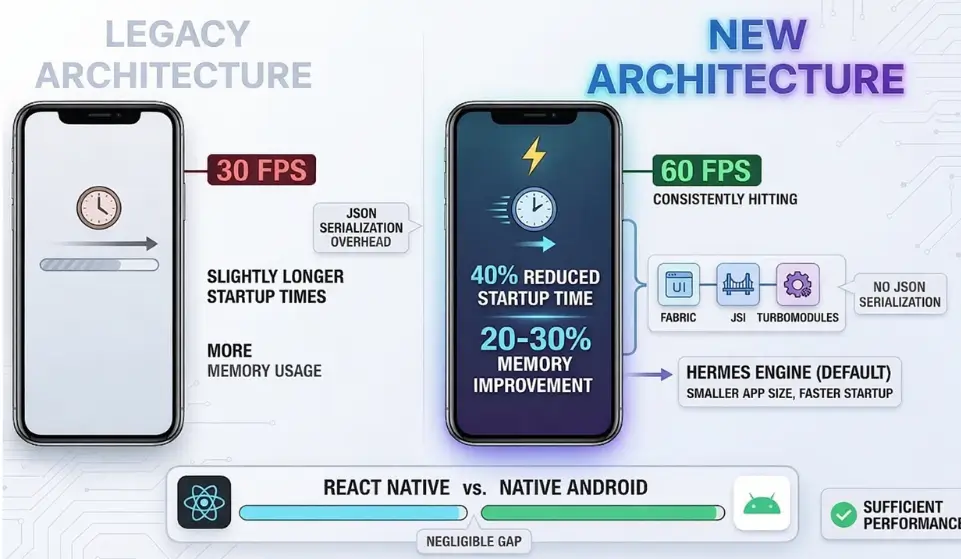
The original article acknowledged React Native “slightly longer startup times” and “more memory usage.” The landscape has fundamentally changed with the New Architecture (Fabric + JSI + TurboModules) now production-ready:
Performance Benchmarks:
Frame rates: Consistently hitting 60 FPS in most production apps (originally slower)
Startup time: Reduced by up to 40% compared to legacy architecture
Memory usage: 20-30% improvement over previous versions
Gap for complex animations or heavy computation: still favors native, but much smaller
For most apps, React Native offers sufficient performance
The Original Article Startup Time Concern
The assertion that React Native apps take a little longer to start in release builds has been made a little less aggressive:
Legacy bridge architecture: 20-30% slower startup
New Architecture: comparable to native for most scenarios
Hermes + New Architecture: often faster than poorly-optimized native code
User Interface
React Native vs. Jetpack Compose: Convergence
The original article has compared the functional components of React Native to the view system of Android. This comparison is no longer relevant, since Jetpack Compose is both functional and declarative, and so is React Native.
Similarities:
Both use functional composition
Both have state management models
Both optimize animations off the main thread
Both support gesture-based interactivity
Key Differences Remain:
Platform adherence: Native Android UI follows Material Design 3; React Native uses its own defaults
Platform-specific features: Android gets device-specific APIs first
Customization: React Native requires more manual theme setup; Material Design is built in for Android
Flexbox vs. Constraint Layout
The original article found Flexbox “challenging for non-web developers.” This remains true, though:
Developers are more web-literate
Compose also uses a flexible layout model
Both ecosystems now have excellent documentation
Native Capabilities and API Access
The “Native Module Problem” Persists, but Improves
The original article warned that React Native is “not a complete replacement for Android/iOS.” This remains accurate, but with improvements:
Reality:
~95% of common use cases work via established React Native libraries
Camera, location, sensors, and permissions have stable community solutions
For 100% edge cases, writing native modules is still necessary, but better documented
Native Modules
The original mentioned “different lifecycles and ready states” as challenges. TurboModules address this:
JSI-based direct method calls (no bridge marshalling)
Type-safe interfaces via Codegen
Lazy loading of modules improves startup
Synchronous calls are now possible where appropriate
Critical Update: CodePush Alternatives
The original article mentioned CodePush as an advantage. Critical change in 2025: Microsoft App Center officially shut down in March 2025, discontinuing CodePush support. Fortunately, several production-ready alternatives emerged:
Regular dependency audits are an industry standard
Third-party library vetting has matured
However, native development still offers more direct control over security-critical code paths.
Deployment and Distribution
OTA Updates: Landscape Changed
CodePush is a React Native strength that was brought to light in the original article. The advantage becomes less obvious with the discontinuation of CodePush:
Before (2023):
React Native: CodePush for instant updates
Android: Only App Store review process
After (2026):
React Native: Multiple OTA solutions available
Android: Google Play currently has a range of app distribution strategies, but it still needs to be reviewed.
New Dynamic:
OTA updates now require careful security consideration
Signed updates and rollback strategies are standard
CI/CD integration is expected for reliable deployments
Firebase Services Integration
The original article mentioned Firebase integration.
Vertex AI (with Gemini APIs) officially supports React Native
The Firebase services can be seamlessly integrated without any native code in most cases.
Cross-platform analytics and crash reporting are mature
Future Outlook: Diverging and Converging Paths
React Native Trajectory
Strengths in 2026:
New Architecture adoption is accelerating across the industry
Continued backing from Meta with stable funding
42% market share and 6,413 job postings signal strong demand
Suitable for rapid MVP development (30-40% faster time-to-market)
Challenges:
Learning curve remains for native platform specifics
Performance still lags native for extreme edge cases
Dependency on third-party libraries for platform-specific features
Android Evolution
Strengths in 2026:
Jetpack Compose is now standard (matching React Native’s declarative approach)
Kotlin is the official language, streamlined and modern
Kotlin Multiplatform offers code-sharing without a third-party framework
Native APIs available immediately upon release
Direct access to all hardware capabilities
Challenges:
Slower development cycle compared to React Native
Separate iOS/Android codebases require parallel development
Higher development costs (separate teams/expertise)
The KMM Emergence
The original article dismissed Kotlin Multiplatform (KMM) as unlikely to compete with React Native. This assessment has proven wrong:
KMM:
Google’s official endorsement (late 2024)
27% market share (up 15 percentage points in 18 months)
Allows sharing business logic (Kotlin) while maintaining native UI
Compose Multiplatform reaches beta for cross-platform UI
Growing but still behind React Native in the job market (1,990 vs 6,413 jobs)
Hybrid Approaches
The trend in 2026 is hybrid architecture:
Use React Native for MVP and rapid iteration
Migrate performance-critical sections to native modules
Employ KMM for shared business logic with native UI
This combines the benefits of all approaches
Performance-Critical Applications
Games and Intensive Processing
The original article correctly stated that “native code works better in longer terms” for resource-intensive apps.
When to Choose Native Android:
High-performance games
Intensive image/video processing
AR/VR applications
Complex scientific calculations
Real-time audio processing
React Native is Insufficient For:
These use cases still require careful architectural decisions
New Architecture helps, but doesn’t eliminate the gap
The hybrid approach (React Native UI + native modules) is now viable
AI and Machine Learning
Both platforms can now integrate AI effectively:
React Native:
Vertex AI in Firebase with Gemini APIs
On-device ML via React Native modules
Good for UI-driven AI features
Native Android:
TensorFlow Lite with deeper integration
MediaPipe for vision tasks
Lower latency for critical inference
Developer Salaries and Job Market
Market Reality
React Native:
Average senior developer salary: $145K USD
6,413 job postings (US, LinkedIn)
More opportunities for cross-platform specialists
Strong remote work prevalence (70% of developers in hybrid/remote)
Native Android (Kotlin):
Average senior developer salary: $135K USD (trending upward)
Fewer total positions but growing faster (KMM driving demand)
More expensive specialists for specific native requirements
Overall Market:
Mobile app developers expected to grow 21% through 2028
Cross-platform skills increasingly valuable
AI integration is becoming an expected skill set
Recommendations
Choose React Native If:
Building a startup MVP quickly (30-40% faster time-to-market)
Cross-platform deployment is a core requirement
Budget constraints limit separate iOS/Android teams
Team has JavaScript/TypeScript expertise
App focuses on business logic rather than hardware integration
Need for rapid iteration and continuous deployment
Choose Native Android If:
Building a performance-critical application
Deep hardware integration required (sensors, camera, Bluetooth)
App requires immediate access to the latest Android features
The team is already Kotlin/Android specialized
Security is paramount (banking, healthcare)
Gaming, AR/VR, or intensive computation is core
Choose Kotlin Multiplatform If:
Want code-sharing without a third-party framework
Can maintain separate native UI codebases
Long-term project with platform-specific requirements
Team comfortable with Kotlin and native development
Business logic is the bottleneck (not UI)
Want Google’s official backing for cross-platform strategy
Conclusion
The comparison of React Native and Android in 2026 will be radically different than that in 2023. The New Architecture removes the historical performance penalties in React Native, and Jetpack Compose removes architectural differences. The real choice is now about:
Time-to-market: React Native still wins (30-40% faster)
Development cost: React Native wins for cross-platform needs
Performance: Gap narrowed dramatically; native still leads for extreme cases
Ecosystem maturity: Both are equally mature in different ways
Future features: Native platforms get features first, but gaps close quickly
React Native is no longer an exclusive solution to startups. It is now a professional option with the backing of Meta in use by Fortune 500 companies and becoming a default solution to cross-platform development. Nevertheless, native Android development, notably modern Kotlin and Compose-based development, is the best option where performance, security, or intimate access to hardware cannot be compromised.
About the writer
Hassan Tahir wrote this article, drawing on his experience to clarify WordPress concepts and enhance developer understanding. Through his work, he aims to help both beginners and professionals refine their skills and tackle WordPress projects with greater confidence.







 Lifetime VPS Europe
 Lifetime VPS Asia
 Lifetime WooCommerce Hosting
 Lifetime Hosting
 France Lifetime Dedicated Servers
 Germany Lifetime dedicated servers
 Lifetime Game Dedicated Servers
 Chicago, US
 Tokyo, Japan
 Singapore
 Hong Kong
 Seoul, South Korea
 Amsterdem, Netherlands
 London, UK
 Stockholm, Sweden
 Oslo, Norway
 Vienna, Austria
 Zurich, Switzerland
 Sydney, Australia
 Wordpress Hosting
 VPS Hosting
 DDOS Protection
 Submit Ticket
 Full Management
 Guides
 Videos and Podcasts
 Discover Creative Ideas
 MetaAgentOS High-Ticket Support System
 Voxfor Mega Menu
 Voxfor Advanced Price Management For WooCommerce
 Voxfor Secure Live Chat and AI Support
 Voxfor Multilanguage
 Voxfor AI Content Summary


