
The AI and VPS scalability synergy has become more theoretical than necessary. Those organisations that embrace AI-based scalability systems today create competitive edges through cost-effectiveness, performance stability, and responsiveness to change, rendering the conventional stationary strategies untrustworthy.
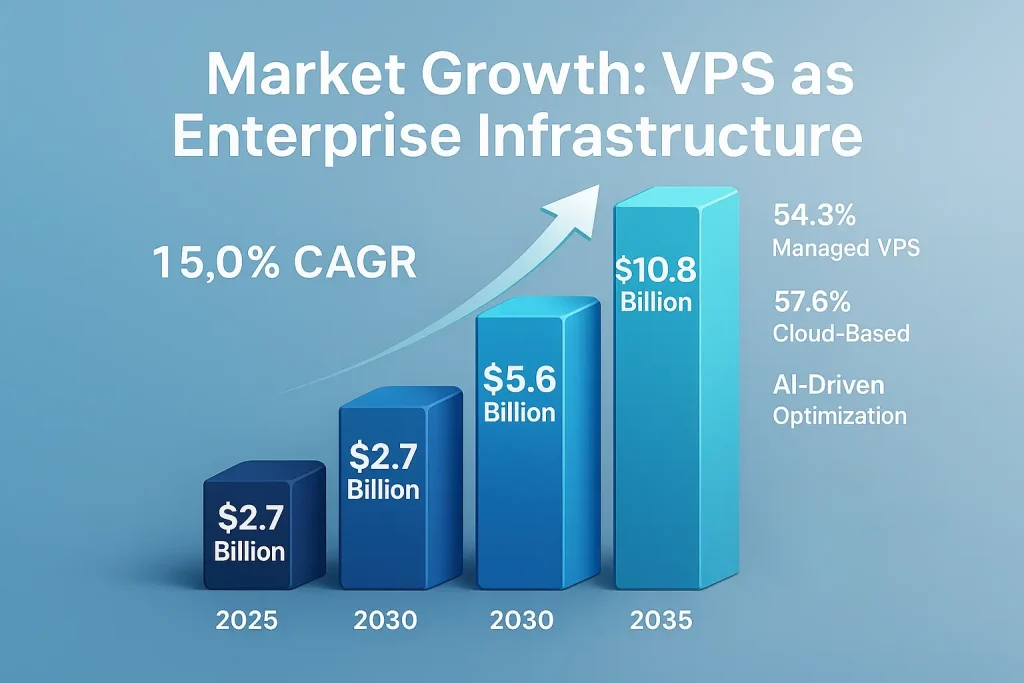
The VPS market reflects rapidly growing enterprise adoption. The VPS market is projected to grow from USD 2.7 billion in 2026 to USD 10.8 billion by 2035, representing a 15.0% CAGR. This explosive growth is driven by enterprises recognizing VPS advantages: managed VPS represents 54.3% of market share in 2026, while cloud-based VPS holds 57.6% of revenue share, indicating strong demand for automated, intelligent hosting.
The adoption is accelerating in critical markets: China is VPS CAGR accelerated to 20.3 (2026-2035), India 18.8 and the United States increased to 12.8. The acceleration is directly linked to the integration of AI, as intelligent resources management was not possible enough to do manually before.
Real-Time Usage Monitoring: AI systems continuously analyze CPU, memory, disk I/O, bandwidth, and network metrics. Unlike static threshold-based monitoring, AI establishes dynamic baselines that adapt to actual application behavior. The system learns your specific workload patterns and adjusts expectations accordingly.
Predictive Resource Forecasting: Machine learning models analyze historical data combined with real-time indicators to predict future requirements before demand arrives. This shift from reactive to predictive infrastructure prevents performance degradation before users experience slowdowns.
Intelligent Anomaly Detection: AI distinguishes between normal usage variations and genuine anomalies. A one-time traffic spike from social media shares differs fundamentally from sustained demand growth, AI recognizes this difference, preventing unnecessary permanent upgrades while ensuring capacity for genuine increases.
Continuous Optimization: Rather than static configurations, AI continuously refines resource allocation as your application evolves. Database queries become more complex, traffic patterns shift, or code changes alter resource requirements, AI adapts automatically without manual intervention.
Reduced Infrastructure Investment: AI identifies both under-utilized and over-provisioned resources. Organizations implementing AI-driven monitoring recover investment in monitoring solutions within months through fewer outages and optimized resource allocation. One documented case involved turning off 25-30 servers during lean hours after implementing AI optimization, directly reducing cloud expenses without performance impact.
Faster Incident Response: Modern AI monitoring improves mean time to discovery (MTTD) by 15-20%, with organizations anticipating 40-50% improvements in mean time to resolution (MTTR) as systems mature. This translates to fewer customer-impacting outages and dramatically reduced response overhead.
Improved Efficiency: AI reduces false positive alerts by 90%+, allowing operations teams to focus on genuine issues rather than investigating noise. This efficiency gain is documented across enterprises implementing smart baselining and data-driven analysis.
Cost Optimization: By identifying exact resource requirements, AI eliminates the expense of over-provisioning. Organizations typically achieve 25-30% cost reduction while maintaining superior performance—a rare achievement of simultaneous cost and performance improvement.
Track Key Performance Indicators: The most important metrics include model accuracy, precision, recall, and F1 scores for predictive models; plus business KPIs like uptime, MTTR, and resource utilization for infrastructure performance.
Implement Automatic Topology Discovery: Modern monitoring tools automatically map infrastructure and identify dependencies without manual configuration. This automated discovery prevents misconfigurations and ensures comprehensive monitoring coverage.
Create Business-Service Mapping: Link technical components to business processes to understand the actual business impact of infrastructure issues. A database latency increase means different things for an API service versus a reporting system.
Enable Smart Baselining: Allow the AI system adequate time to observe normal operating patterns before enabling predictive alerts. Most systems require 1-4 weeks to establish accurate baselines.
Validate AI Recommendations: Human expertise remains valuable for validating critical recommendations and understanding context. AI excels at pattern recognition; humans provide business context and approve changes.
E-Commerce Peak Optimization: Predictive analytics forecasts Black Friday traffic based on historical patterns, marketing spend, and inventory. AI automatically stages resources before the shopping event, ensuring performance throughout peak demand. After the event, resources scale down automatically, eliminating weeks of over-provisioning costs.
Streaming Platform Reliability: A media company used AI to monitor real-time traffic anomalies. Unusual bandwidth usage patterns triggered immediate alerts, enabling proactive bandwidth adjustments that prevented buffering, reducing support tickets by 40% while increasing customer satisfaction.
Development/Staging Optimization: Teams running multiple staging environments benefit from AI identifying unused containers and consolidating workloads. One organization reduced staging infrastructure costs by 35% while maintaining development team productivity.
Companies that use AI-based insights to host VPS have a clear competitive edge: reduced response time, cost optimization, predictable scalability, and uninterrupted increases in performance without human involvement. This competitive edge will be available to both large and small organizations because of the convergence of the relatively low-cost AI monitoring platforms with more developed machine learning models.





 Lifetime VPS Europe
 Lifetime VPS Asia
 Lifetime WooCommerce Hosting
 Lifetime Hosting
 France Lifetime Dedicated Servers
 Germany Lifetime dedicated servers
 Lifetime Game Dedicated Servers
 Chicago, US
 Tokyo, Japan
 Singapore
 Hong Kong
 Seoul, South Korea
 Amsterdem, Netherlands
 London, UK
 Stockholm, Sweden
 Oslo, Norway
 Vienna, Austria
 Zurich, Switzerland
 Sydney, Australia
 Wordpress Hosting
 VPS Hosting
 DDOS Protection
 Submit Ticket
 Full Management
 Guides
 Videos and Podcasts
 Discover Creative Ideas
 MetaAgentOS High-Ticket Support System
 Voxfor Mega Menu
 Voxfor Advanced Price Management For WooCommerce
 Voxfor Secure Live Chat and AI Support
 Voxfor Multilanguage
 Voxfor AI Content Summary


