
Virtual Private Server (VPS) hosting powers modern digital infrastructure, but traditional static resource allocation creates significant inefficiencies. Over-provisioning wastes money; under-provisioning crushes performance. Manual configuration of organizations to meet peak demand means that organizations spend money on the ability to achieve no more than 20 percent of their capacity utilization. This is permanently fixed by AI-based resource optimization, which involves machine learning to aid in predicting the demand, automatically distributing only the necessary ones and making hosting an act of intelligence and not firefighting.
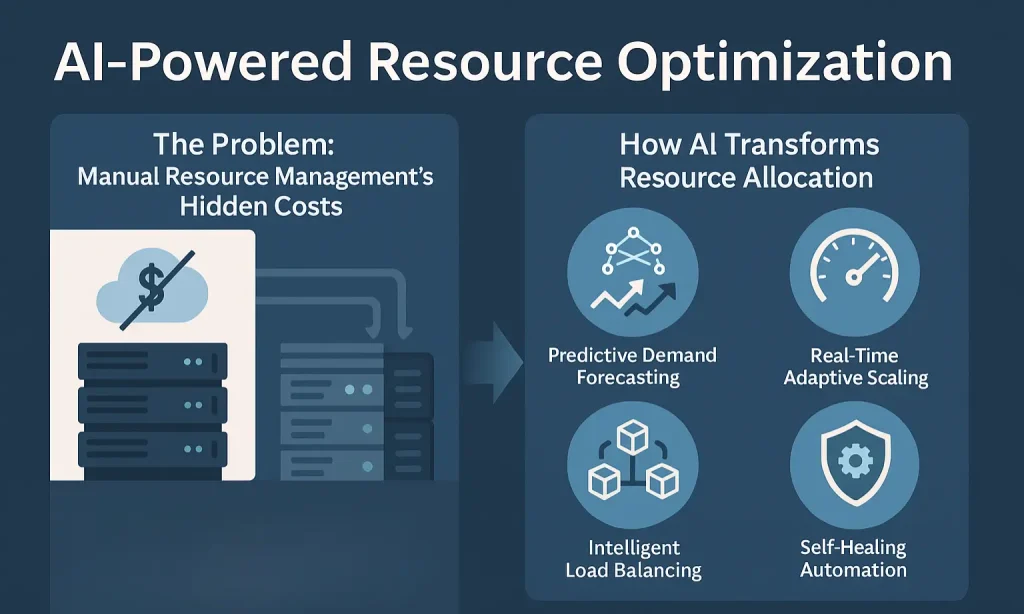
VPS environments have an inherent weakness: the administrators allocate resources on a best-guess basis rather than based on actual demand. Statics are incapable of responding to unexpected traffic bursts, daily rhythms, or seasonal changes. An abrupt marketing exercise or spurt in viral content overloads the resources, with performance declining or emergency scaling. Meanwhile, when the season is not at its peak, the resources that were allocated are not wasted.
Predictive Demand Forecasting: Machine learning models analyze historical data, traffic patterns, user behavior, and external factors to forecast resource requirements days or weeks in advance. Rather than scrambling during peaks, infrastructure scales automatically beforehand, eliminating performance degradation.
Real-Time Adaptive Scaling: The system continuously monitors CPU, RAM, disk I/O, and network metrics, making dynamic allocation decisions within seconds, not hours. When demand changes unexpectedly, AI responds immediately, preventing both bottlenecks and waste.
Intelligent Load Balancing: Machine learning means that none of the VPS instances will become over-utilized and other idle, the workloads will be distributed in the most optimal way possible among the resources, and the overall infrastructure efficiency will be maximized.
Self-Healing Automation: AI systems automatically detect and correct misconfigurations, failing hardware, software bugs, and anomalous activity without human intervention, reducing downtime and maintenance overhead.
Resource Utilization Improvement: Machine learning means that none of the VPS instances will become over-utilized and other idle, the workloads will be distributed in the most optimal way possible among the resources, and the overall infrastructure efficiency will be maximized.
Response Time Reduction: The same LSTM+DQN approach reduces average response time by 43.3%, directly improving user experience and conversion rates.
Operational Cost Savings: Organizations that use smart resource allocation save on operations costs of 26.6, which leads to an eradication of unwarranted over-provisioning without any performance losses.
Prediction Accuracy: Neural network-based performance prediction methods achieve over 90% accuracy in application identification and resource forecasting, with some approaches surpassing traditional methods by 2x in prediction accuracy.
Energy Efficiency: LSTM and Simple Moving Average (SMA) algorithms reduce energy usage and SLA violations by 2.5x compared to other methods, translating directly to lower hosting costs.
The optimization of VPS in terms of intelligent resource allocation consists of monitoring the usage of resources, applying caching techniques, optimizing software layers, and using cloud services in a cost-efficient manner. The cumulative effect allows organizations to support more traffic using the same hardware, which is a significant boost in cost-per-transaction metrics.
Research from the University of Virginia and peer-reviewed studies demonstrates that ML-based workload prediction doesn’t compromise accuracy and dramatically improves provisioning decisions, preventing both under- and over-provisioning inefficiencies.
LSTM Network Prediction: Long Short-Term Memory networks are good at the patterns of workload over time, as they can be used to make correct multi-step predictions of future resource requirements.
Deep Q-Networks (DQN): Reinforcement learning algorithms learn optimal resource allocation strategies through continuous interaction with cloud environments, improving decisions automatically over time.
Real-Time Analytics: Smart resource allocation, Operations optimization and data analytics are applied to allocate resources effectively to ensure maximum productivity and a minimum of waste and make sure that no resource is deployed without alignment to organizational goals.
Automated Remediation: In case of problems, configuration drift, resource usage, and other unwanted activity, the AI mechanisms automatically take corrective measures and eliminate delays caused by humans.
Eliminate Over-Provisioning: By matching resources precisely to actual demand instead of peak scenarios, organizations stop paying for unused capacity.
Reduce Emergency Scaling: Predictive allocation prevents the expensive last-minute scaling that occurs during demand spikes.
Decrease Manual Overhead: Automation eliminates time-consuming manual resource adjustments, reducing administrative labor costs.
Extend Hardware Lifetime: Optimal utilization prevents the hardware degradation from idle over-provisioning, improving infrastructure ROI.
Start with Monitoring: Implement effective resource tracking systems to determine the right demand trends and past benchmarks.
Choose Appropriate ML Models: Match algorithms to your specific needs—LSTM for complex temporal patterns, simpler methods for straightforward predictions.
Continuous Model Improvement: Regularly retrain models with recent data to maintain accuracy as workloads evolve.
Test Before Full Deployment: Validate AI recommendations on non-critical systems before production-wide implementation.
Maintain Transparency: Ensure administrators understand AI decision-making for confidence in automated scaling.
The companies that embrace AI-based VPS resource optimization form clear competitive advantages: cost reduction and performance increase at once, which are quite uncommon and directly affect the profitability of the business.
With the sophistication of infrastructure and the growing demand of customers to work at any time and at their desired performance, manual management of resources is bound to give way to competitors who employ AI predictive capabilities.
The AI-based VPS resource optimization constitutes the transformation of the reactive, manual management approach to the proactive, intelligent distribution. Organizations use predictive analytics, real-time responsiveness, and automated decision-making to result in cost savings of 26-32, performance gains of more than 43, and resource usage gains of 18-32.





 Lifetime VPS Europe
 Lifetime VPS Asia
 Lifetime WooCommerce Hosting
 Lifetime Hosting
 France Lifetime Dedicated Servers
 Germany Lifetime dedicated servers
 Lifetime Game Dedicated Servers
 Chicago, US
 Tokyo, Japan
 Singapore
 Hong Kong
 Seoul, South Korea
 Amsterdem, Netherlands
 London, UK
 Stockholm, Sweden
 Oslo, Norway
 Vienna, Austria
 Zurich, Switzerland
 Sydney, Australia
 Wordpress Hosting
 VPS Hosting
 DDOS Protection
 Submit Ticket
 Full Management
 Guides
 Videos and Podcasts
 Discover Creative Ideas
 MetaAgentOS High-Ticket Support System
 Voxfor Mega Menu
 Voxfor Advanced Price Management For WooCommerce
 Voxfor Secure Live Chat and AI Support
 Voxfor Multilanguage
 Voxfor AI Content Summary


