Managing multiple web servers manually overwhelms even skilled IT teams. Traditional server administration requires constant monitoring, manual resource allocation, reactive troubleshooting, and time-consuming patch management. As infrastructure scales to thousands of servers, manual approaches become impossible. AI-driven multi-server management transforms this challenge, using machine learning and predictive analytics to automate operations, prevent failures, and optimize performance autonomously.
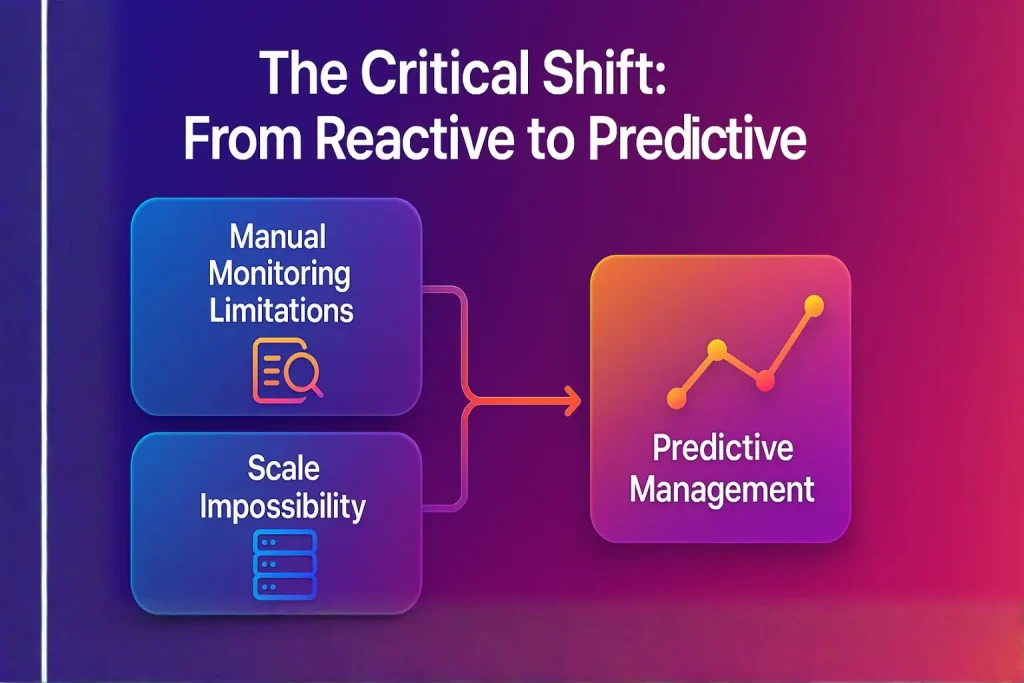
Traditional server management is reactive; an issue arises, followed by administrators being able to diagnose and correct it. This type of method establishes three disastrous failures:
Manual Monitoring Limitations: Administrators track metrics manually, searching logs when issues arise. This process is time-consuming, and solutions arrive too late to prevent user impact.
Inefficient Resource Allocation: Without predictive analytics, resources remain either over-provisioned (wasting money) or under-provisioned (degrading performance).
Scale Impossibility: Managing thousands of servers through manual coordination requires AI to analyze patterns and forecast issues across multiple machines simultaneously.
Predictive Maintenance: AI reduces server downtime by 30% or more through predictive maintenance powered by continuous metric analysis. Organizations implementing AI achieve 60% downtime reduction, 70% breakdown reduction, and 25% maintenance cost reduction.
Intelligent Automation: AI platforms are used to perform repetitive duties, implementing updates, patches, and security patches at the appropriate rate, keeping servers up to date and reducing opportunities for breaches and human mistakes.
Real-Time Anomaly Detection: Instead of fixed alarm levels, AI algorithms spot changes in regular activities, allowing for to detect and prevention of them with a minimum amount of downtime. False positives are reduced by half, and alert fatigue goes down.
Predictive Scaling: Machine learning forecasts future resource requirements based on historical patterns, seasonal trends, and external factors, enabling proactive capacity adjustments.
Optimized Load Balancing: AI does not simply move traffic evenly, but dynamically, taking into account the health of servers, latency, location and the cost of electricity to send traffic most optimally.
When used with an AI-powered analytics, such as DataForge, Zabbix can transform the process of monitoring as it is able to process the metrics of servers (CPU, RAM, I/O, network) and create dynamic baselines per server. Key capabilities:
Advanced Anomaly Detection: Machine learning algorithms identify more elaborate patterns that are not identified by static rules, minimizing false positives and concentrating on real problems.
Multi-Metric Context: Instead of looking at the individual metrics, AI would analyze several metrics at the same time and correlate temperature and power usage, CPU and memory usage to identify anomalies in system-specific scenarios.
Temporal Dependencies: AI learns that certain values are expected at specific times, eliminating false alarms during scheduled backups or maintenance windows.
Cross-System Learning: Models comprehend interdependencies of many systems and services and identify cascading problems at their inception.
While tools like Zabbix excel at detecting anomalies, the next evolution in server management is autonomous resolution. This is where Voxfor MetaAgentOS bridges the critical gap between alert and action. MetaAgentOS, in contrast to typical monitoring, which merely informs a server administrator, can utilize sophisticated AI algorithms (Claude 4.5 Sonnet and Opus 4.1) to interpret the surrounding of the alert and identify the underlying cause, and perform the required fix, be it restarting a hung service, rebalancing load or patching a vulnerability, safely and securely. This feature can turn a multi-server management into a watch and respond process to a self-healing infrastructure.
The numbers confirm AI’s transformative role. The global server automation market grew from $3.89 billion (2024) to a projected $8.67 billion (2030), driven by demand for zero-touch provisioning, automated patching, and predictive maintenance. Organizations increasingly adopt AI-driven automation, with 65% reporting active generative AI use in 2025 (up from 32% in 2024).
AI anomaly detection reduces root cause analysis by 60 per cent, cutting down the troubleshooting time. Predictive maintenance enhances productivity by 25, decreases breakdowns by 70, and decreases maintenance costs by 25 (Deloitte).
Additional documented benefits:
AI monitors access logs, user behavior and network traffic continuously to identify and take action against suspicious activities quicker than conventional security mechanisms. This is proactive security that preempts breaches prior to the systems being compromised.
Start with Assessment: Assess the existing infrastructure and pinpoint bottlenecks, blind spots and places where unexpected downtime is likely to happen.
Choose Compatible Tools: Select AI platforms offering predictive scaling, automated threat detection, and intelligent load balancing compatible with existing stacks.
Gradual Migration: Validate AI benefits on non-critical systems before full production deployment.
Continuous Training: Allow AI systems adequate time to establish accurate behavioral baselines before enabling full automation.
Measure Impact: Track downtime reduction, alert accuracy, resource utilization efficiency, and cost savings to validate ROI.
The leading vendors, such as Microsoft, IBM, BMC Software, and Red Hat, make available brilliant automation tools that lessen the number of errors made by hand, enhance compliance and uptime. Companies that apply AI to their managerial systems experience quantifiable competitive benefits: 60% decrease in downtimes, 50% false alerts, 70% reduction in breakdowns, and 25% cost reduction.
In the case of hosting providers that operate in multi-server environments, AI integration is not a choice; it is a necessity to stay competitive, keep reliability, and ensure the operational costs are under control in more and more complex digital infrastructure.





 Lifetime VPS Europe
 Lifetime VPS Asia
 Lifetime WooCommerce Hosting
 Lifetime Hosting
 France Lifetime Dedicated Servers
 Germany Lifetime dedicated servers
 Lifetime Game Dedicated Servers
 Chicago, US
 Tokyo, Japan
 Singapore
 Hong Kong
 Seoul, South Korea
 Amsterdem, Netherlands
 London, UK
 Stockholm, Sweden
 Oslo, Norway
 Vienna, Austria
 Zurich, Switzerland
 Sydney, Australia
 Wordpress Hosting
 VPS Hosting
 DDOS Protection
 Submit Ticket
 Full Management
 Guides
 Videos and Podcasts
 Discover Creative Ideas
 MetaAgentOS High-Ticket Support System
 Voxfor Mega Menu
 Voxfor Advanced Price Management For WooCommerce
 Voxfor Secure Live Chat and AI Support
 Voxfor Multilanguage
 Voxfor AI Content Summary


