The SaaS marketing will be tremendously different from what it was before. As AI-based personalization has become table stakes, community-based growth challenges product-based growth, and retention metrics are being squeezed, SaaS marketers have a new rulebook.
SaaS marketing remains fundamentally the selling of recurring-revenue software, but the definition now encompasses a much broader set of tactics.
Original Definition: “The process of promoting and selling a software product with a license, or recurring revenue, cash flow.”
Current Reality: SaaS marketing is the strategic combination of product-led growth, community-led interaction, AI-customized substance, customer accomplishment robotization, and resultant-based message to gain, mobilize, keep, and broaden a recurring-income software cast and uphold a lucrative unit economics.
Key Shifts
The original article focused on generic SaaS companies. Today, the market has splintered:
Horizontal SaaS: General tools for all industries (Salesforce, Slack, Asana)
Vertical SaaS: Industry-specific solutions, growing at 23.9% CAGR and reaching $157.4 billion by 2025
Enterprise SaaS: Complex, high-touch sales cycles
SMB/Self-Serve SaaS: Freemium models with rapid onboarding
The market stratification means one-size-fits-all marketing no longer works.
Why Do SaaS Companies Need a Marketing Strategy?
Market Growth
The US SaaS market is estimated at $299 billion (up from ~$150 billion in 2020)
80% of B2B SaaS sales now take place online (digital-first execution is mandatory)
50% of organizations are projected to use project management tools by 2026, creating an integrated ecosystem that demands
87% of SaaS companies report heightened growth through AI-powered personalization
Omnichannel orchestration (70% of B2B buyers engage across multiple touchpoints before sales contact)
Steps to Create Your SaaS Marketing Strategy
Develop a Great Product or Service (Unchanged Principle, Evolved Application)
The original guidance remains valid: identify problems customers face and solve the most costly ones.
2025 Enhancement:
Product-led growth is now standard. Your product IS your marketing. Freemium models, free trials, and self-serve onboarding are expected, not optional.
Outcome metrics matter more than features. Customers want to know: “How much revenue will this generate?” or “How much time/cost will this save?” Not: “Does it have 47 integrations?”
Community involvement in product development is now essential. Companies like Slack, Discord, and Notion succeed because users shape the product roadmap.
Actionable Step: Set up a user advisory board or community feedback loop. Track feature requests and show customers that their input was implemented.
Understand Your Target Audience (Critical—Now More Nuanced)
The original advice was solid but incomplete. In 2025, understanding the audience means segmentation at multiple levels:
Segment By:
Company size: Enterprise (needs sales team + custom features) vs. SMB (self-serve friendly)
Buying committee: Individual contributor, manager, director, C-suite (each has different pain points)
Industry vertical: Segment messaging by industry-specific challenges
Maturity level: Early-stage vs. growth-stage vs. mature companies
Adoption readiness: Tech-forward early adopters vs. skeptical traditionalists
Tool: Use intent data (tools like 6sense, Demandbase) to identify buying signals before outreach.
Set Goals and KPIs (Now More Sophisticated)
The original article listed solid metrics: conversion rate, CAC, LTV, MRR, ARR, churn, and traffic.
2025 Additions, Critical Metrics Now:
Retention Metrics (More Important Than Acquisition):
Net Revenue Retention (NRR): Median is 106% in 2025; top performers exceed 120%
Gross Revenue Retention (GRR): Median 90%, top quartile 95%+
Feature Adoption Rate: Median 60%; customers engaging 70%+ of core features are 2x more likely to stay
First-Year Retention: Improved onboarding now boosts retention by 25%
Why This Matters: The initial ProfitWell experiment (retention is 2-4X greater impact than acquisition) is not refuted; however, benchmarks are narrowed down. Maintaining the current customers by 1 percentage point will pay off more than obtaining new customers at a high CAC.
Real Data (2025):
Customer acquisition costs rose 14% year-over-year
Smaller companies ($1M–$10M ARR) hover at 98% NRR and 85% GRR
Companies leveraging product usage data report 15% higher retention than those that don’t
Structured onboarding programs boost first-year retention by 25%
Updated KPI Framework: Instead of just tracking CAC and LTV, track:
Magic Moment Time: How quickly do free trial users experience core product value?
Activation Rate: What % of trial users complete onboarding and use key features?
Expansion Rate: What % of customers expand to higher tiers or add-ons?
NRR Trend: Is expansion revenue outpacing customer losses?
Evaluate Your Competition (Tools Evolved)
The original article recommended SpyFu. In 2025, more sophisticated competitive intelligence tools exist:
LinkedIn Sales Navigator: See who’s buying from competitors
Customer interviews: Ask customers why they evaluated competitors and what made them choose you
Competitive Advantage: Analyze your competitor’s customer success stories, case studies, and testimonials, not just their SEO strategy. What outcomes are they promising? What industries are they targeting? Where are they weak?
Optimize Your Website for Conversions (Fundamentally Important—Now Science-Based)
The initial paper featured a minimalistic design and CTAs. By 2025, conversion rate optimization (CRO) will have evolved to an advanced level:
Homepage Optimization:
Refine value proposition (not feature dump)
Hero section should answer: “Who is this for?” and “What problem does it solve?” in under 5 seconds.
Social proof integration: customer logos, review ratings, testimonials
Show what the customers are receiving as opposed to what they are not receiving.
Mobile-responsive (79% of traffic demands mobile-first design)
CTA buttons should be the most prominent element
Signup Flow:
Minimize required fields (reduce friction)
Show progress indicators
Personalized error messages (not generic “Error”)
Post-signup experience should immediately deliver value
Performance Requirements:
Page load time: under 3 seconds (mobile: critical)
Mobile conversion optimization: buttons sized for thumb-tapping
A/B test everything: headlines, CTAs, form fields, page layout
Real Data:
79% of traffic is mobile
Exit-intent offers still work (but time-triggered and scroll-based triggers outperform)
The simplified signup forms are better than the long forms by 30-50%
Video on homepage increases conversion by 2-5%
Leverage Content (AI-Enhanced, Not Replaced)
The original article cited: “Consumers are 131% more likely to buy from brands that create educational content.”
Update: This remains true, but content now has new dimensions:
Content Strategy Overhaul:
Only 29% of SaaS marketers say their content strategy is very effective (70% are struggling)
The issue: volume over value. Successful companies focus on high-impact, long-form, SEO-optimized content
AI-powered thought leadership content yields 156% higher ROI than traditional formats
Content Types That Convert:
Educational Guides: Deep-dive articles solving specific problems (900-2000 words, SEO-optimized)
Case Studies: Real customer outcomes (not generic testimonials)
Webinars & Demos: Generates 73% higher-quality leads than other channels and costs 90% less than in-person events
Vertical-Specific Content: Different messaging for different industries
AI-Dynamically personalized email content: Content blocks, which will dynamically change depending on subscriber data
AI’s Role in Content:
Content generation: AI drafts can save 60% of writing time; humans edit for accuracy and brand voice
Content personalization: AI analyzes user behavior to recommend the next article or case study
SEO optimization: AI suggests keywords, structure, and content length
Content distribution: AI automates scheduling and channel selection
Predictive analytics: AI forecasts which content topics will trend
Important Caveat: AI generates more content, but only human-reviewed, factually accurate, and strategically aligned content drives conversions. Generic AI-generated content underperforms.
Distribution Strategy: 61% of B2B buyers start with a web search. Content must:
Rank on Google (SEO optimization non-negotiable)
Be repurposed across channels (same blog article → LinkedIn post, email sequence, webinar)
Have a clear audience segment (not generic)
#7: Maintain a Strong Presence on Social Media (Platform Strategy Matters)
The original article used archaic statistics (Facebook numbers: 2.11 billion daily active users; LinkedIn: 134.5 million).
Wrong platform focus: Posting on Facebook when your audience lives on LinkedIn
Ignoring NRR: Only tracking CAC; ignoring retention means growth is unsustainable
No community: Missing out on lower-cost customer acquisition and advocacy
No competitive monitoring: Not tracking how competitors are positioning
Conclusion
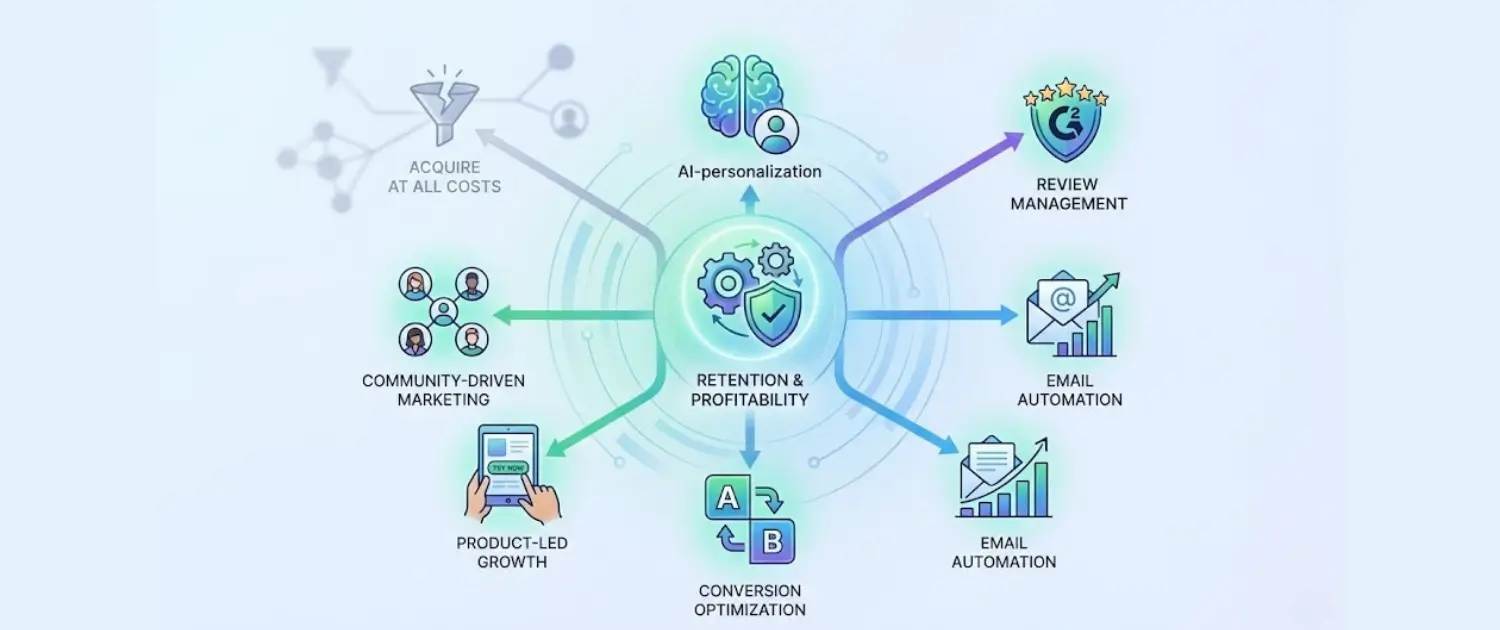
SaaS marketing is fundamentally different from 2023. The game has shifted from “acquire at all costs” to “acquire profitably and retain obsessively.”
Retention now drives more ROI than acquisition
AI-personalization is table stakes, generic marketing underperforms
Community matters, your best customers become your best marketers
Product-led growth is the default for self-serve SaaS
Conversion optimization is science, not art, A/B test everything
Email automation drives 2,270% higher conversions, this works at scale
Reviews influence 40% of enterprise purchases, manage your G2 rating obsessively
The SaaS companies winning in 2025 are those treating marketing as a data-driven, retention-focused, community-enabled function, not just a lead-generation engine.
About the writer
Hassan Tahir wrote this article, drawing on his experience to clarify WordPress concepts and enhance developer understanding. Through his work, he aims to help both beginners and professionals refine their skills and tackle WordPress projects with greater confidence.








 Lifetime VPS Europe
 Lifetime VPS Asia
 Lifetime WooCommerce Hosting
 Lifetime Hosting
 France Lifetime Dedicated Servers
 Germany Lifetime dedicated servers
 Lifetime Game Dedicated Servers
 Chicago, US
 Tokyo, Japan
 Singapore
 Hong Kong
 Seoul, South Korea
 Amsterdem, Netherlands
 London, UK
 Stockholm, Sweden
 Oslo, Norway
 Vienna, Austria
 Zurich, Switzerland
 Sydney, Australia
 Wordpress Hosting
 VPS Hosting
 DDOS Protection
 Submit Ticket
 Full Management
 Guides
 Videos and Podcasts
 Discover Creative Ideas
 MetaAgentOS High-Ticket Support System
 Voxfor Mega Menu
 Voxfor Advanced Price Management For WooCommerce
 Voxfor Secure Live Chat and AI Support
 Voxfor Multilanguage
 Voxfor AI Content Summary


