
Maturity of frontend engineering in 2026 is defined by the conclusive shift in the framework competition to architectural orchestration. In the past, the choice of a frontend library, which could be React or Vue, was a binding decision that predetermined the course of technical development of an organization over many years. Nevertheless, the introduction of sophisticated Micro-Frontend designs and the stabilization of Module Federation have changed this view to a modular ecosystem in which various technologies exist on the same user interface. Such a paradigm shift also enables companies to use the unique advantages of different frameworks, like React strong complex data management ecosystem and Vue high performance reactivity as efficient widgets with ease, without affecting the integrity of the entire application.
The essence of this development is the breakdown of the monolithic frontend architectures to independently deliver units. It is common to imagine that by 2026, the idea of enterprise-scale applications is often visualized as a fleet of specialized vessels, as opposed to one, cumbersome ship. This solution addresses the inherent weakness of monoliths, which is that a breakdown in a small detail can historically expose the whole user experience to potential ruin. Development teams today coordinate a seamless experience through a so-called Main Shell or host application, using which functional blocks are pulled in on-the-fly. This LEGO block approach makes innovation fast, with each module being able to be patented, refactored, or even completely replaced with current tools such as the React Compiler or Vue Vapor Mode, without the whole site needing to be recreated.
The following table provides a comparison of the key performance and architectural metrics that define the 2026 frontend environment for React 19.2 and Vue 3.5, the leading frameworks utilized in these federated setups.
| Metric | React 19.2 (2026 Standard) | Vue 3.5 (2026 Standard) |
| Typical Starter Bundle Size | 32–40 KB | 18–22 KB |
| Typical Hydration Time | 40–70 ms | 25–45 ms |
| Core Performance Engine | React Compiler (Automatic Memoization) | Vapor Mode (No-VDOM Option) |
| Primary Meta-Framework | Next.js (RSC-focused) | Nuxt 3 (Signal-focused) |
| Data Reactivity | Stable Hooks & Shared Caches | Fine-grained Signals |
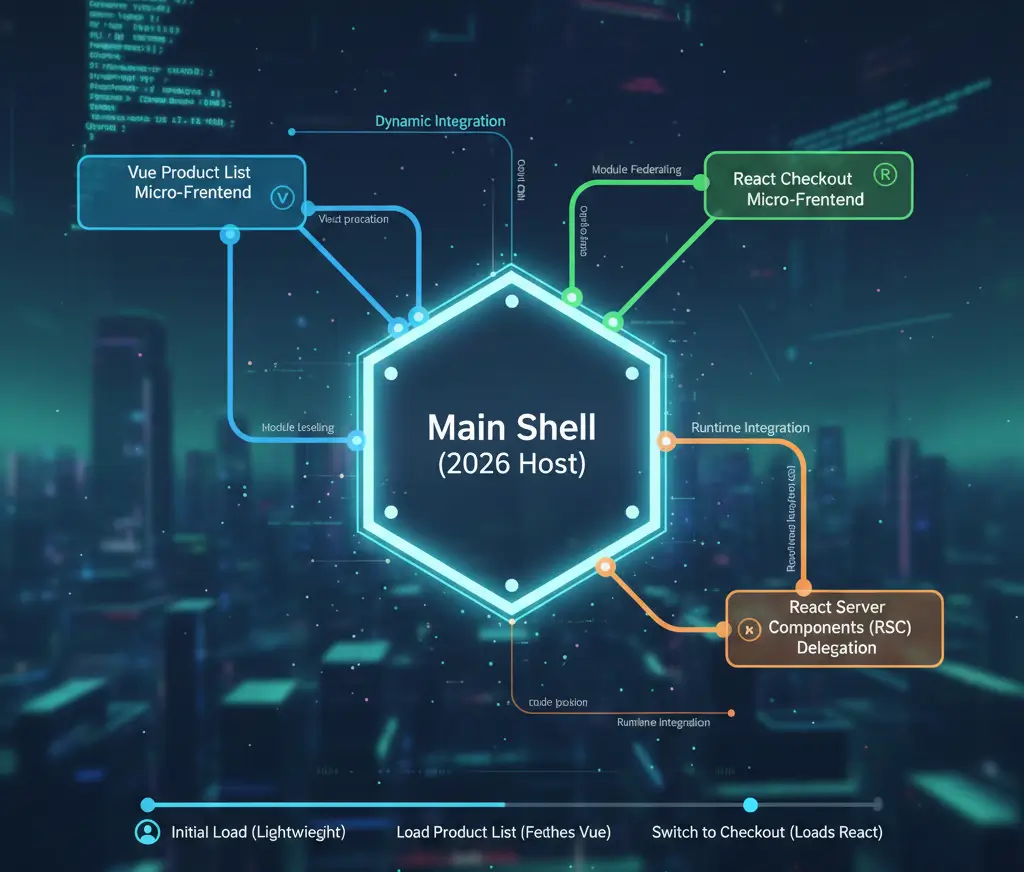
The deployment of a multi-framework environment requires an advanced “Main Shell or container application, or host application. The shell is the lifecycle manager of the application, and in 2026, it is in charge of not just routing and global authentication but also dynamically loading remote modules. It is usually constructed on a stable, highly compatible framework, commonly React, since it has prevailed in enterprise-grade administrative and dashboard usage. Nonetheless, its major role is to be framework-agnostic as far as the modules it consumes are concerned. The shell is a defining point of entry, defining layout and high-level routing rules such that each micro-frontend is the one to be used at a given time, depending on the current URL of the user.
The operational efficiency of the shell depends on its ability to handle “Runtime Integration.” Unlike traditional build-time integration, where modules are bundled together into a single file, 2026 architectures utilize Module Federation to load code only when a specific route or feature is accessed. This ensures that the user’s initial load remains lightweight, as the browser only downloads the shell and any critical initial modules. For example, if a user navigates to the “Product List,” the shell identifies that this section is a remote module built in Vue and fetches its assets from a dedicated CDN. If the user then switches to the “Checkout” page, which might be built in React, the shell unmounts the Vue instance and dynamically loads the React-based checkout module.
One of the most significant advancements in shell architecture is the integration of “RSC Delegation.” In high-performance systems, the shell can delegate specific React Server Components to different micro-frontends or separate servers. This optimization ensures that resource-intensive operations are handled on the server, sending only the final UI structure to the client and drastically reducing the amount of JavaScript that must be executed in the browser. This pattern is particularly useful when integrating React and Vue, as the shell can manage the server-side rendering of the common layout while allowing the client-side frameworks to take over for highly interactive islands.
The technical feasibility of mixing React and Vue is underpinned by Module Federation 2.0. This technology, which evolved from the original Webpack 5 feature, has become the industry standard for runtime module sharing. By 2026, Module Federation will no longer be confined to Webpack; high-speed build tools like Rspack and Vite 6 support it. Rspack, in particular, has gained massive adoption in large-scale enterprise environments because it is written in Rust, providing build speeds that are five to ten times faster than legacy JavaScript-based bundlers. This speed is essential for teams working in monorepos where multiple frameworks and dozens of micro-frontends must be compiled and linked simultaneously.
Module Federation 2.0 introduces several features that are critical for framework coexistence. Dynamic TypeScript type hints allow developers to maintain type safety even when consuming modules across different framework boundaries. Furthermore, improved preloading strategies enable the host application to intelligently predict which remote modules the user will need next based on their behavior, effectively masking the network latency of loading a new framework runtime. This creates a “seamless” transition where the user cannot distinguish between a natively loaded component and a federated remote module.
The relationship between the host and remote modules is governed by a “Remote Entry” manifest file. This file acts as the bridge, describing what specific modules are exposed, what their dependencies are, and how they should be initialized. In a multi-framework setup, the manifest is particularly important for dependency management. If both a React host and a Vue remote require a shared utility library like Lodash, Module Federation ensures that only one copy is loaded into the browser memory, preventing the “dependency bloat” that previously made multi-framework applications impractical.
The integration of Vue modules into a React host requires a specialized “Mounting” strategy to reconcile the different lifecycles and rendering mechanisms of the two libraries. Because React and Vue have distinct virtual DOM implementations, they cannot directly interact at a component level. Instead, the standard 2026 approach utilizes a wrapper component that serves as a bridge. This wrapper is a standard React component that, upon mounting, creates a new Vue application instance and attaches it to a specific DOM element within the React render tree.
The lifecycle management of this integration is performed using React useEffect hook. When the wrapper component is rendered, the useEffect hook triggers the initialization of the Vue app using Vue createApp method. This process involves fetching the remote Vue component via a dynamic import and then mounting it to a “ref” provided by React. To maintain a clean environment and prevent memory leaks, the cleanup function of the useEffect hook must explicitly call the Vue instance’s unmount method when the React component is removed from the DOM. This ensures that all reactive observers and event listeners within the Vue module are properly disposed of.
For more complex scenarios, “Bridge” libraries like @module-federation/bridge-react and @module-federation/bridge-vue3 have become the preferred standard. These libraries provide application-level exports that automatically handle the framework-specific initialization and routing synchronization. By using a bridge, a complete Vue application, including its internal routing and business logic- can be loaded into a React host as a single module. This is particularly advantageous for large-scale migrations where an existing Vue monolith is being integrated into a new React-based architecture.
The following table outlines the technical workflow for integrating a Vue remote into a React-based host application using the standard 2026 Module Federation 2.0 configuration.
| Stage | Action | Responsibility | Technical Mechanism |
| Configuration | Define Remotes | Host Application | vite.config.ts or rsbuild.config.ts |
| Exposure | Declare Public Modules | Remote Application | ModuleFederationPlugin exposes object |
| Loading | Dynamic Import | Host Application | React.lazy or import() function |
| Initialization | Create Vue Instance | Wrapper Component | createApp(RemoteComponent) |
| Execution | DOM Mounting | Wrapper Component | app.mount(“#target-id”) |
| Cleanup | Unmount Instance | Wrapper Component | useEffect return function app.unmount() |
One of the most complex aspects of using React and Vue together is preventing CSS bleeding, where styles from one framework component inadvertently affect the other. In a federated environment, CSS is global by default, meaning a single rule defined in a Vue module could potentially alter the appearance of the entire React host. By 2026, the industry will have standardized on “CSS Modules” as the primary defense against this fragmentation. CSS Modules automatically hash class names at build time, ensuring that a class name like .button becomes a unique string like.Button_button__x7z9q that cannot collide with styles from other modules.
For stricter isolation requirements, particularly when completely independent third-party teams develop modules, the Shadow DOM is utilized. The Shadow DOM creates a “private” DOM tree for a component that is hidden from global CSS rules. While this provides near-perfect isolation, it introduces challenges for modern utility-first frameworks like Tailwind CSS. Because Tailwind relies on global utility classes, those classes are often blocked by the shadow boundary. Consequently, 2026 developers frequently use “Tailwind Prefixing” where every Tailwind class in a micro-frontend is prefixed with a unique identifier (e.g., mfe1-p-4), allowing Tailwind to work reliably without leaking styles to the host.
Visual consistency across frameworks is maintained through “Design Tokens” distributed via a shared npm package. These tokens are JSON-based definitions of an organization’s design language, including colors, typography, and spacing. By consuming the same design tokens, a React team using Styled Components and a Vue team using Scoped CSS can ensure that their components look identical to the end user. This technical alignment allows for a “Ransom Note” UI to be avoided, even when the underlying technologies are completely different.
The decentralization of the frontend makes state synchronization a significant challenge. In 2026, the prevailing architectural principle is “Local State First.” Each micro-frontend is encouraged to manage its own internal state independently to maintain the benefits of decoupling. Architects generally advise against sharing a single global state store (like a massive Redux or Pinia instance) across both React and Vue MFEs, as it creates tight coupling and makes independent deployments difficult. Instead, micro-frontends communicate via strictly defined interfaces.
For cross-cutting concerns like user authentication or theme settings, an “Event-Based Communication” model is favored. This approach utilizes the browser’s native CustomEvent API or a lightweight pub-sub system. For instance, when a user logs in via a React-based authentication module, it broadcasts a user:login event. A Vue-based dashboard module can listen for this event and update its display accordingly. This mechanism ensures that the modules remain framework-agnostic, as they only need to understand the event contract rather than the internal state of another module.
For scenarios requiring persistent data sharing without real-time synchronization, Web Storage (LocalStorage and SessionStorage) remains a reliable and simple solution. This is often used for non-reactive data like user preferences or cached API responses. By 2026, sophisticated teams also utilize “URL-Based State Management,” where the application state is encoded directly into query parameters. This ensures that the state is not only shareable across frameworks but also survives page refreshes and remains deeply linkable.
The following table summarizes the different state management strategies utilized in 2026 multi-framework environments.
| Strategy | Mechanism | Level of Coupling | Best Use Case |
| Local State | useState / ref | Zero | Component-internal logic |
| Custom Events | window.dispatchEvent | Very Low | Cross-module notifications |
| Shared Kernel | Library-based (Zustand) | Moderate | Global Auth / Permissions |
| URL / Query | URLSearchParams | Low | Filtering, Search, Pagination |
| Web Storage | localStorage | Low | Persistent User Preferences |
The primary argument against mixing React and Vue has traditionally been the performance overhead of loading multiple framework runtimes. In 2026, this “Framework Tax” is mitigated through “Aggressive Dependency Sharing” Module Federation allows the host application to act as a central repository for shared libraries. If both a React host and a Vue remote require a specific version of a library like Axios or D3, the host can be configured to provide these as singletons. This means the browser only downloads the library once, regardless of how many micro-frontends use it.
Furthermore, the shift toward “Edge Rendering” has significantly improved initial load times for federated applications. By 2026, meta-frameworks like Next.js and Nuxt can render the shell and critical modules at the network edge, closer to the user. This reduces the time to first byte and allows the browser to begin parsing the HTML and pre-fetching remote framework runtimes before the user even interacts with the page. This strategy is essential for maintaining high Core Web Vitals scores in a multi-framework environment.
Build-time optimizations have also advanced with the introduction of the React Compiler and Vue Vapor Mode. The React Compiler automatically memoizes components, eliminating the need for manual optimization and reducing unnecessary re-renders in a federated host. Simultaneously, Vue Vapor Mode allows specific Vue-based micro-frontends to be compiled without a Virtual DOM, resulting in “near-native” performance for small widgets. These advancements ensure that even if multiple frameworks are present on a page, they are operating at peak efficiency.
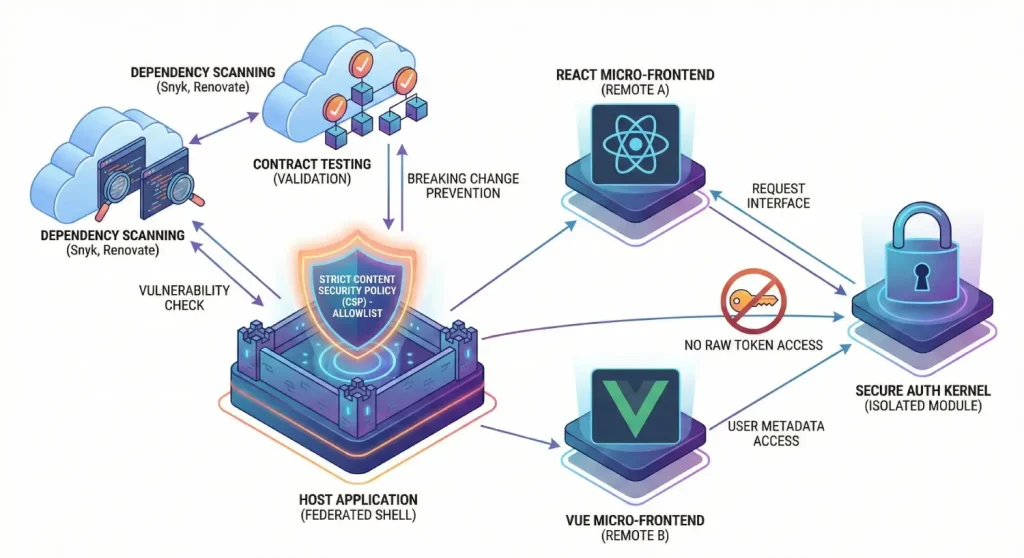
Security is a paramount concern when loading code from multiple remote origins into a single user session. In 2026, a “Strict Content Security Policy (CSP)” is mandatory for any federated application. The CSP acts as an allowlist, defining exactly which remote entry files can be executed and from which domains. This prevents “Rogue Script Injection,” where a compromised remote server could attempt to load malicious code into the main application. Without a robust CSP, a federated architecture is inherently vulnerable to cross-site scripting attacks originating from any of its modules.
Another critical security pattern is the “Isolation of Sensitive Tokens” Historically, developers often attached authentication tokens to the window object to make them accessible to all micro-frontends. In 2026, this is considered a high-risk anti-pattern. Instead, organizations use a “Secure Auth Kernel“, a dedicated, isolated module that manages the authentication lifecycle. This kernel provides other MFEs with an interface to make authenticated requests or retrieve user metadata, but it never exposes the raw token string to the other frameworks. This minimizes the impact of a potential vulnerability in any single micro-frontend.
Governance of the federated ecosystem is maintained through “Dependency Scanning” and “Contract Testing” Tools like Renovate or Snyk are used to scan all repositories in the fleet, ensuring that every micro-frontend, whether React or Vue, is using secure and up-to-date versions of shared libraries. Contract testing ensures that changes to an exposed module do not break the host’s expectations. This is particularly vital when frameworks are mixed, as a change in a Vue remote bootstrap function could inadvertently break the React host wrapper component if not properly validated.
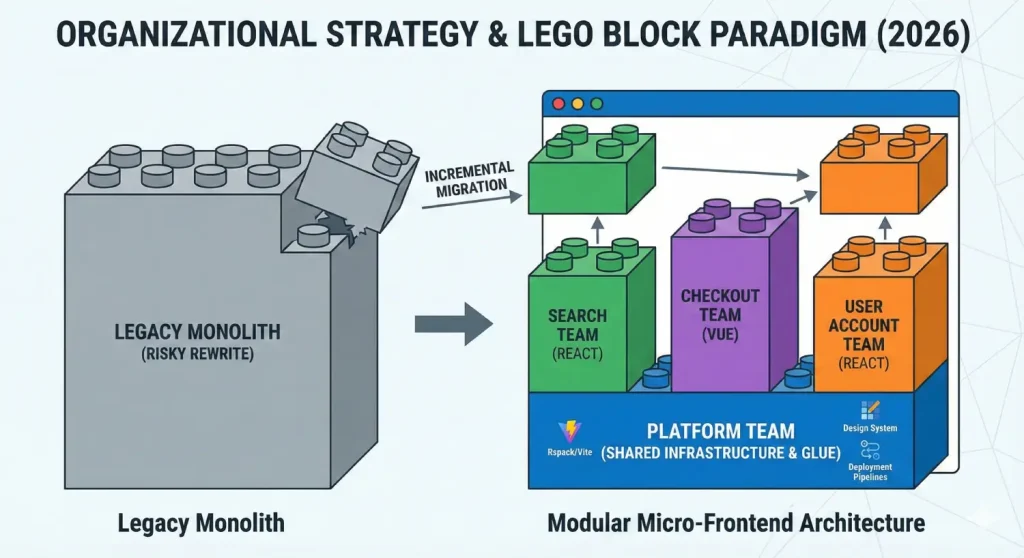
The move toward using React and Vue together is fundamentally an organizational strategy designed to solve team bottlenecks. By 2026, large technology organizations have abandoned the idea of a single, unified frontend stack in favor of “Domain-Driven Design.” This allows teams to be organized around business value, such as the “Search Team” or the “Checkout Team“, rather than technical layers. Each team is given the autonomy to choose the tool that best fits their specific problem, provided they adhere to the shared contract of the federated system.
This “LEGO block” approach enables “Incremental Migration,” allowing companies to upgrade their legacy systems one piece at a time. Instead of a risky, multi-month rewrite of a massive monolith, a team can extract a single feature, rebuild it in a modern framework like Vue 3.5, and integrate it into the existing React-based monolith as a federated remote. This reduces the risk of the migration and allows the business to continue delivering value throughout the process. The ability to deploy different parts of the site at different speeds is the “Holy Grail” of 2026 frontend architecture.
Nonetheless, with this architecture, there must be a specialized group known as the Platform Team to maintain the infrastructure. This team will take care of the shared build tools (Rspack, Vite), the design system, and the deployment pipelines. They give the feature teams the glue that enables them to operate separately. Lack of such central orchestration results in a multi-framework environment that is prone to rapidly degenerate into a disorganized and uncontrollable mess. The great performance of the “LEGO block paradigm is more of a human coordination than a technical procedure.

Hassan Tahir wrote this article, drawing on his experience to clarify WordPress concepts and enhance developer understanding. Through his work, he aims to help both beginners and professionals refine their skills and tackle WordPress projects with greater confidence.





 Lifetime VPS Europe
 Lifetime VPS Asia
 Lifetime WooCommerce Hosting
 Lifetime Hosting
 France Lifetime Dedicated Servers
 Germany Lifetime dedicated servers
 Lifetime Game Dedicated Servers
 Chicago, US
 Tokyo, Japan
 Singapore
 Hong Kong
 Seoul, South Korea
 Amsterdem, Netherlands
 London, UK
 Stockholm, Sweden
 Oslo, Norway
 Vienna, Austria
 Zurich, Switzerland
 Sydney, Australia
 Wordpress Hosting
 VPS Hosting
 DDOS Protection
 Submit Ticket
 Full Management
 Guides
 Videos and Podcasts
 Discover Creative Ideas
 MetaAgentOS High-Ticket Support System
 Voxfor Mega Menu
 Voxfor Advanced Price Management For WooCommerce
 Voxfor Secure Live Chat and AI Support
 Voxfor Multilanguage
 Voxfor AI Content Summary


