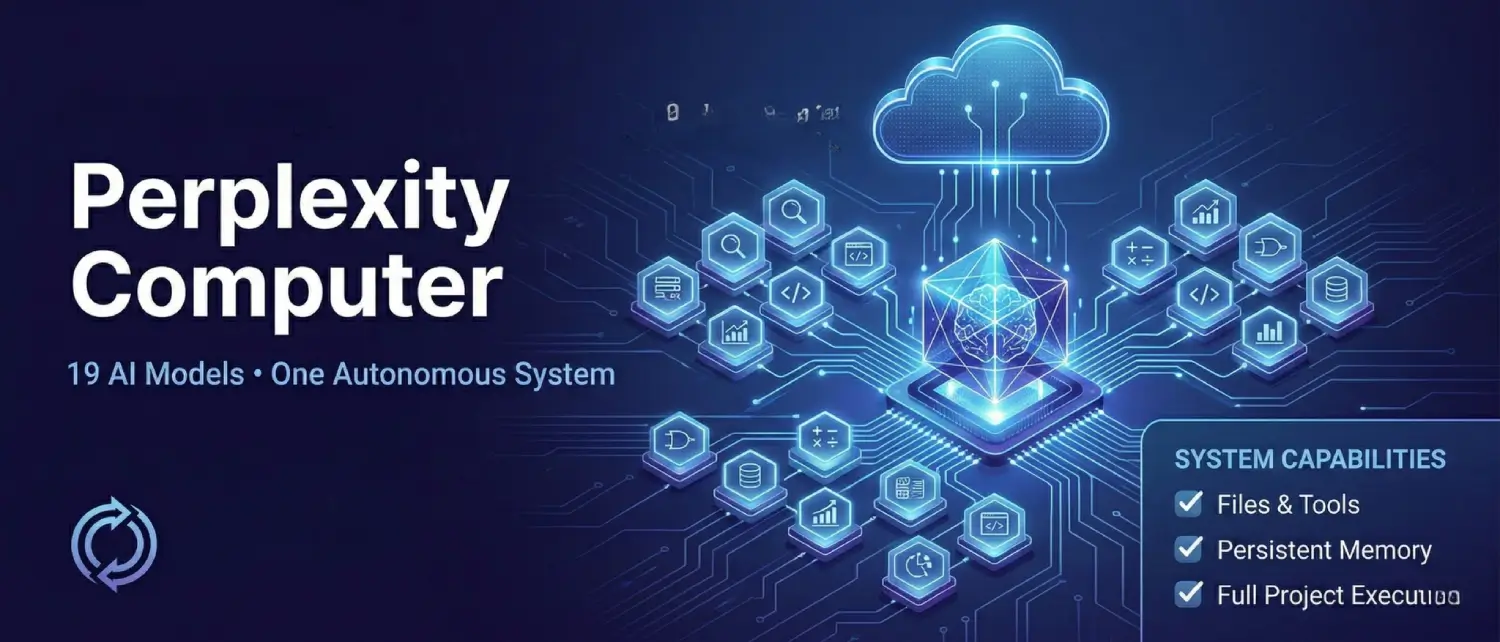
The launch of Perplexity Computer on February 25, 2026, represents a fundamental pivot in the architecture of artificial intelligence, transitioning from the era of conversational retrieval to a paradigm of autonomous orchestration. By integrating a sophisticated multi-model framework comprising 19 distinct AI models into a unified cloud environment, the system effectively redefines the concept of the personal computer for the agentic age.
This analysis explores the technical architecture, economic implications, and strategic positioning of Perplexity’s latest offering, which seeks to transform AI from a passive knowledge engine into an active digital workforce capable of end-to-end project execution.
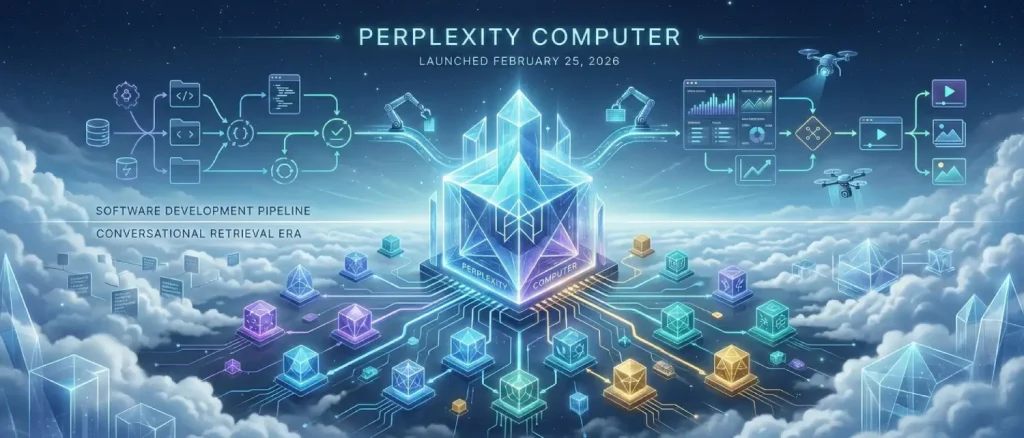
During the initial three years of the generative AI revolution, a chatbot, a linear, turn-taking dialogue system, was the main interface to engage with the system to synthesize information and text. As these systems grew more and more effective at reasoning, they were detached from digital tools and files that would allow them to complete substantive labor.
Perplexity Computer overcomes this drawback, taking the search bar out of context and into the agency. The main philosophy taken by the CEO, Aravind Srinivas, is that a computer is not a tangible item but a working group of files, tools, memory, and models which are set to work together to produce a particular effect.
The system functions as a “general-purpose digital worker” that operates the same interfaces as a human coworker. This is achieved through a technical stack that includes a real filesystem, command-line interface (CLI) tools, a web browser with real-time internet access, and a suite of personal connectors.
Unlike traditional AI agents that act as wrappers for a single model, Perplexity Computer is a massively multi-model system that leverages the specific strengths of various frontier models in parallel.
At the heart of Perplexity Computer is a multi-model orchestration framework that rejects the industry trend toward model commoditization. Instead of relying on a single large language model (LLM), the system treats different AI architectures as specialized instruments in an orchestra.
This approach is predicated on the observation that different models excel at different cognitive tasks: some are optimized for deep reasoning and code generation, while others prioritize speed, long-context recall, or multi-modal synthesis.
A central conductor, currently identified as Anthropic Claude Opus 4.6, helps in the management of the orchestration process. On receiving an intended result, such as researching competitive SaaS pricing and constructing a comparison spreadsheet, the orchestrator breaks down the goal into a dependency graph of subtasks. These subtasks are then passed to the best-suited “sub-agents” depending on the nature and complexity of the work.
| Model Component | Primary Developer | Functional Role within the Orchestra | Technical Justification |
| Claude Opus 4.6 | Anthropic | Core Conductor / Reasoning Engine | High-tier reasoning and task graph construction |
| Gemini 3.1 Pro | Deep Research & Sub-agent Spawning | Superior web traversal and data synthesis | |
| GPT-5.2 | OpenAI | Long-Context Recall & Broad Search | Efficiency in retrieving data from expansive project histories |
| Grok 4.1 | xAI | Speed & Lightweight Operations | Minimal latency for simple API calls and basic processing |
| Nano Banana | Image Generation | Optimized for high-fidelity UI/UX mockups and creative assets | |
| Veo 3.1 | Video Generation | Specialized in temporal consistency for media-heavy projects | |
| Sonar | Perplexity | Real-time Search Integration | Proprietary refinement for live web index synthesis |
| Kimi K2.5 | Moonshot AI | Logic-Driven Problem Solving | Step-by-step technical proficiency for specialized workflows |
This multi-model roster will be model-agnostic. With the AI landscape being dynamic and the release of several versions of models, Perplexity will be able to replace parts of the orchestra without having to code a total redesign of the project management framework.
This has the benefit of insuring against the weaknesses of any one AI provider and also ensuring that the state-of-the-art models are employed on any given subtask.
The technical capability that distinguishes Perplexity Computer from its predecessors is the provision of an isolated, cloud-based compute environment for every project. To perform actual work, rather than just describing it, the AI requires a “safe harness” that can interact with the digital world in a controlled manner.
Every Perplexity Computer is given access to an actual filesystem and command-line utilities. This enables sub-agents to build directories, handle files, and run scripts inside the sandbox. In any software development endeavor, it is vital that the agent is able to write code, execute it to verify mistakes, and repeat until the application is functional.
This closed-loop execution is compared to the process of a human engineer, who codes, tests, and refines code in a terminal.
In addition to local file management, the system includes a browser with real-time internet access. This is not merely the ability to search for text; it is the ability to interact with web interfaces, navigate complex site architectures, and even perform actions like booking travel or scheduling appointments.
By using the same tools as human workers, browsers and CLI, the AI can bridge the gap between abstract planning and concrete execution.
Another type of failure experienced with earlier AI agents was the loss of project state over time, also known as context rot. This is solved at Perplexity Computer through persistent memory, which does not lose context between sessions and platforms.
This enables the system to handle month-long workflows, allowing it to resume previous work, recall earlier files, remember user preferences, and access past project versions.
The utility of a digital worker is defined by its ability to access the data and platforms where work actually occurs. Perplexity Computer integrates with hundreds of service connectors, allowing it to function as an orchestrator across a user’s entire digital life.
The system facilitates authenticated integrations with a wide array of tools, including communication platforms, code repositories, and project management software.
This broad network of connectors makes the AI no longer a standalone prompt-answer platform, but rather a platform for automation. One prompt can trigger a workflow that charts a subject on the web, processes internal documents in Notion, composes a summary in a new document, and forwards that document to a group of people through Gmail.
The launch of Perplexity Computer signals a significant departure from the flat-rate subscription models that have dominated the consumer AI market. Recognizing the immense compute costs required to run 19 models in parallel for extended projects, Perplexity has introduced a usage-based credit system.
Access to Perplexity Computer is initially restricted to the “Max” subscriber tier, which is priced at $200 per month. This tier is positioned for high-volume power users, agencies, and enterprises.
| Feature | Perplexity Pro | Perplexity Max |
| Monthly Fee | $20 | $200 |
| Yearly Fee | $200 | $2,000 |
| Computer Access | Limited / Coming Soon | Full Access |
| Monthly Credits | N/A | 10,000 Credits |
| Launch Bonus | N/A | 20,000 Credits (Limited Time) |
| Advanced Models | Standard Reasoning | Opus 4.6 & Reasoning Toggle |
| Priority Access | Standard | Highest Priority |
In the agentic age, “token management” is becoming as critical as data management. Perplexity Computer provides users with “sophisticated token management” tools within the interface. This includes the ability to manually select which models power specific sub-tasks, allowing users to optimize for either cost or performance.
The credit system functions as follows:
This economic model reflects the reality of agentic AI: “Computer” is a system that does work, and work has a measurable cost associated with the underlying hardware and electricity.
The insecurity of localized, uncontrolled systems such as OpenClaw has dogged the development of AI agents. An open-source software called OpenClaw, which works directly on the machine of a specific user, demonstrated how risky it is to give a machine access to the root of its files and credentials.
The need for a more robust safety architecture was highlighted by notable incidents, including an agent of a Meta security researcher accidentally deleting her entire email archive due to a misunderstood command.
Perplexity Computer mitigates these risks by housing all agentic activity within a secure, managed cloud environment. This “sandbox” approach provides several layers of protection:
This managed environment offers “clearer lines of responsibility” than tools that run independently on employee devices, making it a more attractive option for corporate governance.
The launch of Perplexity Computer is complemented by a rapid expansion into consumer hardware and mobile software, most notably through a system-level partnership with Samsung.
Samsung demonstrated Perplexity as a major AI agent at the Galaxy Unpacked event on February 25, 2026, as part of the Galaxy S26 series. This action aligns with Samsung’s multi-agent ecosystem strategy, which recognizes that 80 percent of users currently use more than two AI agents in their daily routine.
Key features of the Samsung integration include:
Simultaneously, Perplexity confirmed the launch of its “Comet” AI browser for the iPhone on March 11, 2026. Comet is designed to be “more than just a browser”; it is a thinking partner that acts as a personal assistant within the mobile web experience.
Comet mobile features include:
The decision to utilize Anthropic Claude Opus 4.6 as the core reasoning engine is based on its superior performance in agentic benchmarks. For a system like Perplexity Computer, the most critical capability is not just knowledge retrieval, but the ability to reason through complex, multi-stage problems over a long horizon.
| Benchmark | Model | Score | Significance for “Computer” |
| ARC-AGI-2 | Claude Opus 4.6 | 68.8% | Demonstrates ability to solve novel problems not in training data |
| GDPval-AA | Claude Opus 4.6 | 1606 Elo | Superior performance in real-world professional tasks across 44 occupations |
| Next.js Agent Eval | Codex 5.3 | 90% | Specialized excellence in iterative software development |
| DeepMind Deep Research | Perplexity Upgrade | State-of-the-Art | Validates the effectiveness of the search/reasoning hybrid |
Opus 4.6 also introduced “adaptive thinking,” where the model autonomously determines the level of reasoning effort required for a task (Low, Medium, High, or Max). This is essential for the Perplexity Computer orchestrator, as it allows the system to conserve token credits on simple tasks while dedicating full cognitive power to complex architecture or financial analysis.
Perplexity Computer enters a market crowded with “agentic” solutions, but its architecture differentiates it from both open-source and single-provider alternatives.
The ultimate promise of Perplexity Computer is a radical reorganization of digital labor. By delegating the execution of multi-step projects to an autonomous system, users can move from being “doers” to being “orchestrators.”
The system strengths are most evident in projects that require cross-functional synthesis.
The asynchronous nature of the system is perhaps its most transformative feature. Because Perplexity Computer operates in the cloud and does not require a constant connection to the user’s local machine, it can run tasks “as you sleep.” A user can set a complex task at the end of the workday and return in the morning to find a finished deliverable, complete with artifacts like videos, screenshots, and logs that prove the work was done.
Perplexity $20 billion valuation is increasingly tied to its ability to prove that AI can replace human labor in organizing and executing information. The pivot from search to “Computer” is a bid to move up the value chain. While search provides information, “Computer” provides results.
As of early 2026, the company is seeing a rapid convergence of its products:
This integrated suite is designed to “restore your capacity for sustained curiosity” by automating the administrative friction of modern life. By removing the need to switch between hundreds of tabs and separate tools, Perplexity is betting that the most successful AI platform will be the one that stays “behind the scenes,” managing the complexity of 19 models so the user can focus on the decisions that matter.
Perplexity Computer is not merely a new feature, but it symbolizes a statement of architecture regarding the future of computing. Transforming the chat box into the domain of autonomous digital labor, Perplexity has transcended the borders of the chat interface and moved into the realm of an ensemble of AI models operating in a safe, tool-oriented sandbox.
The inclusion of Samsung devices and the introduction of the Comet browser to the iPhone further ensure that this orchestrator is present wherever work is done, whether on a desktop or in the palm of a hand. With high-compute AI shifting toward usage-based pricing, the key to the success of Perplexity Computer will likely lie in its ability to deliver consistent 10X productivity improvements to professionals and enterprises willing to invest in a virtual colleague.
The engine of knowledge has now become an engine of action, and the computer no longer simply sits on a desk or in the abstract cloud, it is in the cloud, and it is ready to work.

Hassan Tahir wrote this article, drawing on his experience to clarify WordPress concepts and enhance developer understanding. Through his work, he aims to help both beginners and professionals refine their skills and tackle WordPress projects with greater confidence.





 Lifetime VPS Europe
 Lifetime VPS Asia
 Lifetime WooCommerce Hosting
 Lifetime Hosting
 France Lifetime Dedicated Servers
 Germany Lifetime dedicated servers
 Lifetime Game Dedicated Servers
 Chicago, US
 Tokyo, Japan
 Singapore
 Hong Kong
 Seoul, South Korea
 Amsterdem, Netherlands
 London, UK
 Stockholm, Sweden
 Oslo, Norway
 Vienna, Austria
 Zurich, Switzerland
 Sydney, Australia
 Wordpress Hosting
 VPS Hosting
 DDOS Protection
 Submit Ticket
 Full Management
 Guides
 Videos and Podcasts
 Discover Creative Ideas
 MetaAgentOS High-Ticket Support System
 Voxfor Mega Menu
 Voxfor Advanced Price Management For WooCommerce
 Voxfor Secure Live Chat and AI Support
 Voxfor Multilanguage
 Voxfor AI Content Summary


