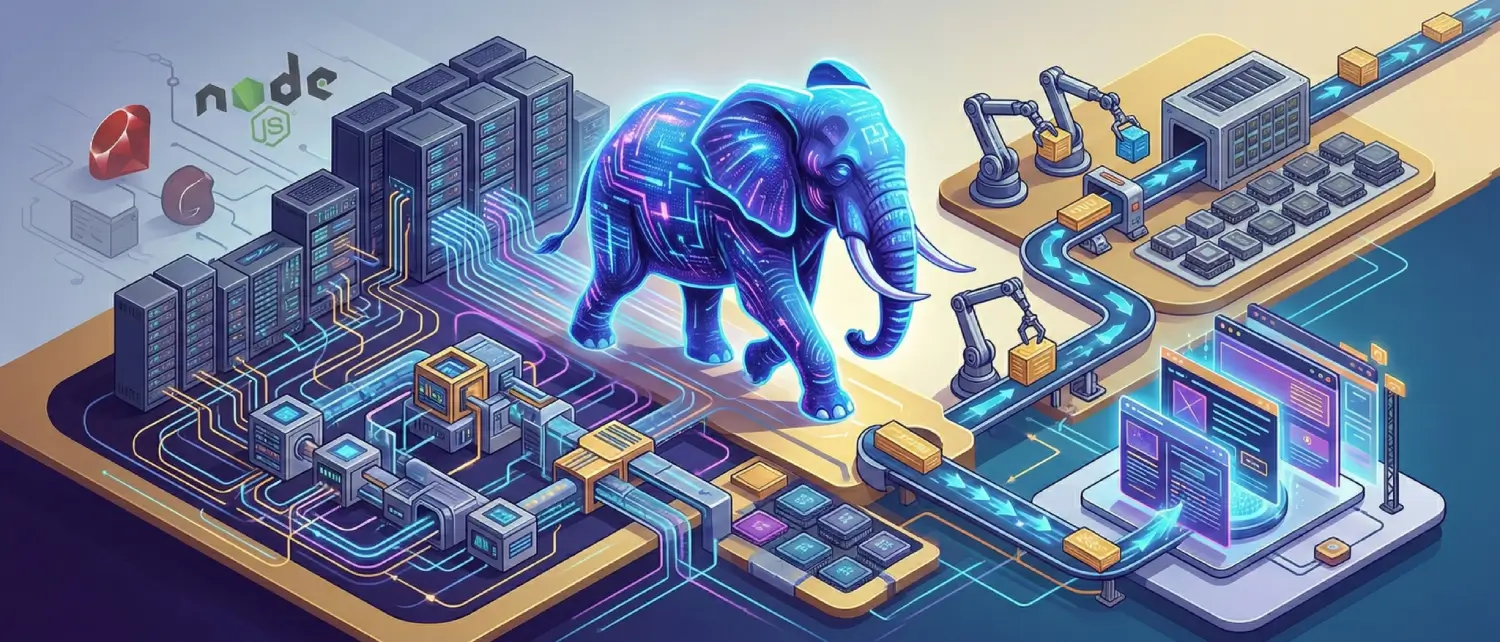
Despite people saying for years that PHP is “dying,” it is still the most popular way to build websites in 2026. According to data from W3Techs, nearly 74% of all websites run on PHP. To put that in perspective, its closest competitors, like Ruby and JavaScript (Node.js), are used by less than 7% of sites.
While other languages like Python are more popular for things like data science, PHP remains the specialist for the “back end” of the web. It isn’t just sticking around because people are too lazy to switch; it’s because PHP has modernized rapidly. Today’s PHP is fast, secure, and uses powerful tools (frameworks) that do the heavy lifting for developers.
The move to PHP 8.4 and PHP 8.5 has completely changed how modern web tools are built, focusing on making code cleaner and websites much faster. PHP 8.4 introduced “property hooks,” which basically cut out a lot of the repetitive “busy work” code developers used to write just to handle data. A bigger breakthrough came in PHP 8.5 with “Lazy Objects.” In the past, large systems like Laravel or Symfony would waste a lot of memory by loading hundreds of background tools every time a page was clicked, even if they weren’t needed. Now, these tools only “wake up” the moment they are actually used, which has cut memory usage in half for some heavy websites. Finally, the new “pipe operator” makes the code itself much easier to read by allowing developers to pass data through a simple, straight line of steps rather than nesting complex instructions inside one another.
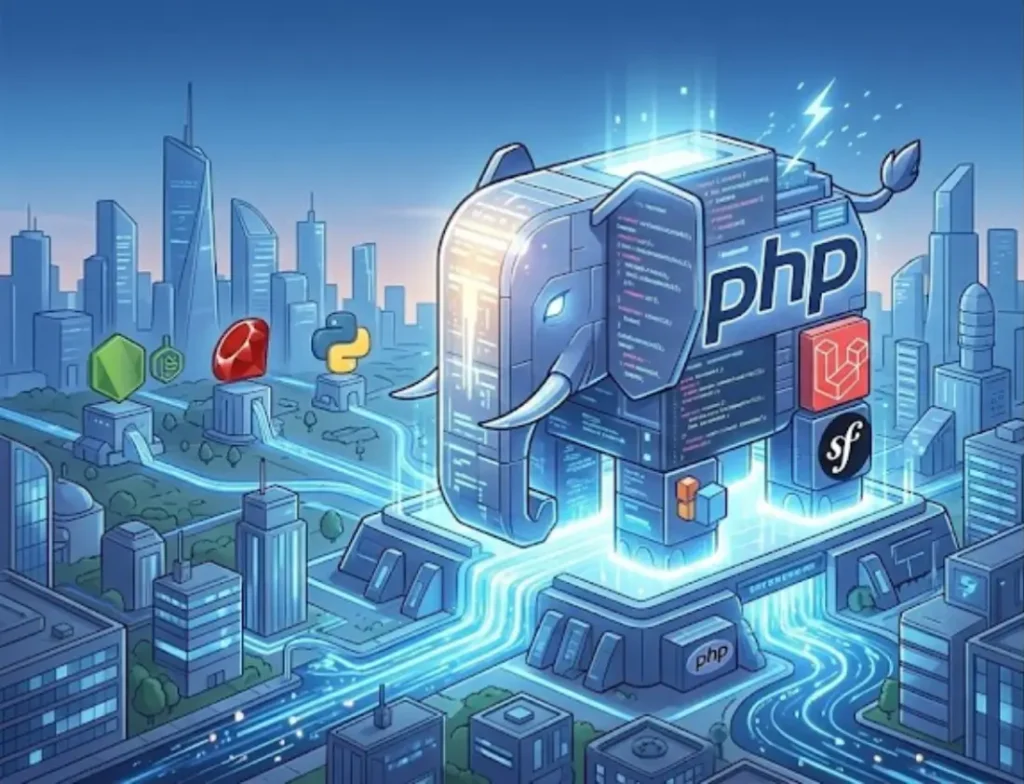
Selecting the appropriate PHP framework for a given project in 2026 requires a nuanced evaluation of several technical and strategic vectors. The decision matrix must account for performance benchmarks, architectural alignment, security posture, and the vitality of the surrounding ecosystem.
The security posture of a framework is non-negotiable. Enterprise-grade frameworks must provide out-of-the-box, configurable protections against SQL injection, Cross-Site Scripting (XSS), and Cross-Site Request Forgery (CSRF). This involves secure password hashing algorithms, authentication middleware, and strict input validation layers. The responsiveness of the framework core team to emerging Common Vulnerabilities and Exposures (CVEs) is also paramount.
The health of a framework’s community and ecosystem is the best way to tell if a project will succeed in the long run. You can measure this by looking at “GitHub stars,” how many times its tools are downloaded, and how many developers actually use it.
When a framework like Laravel becomes this popular, with over 83,000 stars and millions of downloads, it creates a massive library of pre-made add-ons and a huge pool of experts you can hire. This makes it much easier to find help or fix bugs compared to using smaller, less popular tools.
Additionally, having great software to write the code is a huge advantage; most professional developers use specialized editors like PhpStorm because they are built to work perfectly with these major frameworks, making the daily experience of building and maintaining a website much smoother and more reliable.
The rise of Artificial Intelligence has added a new way to measure a framework value: how well it talks to AI coding tools. As more developers use AI assistants like Claude Code and Cursor to write their software, they need frameworks that are “AI-ready.”
This means the framework provides clear, organized information that helps an AI agent understand the app’s structure and rules immediately. Frameworks that are built this way allow developers to build and fix features much faster than older systems, which often confuse AI agents with messy or hidden logic.
| Framework | Architecture | 2026 Focus Area | Performance Overhead | Ecosystem Size | Primary Use Case |
| Laravel 13 | Full-Stack MVC | AI Integration, Developer Experience | Moderate | Massive (83k+ Stars) | Enterprise SaaS, Rapid Prototyping |
| Symfony 8.0 | Component / MVC | Modularity, Enterprise Standards | Moderate to Low | Very Large (30k+ Stars) | Complex Enterprise Systems |
| Spiral | Hybrid PHP/Go | Long-running daemon, Async | Very Low | Growing | High-concurrency Microservices |
| Yii 3 | Component / MVC | PSR Compliance, Decoupling | Low | Medium | High-performance Web Portals |
| Phalcon | C-Extension | Hardware Efficiency | Extremely Low | Niche | Low-latency APIs, Resource Constrained |
| Laminas (Mezzio) | Middleware | PSR-15 Pipelines, Interoperability | Low | Medium | API-first Microservices |
| CodeIgniter 4 | Lightweight MVC | Minimal Configuration | Low | Medium (18k+ Stars) | SME Applications, Legacy Upgrades |
| CakePHP 5.1 | Convention/MVC | Rapid Development, Scaffolding | Moderate | Medium | CRUD-heavy Internal Tools |
In 2026, Laravel remains the undisputed leader in the world of PHP, powering nearly 45% of all framework-based websites. Its massive popularity is proven by over 83,000 “stars” from developers and nearly half a billion downloads of its various tools.
The reason it stays on top is its focus on making the developer’s life easy; it uses a clear and “elegant” way of writing code that handles all the difficult background tasks like security, user logins, and data storage automatically. This allows programmers to focus on building features rather than wrestling with the technical plumbing of a website.
The release of Laravel 13 in early 2026 is a major step forward, as it now requires at least PHP 8.3, forcing developers to use the latest and most efficient coding methods. This version is built to take full advantage of the speed boosts found in newer versions of PHP while making background tasks like sending thousands of emails much more reliable and predictable.
One of the biggest changes is how the framework is set up; it is moving away from messy, flexible lists (arrays) and toward “strict” objects. This might sound technical, but it basically means that coding tools can now spot errors instantly before the website even runs, making it much safer to change or update code.
Finally, Laravel 13 gives developers an “X-ray view” into exactly how the website is running, allowing professional teams to build detailed dashboards that track performance and catch hidden glitches in real-time.
Despite its vast capabilities, Laravel is not without drawbacks. As a highly opinionated, full-stack framework with numerous default features, it inherently carries more performance overhead compared to micro-frameworks or specialized high-performance runtimes.
While tools like Laravel Octane (which boots the framework once and keeps it in memory using Swoole or RoadRunner) mitigate this, a standard Laravel deployment relies heavily on optimizing database queries and caching to maintain high throughput.
Symfony is the second-largest player in the PHP world, holding about 10% of the market and over 30,000 “stars” from developers. While Laravel is popular for building websites quickly and easily, Symfony is the top choice for massive, high-security corporate systems that need to be highly customized.
Its structure is unique because it isn’t just one big tool; it’s a collection of many smaller, independent parts that can be used on their own. Because these parts are so reliable, other famous platforms like Laravel, Drupal, and Magento actually build their own systems using Symfony foundational components to handle things like web traffic and command-line tasks.
Symfony 8.0 marks a major shift by requiring the latest version of PHP, focusing heavily on making code more predictable and error-free. One of the biggest changes is how the framework is configured; it has replaced old, flexible settings with a “strict” format that helps coding tools automatically suggest the right options and catch mistakes before the website even goes live.
This new approach also makes the background “engine” of the framework start up much faster. Additionally, Symfony 8.0 now works perfectly with a high-speed tool called FrankenPHP, which helps the website handle much more traffic while making the daily work of building and testing features significantly smoother for developers.
Security and data integrity are heavily emphasized in the latest Symfony iterations. The Messenger component now includes robust message signing capabilities, ensuring that background jobs and queued messages cannot be intercepted or tampered with prior to processing.
Additionally, the framework has expanded its use of PHP attributes, allowing developers to extend validation and serialization metadata for classes over which they do not have direct control, a crucial feature for integrating complex third-party libraries.
As traditional PHP applications reach their limits when handling massive amounts of traffic, a new group of tools has arrived to handle heavy workloads and thousands of users at once. The Spiral Framework is at the forefront of this change in 2026. Developed by the experts at Spiral Scout, Spiral is a professional-grade system specifically built to combine the strengths of two different programming languages: PHP and Go.
Despite its revolutionary runtime, the actual developer experience within Spiral feels familiar to those accustomed to modern PHP. It utilizes a classic MVC approach, features a routing system conceptually similar to Laravel, and leverages proven Symfony components where appropriate.
Spiral also implements Aspect-Oriented Programming (AOP) through the use of interceptors, allowing developers to execute specific logic such as security checks or logging before or after method calls, cleanly separating business logic from cross-cutting concerns.
While its community and ecosystem of pre-built packages are smaller compared to the giants of the industry, Spiral PSR compliance ensures compatibility with a vast array of existing PHP libraries, making it an increasingly popular choice for microservice architectures and high-performance enterprise applications in 2026.
The Laminas Project is the modern, open-source version of the famous Zend Framework, and in 2026, it fills a very specific role for large companies building complex systems. While it moved away from its older, all-in-one style of building websites, it has found success by offering a massive library of high-quality, independent parts that can be used separately.
Its most important tool today is the Mezzio framework, which is a lightweight system designed specifically for building “microservices”—small, specialized programs that work together to run a massive application.
The downside to all this flexibility is that it is much harder to learn. Developers need a deep understanding of industry-standard coding rules and complex design patterns, as they have to manually connect parts that other “all-in-one” frameworks would set up automatically. There are also fewer beginner tutorials and community guides available compared to more popular tools like Laravel.
However, for expert engineering teams building high-end, strictly organized systems, Laminas and Mezzio offer a professional foundation. It avoids the “hidden magic” and automatic shortcuts found in other frameworks, giving developers total control and clarity over how every part of their application works.
The Yii framework has historically been recognized for its high performance and strong focus on security, particularly in data-heavy applications and administrative dashboards. The transition from Yii 2 to Yii 3, fully realized and stabilized by 2026, represents a massive architectural overhaul aimed at modernization and extreme modularity.
Yii 2, while powerful, suffered from tight coupling to specific frontend assets like jQuery and Bootstrap and operated as a somewhat monolithic entity. Yii 3 addresses these technical debts by completely splitting the framework into numerous independent, standalone packages.
At its core, Yii 3 makes zero assumptions about the web stack, allowing developers to cherry-pick only the specific packages required for their project, such as yiisoft/mailer or yiisoft/view-renderer.
High performance is the main reason developers choose Yii 3, as it is built to handle massive amounts of website traffic by speeding up database tasks and saving data for quick access. It uses modern tools to handle data more efficiently and connects deeply with monitoring software like Tideways, which helps developers spot exactly where a website might be slowing down.
While switching from the older Yii 2 to this new version takes a lot of work because the entire system has been redesigned into smaller, separate pieces, the final result is a much leaner and more secure framework. This makes it a perfect fit for complex business-to-business platforms and powerful web services that need to stay fast and easy to maintain over time.
For projects that do not require the sprawling infrastructure of Laravel or the enterprise rigidity of Symfony, CodeIgniter 4 and CakePHP 5.1 offer compelling alternatives focused on speed of development and operational simplicity.
CodeIgniter 4 is still the “lightweight champion” of PHP because it is incredibly small; the entire framework, including its manual, is only about 2MB. It is designed to work almost instantly without needing a complicated setup.
In 2026, it will be fully updated to run very fast on modern PHP versions, making it a great choice for beginners because it uses a simple, easy-to-understand structure. This makes it perfect for small businesses, building quick prototypes, or using cheap web hosting where you don’t have full control over the server.
However, because it is so small, it doesn’t come with the massive built-in tools that giant frameworks have, so it isn’t always the best choice for enormous, high-traffic websites.
CakePHP 5.1, conversely, focuses heavily on the principle of “Convention over Configuration.” By adhering strictly to naming conventions for database tables and classes, CakePHP eliminates the need for vast configuration files, allowing developers to scaffold robust CRUD (Create, Read, Update, Delete) applications incredibly quickly.
The release of CakePHP 5.1 brings the framework into full alignment with modern PHP, specifically optimizing for PHP 8.4 features. This harmony allows developers to leverage property hooks and asymmetric visibility within CakePHP’s powerful built-in ORM. The 5.1 update also introduces significant quality-of-life improvements, such as the ability to resolve dependencies via the DI container directly into component constructors, and enhanced type-safe casting functions for request data.
While CakePHP’s strict conventions can feel restrictive to developers desiring architectural freedom, its ability to generate functional applications rapidly makes it highly relevant for digital agencies and internal business tooling in 2026.
Phalcon occupies a highly specific niche within the PHP ecosystem. Unlike every other framework discussed, which is written in PHP, Phalcon is implemented as a C-extension. This means the framework core classes and functions are compiled directly into a web server module and loaded into RAM once when the daemon starts.
However, Phalcon’s unique architecture presents significant operational challenges. Installing the framework requires root server access to compile and load the C-extension, making it incompatible with most standard shared hosting environments.
Furthermore, as PHP evolves rapidly, maintaining a C-extension requires specialized knowledge of the Zend Engine’s inner workings. While the Phalcon team relying heavily on the Zephir compilation language continues to release updates such as v5.10.0 in late 2025, which included validation enhancements and storage adapter fixes, keeping pace with major PHP core updates like PHP 8.4 and PHP 8.5 often involves delays compared to pure-PHP frameworks.
Consequently, while Phalcon performance is legendary, its adoption is limited to highly specialized, infrastructure-controlled environments.
While full-stack frameworks dominate large projects, the rise of microservices and highly focused, single-purpose RESTful APIs has sustained a robust market for micro-frameworks. In 2026, the micro-framework space is largely defined by the competition between Slim and Flight PHP.
These frameworks strip away massive ORMs, complex templating engines, and built-in authentication systems, focusing purely on high-performance HTTP routing, request handling, and middleware execution.
| Metric | Slim Framework (v4.x) | Flight PHP (v3.x) | Fat-Free Framework (F3) |
| Design Philosophy | PSR-7 Compliant, Modular | Zero-Dependency, All-in-one | Lightweight, Feature-rich |
| Performance (RPS) | ~73,000 (TechEmpower) | ~190,000 (Plaintext) | ~139,000 (Plaintext) |
| Ecosystem Size | Very Large (12.2k+ Stars) | Growing (2.8k+ Stars) | Medium |
| Complexity | Medium | Very Low | Low to Medium |
| Dependencies | Requires bolt-on packages | None (Core) | None (Core) |
Slim Framework has long been the industry standard for PHP frameworks. Its architecture is strictly PSR-7 compliant, meaning it seamlessly integrates with any standardized PHP HTTP message interface. Slim relies heavily on a robust middleware architecture, allowing developers to inject authentication, CORS handling, or logging cleanly into the request lifecycle.
Because Slim provides only the bare essentials such as routing and HTTP handling, developers are expected to “bolt on” preferred third-party components, such as Eloquent for database abstraction or Twig for templating. While this provides ultimate flexibility and access to a massive troubleshooting community, the accumulation of dependencies can eventually erode the “micro” nature of the application, leading to performance that, while solid (~73k RPS), is slower than ultra-lean alternatives.
Flight PHP has surged in popularity in 2026 as the preeminent alternative to Slim, driven by its exceptional speed and “zero-dependency” philosophy. Flight is designed to be completely self-contained; its core framework contains no external packages, polyfills, or mandatory PSR interfaces, which drastically reduces its footprint and eliminates the risk of upstream breaking changes.
This minimal overhead results in blistering performance, with plaintext benchmarks hitting over 190,000 RPS, making it significantly faster than Slim in raw throughput.
The trajectory of PHP framework development beyond 2026 is unmistakably pointed toward two major horizons: the complete integration of Artificial Intelligence into the development lifecycle and the pursuit of true asynchronous, multithreaded execution.
The concept of “AI-assisted” programming is rapidly giving way to “AI-native” frameworks. Laravel Boost exemplifies the beginning of this trend, but future iterations of frameworks will likely be designed specifically to be easily parseable by Large Language Models (LLMs). This means enforcing hyper-strict typing, eliminating dynamic “magic methods” that confuse static analyzers and AI context windows, and relying heavily on standardized PHP Attributes for routing and event handling.
Emerging tools like Mago, a Rust-based toolchain for PHP, providing static analysis and linting at speeds 90x faster than traditional PHP-based tools, will become standard integrations, ensuring that AI-generated code is instantly verified for type safety and logic bugs before execution. Furthermore, frameworks like the newly emerging Tempest emphasize “zero configuration” and utilize PHP attributes aggressively to auto-discover routes and middleware, a design pattern that drastically reduces boilerplate and simplifies AI-driven generation.
The PHP framework ecosystem in 2026 is highly mature, profoundly diversified, and rapidly innovating. The assertion that PHP is a legacy technology is demonstrably false; modern PHP, powered by versions 8.4 and 8.5, coupled with highly optimized frameworks, offers enterprise-grade security, exceptional scalability, and unmatched developer productivity.
For strategic adoption, organizations must align framework selection with their specific technical and business requirements:
Ultimately, the best PHP framework in 2026 is not an absolute, but a highly contextual choice. By carefully evaluating performance overhead, architectural patterns, and the ecosystem’s alignment with modern paradigms like AI generation and asynchronous execution, engineering teams can build resilient, high-performance web applications that will scale well into the next decade.

Hassan Tahir wrote this article, drawing on his experience to clarify WordPress concepts and enhance developer understanding. Through his work, he aims to help both beginners and professionals refine their skills and tackle WordPress projects with greater confidence.



 Lifetime VPS Europe
 Lifetime VPS Asia
 Lifetime WooCommerce Hosting
 Lifetime Hosting
 France Lifetime Dedicated Servers
 Germany Lifetime dedicated servers
 Lifetime Game Dedicated Servers
 Chicago, US
 Tokyo, Japan
 Singapore
 Hong Kong
 Seoul, South Korea
 Amsterdem, Netherlands
 London, UK
 Stockholm, Sweden
 Oslo, Norway
 Vienna, Austria
 Zurich, Switzerland
 Sydney, Australia
 Wordpress Hosting
 VPS Hosting
 DDOS Protection
 Submit Ticket
 Full Management
 Guides
 Videos and Podcasts
 Discover Creative Ideas
 MetaAgentOS High-Ticket Support System
 Voxfor Mega Menu
 Voxfor Advanced Price Management For WooCommerce
 Voxfor Secure Live Chat and AI Support
 Voxfor Multilanguage
 Voxfor AI Content Summary


