Before exploring specific marketplace platforms, beginners need to understand what multi-vendor marketplaces are and how they differ fundamentally from traditional single-vendor ecommerce stores. A multi-vendor marketplace is an online platform where multiple independent sellers (vendors) offer their products through a single unified storefront. Think of it like a shopping mall: customers visit one central location where dozens of different stores operate simultaneously, each managing its own inventory and fulfillment while the mall operator manages the overall platform, collects commissions, and handles customer service.
Understanding marketplace market dynamics helps contextualize why multi-vendor models represent increasingly attractive business opportunities for entrepreneurs and established retailers in 2025. The marketplace segment demonstrates remarkable growth despite broader ecommerce saturation because marketplaces solve fundamental challenges that single-vendor businesses struggle to address independently. Instead of each brand managing its own customer acquisition, fulfillment infrastructure, and technology stack, marketplaces aggregate multiple vendors under unified platforms, dramatically reducing individual seller operational burdens while providing customers with convenience through centralized shopping.
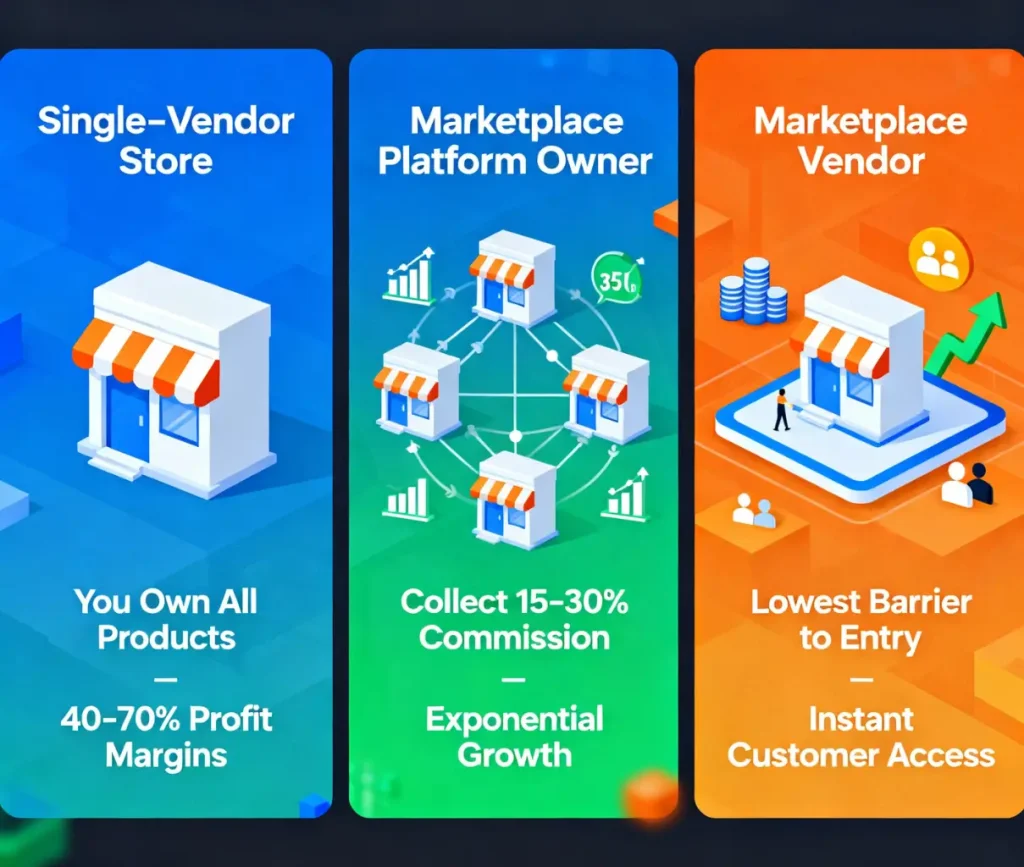
Understanding fundamental differences between business models enables informed strategic decisions aligned with long-term business objectives. This comparison framework helps entrepreneurs, established retailers, and platform operators evaluate which approach best matches their specific circumstances, resources, and growth ambitions.
Single-Vendor Ecommerce Store: You own and manage all products directly. You handle product sourcing, inventory management, pricing decisions, fulfillment, customer service, and marketing entirely. Your profit margins depend on wholesale costs, pricing power, and operational efficiency. Examples include Shopify stores, WooCommerce sites, and direct brand websites. Single-vendor models suit entrepreneurs with specific product expertise, established supplier relationships, or premium brands requiring complete brand control.
Multi-Vendor Marketplace as Platform Owner: You build and operate the marketplace platform. Multiple vendors list products on your platform. You collect commission (typically 15-30% per transaction), manage vendor relationships, handle customer disputes, invest in technology and marketing, and bear platform operational expenses. Revenue depends on vendor activity, sales volume, and commission rate optimization. Examples include Dokan, CS-Cart, and Webkul implementations.
Multi-Vendor Marketplace as Vendor: You sell products on existing marketplaces (Amazon, Etsy, eBay, Walmart Marketplace). You manage your product listings, fulfill orders, handle customer service, and pay commission fees. You don’t manage platform infrastructure. This approach offers the lowest barrier to entry with instant customer access but sacrifices margin control and customer direct relationships.
| Factor | Single-Vendor | Marketplace Owner | Marketplace Vendor |
|---|---|---|---|
| Startup Capital | $5,000-20,000 | $30,000-200,000+ | $100-1,000 |
| Time to Revenue | 3-6 months | 6-12 months | 1-2 weeks |
| Profit Margin | 40-70% (variable) | 15-30% (commission) | 20-50% (after commission) |
| Inventory Risk | High | Zero | Medium |
| Scalability | Linear (you scale) | Exponential (vendors scale) | Limited (platform caps) |
| Complexity | Medium | High | Low |
Decision Framework: Choose a single vendor if you have specific product expertise, supplier relationships, and brand differentiation. Choose a marketplace owner if you have technology expertise and want to build an asset-light, high-growth business. Choose a marketplace vendor if entering ecommerce quickly with minimal investment.
Overview: Dokan powers the WordPress ecosystem most flexible multi-vendor marketplace solution. Built directly on WordPress and WooCommerce, Dokan enables entrepreneurs to transform existing WordPress sites into commission-based marketplaces supporting unlimited vendors.
Key Features:
Pricing:
Pros:
✅ WordPress integration (works if you already use WordPress)
✅ Budget-friendly ($0-999/year)
✅ Highly customizable through the WordPress ecosystem
✅ Large community support (150,000+ active installations)
✅ Excellent documentation and tutorials
✅ Easy vendor onboarding process
Cons:
❌ WordPress dependency (doesn’t work standalone)
❌ Requires WordPress hosting knowledge
❌ Scalability is limited compared to dedicated platforms
❌ Performance optimization required for high vendor counts
❌ Less powerful than dedicated marketplace platforms
Core Web Vitals Performance: 72-78 PageSpeed (requires optimization)
Best For: Existing WordPress site owners, agencies serving multiple clients, budget-conscious entrepreneurs, niche marketplace creators.
Implementation Timeline: 2-3 weeks for basic setup, 4-8 weeks for complete customization.
Overview: CS-Cart represents enterprise-grade multi-vendor marketplace software designed for serious ecommerce operations. CS-Cart provides a complete all-in-one solution, including a shopping cart, vendor management, payment processing, and fulfillment tools, without requiring external plugins or dependencies.
Key Features:
Pricing:
Pros:
✅ All-in-one platform (no plugins needed)
✅ Powerful vendor management for scale
✅ Built-in SEO and performance optimization
✅ Mobile app for vendor management
✅ Reliable infrastructure handling 10,000+ products
✅ 24/7 customer support included
Cons:
❌ Higher price point ($55-275/month)
❌ Steeper learning curve than Dokan
❌ Requires technical backend knowledge for customization
❌ Setup takes 4-8 weeks typically
❌ Monthly recurring costs accumulate
Core Web Vitals Performance: 82-87 PageSpeed (optimized)
Best For: Serious entrepreneurs, existing established businesses expanding into marketplaces, operations requiring 50+ vendors, and enterprises prioritizing professional support.
Implementation Timeline: 4-8 weeks for professional setup, 8-12 weeks for customization.
Overview: Webkul provides marketplace extensions for existing platforms, including Shopify, WooCommerce, Magento, and OpenCart. Webkul enables merchants already operating ecommerce platforms to add multi-vendor marketplace capabilities without platform migration.
Key Features:
Pricing: $399-999 (one-time license fee) plus $99-299 annual support.
Pros:
✅ Works with existing platform (no migration needed)
✅ One-time payment model (no recurring costs)
✅ Faster implementation (existing platform foundation)
✅ Platform expertise available
✅ Multiple platform support options
Cons:
❌ Dependent on underlying platform capabilities
❌ Hidden costs in customization
❌ Limited to the platform ecosystem
❌ Ongoing support paid separately
Best For: Merchants with existing Shopify/WooCommerce/Magento sites, businesses wanting marketplace addition without platform change, and enterprises with platform preference.
Implementation Timeline: 2-4 weeks.
Overview: Amazon Marketplace enables sellers to list products on the world’s largest ecommerce platform, immediately accessing 300 million+ customers worldwide. Sellers operate stores within Amazon’s infrastructure without managing platform technology.
Commission Structure:
Pros:
✅ Largest customer base (300M+ active buyers)
✅ Minimal startup investment ($0-100)
✅ Established fulfillment infrastructure
✅ Payment processing and dispute handling included
✅ Built-in marketing through Amazon Search
Cons:
❌ High commission fees (15-45% total)
❌ Limited control over product presentation
❌ Amazon algorithm dependency
❌ Seller account suspension risks
❌ No direct customer relationships
Best For: Sellers seeking immediate market access, product testing, and vendors without ecommerce expertise.
Overview: Etsy specializes in handmade, vintage, and craft products. Over 7 million active sellers offer unique products to 90+ million monthly visitors.
Commission Structure:
Pros:
✅ Audience seeking handmade/vintage products
✅ Lower commission than Amazon
✅ Active seller community and forums
✅ Built-in payment and fulfillment
✅ Good for artisans and craftspeople
Cons:
❌ Category limitations (handmade only)
❌ High competition within categories
❌ Etsy algorithm determines visibility
❌ Limited brand control
❌ Ongoing listing fees
Best For: Artisans, handmade product creators, vintage sellers, small batch manufacturers.

In 2025, approximately 50% of ecommerce marketplace queries trigger Google AI Overviews instead of traditional search results. When customers search “best marketplace for sellers” or “top ecommerce marketplace platforms,” Google increasingly displays AI-synthesized answers citing specific platforms rather than showing organic rankings. Platform selection directly influences whether your marketplace achieves visibility in these AI-generated responses or remains invisible despite quality content.
How Marketplace Platforms Impact AI Visibility:
Platform choice, therefore, represents a strategic decision directly impacting whether marketplaces achieve AI Overview citation or remain invisible to AI-driven discovery in 2025.
Multi-vendor marketplace models represent transformative business opportunities enabling entrepreneurs to build asset-light, commission-based revenue streams serving multiple vendor audiences simultaneously. Understanding fundamental differences between single-vendor stores, marketplace ownership, and marketplace vendor roles enables informed strategic decisions aligned with business objectives, resource constraints, and growth ambitions.

Hassan Tahir wrote this article, drawing on his experience to clarify WordPress concepts and enhance developer understanding. Through his work, he aims to help both beginners and professionals refine their skills and tackle WordPress projects with greater confidence.





 Lifetime VPS Europe
 Lifetime VPS Asia
 Lifetime WooCommerce Hosting
 Lifetime Hosting
 France Lifetime Dedicated Servers
 Germany Lifetime dedicated servers
 Lifetime Game Dedicated Servers
 Chicago, US
 Tokyo, Japan
 Singapore
 Hong Kong
 Seoul, South Korea
 Amsterdem, Netherlands
 London, UK
 Stockholm, Sweden
 Oslo, Norway
 Vienna, Austria
 Zurich, Switzerland
 Sydney, Australia
 Wordpress Hosting
 VPS Hosting
 DDOS Protection
 Submit Ticket
 Full Management
 Guides
 Videos and Podcasts
 Discover Creative Ideas
 MetaAgentOS High-Ticket Support System
 Voxfor Mega Menu
 Voxfor Advanced Price Management For WooCommerce
 Voxfor Secure Live Chat and AI Support
 Voxfor Multilanguage
 Voxfor AI Content Summary


