 Lifetime VPS Europe
 Lifetime VPS Asia
 Lifetime WooCommerce Hosting
 Lifetime Hosting
 Lifetime Game Dedicated Servers
 Chicago, US
 Tokyo, Japan
 Singapore
 Hong Kong
 Seoul, South Korea
 Amsterdem, Netherlands
 London, UK
 Stockholm, Sweden
 Oslo, Norway
 Vienna, Austria
 Zurich, Switzerland
 Sydney, Australia
 Wordpress Hosting
 VPS Hosting
 DDOS Protection
 Submit Ticket
 Full Management
 Guides
 Videos and Podcasts
 Discover Creative Ideas
 Voxfor Autonomous AI Workers
 Voxfor Mega Menu
 Voxfor Advanced Price Management For WooCommerce
 Voxfor Secure Live Chat and AI Support
 Voxfor Multilanguage
 Voxfor AI Content Summary
 Voxfor Autopilot
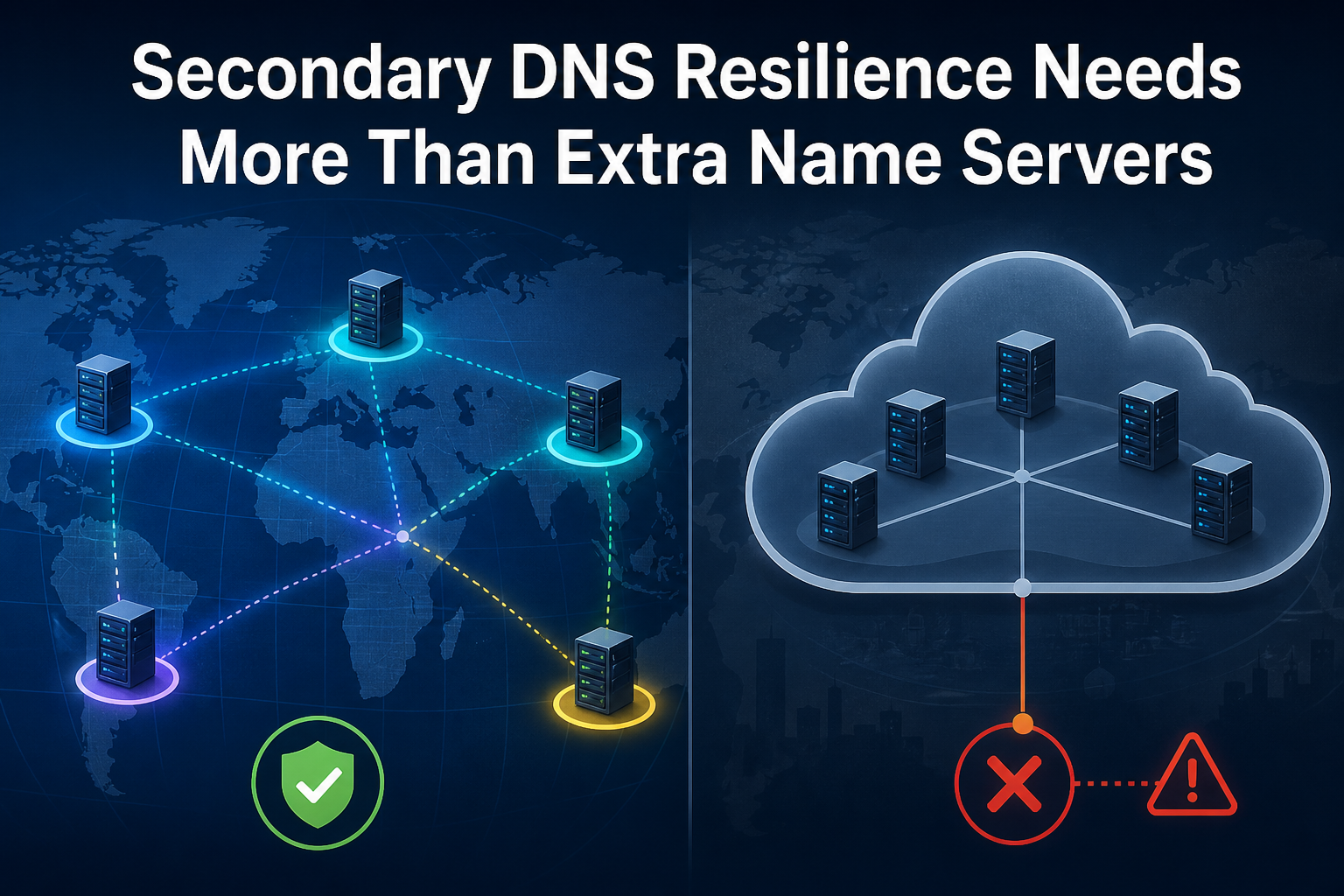
Four name servers appear in a domain’s delegation. A provider outage begins, and all four stop answering at once. Nothing contradictory happened: the list contained four server names, but every name depended on one company, one control plane, and perhaps one network edge.
Secondary DNS improves the availability of authoritative answers only when it removes common failure domains and receives correct zone changes in time. It is not a magic copy of a website, an application failover system, or proof that two logos represent independent infrastructure. A useful design must pass three tests: the servers fail independently, the zone converges, and someone can prove both conditions.
Count Failure Domains, Not Name Servers
An authoritative name server answers from the official record set for a domain, called a zone. A failure domain is any dependency that can remove several supposedly redundant components in one event. The dependency might be a provider network, control plane, account suspension, registrar delegation, billing relationship, or a bad change sent to every server.
RFC 2182 says secondary servers should be physically and topologically diverse. That old but durable principle matters more than the number printed in an NS response. Four servers behind the same provider can offer excellent resilience against a single machine failure while still sharing a provider-wide failure.
Start the review with ownership. Map responsibilities first with domain-control ownership inventory, which separates registrar access, authoritative DNS, hosting, email, and certificate duties before anyone buys another DNS product.
| Dependency | Weak evidence | Evidence of useful independence |
|---|---|---|
| DNS provider | Four different server names | Two separately operated authoritative platforms |
| Network path | Different IP addresses | Different networks and routing paths, confirmed by provider design |
| Control plane | Two names in one dashboard | Separate change and incident boundaries |
| Account and billing | One customer account owns everything | Recovery access and payment failure cannot disable both providers |
| Zone data | Both providers currently answer | SOA serials and record sets converge after a controlled change |
| Registrar delegation | Intended name servers are documented | Parent delegation publicly lists every active authoritative server |
A second provider also does not remove every common dependency. Both providers still depend on the same parent-zone delegation. They may receive the same mistaken record deletion. An attacker with access to the registrar or source-of-truth account may be able to redirect or disable both. Secondary DNS narrows the blast radius; it does not eliminate configuration and ownership risk.
Choose One Source of Truth
Before adding providers, decide where an approved DNS change begins. That system is the source of truth. Without one, people may edit both dashboards and create two plausible but different versions of the zone.
| Design | Where changes begin | Main advantage | Main risk |
|---|---|---|---|
| Primary-secondary | One public primary sends transfers to secondary servers | Simple, established replication model | The primary may remain exposed and transfer rules must be correct |
| Hidden primary | One unlisted primary sends transfers; only secondaries answer publicly | Separates editing/transfer origin from public query service | A failed hidden primary can leave secondaries serving stale data until expiration |
| Multi-primary automation | One external configuration pipeline writes to multiple providers | Works when providers do not support standard transfers | Partial API writes can create inconsistent zones |
In a traditional primary-secondary design, the primary holds the editable zone and secondaries copy it with a full or incremental zone transfer. A hidden primary uses the same idea but is not listed in public delegation. Oracle’s secondary DNS documentation describes both active dual delegation and hidden-primary arrangements.
Some managed platforms cannot import every provider-specific object. Flattened aliases, traffic-steering rules, synthetic records, health checks, and Domain Name System Security Extensions (DNSSEC) signing behavior may not survive a standard transfer. DNSimple’s hidden-primary guidance warns, for example, about imported DNSSEC signature support in its particular workflow. Treat every non-standard record type as a compatibility question, not as an assumed copy.
Administrative continuity belongs in the same design. Use recovery-access transfer checklist to ensure the registrar, primary DNS, secondary provider, recovery email, and emergency contacts are not trapped in one employee or agency account.
Availability Includes Zone Convergence
An available secondary that serves yesterday’s address can be worse than an obvious outage. Convergence means every authoritative platform has received and serves the intended current zone.
The zone’s Start of Authority, or SOA, record carries a serial value used to identify versions. When a primary changes, it can send NOTIFY messages so secondaries check sooner. Secondaries also use refresh and retry timers. The expire timer places the final boundary: if a secondary cannot refresh for long enough, it should stop serving data it can no longer trust.
Timer selection is a design choice, not a universal best number. A longer expiration can keep old answers available during a transfer outage; it can also prolong a dangerously stale answer. A shorter expiration limits staleness but may convert a recoverable transfer interruption into authoritative failure sooner. Match it to how quickly records change, how destructive stale routing would be, and how long humans need to restore the transfer path.
Monitor more than a green provider dashboard. Oracle exposes transfer success, transfer failure, and time-to-expiration metrics for its service; other platforms may use different names. The evidence you need remains portable:
- latest SOA serial observed on every authoritative server;
- timestamp and result of the last successful transfer or API synchronization;
- remaining time before stale secondary data expires;
- differences in critical
A(IPv4 address),AAAA(IPv6 address),MX(mail destination),CAA(permitted certificate authority),TXT(text or policy), and delegation-related records; - alerts delivered outside the DNS platform that is being monitored.
Certificate validation is one practical reason to inspect public answers. Follow public DNS validation trace to see how authoritative answers and challenge paths can affect certificate issuance. Continue with CAA authority-failure repair path: an authoritative failure can block a certificate authority even when the website still loads for cached visitors.
Prove the Design With a Dependency Drill
Do not begin by causing an outage. Begin with read-only evidence and a planned maintenance window. Query each authoritative server directly so a resolver cache cannot hide disagreement. Replace the example names with the servers and zone you actually control:
dig @ns1.example.net example.com SOA +norecurse +noall +comments +answer
dig @ns2.example.net example.com SOA +norecurse +noall +comments +answer
dig @ns3.other-provider.net example.com SOA +norecurse +noall +comments +answer
dig @ns4.other-provider.net example.com SOA +norecurse +noall +comments +answer
A passing snapshot shows status: NOERROR, aa in the response flags, the expected SOA serial, and a queried server that is present in the current parent delegation. If aa is absent, the response is not evidence that this server is authoritative. It is still only a snapshot. Complete the proof with a harmless, uniquely named test record and a documented rollback.
- Record the parent delegation, current SOA serials, critical records, and provider status before change.
- Add a low-impact test record at the approved source of truth with a conservative time to live (TTL), the duration a resolver may cache that record.
- Observe when every authoritative server returns that exact value; record convergence time rather than assuming it.
- Remove the test record through the same source and prove that removal converges too.
- During an approved exercise, isolate one provider path at a time or use a provider-supported test method; confirm the remaining provider still answers the same zone.
- Confirm monitoring detects transfer failure before expiration and reaches a contact who can act.
| Failure introduced or simulated | Pass condition | Common false pass |
|---|---|---|
| Public primary unavailable | Listed secondaries keep answering the current zone | Resolver cache answers without reaching authority |
| Hidden primary unavailable | Secondaries answer and expiration alert leaves enough repair time | Current serial is unknown, so stale data looks healthy |
| Provider A unavailable | Provider B remains reachable through public delegation | Status page is green but direct queries fail |
| Transfer blocked | Alert fires, serial lag is visible, and recovery procedure works | Only query availability is monitored |
| Bad approved change | Rollback converges to every authority | One dashboard shows the rollback while another serves old data |
Keep the drill proportional. A small organization may test transfer interruption in a staging zone first, then run a tightly bounded production observation. The point is not theatrical failure; it is evidence that the declared boundary behaves as designed.
Secondary DNS Does Not Recover the Website
Secondary DNS keeps records reachable. It does not create another web server, copy a database, repair an overloaded origin, or decide which healthy endpoint should receive traffic. DigiCert’s comparison correctly separates secondary DNS from DNS failover: one preserves authoritative record service, while the other may change a record to direct users elsewhere.
An organization can therefore have fully redundant DNS that consistently returns the address of a failed application. It can also have application replicas that nobody can find because every authoritative server is unavailable. These are separate layers with separate acceptance tests.
Extend the DNS drill through customer-path availability probes so login, checkout, forms, and other business paths are tested after resolution. That prevents “DNS answered” from becoming an accidental claim that the service works.
FAQ: Secondary DNS Decisions
Is secondary DNS the same as adding more name servers?
No. More nameservers improve resilience only when they do not share the failure that matters. Secondary DNS should add an independently operated authoritative path and a tested method for keeping its zone synchronized.
How many authoritative DNS providers are enough?
Two independent providers are a common practical design, but provider count alone is not the acceptance criterion. Confirm distinct networks and control planes, correct parent delegation, compatible records, observable convergence, and recoverable account ownership. Extra providers add coordination and inconsistency risk.
Does secondary DNS make a website highly available?
It makes authoritative DNS records more available. Website availability also requires healthy application endpoints, data, certificates, network paths, and traffic-failover behavior. Test those layers separately.
What is a hidden primary DNS server?
A hidden primary is the editable transfer source for a zone but is not listed among the public authoritative servers. Public secondaries answer user queries. The design reduces exposure of the source system, but transfer health and expiration still require monitoring.
Can two managed DNS providers serve different records?
They can, accidentally or by design, but inconsistent authoritative answers are dangerous when the difference is not deliberate. Use one source of truth, compare serials and critical records, and treat partial API updates or unsupported record types as failed convergence.
Does DNSSEC work with secondary DNS?
Yes, but the signing model and transfer capability must match. Determine where signing occurs, whether signatures and denial-of-existence records transfer correctly, and whether both providers publish a zone consistent with the parent Delegation Signer (DS) record—the parent zone’s digest that tells validators which child signing key to trust. Provider-specific synthetic records may need separate handling.
How do I know a zone transfer is healthy?
Check the last successful transfer, transfer failures, SOA serial agreement, record-set agreement, and remaining time before expiration. Then prove a controlled record addition and removal reaches every listed authoritative server.
When is a second DNS provider not worth the complexity?
It may not be worthwhile when the application has no comparable recovery path, the zone depends heavily on non-portable provider features, or nobody can own synchronization and drills. Document the residual risk instead of claiming redundancy that the organization cannot operate.
Keep a DNS Resilience Receipt
The durable output is a short record, not a promise that “we use four nameservers.” Keep the public delegation, provider and network boundaries, source of truth, supported record differences, latest convergence result, expiration margin, alert route, last dependency drill, and named recovery owner together.
Review that receipt after provider, registrar, DNSSEC, automation, or account changes. Secondary DNS is credible when another authoritative path survives the failure you designed for and serves the same intended zone—not when a configuration screen simply shows more server names.