
We are witnessing a massive change in technology: moving from flat screens to a 3D world. Augmented Reality (AR) was once just a dream in science fiction or a secret project in expensive labs. But today, it is real and ready for everyone. Digital information isn’t stuck inside a screen anymore; it is blended perfectly with the real world around us.
This marks the end of the “looking down” era, where we had to stare at a phone or monitor to see data. In 2025, the world itself has become the interface. This creates a seamless experience powered by better lenses, smarter sensors, and advanced Artificial Intelligence (AI). It didn’t happen overnight, though. This reality is the result of decades of slow, steady improvements in how computers see and understand the physical world.
The story of Augmented Reality begins in the late 1960s, right when computer graphics were first being invented. In 1968, a researcher named Ivan Sutherland built the very first headset. It was incredibly heavy, so heavy, in fact, that it had to be suspended from the ceiling by a mechanical arm to support its weight. Because it hung over the user’s head, people famously nicknamed it “The Sword of Damocles.”
Although the graphics were a mere set of wire lines, what the device did was something revolutionary: the digital image would move as you turned your head. This was the first demonstration that digital objects can be synchronized with the movements of the real world, and this is the basis of all AR technology we use today.
In the 1970s and 80s, researchers shifted their focus from heavy headsets to how people actually interact with computers. In 1975, Myron Krueger created a system called “Videoplace.” Instead of making you wear glasses, it used cameras to track your silhouette (shadow). This allowed people to interact with a screen just by moving their bodies. This early experiment showed that using natural hand gestures was a great way to control technology, a concept that is still the standard for AR today.
| Era | Key Milestone | Technical Achievement | Primary Use Case |
| 1960s | The Sword of Damocles | First 3D head-mounted display system. | Experimental computer graphics. |
| 1970s | Videoplace | Projection-based interactive “artificial reality”. | Human-computer interaction research. |
| 1990s | Virtual Fixtures | First fully immersive AR system for performance. | US Air Force pilot training. |
| 1990s | Terminology Birth | Coining of “Augmented Reality” by Caudell & Mizell. | Aircraft manufacturing support. |
| 2000s | ARToolkit | Open-source marker-based tracking library. | Democratization of AR software. |
| 2010s | Pokémon GO | Mass-market mobile AR via geolocation. | Consumer entertainment and social gaming. |
| 2020s | Spatial Computing | High-fidelity passthrough and LiDAR integration. | Enterprise productivity and creative workflows. |
At the beginning of the 1990s, Augmented Reality left the laboratory and entered the world. In the Boeing Company, engineers Thomas Caudell and David Mizell had a challenging issue, which was wiring aircraft; this was extremely difficult, and employees had to go and examine huge wooden instruction boards. They came up with a headset that showed the digital wiring plans directly in front of the worker’s eyes. This was not only an invention to simplify the task, but also the technology itself earned its well-known name: “Augmented Reality.”
Around the same time, the US Air Force used AR to help personnel control machines from a distance. This proved that adding digital guides to the real world could make difficult, dangerous tasks much safer and more accurate.
Soon, AR started appearing in places we all recognize. NASA used it to project flight maps directly onto cockpit windows to help pilots navigate spacecraft. Then, in 1998, football fans saw AR in their living rooms: the yellow “First Down” line shown during NFL games was the first time most people saw this technology in action. Finally, in 2000, a free software tool called “ARToolkit” was released. This was a huge turning point because it allowed regular developers, not just the military or big companies, to start building their own AR apps.
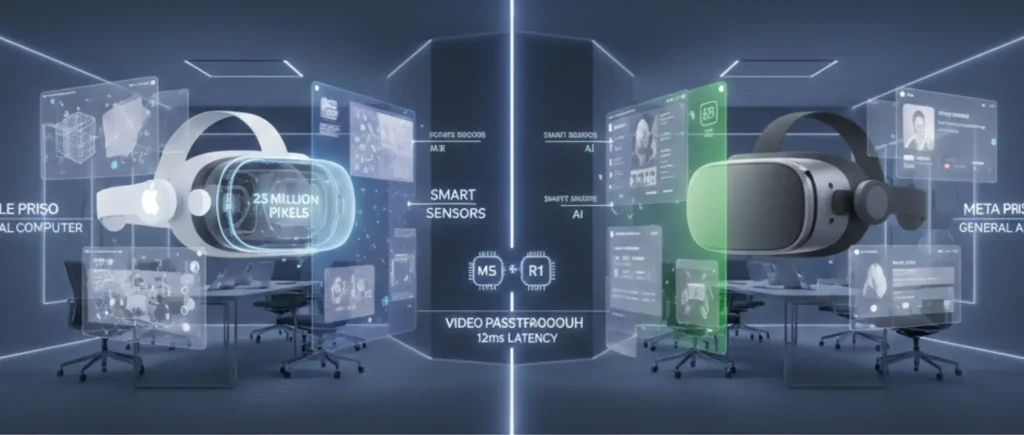
The modern condition of the augmented reality hardware is characterized by a shift towards high-quality rather than mere optical overlay systems, which are currently known as the spatial computing platforms. In 2024 and 2025, the market will mostly be divided between the high-end, high-priced ecosystems of the Apple Vision Pro or Samsung Galaxy XR and the more affordable, generalized technology of the Meta Quest 3 and 3S. This is the period of the dominance of the technologies of video passthrough, in which the external cameras are used to capture the real world and show it on the high-resolution internal monitors, with the possibility of a much more advanced control over brightness, contrast, and smooth integration of the digital and physical resources.
The Apple Vision Pro, introduced as a “spatial computer,” leverages a dual-chip architecture, the M5 for general computing and the R1 co-processor for sensor processing, to maintain a nearly imperceptible latency of 12 milliseconds. Its Micro-OLED displays provide 23 million pixels, a density that allows for the clear rendering of text and complex 3D textures that were previously blurry in earlier generations of VR/AR hardware. This device is designed for high-stakes productivity, mirroring macOS environments and enabling professional designers and engineers to work within an “infinite canvas” of floating windows.
| Hardware Feature | Apple Vision Pro (2025 Refresh) | Meta Quest 3 | Meta Quest 3S |
| Display Technology | Dual Micro-OLED | 4K+ Infinite Display | High-Density LCD |
| Resolution per Eye | Greater than 4K | 2064 x 2208 | 1832 x 1920 (approx) |
| Refresh Rate | 90Hz / 100Hz | Up to 120Hz | 90Hz |
| Tracking Sensors | 12+ Cameras, LiDAR, IR | 4 IR, 2 Color, Depth | 4 IR, 2 Color |
| Input Modality | Eye, Gaze, Hand, Voice | Controllers, Hand, Gaze | Controllers, Hand |
| Battery Placement | External Tethered Pack | Integrated | Integrated |
| Price Point | $3,499 | $499 | $349 |
The Meta Quest 3, on the contrary, focuses on mobility and touch. It does not have the ultra-high resolution of the Vision Pro. Still, it uses pancake lenses to help keep the weight and thickness down in order to achieve a more balanced ergonomic profile, which is essential in long-duration training events in factory and warehouse settings. Quest 3 also has physical controllers with the haptic feedback option, which is regarded by many business customers as an important feature of making the virtual tools respond to be responded to and controlled with accuracy. This is still not an easy task when using only the gesture-based systems, such as the Vision Pro.
The application of LiDAR (Light Detection and Ranging) in the present day gadgets has provided a quantum leap in the understanding of the environment. This technology can be used to sensitise per-pixel depths, the foundation of the so-called occlusion, which enables digital objects to be realistically shadowed by real buildings. To the developers, this implies that a virtual character can stroll behind a real sofa or a computerized circuit board can be precisely attached to a particular part of an intricate engine block, which opens the potential of AR to be of much use in maintenance and repair scenarios.
To succeed in the augmented reality industry in 2026, a developer should have a multidisciplinary skill base between traditional software engineering, 3D graphics theory, and human-centric design. To pass through the 2D screen-based coding to 3D spatial development, one must have a basic knowledge of how objects are in place and how they interact in a coordinate system.
The most critical technical foundation for an AR developer is proficiency in 3D mathematics. Immersive development is inherently spatial, requiring the constant manipulation of positions, rotations, and scales within a global and local coordinate system. Developers must be fluent in vector operations, such as dot products for calculating angles between vectors and cross products for determining surface normals, which are essential for realistic lighting and collision detection.
| Mathematical Concept | Application in AR Development | Importance Level |
| Vectors | Determining object position and directional movement. | Essential. |
| Matrices | Calculating complex transformations and camera projections. | High. |
| Quaternions | Ensuring smooth, gimbal-lock-free rotations for HMD. | Critical. |
| Raycasting | Detecting user interaction with virtual objects in 3D space. | Essential. |
| SLAM Algorithms | Synchronizing digital overlays with physical camera movement. | High. |
Moreover, it is non-negotiable that the mastery of “Quaternions” should be acquired. In traditional Euler angles, one can frequently reach a gimbal lock, i.e., two of the three angles become zero, and one degree of freedom is lost, resulting in digital objects jumping or inverting at random. With quaternions, rotation can be interpolated smoothly and continuously, which is essential to preserve the illusion of having digital assets in the physical existence of the user.
The software landscape is dominated by real-time engines, with Unity 3D and Unreal Engine 5 (UE5) serving as the primary platforms. Unity is widely favored for mobile-first AR and cross-platform deployment due to its “AR Foundation” framework, which abstracts the complexities of Apple ARKit and Google ARCore into a single API. This allows developers to build an application once and deploy it across iOS and Android ecosystems with minimal hardware-specific adjustments.
Unreal Engine 5, conversely, is the tool of choice for high-end simulations requiring photorealistic rendering. Its “Blueprints” visual scripting system allows designers to build complex logic without deep C++ knowledge, while its advanced lighting systems, such as Lumen, enable digital objects to realistically react to the light of the physical world.
For web-based AR (WebAR), which requires no app installation, developers often turn to JavaScript-based frameworks like 8th Wall or Three.js, which leverage the browser’s access to the camera to deliver lightweight, highly accessible experiences for retail and marketing.
One of the defining challenges for AR developers is the “strict performance budget” of mobile and wearable hardware. Unlike traditional gaming, where a frame rate drop is merely a visual annoyance, in AR/VR, it can cause physical discomfort and motion sickness.
To maintain a stable 90Hz or 120Hz refresh rate, developers must optimize the “rendering pipeline,” focusing on techniques like “Draw Call” batching and the use of Level of Detail (LOD) models, which reduce the complexity of objects as they move further from the user’s view.
| Skill Category | Specific Competency | Strategic Value |
| Optimization | Profiling CPU/GPU bottlenecks to eliminate latency. | Prevents user motion sickness. |
| 3D Assets | Understanding polygon budgets and texture compression. | Maintains high frame rates. |
| Networking | Implementing low-latency multiplayer for shared AR. | Enables collaborative work. |
| Audio | Spatial audio mapping for environmental realism. | Enhances user immersion. |
Designing for augmented reality requires a total departure from traditional 2D user interface (UI) principles. In an AR environment, the user is the center of the coordinate system, and their physical environment is the background.
This necessitates a focus on “Natural Interactions“, gestures, gaze, and voice commands that mimic how humans interact with the physical world.
A primary concern in spatial design is “Gorilla Arm,” a term describing the physical fatigue users experience when forced to interact with UI elements placed at an uncomfortable height or distance for prolonged periods. Best practices dictate that primary interactive elements should be placed within a “comfortable gaze area,” typically between 0.5 and 2 meters from the user, and slightly below eye level to reduce strain on the neck and shoulder muscles.
Interaction design must also account for the user’s field of view (FOV). High-priority information should never be placed in the far periphery, as the FOV of many current AR devices is limited to a central rectangular “window”.
Instead, designers use “Spatial Anchors” to fix UI panels to specific real-world locations—such as a virtual manual floating next to a machine, allowing the user to move around the data rather than having it follow their head movement, which can be disorienting.
AR interfaces must remain legible across vastly different lighting conditions, from bright sunlight to dimly lit factory floors. This is achieved by using high-contrast color palettes and “billboarding,” a technique where 2D UI elements always rotate to face the user regardless of their position.
Furthermore, designers must prioritize “Minimalism,” as a cluttered AR display can obscure real-world hazards, such as steps or moving machinery, creating significant safety risks for the user.
| Interaction Paradigm | Mechanism | Use Case |
| Gaze+Pinch | The user looks at an object and pinches their fingers to select. | Navigation and window management. |
| Direct Manipulation | Reaching out to “touch” or “grab” a 3D object. | Precise 3D modeling and assembly. |
| Voice Commands | Natural language processing for hands-free control. | Remote support and complex workflows. |
| Spatial Audio | Sound originates from a specific 3D coordinate. | Wayfinding and situational alerts. |
The practical impact of augmented reality is most visible in its application within mission-critical sectors. By 2026, the technology will have transitioned from speculative pilots to integrated programs that provide measurable improvements in efficiency and safety.
In the medical field, AR is revolutionizing surgical planning and execution. Surgeons now use head-mounted displays to overlay patient MRI and CT data directly onto the surgical site, providing a “non-invasive X-ray” that allows for more precise incisions and reduced damage to healthy tissue.
A study published in 2024 revealed that using mixed reality improved the accuracy of complex orbital reconstruction surgeries and increased patient satisfaction scores by 8%.
Medical education has seen a similar shift toward “Experiential Understanding.” Instead of static diagrams, students use AR platforms like “Precision VR” to walk around and interact with 3D anatomical models of pathology.
These platforms track every movement, providing objective performance data that allows educators to identify specific skill gaps in technical procedures, such as laparoscopic surgery, where AR simulations have been shown to increase student confidence and technical accuracy significantly compared to traditional guidebooks.
| Healthcare Application | AR Mechanism | Documented Outcome |
| Neurosurgery | Intraoperative 3D anatomical overlays. | Higher surgical accuracy and confidence. |
| Physical Rehab | Real-time visual cues and gamified exercise. | 75% improvement in patient engagement. |
| Surgical Training | HMD-assisted step-by-step guidance. | Reduced learning curves and error rates. |
| Patient Education | Visualizing complex conditions in 3D. | Better patient comprehension of surgery. |
The industrial sector has become the primary driver of AR adoption for frontline workers. Platforms like “AIDAR.Service” allow technicians to access “remote expert support,” where a specialist in another location can see the technician’s view and draw 3D annotations directly onto the machinery.
Case studies indicate that this form of “see-what-I-see” instruction can lead to a 50% reduction in service times and a fourfold increase in training throughput.
Enterprises also utilize AR for “Equipment Placement Simulations,” where high-fidelity 3D models of new machinery are projected into a factory space using LiDAR-enabled devices.
This allows managers to identify logistical conflicts or ergonomic issues before the physical equipment is even purchased, avoiding millions of dollars in potential downtime or installation errors.
In educational settings, AR serves as a bridge between theoretical knowledge and practical application. Research conducted between 2024 and 2025 shows that AR-supported instruction has a large overall effect on learning gains, particularly in sciences and humanities.
For instance, engineering students utilizing AR for virtual gear fitting tasks reported that the ability to manipulate components in 3D made the final exam recall “almost effortless.”
Furthermore, AR has transformed campus safety education. Students can participate in immersive fire safety drills where virtual smoke and hazards are overlaid onto their actual dormitory or classroom environment.
This allows them to practice evacuation protocols and hazard recognition in a highly realistic yet completely safe setting, fostering “legal awareness” and “ethical reasoning” that traditional lectures fail to provoke.
While hardware has improved, the “ultimate display” still faces fundamental optical challenges, the most persistent of which is the Vergence-Accommodation Conflict (VAC).
In the physical world, human eyes automatically synchronize “vergence” (rotating the eyes to align on an object) and “accommodation” (the lens changing shape to focus).
In current AR headsets, the eyes may verge on a digital object that appears three meters away, but the physical lens must focus on a screen just centimeters from the eye.
| Optical Challenge | Mechanism of Issue | User Impact | Solution Pathway |
| VAC | Focus/Rotation mismatch. | Eye strain, nausea, fatigue. | Dynamic varifocal displays. |
| Thermal Throttling | High compute creates heat. | Performance drops, skin heat. | Remote cloud rendering (5G). |
| Field of View | Optic limits to the center view. | Broken immersion, “tunnel vision”. | Breakthrough waveguide optics. |
| Battery Life | Sensors consume high power. | Limited 2-hour sessions. | Solid-state batteries, offloading. |
To address this, researchers are developing “Varifocal Displays” and “Multi-Layer Mixed Reality” systems.
These devices use transparent screens that physically shift their position based on gaze tracking or liquid crystal lenses that change focal properties in milliseconds. By creating a “focal volume” rather than a single focal plane, these systems can provide the eyes with true depth cues, finally resolving the primary culprit behind the motion sickness that has hindered mass-market adoption of wearable AR.
The future of augmented reality is defined by three converging trends: the emergence of the “AR Cloud,” the integration of generative AI for rapid content creation, and the maturation of the “Industrial Metaverse.”
Think of Augmented Reality (AR) as the “eyes” that see the world, and Artificial Intelligence (AI) as the “brain” that understands it. In 2026, computers are getting smart enough to understand context, not just identify objects.
For example, if you are standing in your kitchen, your device will know you are ready to cook. It can look at the ingredients on your counter and project a recipe right onto the table, even showing you exactly where to slice the vegetables.
AI is also changing how digital worlds are built. In the past, creating 3D objects and animations was difficult and expensive. Now, new tools make it incredibly easy.
You can take a single flat photo, and AI will instantly turn it into a 3D scene you can walk around in. Similarly, you can draw a simple rough sketch, and the computer will turn it into a moving 3D character.
This means small teams, or even individuals, can now build amazing virtual worlds without needing a Hollywood budget.
The “AR Cloud” represents a persistent, 1:1 digital twin of the physical world, a shared spatial map that exists in the cloud and is constantly updated by every connected device.
This allows digital data to be “anchored” to a specific physical coordinate permanently. A user could leave a virtual note at a restaurant for a friend, or a city could project navigation arrows directly onto the sidewalk that are visible to any visitor with AR glasses.
This turns the physical environment into a “dynamically programmable space,” essentially creating a collective layer of intelligence over the planet.
The economic value of this technology is projected to reach unprecedented heights. By 2030, the global AR market is estimated to be worth $76 billion, with the combined AR/VR/XR market surpassing $138 billion by 2032.
The software segment is expected to be the most aggressive driver of growth, with a compound annual growth rate (CAGR) of 41.8%, as enterprises move away from isolated pilots and toward full-scale industrial metaverse deployments.
| Market Segment | 2024/2025 Value (USD) | 2030+ Projection (USD) | CAGR (%) |
| Global AR Market | $58.29 Billion | $828.47 Billion (2033) | 34.3% |
| Combined XR Market | $75.18 Billion | $138.60 Billion (2032) | 19.2% |
| Healthcare AR/VR | $3.40 Billion | $18.38 Billion (2034) | 18.0%+ |
| Medical Simulation | $8.70 Billion | $19.50 Billion (2030) | 14.0%+ |
North America currently leads the market with a 35.6% share, driven by major players like Apple and Meta.
Still, the Asia-Pacific region is the fastest-growing market due to aggressive manufacturing and government innovation policies in China and Japan.
The shift of augmented reality from an experimental tool with a limited niche to a computational layer that lies at the core of the world is almost over. To the professional developer, the transition to spatial computing demands a sense of constant learning as the ecosystem evolves out of 2D overlays to semantic, AI-driven worlds.
The key competencies in this area are threefold: strong mathematical skills, knowledge of real-time rendering engines, and adherence to the human-centered approach to interaction design that ensures the safety and comfort of the users.
As we look toward 2030, the replacement of the smartphone with AR eyewear appears increasingly likely. The emergence of the AR Cloud and the integration of generative AI will democratize the creation of digital worlds, allowing individuals and enterprises to build persistent, context-aware layers of information that enhance every aspect of human life, from high-stakes surgery to everyday navigation.
The spatial revolution is no longer coming; it is already here, and it is fundamentally redefining the relationship between the digital and the physical.

Hassan Tahir wrote this article, drawing on his experience to clarify WordPress concepts and enhance developer understanding. Through his work, he aims to help both beginners and professionals refine their skills and tackle WordPress projects with greater confidence.





 Lifetime VPS Europe
 Lifetime VPS Asia
 Lifetime WooCommerce Hosting
 Lifetime Hosting
 France Lifetime Dedicated Servers
 Germany Lifetime dedicated servers
 Lifetime Game Dedicated Servers
 Chicago, US
 Tokyo, Japan
 Singapore
 Hong Kong
 Seoul, South Korea
 Amsterdem, Netherlands
 London, UK
 Stockholm, Sweden
 Oslo, Norway
 Vienna, Austria
 Zurich, Switzerland
 Sydney, Australia
 Wordpress Hosting
 VPS Hosting
 DDOS Protection
 Submit Ticket
 Full Management
 Guides
 Videos and Podcasts
 Discover Creative Ideas
 MetaAgentOS High-Ticket Support System
 Voxfor Mega Menu
 Voxfor Advanced Price Management For WooCommerce
 Voxfor Secure Live Chat and AI Support
 Voxfor Multilanguage
 Voxfor AI Content Summary


