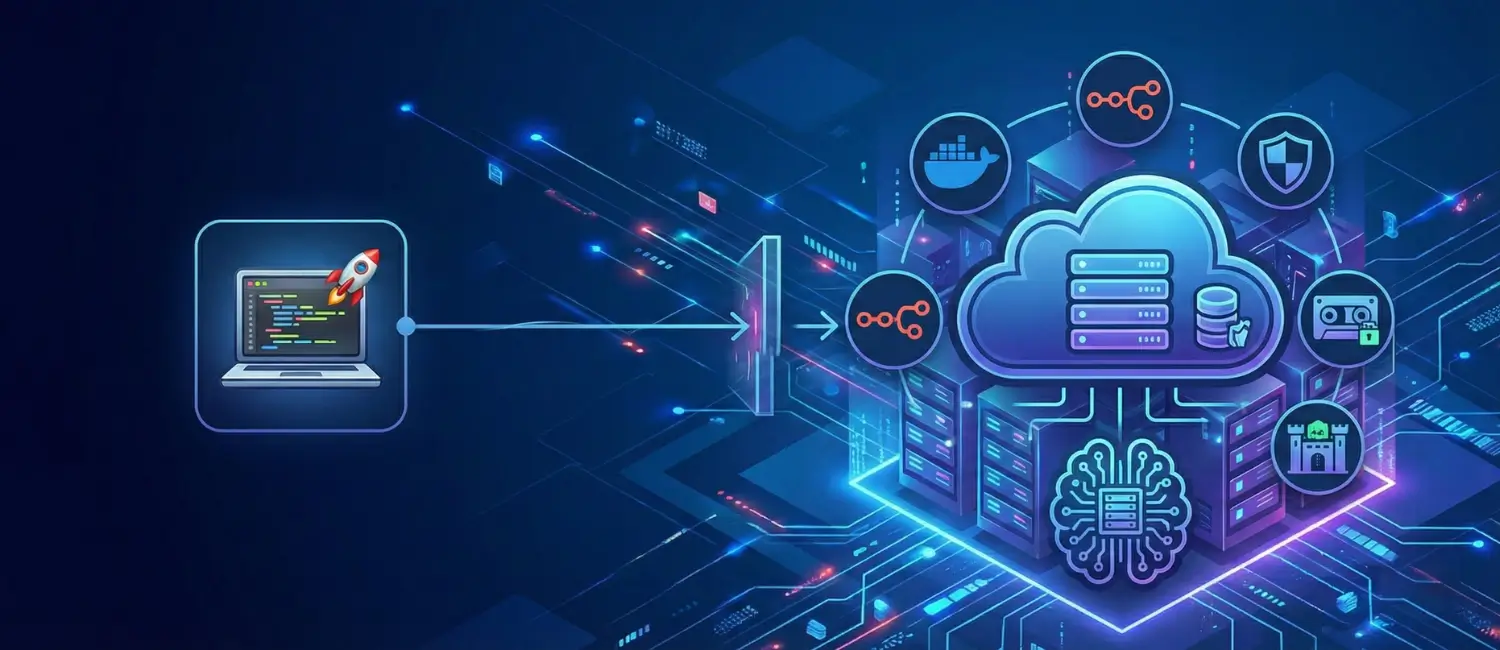
For the last year, something noticeable has been happening across the tech industry: more people can build software than ever before. With AI copilots to scaffold apps, generate APIs, write Dockerfiles, and assemble entire workflows through a few prompts, teams are shipping MVPs in days instead of months. Products that used to take weeks to prototype now go from idea to click‑tested demo in less than a sprint.
But there’s a hidden truth behind this “vibe‑coded” boom: most projects don’t fail because the code is bad. They fail because the environment is wrong.
A huge portion of those projects live on a laptop, on localhost, or on a half‑configured dev machine, where everything “just works” and everyone thinks: “We’re basically done.” The moment that the project touches real life, the illusion breaks.
Real users bring real concurrency.
Real payments bring real webhooks.
Real uptime expectations bring real scrutiny.
Real attackers, scanners, and bot traffic start probing every exposed port.
Real cost surprises show up on the next bill.
And real backups, when they exist, become the line between “minor outage” and “permanent loss.”
That’s the moment many teams realize something uncomfortable: they never built a system. They built a demo.
And that’s exactly why Cloud VPS is more important in 2026 than ever before, not because it’s loud in the headlines, but because it’s the fastest path from “we built it” to “we can run it, safely and reliably.”
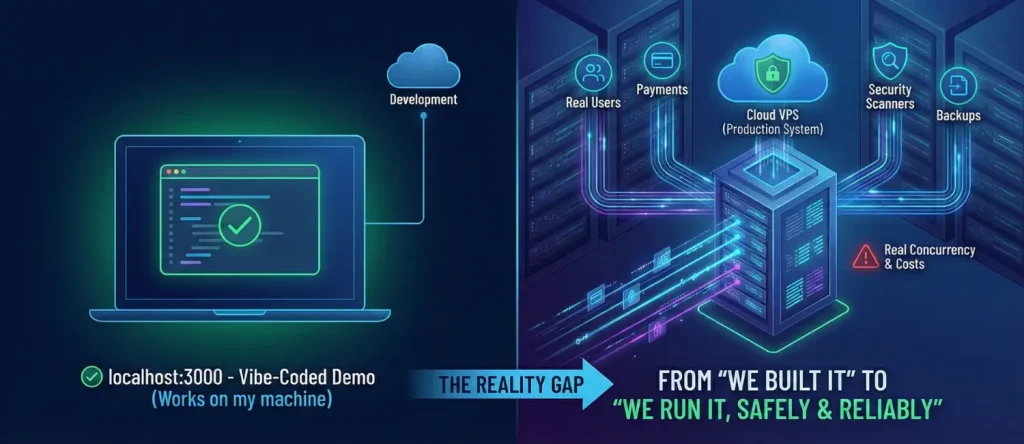
Building on a personal machine creates a false sense of security. Local environments are forgiving in ways production never is:
Production is a different planet. The moment your service goes online, it becomes a target. Automated scanners probe every open port. Credential‑stuffing bots hammer your auth endpoints. Misconfigured headers get exploited. A single leaked key can lead to a full‑stack compromise.
Even without attackers, production will still punish you.
A small memory leak becomes downtime.
A “minor” database lock becomes a cascading failure.
A single webhook edge case becomes lost revenue.
A quiet backup failure becomes permanent data loss.
That’s why “just deploy it” is not a strategy. It’s a wish.
When people hear “VPS” some still picture a cheap box to host a static website. That’s not what modern teams need today.
Modern Cloud VPS is a control layer:
If you’re running workflows (like n8n), Docker‑based apps, API, SaaS apps, AI inference endpoints, scraping pipelines, automation agents, or client systems, you want an environment that behaves like production from day one.
Cloud VPS is where that starts.
Most teams don’t fail because they don’t care. They fail because they don’t know what questions to ask.
Production isn’t a single deployment, it’s a discipline made up of:
AI helps you generate code faster, but it does not automatically generate this discipline. That’s where experienced operators matter.
At Voxfor, we focus on the part most teams skip: taking what you’ve built and making it run correctly in production.
We help you move from:
We do it in a modern way: professionals working with autonomous AI agents, not replacing them. We don’t sell AI magic. We sell execution.
Our team combines real infrastructure and security expertise with autonomous AI agents that accelerate:
The advantage isn’t that an agent can type faster. It’s that experienced operators know what to ask, what to verify, and what can break, and AI helps execute without sacrificing correctness.
If you’re building fast in 2026, you need a deployment partner that can keep up and keep it safe.
Here are some common real‑world setups we help teams implement:
No matter what you’re building, we can help you run it properly.
Clients bring requirements, and if they don’t, we help define them. That’s the right approach.
Our work is typically delivered as hourly technical services, where we can help with:
No inflated promises. No vague “AI consulting” Just practical, hands‑on production delivery.
In 2026, almost anyone can generate an MVP.
Operating a reliable, secure, cost‑aware production system is still the difference between a project that survives and a demo that disappears.
Cloud VPS is the foundation layer teams need.
Voxfor exists to help you deploy that foundation correctly and to move your AI‑built MVP into real production, not just working locally.
If you want help setting up your Cloud VPS, deploying n8n, running Docker workloads, hardening a server, implementing backups, or moving an AI‑built MVP into real production, open a support ticket and tell us what you’re trying to run. We’ll map the requirements and propose the fastest, safest path to production.
Voxfor Premium High‑Ticket Technical Services (MetaAgentOS):
https://www.voxfor.com/premium-high-ticket-technical-services-with-metaagentos.php

Netanel Siboni is a technology leader specializing in AI, cloud, and virtualization. As the founder of Voxfor, he has guided hundreds of projects in hosting, SaaS, and e-commerce with proven results. Connect with Netanel Siboni on LinkedIn to learn more or collaborate on future project.





 Lifetime VPS Europe
 Lifetime VPS Asia
 Lifetime WooCommerce Hosting
 Lifetime Hosting
 France Lifetime Dedicated Servers
 Germany Lifetime dedicated servers
 Lifetime Game Dedicated Servers
 Chicago, US
 Tokyo, Japan
 Singapore
 Hong Kong
 Seoul, South Korea
 Amsterdem, Netherlands
 London, UK
 Stockholm, Sweden
 Oslo, Norway
 Vienna, Austria
 Zurich, Switzerland
 Sydney, Australia
 Wordpress Hosting
 VPS Hosting
 DDOS Protection
 Submit Ticket
 Full Management
 Guides
 Videos and Podcasts
 Discover Creative Ideas
 MetaAgentOS High-Ticket Support System
 Voxfor Mega Menu
 Voxfor Advanced Price Management For WooCommerce
 Voxfor Secure Live Chat and AI Support
 Voxfor Multilanguage
 Voxfor AI Content Summary


