The digital commerce landscape within the WordPress ecosystem is currently undergoing a structural transition that mirrors broader shifts in the global software industry. For over a decade, WooCommerce has operated as the monolithic standard for WordPress e-commerce, leveraging the platform’s open-source heritage to provide a highly flexible, self-hosted solution. Nevertheless, the advent of SureCart points to a new paradigm of so-called headless or hybrid-SaaS, which aims to solve the performance bottlenecks and maintenance overhead of the traditional monolithic architectures. This report includes a detailed technical and strategic comparison between the two platforms, including the difference in their architecture, the economic impact, the ease of access by developers, and how either platform can be adapted to various business models in the 2025 environment.
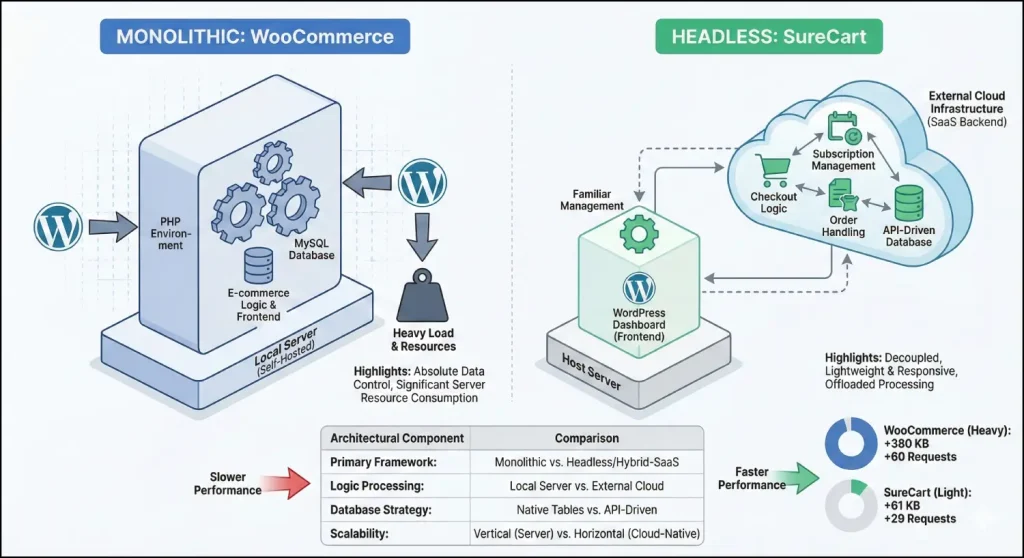
The structural incompatibility between WooCommerce vs SureCart lies in the underlying architecture of their basic systems. WooCommerce follows a monolithic architecture, where the e-commerce logic, database management, and frontend rendering are all handled on the local WordPress server. Every product query, tax calculation, and payment processing step executes within the host’s PHP environment and writes to the local MySQL database. While this ensures the merchant maintains absolute control over data, it also consumes significant server resources, particularly as a store scales.
In contrast, SureCart utilizes a headless eCommerce architecture. Although the merchant manages the store through a familiar WordPress dashboard, the critical processing tasks—such as checkout logic, subscription management, and order handling—are offloaded to SureCart’s external cloud infrastructure. This decoupling of the frontend from the backend allows the website to remain lightweight and responsive, as the host server is no longer burdened with the heavy lifting of transactional processing.
| Architectural Component | WooCommerce | SureCart |
| Primary Framework | Monolithic / Self-Hosted | Headless / Hybrid-SaaS |
| Logic Processing | Local Server (PHP/MySQL) | External Cloud Infrastructure |
| Database Strategy | Native WordPress Tables (Local) | External API-Driven (SaaS Backend) |
| Security Responsibility | Merchant-Managed (Host-Side) | SaaS-Managed (Sovereign Infrastructure) |
| Scalability Mechanism | Vertical Scaling (Server Resources) | Horizontal Auto-Scaling (Cloud-Native) |
The implications of these architectural choices manifest most clearly in site performance metrics. In standardized tests, WooCommerce has been shown to add significantly more weight to a WordPress installation than SureCart. For instance, on a clean installation, the core WooCommerce plugin can increase total page size by over 380 KB and add more than 60 requests to the frontend, whereas SureCart adds approximately 61 KB and 29 requests. This represents a 6.3x difference in weight, suggesting that the headless model provides an inherent advantage for site speed and server efficiency.
To the technical stakeholders, the open versus closed code systems is a battle between complete control and controlled stability. WooCommerce is a completely open-source platform, which means that developers may gain access to and alter any component of the PHP codebase. This editing freedom is also a foundation of the platform that allows developers to design custom workflows, custom hooks, and deep integrations and is only constrained by their technical abilities.
SureCart operates as a partially closed system, which is common in SaaS-hybrid models. While developers cannot modify the core backend logic running on SureCart servers, the platform provides a comprehensive suite of developer tools designed for the WordPress runtime. They consist of action and filter hooks built into WordPress, a powerful REST API, and special PHP models through which the developer can query and manipulate data in a Laravel-like syntax.
| Capability | WooCommerce | SureCart |
| Core Logic Modification | Full PHP Access (GPL) | Restricted (SaaS Backend) |
| Database Manipulation | Direct SQL Querying / Custom Tables | API-Based Interaction Only |
| Templating System | Override System (PHP Templates) | Block-Based / Component-Driven |
| Automation Triggers | Local PHP Hooks / Actions | Webhooks / API Events / SureTriggers |
The “open code” nature of WooCommerce facilitates the development of highly complex or niche features, such as advanced product filtering or multi-location shipping calculations, by allowing developers to write custom code directly into the transactional flow. However, this freedom comes with a significant maintenance overhead; the more a store is customized, the more difficult it becomes to manage updates and ensure security.
SureCart’s “API-first” approach provides a different kind of freedom. By abstracting the core complexities of the e-commerce engine, such as subscription billing cycles and secure checkout logic, it allows developers to focus on the frontend experience and unique business integrations.
Developers can utilize the IntegrationService class to handle purchase lifecycles, such as granting access to specific WordPress user roles or LMS courses upon successful payment, without needing to worry about the underlying transaction security.
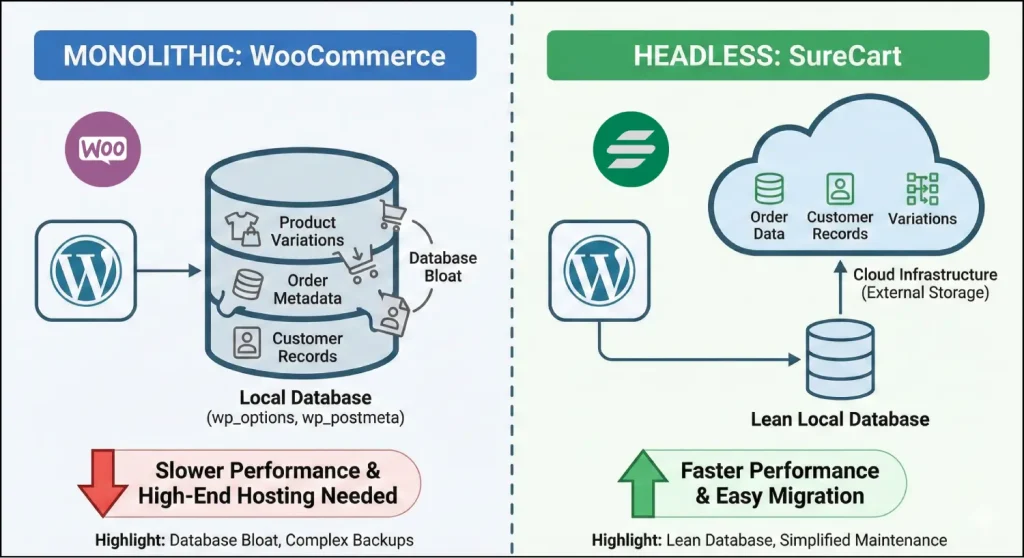
One of the major concerns of high-traffic sites is the effect of e-commerce activities on a WordPress database. Plugins such as the monolith WooCommerce are also known to result in database bloat, because the entire range of product variations, order metadata, and customer records are stored in the underlying WordPress wp_options and wp_postmeta tables. With time, this may cause severe loss of performance of the site; one may need to hire a professional database tuning and high-end hosting to remain responsive.
SureCart mitigates this by keeping the WordPress database “lean”. Because order data and customer records are primarily stored on SureCart cloud infrastructure, the local WordPress database is spared from the ballooning effect typical of legacy e-commerce plugins. This external storage model not only improves site speed but also simplifies the site’s backup and migration processes.
| Metric | WooCommerce | SureCart |
| Page Load Impact (Size) | High (+387 KB on average) | Low (+61 KB on average) |
| Request Count Impact | High (+62 requests) | Low (+29 requests) |
| TTFB (Time to First Byte) | Dependent on local server optimization | Consistent (cloud-offloaded logic) |
| Database Table Usage | Extensive local table writing | Minimal local footprint |
In terms of scaling, WooCommerce requires vertical expansion, essentially throwing more CPU and RAM at the server as the product catalog and visitor numbers grow. SureCart, leveraging horizontal auto-scaling cloud technology (comparable to infrastructure used by Salesforce and Kajabi), adapts to traffic spikes without requiring the merchant to upgrade their local hosting plan. This makes SureCart particularly attractive for “drop” style sales or viral events where traffic might suddenly surge.
The initial perception that WooCommerce is “free” is often challenged when merchants factor in the cost of premium extensions and high-performance hosting. To achieve feature parity with SureCart in areas like subscriptions, order bumps, and tax automation, a WooCommerce user must often purchase a stack of expensive add-ons.
| Feature | WooCommerce Costs | SureCart Costs |
| Core Software | Free | Free (with 1.9% fee on some plans) |
| Subscription Logic | /year | Included natively |
| Checkout Customization | /year (e.g., CartFlows) | Included natively |
| Tax/VAT Automation | Paid Extension Required | Included natively |
| Order Bumps/Upsells | Paid Extension Required | Included natively |
| Hosting Requirements | High-End Managed Hosting Recommended | Basic Shared Hosting is often sufficient |
While WooCommerce provides “true ownership” without recurring platform fees, the maintenance costs and the “extension tax” can lead to a higher total cost of ownership (TCO) for complex stores.
SureCart’s pricing model is more transparent, offering paid tiers that remove transaction fees and include all advanced features in a single subscription. For many small and medium-sized businesses, this predictability is a significant advantage over the fragmented billing of multiple WooCommerce extension developers.
The day-to-day management of an online store is where the user interface (UI) and user experience (UX) become critical. SureCart is designed as a modern “single-page application” inside the WordPress admin, providing a smooth, fast interface that removes much of the “clutter” found in traditional plugins. Merchants have noted that the SureCart dashboard feels more intuitive and requires less training for support staff.
WooCommerce, while familiar to long-time WordPress users, often feels “dated” and “clunky”. Its administrative interface is spread across numerous menus, and the product editor can feel overwhelming due to the sheer number of settings and third-party plugin notices that often compete for attention.
| Operational Task | WooCommerce Experience | SureCart Experience |
| Product Setup | Comprehensive but complex settings | Streamlined, modern visual editor |
| Checkout Builder | Standard pages; blocks are evolving | Drag-and-drop visual form builder |
| Bulk Management | Advanced bulk editing for large catalogs | Basic; currently lacks advanced bulk tools |
| Account Management | Standard WordPress dashboard style | Modern SaaS-style customer portal |
One area where WooCommerce maintains a distinct advantage is in the management of very large physical inventories. Its mature toolset for SKU management, backorder control, and bulk updates makes it better suited for enterprises with thousands of products.
SureCart, while rapidly evolving, still faces some “workflow bottlenecks” for massive inventories, such as the current inability to efficiently bulk-manage variable products via CSV exports.
In the realm of global commerce, the ability to accept diverse payment methods and remain compliant with regional tax laws is paramount. Both platforms integrate with the “big two” Stripe and PayPal, but their approaches to expansion differ.
Hundreds of payment gateways are supported by WooCommerce via its expansive collection of extensions, including region-specific solutions necessary to support markets in Africa, Asia, and South America. This makes it the safer option for merchants in countries where mainstream gateways, such as Stripe, are restricted or limited.
SureCart focuses on modern, integrated payment flows, supporting Stripe, PayPal, Mollie, and Paystack natively. It excels in “frictionless” checkouts, supporting Google Pay and Apple Pay out of the box to boost conversion rates. Furthermore, SureCart’s built-in tax and EU VAT handling is a major advantage for sellers who do not want to manage complex tax rate tables manually.
| Requirement | WooCommerce | SureCart |
| GDPR Compliance | Merchant-responsible configuration | Built-in data handling compliance |
| Tax/VAT Calculation | Often requires paid plugins (e.g., TaxJar) | Automatic global tax calculation |
| PCI Compliance | High burden on server security | Offloaded to secure cloud checkout |
| Spam Protection | Requires additional plugins (e.g., OOPSpam) | Built-in honeypot and reCAPTCHA |
The “headless” nature of SureCart significantly simplifies security for the merchant. Because the checkout and payment processing occur on SureCart’s secure infrastructure, the risk of credit card data touching the merchant’s server is effectively zero.
This reduces the merchant’s PCI compliance scope and provides an “enterprise-grade” security layer that would otherwise be expensive to implement on a self-hosted WooCommerce store.
The strength of a platform is often measured by its ecosystem. WooCommerce, having been in the market for 14 years, boasts a community and resource library that is unmatched by any other WordPress plugin. If a merchant encounters a problem, there is almost certainly a forum post, a YouTube tutorial, or a freelance developer ready to assist.
SureCart, while younger, is backed by the creators of the Astra theme and the Brainstorm Force ecosystem, giving it a high degree of credibility and a rapidly growing user base. Its primary ecosystem advantage is its integration with SureTriggers (OttoKit), a cloud-based automation platform that allows merchants to connect their store with over 170 other applications without code.
| Feature | AutomateWoo (WooCommerce) | SureTriggers / OttoKit (SureCart) |
| Deployment Model | Local WordPress Plugin | Cloud-Based Automation Service |
| Primary Strength | Deep local store automation | Multi-site and cross-SaaS workflows |
| Visual Builder | Robust workflow builder | Drag-and-drop no-code editor |
| Connectivity | Focused on the WooCommerce ecosystem | Connects 170+ WP and SaaS apps |
AutomateWoo remains a “robust workflow builder” specifically for WooCommerce, excelling at targeting inactive customers or managing personalized discounts within a single store.
SureTriggers, however, offers a broader scope, enabling complex multi-step automations that can span multiple websites and external services, such as adding a customer to a CRM, enrolling them in an LMS, and sending a Slack notification all in one sequence.
The selection between WooCommerce and SureCart is not a binary “better or worse” decision; rather, it is a matter of aligning the platform’s strengths with the business-specific needs.
SureCart is better at the present time among people who sell digital products, online courses, or memberships. Its digital downloads, the integrated license key generation feature, and the smooth integration with other popular LMS integration tools, such as LearnDash, make it a lightweight and very efficient solution.
Recurring payments and installment plans can be managed without additional extensions, enabling creators to launch faster and with less initial expenditure.
For businesses managing thousands of physical SKUs, complex shipping configurations, and international logistics, WooCommerce remains the “powerhouse”. Its advanced inventory management, bulk-editing capabilities, and support for niche localized payment gateways make it more robust for traditional retail at scale.
While SureCart can handle physical goods, its feature set in this area is currently more suited for small and medium-sized inventories.
Agencies building sites for clients who prioritize speed, security, and low maintenance are increasingly turning to SureCart. The headless architecture allows agencies to deliver high-performing stores even on basic hosting, and the reduced risk of plugin conflicts simplifies the long-term management of client sites.
The visual checkout builder also allows agencies to create highly optimized conversion flows without needing custom CSS or additional paid tools.
| Business Type | Recommended Platform | Primary Reason |
| Digital Downloads / Software | SureCart | Native licensing and secure delivery. |
| Online Courses / Coaches | SureCart | LMS integration and built-in subscriptions. |
| Large Physical Catalog (10k+ SKUs) | WooCommerce | Superior bulk management and SKU tools. |
| Localized Markets (Restricted Gateways) | WooCommerce | Broadest support for regional payment plugins. |
| SMEs Seeking Fast Launch | SureCart | Zero-friction setup and integrated tools. |
| Developer-Centric Custom Stores | WooCommerce | Total PHP and database control. |
A primary argument for WooCommerce is the “ownership of data”. Because the store and its data reside on the merchant’s server, they are not dependent on a third party’s business decisions or server uptime. If a SaaS provider were to go out of business, a merchant might face significant disruptions.
However, this sovereignty comes with the “maintenance responsibility”. The merchant is responsible for backups, updates, and server security. SureCart, acting as a “managed eCommerce” solution, removes these burdens, allowing the merchant to focus on sales rather than infrastructure.
Migrating between the two platforms is a task that requires careful planning. While both support CSV exports, the underlying data models are different.
The “vendor lock-in” of SureCart is a conscious tradeoff. By choosing the efficiency of a SaaS-hybrid, the merchant accepts a level of dependence on SureCart servers. For many, the advantages of superior performance, reduced server load, and built-in compliance “far outweigh the negatives” of this dependency.
The Gutenberg Block Editor is the future of WordPress editing, and both platforms have embraced this trend, though with contrasting philosophies. WooCommerce has been retrofitting its legacy code with new Cart and Checkout Blocks, offering a more modern design experience, but sometimes encounters compatibility issues with older themes.
SureCart was built with a “block-first” mentality. Its visual checkout builder is natively integrated into the WordPress block editor, allowing for a seamless design experience where every field and button can be moved or customized as a block. This approach ensures that the checkout process is always mobile-responsive and visually consistent with the rest of the site.
Accessibility is an area where SureCart’s component-based architecture shines. Because the platform is built with modern web components, it explicitly supports ARIA roles, keyboard navigation, and screen-reader readiness out of the box.
WooCommerce accessibility depends heavily on the specific theme and the combination of plugins used, which can lead to inconsistent experiences for users with disabilities.
As the WordPress platform continues to evolve toward a “headless” and “API-first” future, the standard for e-commerce plugins is shifting from simple feature sets to high-performance architectures. WooCommerce remains an “Enterprise Powerhouse” by virtue of its massive community and the total freedom it offers developers. Its role as a “Swiss Army knife” ensures it will remain a staple for complex, custom, and localized retail.
SureCart, however, represents the “next generation” of WordPress e-commerce. By offloading critical processes to the cloud, it has solved the primary pain points of the monolithic era: speed, security, and maintenance overhead. For the modern digital entrepreneur, whether they are selling software, courses, or specialized services, SureCart provides a “slick, minimalist” alternative that prioritizes the user and customer experience over technical features.

Hassan Tahir wrote this article, drawing on his experience to clarify WordPress concepts and enhance developer understanding. Through his work, he aims to help both beginners and professionals refine their skills and tackle WordPress projects with greater confidence.





 Lifetime VPS Europe
 Lifetime VPS Asia
 Lifetime WooCommerce Hosting
 Lifetime Hosting
 France Lifetime Dedicated Servers
 Germany Lifetime dedicated servers
 Lifetime Game Dedicated Servers
 Chicago, US
 Tokyo, Japan
 Singapore
 Hong Kong
 Seoul, South Korea
 Amsterdem, Netherlands
 London, UK
 Stockholm, Sweden
 Oslo, Norway
 Vienna, Austria
 Zurich, Switzerland
 Sydney, Australia
 Wordpress Hosting
 VPS Hosting
 DDOS Protection
 Submit Ticket
 Full Management
 Guides
 Videos and Podcasts
 Discover Creative Ideas
 MetaAgentOS High-Ticket Support System
 Voxfor Mega Menu
 Voxfor Advanced Price Management For WooCommerce
 Voxfor Secure Live Chat and AI Support
 Voxfor Multilanguage
 Voxfor AI Content Summary


