
By 2026, the digital environment will be described as mature with a highly bifurcated market of content management systems (CMS) and website builders. With organizations becoming more and more digital in the way they conduct operations, the architectural choices involved with web infrastructure have far-reaching consequences of long-term scalability, total cost of ownership (TCO), search engine visibility, and data sovereignty. This in-depth analysis of both the technical and strategic ecosystems of the two paradigm leaders of the modern web development landscape, the open-source, highly extensible architecture embodied by WordPress and the closed-ecosystem, fully managed Software-as-a-Service (SaaS) model embodied by Squarespace, is a holistic report. Other websites, including Wix and Shopify, also take up important niches in the market, but the real dichotomy lies between the self-hosted freedom and the proprietary convenience.
Combinations of quantitative market data, performance benchmarks, financial models, and the transformational impact of artificial intelligence on web deployment workflows, this analysis attempts to unpack the second- and third-order implications of platform choice. The most significant contrast between the wear and tear of unlimited customization and the limitation of repairs without any effort is an underlying dichotomy. WordPress is still providing unmatched flexibility, with a preponderance of the web in its hands, but requires proactive management, technical expertise, and a delicate sense of the hosting infrastructure. In contrast, Squarespace offers an extremely streamlined, beauty-conscious, and frictionless experience, which removes the complications of server administration and security at the expense of extensively controlling the architecture and providing absolute data portability.
The choice of stakeholders of enterprises, digital agencies, and commercial organizations in 2026 is much broader than aesthetic preferences. It includes compliance with strict web performance standards, integration with sophisticated generative AI tools, mitigation of advanced cyber threats, and the financial implications of transactional infrastructure. In this report, the important vectors are broken down in a data-based approach to strategic digital infrastructure investments in the new age, which will prove that the platform chosen by an organization is not about short-term aesthetic satisfaction but a reliable basis of scalable and cost-effective operations in the future.
The market structure of content management in 2026 indicates an acutely hierarchical field, which has been formed due to several years of network effects, the development of developer ecosystems, and changes in consumer demands toward digital availability. The macro-market forces are critical in helping one to contextualize the lifespan, support system, and integration capacity of any platform of choice. A platform that has a large market share will inherently attract a stronger ecosystem of third-party developers, thus guaranteeing an unending flow of innovation and security improvements.
In stark contrast, the managed SaaS website builder segment, while numerically smaller, exhibits concentrated growth among specific user demographics, particularly creatives, boutique e-commerce ventures, and small-to-medium enterprises (SME). Within this proprietary ecosystem, Shopify leads the specialized e-commerce sector with a CMS market share fluctuating between 6.7% and 7.2%, powering approximately 48 million websites. Wix follows as a general-purpose builder at 4.8% to 6.0% (representing roughly 29 million websites). Squarespace captures between 3.2% and 3.4% of the CMS market, amounting to over 23 million websites globally.
| Content Management System | Estimated Global Websites | CMS Market Share (Early 2026) | Share of All Websites |
| WordPress | 472 million | 59.9% – 61.9% | 43.3% |
| Shopify | 48 million | 6.7% – 7.2% | 4.4% – 4.6% |
| Wix | 29 million | 4.8% – 6.0% | 2.7% – 3.2% |
| Squarespace | 23 million | 3.2% – 3.4% | 2.1% – 2.2% |
| Joomla | 18 million | 1.6% – 2.3% | 1.6% – 1.7% |
Data aggregated from multiple 2025-2026 market intelligence reports detailing CMS usage statistics.
The underlying trend suggested by these figures is a structural stabilization of the market. The open-source paradigm has effectively won the battle for scale and complex enterprise deployment, while the managed SaaS paradigm has successfully captured the low-to-medium complexity market segment. Squarespace, specifically, has positioned itself as the preeminent platform for visual aesthetics and brand-focused deployments. It intentionally sacrifices the infinite extensibility of open-source software to deliver a highly controlled, high-fidelity user experience. Wix has similarly evolved into a sophisticated developer platform via Wix Studio, but it remains a closed SaaS ecosystem.
This type of market bifurcation offers a trade-off decision-making framework to decision-makers. Selecting a platform whose market share is 60% CMS will ensure ecosystem permanence but will bring about the anarchy of a decentralized, unregulated marketplace of plugins. On the other hand, choosing a platform with a market share of 3.4% will ensure a curated, high-end experience, but constrain the technology roadmap to the choices and business interests of a single corporate entity. The endurance of the online existence of a business is by definition linked to the sustainability and philosophical direction of the platform in question.
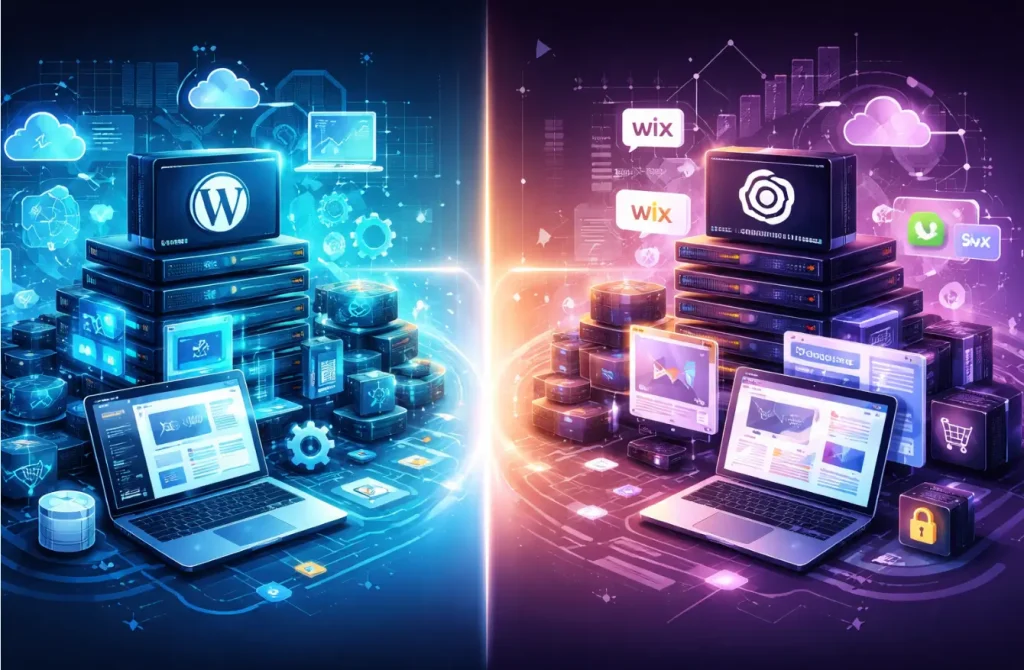
To comprehend the operational realities of WordPress and Squarespace, one must first dissect their foundational architectures. The distinction between an open-source, self-hosted framework and a closed-loop, managed SaaS platform dictates every subsequent capability, from data portability and server-level optimization to the fundamental ownership of digital assets.
WordPress is fundamentally based on open-source architecture, i.e., the core software is free and can be modified indefinitely without any particular commercial infrastructure. This provides the deploying entity with unqualified digital sovereignty. The codebase may be reviewed line by line, modified to fit very specific requirements, and is usable in any server infrastructure worldwide. An organization may decide to deploy a WordPress site on low-level shared hosting, migrate to a Virtual Private Server (VPS), or install it in vast, load-balanced enterprise cloud clusters using either Amazon Web Services (AWS) or Google Cloud.
However, this freedom necessitates the assembly of a fragmented technology stack. A functional WordPress deployment in 2026 requires the core software, a web server (such as Nginx or Apache), database management software (MySQL or MariaDB), a chosen theme framework, and a constellation of functional plugins. This modularity is the exact source of WordPress’ infinite scalability; it allows developers to engineer bespoke functionalities, integrate proprietary APIs, and sculpt the backend architecture to exact organizational specifications.
The second-order implication of such a decentralized structure is the total maintenance load. Since the elements are supplied by different developers worldwide, interoperability becomes an ongoing challenge. The implementation of security patches, updating PHP versions, and resolving plugin conflicts are all the responsibility of the site owner or hosting provider.
Moreover, fundamental features that users of contemporary software require, including automatic autosaving and content versioning, are robustly supported in WordPress. Conversely, rival SaaS solutions may lack such critical fail-safes in some cases.
Ultimately, the WordPress platform requires dynamic, ongoing governance to prevent performance degradation or security risks, making it less suitable for organizations unwilling to invest in technical overhead.
Squarespace represents an opposed philosophical approach to web architecture. It is a fully managed, proprietary SaaS ecosystem where the application layer, database, hosting infrastructure, and content delivery network (CDN) are inextricably integrated and managed entirely by the vendor. The end-user is completely insulated from the underlying server architecture, interacting solely with a polished, front-end graphical user interface (GUI).
This abstraction translates into unrivalled operational seamlessness. There are no software installations, no plugin updates, no database prefix settings, and no server setups to be fine-tuned. The highly controlled nature of the platform also means that every part of it will work together cohesively, since all features, templates, and integrations are engineered, tested, and deployed by a unified development team. This architecture is very beneficial to organizations without internal technical resources and those that consider IT management a side-distraction from their core business goals.
The critical trade-off for this convenience is the severe lack of structural flexibility. The deployment is fundamentally restricted by the feature set explicitly permitted by Squarespace. Users cannot manipulate the core code, optimize server-level caching mechanisms, or implement complex, non-native database relationships.
Furthermore, the SaaS model introduces the concept of digital tenancy rather than digital ownership. The organization is essentially renting space on a proprietary server; they do not own the underlying technology that powers their digital presence. If Squarespace determines that a specific feature is no longer profitable to support, or decides to increase subscription fees arbitrarily, the tenant organization has little recourse other than compliance or complete platform migration.
Digital infrastructure should be financially modeled with a holistic view of the Total Cost of Ownership (TCO) over a multi-year period. The most obvious type of entry-level pricing often clouds the real economic cost and benefit of scaling operations, integrating premium software, and absorbing transactional fees. Both platforms have developed cost structures that require close financial forecasting in 2026.
Squarespace operates on a tiered, predictable subscription model. The vendor attempts to consolidate the entirety of a business’s web expenses into a single, predictable monthly or annual invoice. In 2026, the platform offers four primary annual plans, each inclusive of hosting, a free custom domain for the first year, SSL certification, and continuous security management.
| Squarespace Plan | Annual Price (Monthly Equivalent) | Online Store Transaction Fee | Digital Product Fee | Target Demographic and Key Features |
| Basic | $16 / month | 2% | 7% | Personal portfolios, simple blogs; 2 contributors, 30 min video storage. |
| Core | $23 / month | 0% | 5% | Small business sites: unlimited contributors, 5 hours of video storage, advanced analytics. |
| Plus | $39 / month | 0% | 1% | Growing e-commerce startups; 50 hours of video storage, lower credit card processing fees. |
| Advanced | $99 / month | 0% | 0% | High-volume retail; unlimited video storage, lowest credit card fees, and advanced shipping. |
The economic benefit of this structure is its predictability. The package quality of the service eliminates hidden costs such as maintenance retainers, security audits, and costly software licenses. A company can accurately forecast its web infrastructure budget without worrying about sudden server overage charges or the need to purchase an emergency security plugin.
However, the inclusion of revenue-sharing mechanisms, specifically the exorbitant 7% and 5% digital product fees on the Basic and Core plans, introduces a severe scalability penalty. This represents a regressive tax on business growth. For a creator selling $10,000 worth of digital courses on the Basic plan, the platform claims $700 in fees in addition to the subscription cost.
This artificial inflation of costs forces growing businesses into rapid upgrades to higher tiers. When calculating Total Cost of Ownership (TCO) over 36 months, a business scaling its e-commerce operations will quickly find itself on the $99/month Advanced plan, equating to nearly $1,200 annually, simply to avoid punitive transaction fees.
It is much more intense to analyze the Total Cost of Ownership (TCO) of WordPress because of its decoupled nature. Though the core WordPress application is technically free of charge, the cost of running a business-scale website can be significant due to variable expenses in hosting, premium themes, proprietary plugins, and ongoing maintenance.
In 2026, the legacy paradigm of inexpensive shared hosting has largely been superseded by Managed WordPress Hosting for professional deployments. The absolute necessity for advanced caching, robust security, and compliance with search engine performance benchmarks drives this shift. The pricing matrix for managed infrastructure varies exponentially based on compute resources, bandwidth requirements, and the level of technical support provided.
| Managed WP Provider | Entry Price (Monthly) | Key Features / Bandwidth Constraints | Target Demographic |
| Hostinger | ~$1.99 – $3.00 | 100 GB+ bandwidth, basic automated optimization | Entry-level bloggers, hobbyists |
| SiteGround | ~$3.99 – $4.00 | Unmetered (fair use), solid value, basic CDN | SME brochures, local businesses |
| Cloudways | ~$11.00 – $14.00 | 1-5 TB bandwidth, highly flexible cloud infra | Developers, high-traffic publishers |
| WP Engine | ~$26.00 – $30.00 | 50 GB+ bandwidth, enterprise-grade security | Corporate entities, complex sites |
| Kinsta | ~$30.00+ | Visitor-based limits, premium staging environments | High-performance enterprise e-commerce |
In addition to infrastructure provision, a professional WordPress stack usually requires capital investment in high-quality plugins. Although free versions are available, advanced features such as sophisticated SEO systems, object caching engines, advanced form builders, and automated off-site backup software are typically offered only under premium licenses, costing between $50 and $500 per year.
Moreover, the maintenance overhead is a significant hidden cost. Whether managed in-house or outsourced to a digital agency, and depending on the complexity of custom code and the volume of content updates, the cost of ongoing maintenance can range between $75 and $15,000 per year.
In 2026, website performance is no longer merely an optimization metric; it is a foundational pillar of digital survival. Search engine algorithms, specifically Google Core Web Vitals (CWV) framework, unequivocally penalize slow digital experiences. They directly correlate page load times, visual stability, and interactive responsiveness with search engine results page (SERP) visibility and customer conversion rates.
The economic penalty for digital latency is severe, with industry data indicating that a single second of delay results in an average 7% reduction in conversions. For an enterprise generating $100,000 daily in revenue, sub-optimal performance can translate into an annualized revenue loss exceeding $365,000. Speed is a direct revenue driver.
WordPress, by virtue of its decentralized architecture, presents a massive variance in performance capabilities. A poorly configured WordPress site, hosted on inexpensive shared infrastructure and burdened by unoptimized, conflicting plugins, will perform disastrously, often worse than a base-level Squarespace site. However, an expertly engineered WordPress deployment represents the absolute pinnacle of web performance.
System administrators retain absolute control over the entire execution stack. This enables the implementation of advanced performance mechanisms such as server-side object caching (e.g., Redis or Memcached), bespoke code minification, granular database query optimization, and integration with high-speed performance environments like LiteSpeed web servers.
When coupled with premium managed hosting such as Kinsta, WP Engine, or custom Cloudways deployments, a highly optimized WordPress site can consistently achieve blazing-fast load times between 0.5 and 2.0 seconds.
| Performance Metric | WordPress (Highly Optimized Environment) | Squarespace (Native SaaS Environment) |
| Average Page Load Time | 1.0 – 2.0 seconds | 2.0 – 4.0 seconds |
| Core Web Vitals Ceiling | Exceptional / Perfect Score Possible | Good / Moderate at best |
| Mobile Speed Optimization | Granular control, highly optimizable | Moderate, strictly platform-restricted |
| Server-Level Caching Control | Complete Access (Redis, Memcached) | Zero Access (Managed by vendor) |
The second-order insight derived from these technical metrics is that competitive advantage in highly saturated, lucrative organic search markets increasingly depends on fractional milliseconds of performance. Achieving these micro-optimizations requires an open-source, fully controllable architecture that only a self-hosted CMS like WordPress can provide. For businesses where organic search is the primary acquisition channel, the performance ceiling of Squarespace becomes a definitive liability.
The most disruptive technological shift in web development leading into 2026 is the profound integration of generative Artificial Intelligence (AI). The paradigm has rapidly evolved from visual drag-and-drop page builders to conversational prompt-to-publish generation engines. Both Squarespace and the broader WordPress ecosystem have heavily invested in AI, albeit through vastly different implementation strategies that reflect their respective architectural philosophies.
Squarespace has seamlessly embedded generative AI directly into the core fabric of its platform. Operating under the umbrella concept of “Design Intelligence” and branded primarily as Blueprint AI, the system functions as a holistic, integrated design partner. By establishing deep API partnerships with leading Large Language Model (LLM) providers, including OpenAI, Anthropic, and Google, Squarespace has engineered a cohesive, frictionless onboarding experience.
A user can now describe their business model, target audience, and select a desired “brand personality” ranging from highly professional to eccentric or quirky. Upon execution, Blueprint AI instantly generates a fully structured, multi-page website.
This includes not only the macro layout, color palettes, and typography, but also the creation of bespoke, contextually relevant content and high-quality imagery, forming an immediate and cohesive visual identity.
The open-source nature of WordPress has fostered a highly competitive, fragmented, and rapidly evolving AI builder marketplace. Rather than relying on a single, monolithic integrated tool, WordPress enables third-party developers to push the absolute boundaries of AI generation independently.
In 2026, the WordPress market is dominated by several specialized AI builders, each catering to different workflow requirements and technical proficiencies:
| WordPress AI Tool | Primary Strength / Best Use Case | Starting Price Model (2026) |
| ZipWP | Free AI site export, no platform lock-in | Freemium (Premium from ~$79) |
| Elementor AI | Deep integration, custom code generation | Subscription (From ~$59/year) |
| Divi AI | Professional design, contextual image gen | Subscription (From ~$227/year) |
| SeedProd AI | Fast full-site and funnel building | Subscription (From ~$39.50/year) |
| Bluehost AI | Managed hosting plus easy AI setup | Bundled with hosting (~$1.99/mo) |
The strategic implication of the WordPress AI ecosystem is profound flexibility. Developers can leverage multiple specialized AI tools simultaneously, using ZipWP for rapid macro-wireframing, Elementor AI for micro-component styling, and dedicated AI SEO plugins for continuous content optimization. While this workflow lacks the monolithic simplicity of Squarespace’s Design Intelligence, it provides a significantly higher ceiling for bespoke architectural design and iterative, prompt-driven development.
The algorithmic landscape of search engines in 2026 prioritizes semantic structure, Core Web Vitals, and authoritative content formatting encapsulated in the E-E-A-T guidelines: Experience, Expertise, Authoritativeness, and Trustworthiness, far beyond legacy metrics like simple keyword density. Consequently, the underlying CMS must provide both baseline technical compliance and advanced granular control to ensure competitive indexing and high-ranking visibility.
Previously scorned by digital marketers due to its draconian SEO restrictions, Squarespace has actively evolved in recent years by enhancing its Fluid Engine. The platform now delivers a high level of reliability in automatically meeting technical SEO requirements in 2026. It inherently generates and dynamically updates XML sitemaps, enforces SSL encryption globally, maintains a clean and readable URL structure, and ensures universal mobile responsiveness across all templates.
For small-to-medium businesses, local service providers, and personal brand portfolios, Squarespace provides an environment where SEO success is driven almost entirely by content quality rather than technical configuration. The platform’s built-in AI tools further reduce the barrier to entry by assisting with rapid optimization of page titles, meta descriptions, and image alt text at no additional cost.
WordPress is the uncontested industry standard for enterprise-level Technical SEO. While the core software provides robust taxonomy controls, a powerful blogging infrastructure essential for long-term SEO expansion, and flexible content structuring, its full potential is unlocked through advanced SEO plugins such as Yoast, Rank Math, and SEOPress, along with server-side customization and development.
In the 2026 SEO environment, the ability to deploy complex, dynamic schema markup is paramount. WordPress allows developers to inject bespoke JSON-LD structured data into any specific page, product, or custom post type. This enables the site to communicate complex entity relationships directly to search engine crawlers, enhancing local SEO visibility and rich result formatting.
Furthermore, WordPress provides absolute, granular control over canonicalization protocols, custom 301 and 302 redirect logic, server log file analysis, and the implementation of Instant Indexing APIs that notify search engines the exact moment content is updated.
The capacity to facilitate digital commerce seamlessly is a primary consideration in modern platform selection. Both platforms offer robust solutions, but they cater to vastly different scales of operational complexity, inventory management requirements, and transactional volume.
Squarespace approaches e-commerce as an integrated, frictionless extension of its design ethos. The platform natively supports physical products, digital downloads, complex service scheduling via its integrated Acuity Scheduling tool, memberships, and content paywalls without requiring external plugins.
Storefront setup is remarkably intuitive, and advanced features such as abandoned checkout recovery algorithms, automatic discount logic, customer accounts, and carrier-calculated regional shipping are seamlessly activated within higher-tier plans.
Crucially, WooCommerce does not impose platform-level transaction fees, ensuring merchants only pay standard payment gateway charges associated with their chosen merchant account. More importantly, the ecosystem supports limitless technical scalability. Developers can build bespoke headless commerce architectures, separate the front-end design from the back-end inventory system, integrate complex ERP (Enterprise Resource Planning) systems, manage expansive multi-vendor marketplaces similar to Amazon, and fully customize every aspect of the digital storefront and checkout funnel.
The 2026 evaluation of digital infrastructure platforms underscores a fundamental truth: in the realm of web architecture, there is no universal technological superiority, only precise strategic alignment. The dichotomy between WordPress and Squarespace represents a definitive choice between absolute architectural sovereignty and frictionless, automated operational management.

Hassan Tahir wrote this article, drawing on his experience to clarify WordPress concepts and enhance developer understanding. Through his work, he aims to help both beginners and professionals refine their skills and tackle WordPress projects with greater confidence.





 Lifetime VPS Europe
 Lifetime VPS Asia
 Lifetime WooCommerce Hosting
 Lifetime Hosting
 France Lifetime Dedicated Servers
 Germany Lifetime dedicated servers
 Lifetime Game Dedicated Servers
 Chicago, US
 Tokyo, Japan
 Singapore
 Hong Kong
 Seoul, South Korea
 Amsterdem, Netherlands
 London, UK
 Stockholm, Sweden
 Oslo, Norway
 Vienna, Austria
 Zurich, Switzerland
 Sydney, Australia
 Wordpress Hosting
 VPS Hosting
 DDOS Protection
 Submit Ticket
 Full Management
 Guides
 Videos and Podcasts
 Discover Creative Ideas
 MetaAgentOS High-Ticket Support System
 Voxfor Mega Menu
 Voxfor Advanced Price Management For WooCommerce
 Voxfor Secure Live Chat and AI Support
 Voxfor Multilanguage
 Voxfor AI Content Summary


