
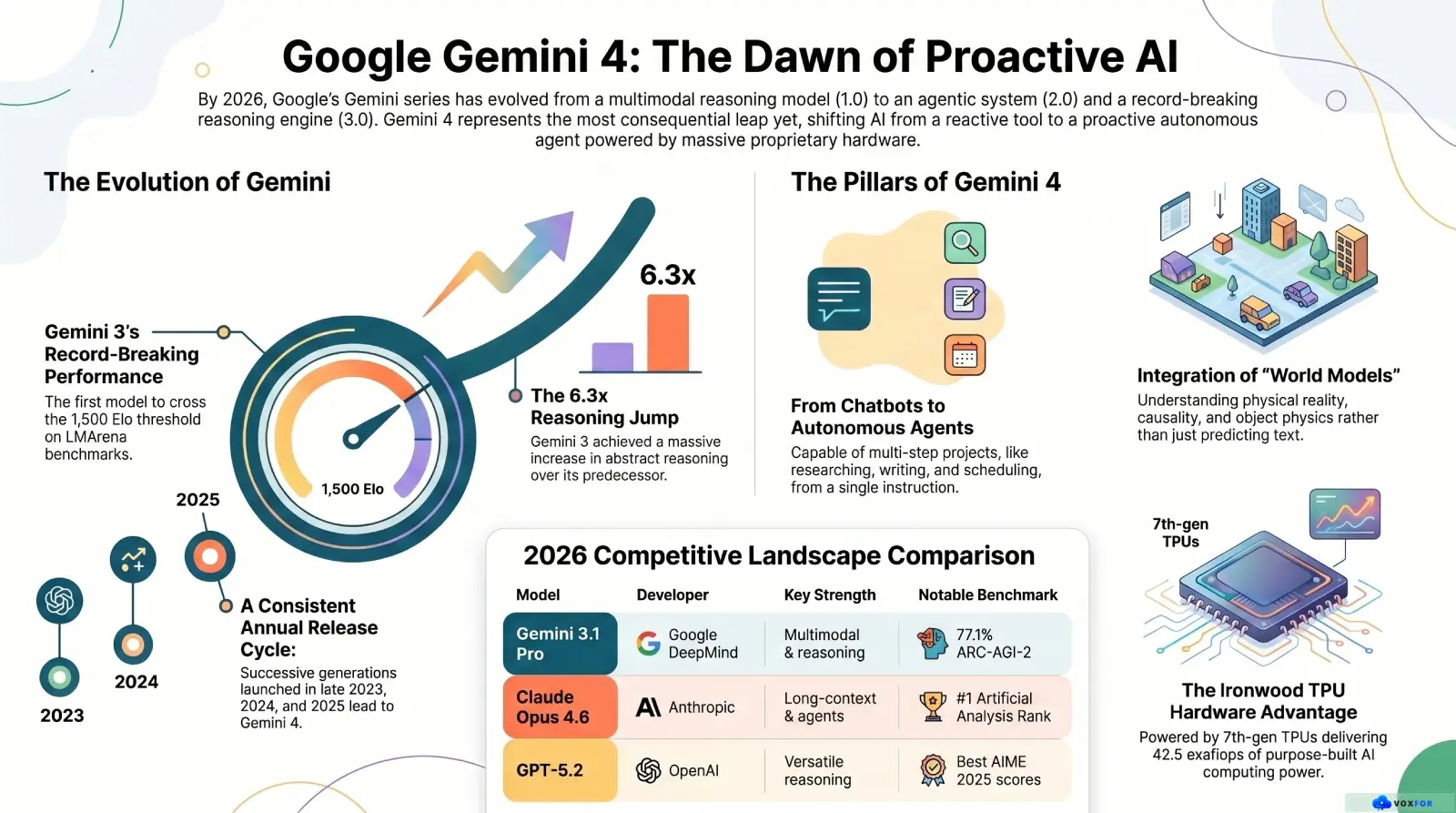
To understand where Gemini 4 is headed, it helps to see how fast Google has already moved. Google launched the original Gemini, a natively multimodal model that could process text, audio, images, and video simultaneously, outperforming OpenAI GPT-4 on several key general-reasoning benchmarks. In late 2024, Gemini 2.0 arrived, introducing native agentic capabilities and powering experimental projects like Project Astra and Project Mariner. Then in March 2025, Google unveiled Gemini 2.5 Pro, which the company described as its “most intelligent model yet”, a reasoning model designed to pause and think before answering, available to subscribers through Google AI Studio.
Inbound Marketing Strategy
Helpful tutorials attract qualified visitors, but reliable hosting keeps those readers engaged. Voxfor VPS gives growing websites the speed, uptime, and control needed to support stronger inbound marketing campaigns.
The pace then accelerated dramatically. Gemini 3, released in late 2025, was nothing short of a generational leap. It crossed the 1,500 Elo threshold on LMArena, the first model ever to do so, breaking a ceiling that had held for over six months. With its Deep Think mode pushing Humanity’s Last Exam scores to 45.1% and ARC-AGI-2 abstract reasoning improving by a factor of 6.3x over the previous generation, Gemini 3 signaled that Google is no longer playing catch-up. It is now actively dictating the pace of the race.
Against this backdrop, Gemini 4, expected later in 2026, arrives as the most consequential AI model Google has ever attempted.
Person entering Google DeepMind office with signage and artwork
Google has not officially announced Gemini 4. No public release date, no confirmed feature list. However, the evidence from Google DeepMind’s published research direction, official blog posts, hardware investments, and statements from CEO Demis Hassabis paints a detailed picture of what is coming.
Historically, Google has released a new Gemini generation roughly every year: Gemini 1.0 in late 2023, Gemini 2.0 in late 2024, and Gemini 3.0 in late 2025. If that pattern holds, Gemini 4 could preview at Google I/O 2026, confirmed for May 19–20, 2026, with a wider rollout through late 2026 or early 2027. Demis Hassabis himself stated in January 2026 that his team is “focusing on Gemini 4 this year,” strongly indicating meaningful progress is already underway behind closed doors.
The single most transformative shift expected in Gemini 4 is the move from responsive AI to proactive AI. Current Gemini models can already “use tools,” but Gemini 4 is expected to handle genuinely autonomous multi-step workflows, plan a campaign, research competitors, write the brief, and schedule the meeting, all from a single instruction.
This is where Project Astra and Project Mariner come in. Project Astra, Google’s effort to build a “universal AI agent that is helpful in everyday life,” has been evolving since Gemini 2.0, with improvements to multilingual dialogue, persistent memory (up to 10 minutes of in-session recall), native tool use through Search, Lens, and Maps, and near-human conversational latency. Project Mariner, built on Gemini 2.0, already enables autonomous web navigation via a Chrome extension, allowing users to delegate tasks like creating shopping carts, booking flights, or form-filling to the AI. For Gemini 4, these agent systems are expected to become even more sophisticated, capable of managing entire multi-step projects across apps and platforms autonomously.
Perhaps the most ambitious aspect of Gemini 4 is what Demis Hassabis calls “world model ideas.” Rather than just predicting the next word in a sequence, a world model AI understands how the physical world works, causality, object physics, and cause and effect.
DeepMind has been developing Genie, a system that generates interactive virtual environments, and Sima, a model that can navigate and act within those environments. Together, they form a training loop where AI can automatically generate increasingly complex scenarios and solve them, learning physical reasoning without direct human supervision. In practical terms, Gemini 4 built on this foundation, could watch a video of a broken appliance, identify the faulty part, understand how it physically functions, and guide you through a real-world fix, not just retrieve a YouTube tutorial. It could also serve as the intelligence backbone for Google’s robotics work, as demonstrated by the Gemini Robotics and Gemini Robotics-ER models launched in early 2025 for real-world manipulation and spatial reasoning.
Gemini 3 already operates with a 1 million-token context window, enough to process an entire book or a large codebase in a single pass. Gemini 4 is expected to push this further, with predictions of 2 million tokens or more, enabling simultaneous analysis of entire enterprise datasets, legal archives, or months-long conversation histories.
On the multimodal front, Gemini’s architecture already handles text, images, audio, video, and code natively. Gemini 4 is anticipated to fuse these modalities even more seamlessly, delivering high-fidelity video generation and editing, spatial understanding for augmented reality and robotics, and potentially music composition, all from a single unified model. Gemini 3 already scores 87.6% on Video-MMMU, a multi-disciplinary video understanding benchmark, and 81.0% on MMMU-Pro for multimodal reasoning. Gemini 4 is expected to raise these ceilings significantly.
One of the most practical improvements coming with next-generation Gemini models is persistent, cross-session memory. Today, Astra provides up to 10 minutes of in-session memory. Tomorrow’s Gemini 4 could remember everything: your work preferences, your project history, your communication style, across devices and months. This moves the AI from being a powerful search-and-respond engine to functioning as a true digital co-worker that learns and adapts over time.
None of Gemini 4’s ambitions would be achievable without the underlying compute infrastructure to match. That infrastructure is Ironwood, Google seventh-generation Tensor Processing Unit (TPU), released in April 2025 and entering mass deployment in 2026.
The numbers are staggering. Each Ironwood chip delivers 4,614 FP8 teraflops of performance, with 192 GB of HBM3E memory per chip, 6x the memory of the previous Trillium generation, and 7.37 TB/s bandwidth. Scaled to a full pod of 9,216 chips, Ironwood delivers 42.5 exaflops of computing power, more than 24x that of the world’s largest supercomputer at the time of launch. Unlike general-purpose GPUs, Ironwood is designed specifically for AI inference workloads, meaning it is purpose-built to run the “thinking” required by models like Gemini. Google plans to buy $9.8 billion worth of TPUs from Broadcom in 2025 alone, up from $6.2 billion in 2024, a spending trajectory that underscores just how seriously Google is investing in the compute foundations for Gemini 4.
The AI race in 2026 is no longer a two-horse competition between Google and OpenAI. Anthropic, xAI (Grok), DeepSeek, and others have turned this into a multi-front battle, with every few weeks bringing a new benchmark leader.
| Model | Developer | Key Strength | Notable Benchmark |
| Gemini 3.1 Pro | Google DeepMind | Multimodal & reasoning | 77.1% ARC-AGI-2 |
| GPT-5.2 / 5.4 | OpenAI | Versatile reasoning, coding | Best AIME 2025 scores |
| Claude Opus 4.6 | Anthropic | Long-context, agents, writing | #1 Artificial Analysis ranking |
| Grok 4 | xAI | Coding | 75% SWE-bench |
| Kimi K2 | Moonshot AI | Web browsing, cost-efficiency | 60.2% BrowseComp |
OpenAI launched GPT-5 in August 2025 and GPT-5.2 in December 2025, featuring a hybrid architecture combining symbolic reasoning and deep learning. GPT-5.2 currently holds the best published AIME 2025 and GPQA Diamond scores in the market. However, Gemini 3.1 Pro’s 77.1% score on ARC-AGI-2, a benchmark specifically designed to be gaming-resistant, is described by analysts as “the most interesting result this cycle,” making it harder to dismiss than typical benchmark achievements.
Where Gemini holds a structural advantage is ecosystem depth. Gemini is embedded directly into Google Search, Gmail, Docs, Sheets, Slides, Android, Chrome, and YouTube. OpenAI relies heavily on Microsoft’s Azure and Copilot integration, powerful, but limited compared to Google’s reach into daily life. For enterprise users already operating in the Google Workspace ecosystem, Gemini offers a friction-free adoption path that GPT simply cannot replicate.
Anthropic Claude 4.6 Opus is currently ranked first on the Artificial Analysis leaderboard and scores particularly well in the AI agents category. Claude 4 introduced a 1-million-token context window, transparent “thinking” chains, and a well-earned reputation among developers for fewer hallucinations on complex analytical tasks. Claude Sonnet 4.6, released in February 2026, became the default for both free and Pro Anthropic users, with notable improvements in computer use, coding, and large dataset handling.
Gemini’s counter-argument is integration at scale. Whereas Claude is primarily accessed via API or the Claude.ai interface, Gemini is the default AI layer across billions of devices. By early 2026, Gemini replaced the legacy Google Assistant across Android phones, Nest smart displays, Google TV, and Android Auto. This distribution moat is something no startup, however technically brilliant, can quickly replicate.
| Model | Input ($/M tokens) | Output ($/M tokens) |
| Gemini 3 Flash | $0.50 | $3.00 |
| Claude Opus 4.6 | $5.00 | $25.00 |
| GPT-5.2 | Varies | Higher tier |
| DeepSeek V3 | $0.00 | $0.00 (open source) |
Gemini 3 Flash aggressive pricing, at $0.50/1M input tokens, while being 3x faster than competing models, reflects Google’s strategy: win on volume and infrastructure, not just model quality. Gemini 4 is expected to continue this pattern, offering cutting-edge capabilities at cost structures that leverage Google’s proprietary TPU infrastructure.
The enterprise wave is already underway. By early 2026, Gemini Enterprise, launched in October 2025, had secured partnerships with CGI (deploying it to tens of thousands of consultants globally), Gordon Food Service, Macquarie Bank, Virgin Voyages, and Wayfair (which used Gemini to validate 30 million product attributes five times faster, boosting conversion rates by 2%). User satisfaction within Google Workspace sits at 75%, and the platform is rated the go-to solution for companies already embedded in the Google ecosystem.
Gemini 4 will push this further. Expect AI agents that don’t just assist with tasks, but own workflows. An AI that receives a business brief, writes the strategy, creates the presentation in Slides, drafts the emails in Gmail, schedules the reviews in Calendar, and tracks execution in Sheets. This is the direction Demis Hassabis described as “AI moving from transitional chatbots to genuine agents”.
Google I/O 2026, set for May 19–20, is expected to be the stage where Google reveals its next developer toolkit. Expect new APIs for agentic AI, expanded Gemini model variants (Pro, Flash, Nano), and deeper integration hooks into Android, Chrome, and Google Cloud. The Gemini API ecosystem is already one of the most accessed developer platforms globally, and Gemini 4 APIs could unlock a new class of autonomous applications, apps that act on behalf of users, not just respond to them.
Google is embedding Gemini directly into the fabric of how the world searches for information. With AI Mode already live in Google Search and Gemini powering AI Overviews, Gemini 4 deeper reasoning and world modeling capabilities could further transform search from a link-retrieval system into an answer-synthesis engine. This has profound implications for SEO, content strategy, and digital publishing. The AI does not just surface content, it synthesizes it.
Demis Hassabis has been clear-eyed and candid: AGI is still 5 to 10 years away, contingent on “one or two additional major breakthroughs” beyond current capabilities. He identifies specific gaps, improved reasoning, stronger memory, and crucially, world modeling, as the remaining hurdles. Gemini 4 is not AGI. But it is the model Google believes will materially close those gaps, moving AI from statistical pattern-matching toward causal understanding of the physical world.
The Genie-Sima closed-loop training system, where AI generates increasingly complex environments and learns to solve them autonomously, represents Google structural bet on how to bridge this gap, one that goes beyond simply scaling up existing LLM architectures.
Gemini 4 potential comes with genuine uncertainties:
The most important thing to understand about Gemini 4 is not any single benchmark or feature. It is the strategic architecture Google is building around it: a proprietary AI hardware stack (Ironwood), a foundation model (Gemini 4), an agent layer (Astra, Mariner, Gemini Enterprise), and an omnipresent distribution network spanning Search, Android, YouTube, Workspace, and Cloud, reaching billions of people daily.
No other company in the world controls that full stack. OpenAI has the model and the brand, but relies on Microsoft’s Azure. Anthropic has the safety pedigree and developer loyalty, but no consumer distribution. Meta has the social reach, but lags in model quality. Only Google can deploy a transformative AI model directly to the most used search engine, the most used mobile operating system, the most used productivity suite, and the most popular video platform, simultaneously.
Gemini 4 is not just a new AI model. It is Google’s declaration that the age of AI infrastructure is here and that it intends to own the infrastructure layer the same way it owned search for two decades.
All capabilities described for Gemini 4 are based on Google’s published research direction, official statements from DeepMind leadership, and grounded analysis of the Gemini roadmap as of March 2026. No official Gemini 4 announcement has been made by Google at the time of publication.

Hassan Tahir wrote this article, drawing on his experience to clarify WordPress concepts and enhance developer understanding. Through his work, he aims to help both beginners and professionals refine their skills and tackle WordPress projects with greater confidence.






 Lifetime VPS Europe
 Lifetime VPS Asia
 Lifetime WooCommerce Hosting
 Lifetime Hosting
 France Lifetime Dedicated Servers
 Germany Lifetime dedicated servers
 Lifetime Game Dedicated Servers
 Chicago, US
 Tokyo, Japan
 Singapore
 Hong Kong
 Seoul, South Korea
 Amsterdem, Netherlands
 London, UK
 Stockholm, Sweden
 Oslo, Norway
 Vienna, Austria
 Zurich, Switzerland
 Sydney, Australia
 Wordpress Hosting
 VPS Hosting
 DDOS Protection
 Submit Ticket
 Full Management
 Guides
 Videos and Podcasts
 Discover Creative Ideas
 MetaAgentOS High-Ticket Support System
 Voxfor Mega Menu
 Voxfor Advanced Price Management For WooCommerce
 Voxfor Secure Live Chat and AI Support
 Voxfor Multilanguage
 Voxfor AI Content Summary


