
Mobile performance has become non-negotiable. With 53% of mobile users abandoning websites that take longer than 3 seconds to load, and users now expecting sub-2-second load times, traditional web hosting optimization falls short. AI-driven solutions transform hosting infrastructure to deliver the speed, responsiveness, and personalization mobile users demand.
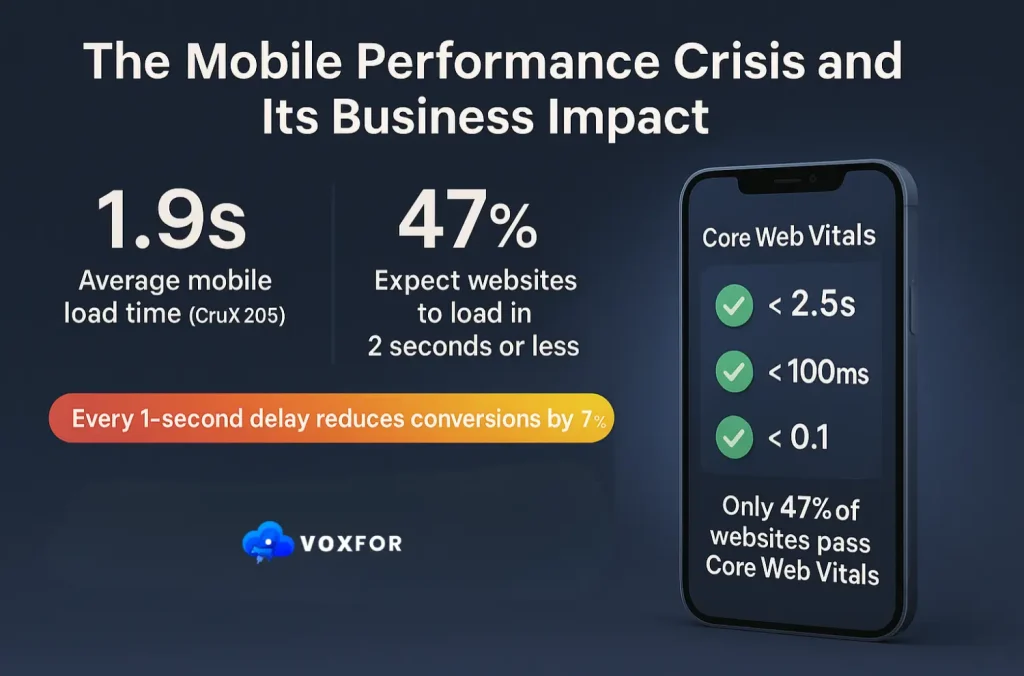
Current statistics paint a critical picture. The average website takes 1.9 seconds to load on mobile devices globally, according to Google Chrome UX Report (CrUX) 2025 data. Yet 47% of smartphone users now expect websites to load in 2 seconds or less, a dramatic shift from previous years. More concerning, delays have direct financial consequences: every one-second delay reduces conversions by 7%, making speed optimization essential for e-commerce and conversion-focused businesses.
With mobile-first indexing now standard, Google prioritizes mobile performance for search rankings. Core Web Vitals, measuring loading performance (LCP under 2.5 seconds), interactivity (FID under 100 milliseconds), and visual stability (CLS below 0.1), are confirmed ranking factors. Yet only 47% of websites currently pass Core Web Vitals assessments, indicating widespread optimization gaps.
The solution lies in AI-powered hosting systems that automatically adapt to mobile demands.
Images constitute the largest portion of webpage bandwidth on mobile devices. Traditional hosting delivers identical assets to all users, wasting bandwidth on mobile devices that can’t effectively display high-resolution images.
AI-powered image compression transforms this through deep learning models that reduce file sizes while maintaining perceived visual quality. According to research on image optimization, websites with properly optimized images experience up to 25% faster loading times and 88% longer user session duration compared to text-only alternatives.
Modern AI compression techniques work by:
– Learning human perception: Neural networks understand which image features humans notice most, preserving crucial details while compressing less visible areas
– Adaptive format selection: AI automatically serves optimal formats (WebP, AVIF, or JPEG) based on device capabilities and network conditions
– Content-aware cropping: Advanced systems analyze image importance and crop unnecessary areas, reducing file size without losing meaning
For example, portrait photography might retain sharp facial details while simplifying background textures. The result: a 40-50% file size reduction with imperceptible quality loss, critical for mobile users on slower 3G or 4G connections.
AI hosting systems learn traffic patterns and user behavior to predict which content users need next. Rather than serving all assets to all users equally, predictive caching systems automatically preload anticipated resources, reducing perceived load time significantly.
For mobile-first applications, this means:
– Route optimization: Users from Asia route to Singapore data centers, European users to Frankfurt. AI automatically finds optimal paths, reducing latency
– Behavioral prediction: Machine learning identifies which product pages typically follow homepage visits, preemptively caching them across CDN edge servers
– Load anticipation: AI forecasts traffic spikes from marketing campaigns or seasonal events, automatically scaling resources before demand peaks
This proactive approach prevents the bottleneck scenarios where traditional hosting struggles during sudden traffic surges.
While responsive design ensures websites function across screen sizes, AI enhances responsiveness through continuous learning. Machine learning models observe user interactions across thousands of mobile devices, identifying optimization opportunities humans might miss.
AI systems can:
– Detect interaction patterns: Analyze which buttons, forms, and elements receive poor engagement on specific device types, triggering automatic layout adjustments
– Conduct continuous A/B testing: Dynamically test different layouts and measure engagement, allowing site design to evolve based on real user behavior
– Personalize interfaces: Remember user preferences (dark mode, simplified navigation) across sessions, improving satisfaction and engagement
Research shows mobile sites with optimized responsiveness see 35% higher average session duration and significantly improved conversion rates.
Google Lighthouse, an open-source automation tool, provides actionable insights into mobile performance. Running automated audits identifies inefficiencies:
– Performance scores for mobile and desktop separately
– Actionable recommendations (image compression, reducing render-blocking scripts, font optimization)
– Real-world field data from Chrome User Experience Report combined with laboratory testing
– Progressive Web App (PWA) capability assessment
By integrating Lighthouse into continuous integration pipelines, hosting providers automate ongoing optimization, ensuring mobile performance improves continuously.
As mobile traffic continues dominating web usage, traditional static hosting optimization becomes increasingly inadequate. AI-driven systems that continuously learn, predict, and adapt deliver the responsive, fast experiences mobile users demand, transforming hosting from a commodity service into a competitive advantage.





 Lifetime VPS Europe
 Lifetime VPS Asia
 Lifetime WooCommerce Hosting
 Lifetime Hosting
 France Lifetime Dedicated Servers
 Germany Lifetime dedicated servers
 Lifetime Game Dedicated Servers
 Chicago, US
 Tokyo, Japan
 Singapore
 Hong Kong
 Seoul, South Korea
 Amsterdem, Netherlands
 London, UK
 Stockholm, Sweden
 Oslo, Norway
 Vienna, Austria
 Zurich, Switzerland
 Sydney, Australia
 Wordpress Hosting
 VPS Hosting
 DDOS Protection
 Submit Ticket
 Full Management
 Guides
 Videos and Podcasts
 Discover Creative Ideas
 MetaAgentOS High-Ticket Support System
 Voxfor Mega Menu
 Voxfor Advanced Price Management For WooCommerce
 Voxfor Secure Live Chat and AI Support
 Voxfor Multilanguage
 Voxfor AI Content Summary


