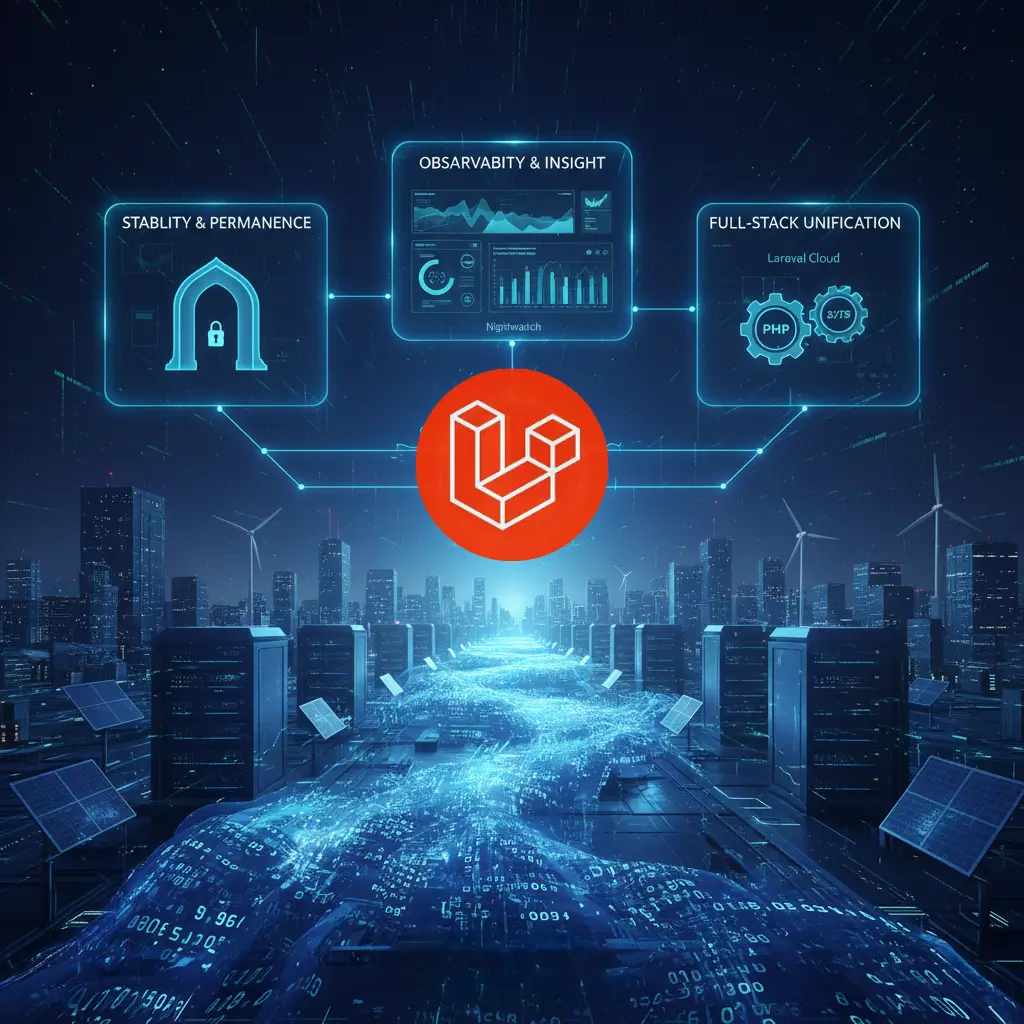
The PHP development landscape was fundamentally changed with the release of Laravel 12. The release is a culmination of a years-long transition to stability in the framework, enterprise observability, and end-to-end full-stack consistent behavior. Although the previous versions of the framework are commonly described as radical architectural swivels, the present-day generation can be marked by the philosophy of maintenance-first that puts less emphasis on the developer experience and system performance without imposing the weight of breaking changes on it. This discussion deals with the systemic improvements made by version 12, the growth of the first-party ecosystem with the help of such tools as Nightwatch and Laravel Cloud, and the technical foundation, which makes the framework capable of processing billions of events in high-concurrency production settings.
Laravel 12 releases according to the annual schedule of the framework, which keeps the platform abreast of the latest developments in the PHP language and web standards in general. The actual launch took place at Laracon EU, with Taylor Otwell officially announcing the launch date and signaling the shift in the framework to be based on the structural grounds of version 11 into an era of aggressive optimization and ecosystem growth. The transition is not just a software update but a deployment of an integrated development platform that would help reduce the friction between the creation of the code and the production deployment.
The support policy for version 12 provides a stable window for enterprise planning, offering bug fixes until August 13, 2026, and security patches until February 24, 2027. This two-year security window is essential for organizations managing long-lived systems where frequent major upgrades are logistically challenging. The historical context of Laravel versioning reveals a steady progression toward this predictable model, moving away from the semi-annual releases of the early 2010 toward a more robust, enterprise-friendly annual cycle.
| Version | Release Date | Bug Fixes Until | Security Fixes Until | PHP Requirement |
| Laravel 9 | February 8, 2022 | August 8, 2023 | February 6, 2024 | 8.0 – 8.2 |
| Laravel 10 | February 14, 2023 | August 6, 2024 | February 4, 2025 | 8.1 – 8.3 |
| Laravel 11 | March 12, 2024 | September 3, 2025 | March 12, 2026 | 8.2 – 8.4 |
| Laravel 12 | February 24, 2025 | August 13, 2026 | February 24, 2027 | 8.2 – 8.5 |
| Laravel 13 | Q1 2026 | Q3 2027 | Q1 2028 | 8.3 – 8.5 |
The use of PHP 8.2 as the minimum version of Laravel 12 is a strategic choice that allows the framework to take advantage of the latest language features, including readonly classes, DNF types, and better garbage collection. This is the technical consistency, which means that the applications developed based on version 12 are automatically more performant and secure because they take advantage of internal optimizations that the PHP engine itself offers and are not limited to framework-level abstractions.
The fundamental part of the Laravel 12 release is a set oflow-levell speed optimizations, which, though they are not always noticeable to the final user, dramatically enhance the responsiveness and scalability of high traffic applications. The biggest of them is the in-house replacement of the MD5 hashing algorithm, with xxHash, which, in non-cryptographic mode, offers throughput that is significantly higher than the older hashing algorithms. In tests based on small data blocks in common with cache key generating and session identification, xxHash has been shown to be 30x faster than MD5.
This shift impacts several critical framework components:
The database layer in Laravel 12 sees a major update in how unique identifiers are handled. The framework has transitioned its default HasUuids trait from UUID version 4 to UUID version 7. This change addresses a long-standing performance bottleneck associated with random identifiers in B-tree indexed databases.
In contrast to UUID v4, which is random and thus causes index fragmentation and high performance overheads when tables are large, UUID v7 is time-sequentialized. These identifiers are monotonically increasing, and therefore, when adding new records, they are not added in random nodes, but instead, they are added at the end of the database index. This gives cleaner indexes, quick range queries, and fewer disk I/O write operations. To support applications that are required to be compatible with the existing UUID v4 schemes, the framework added the HasVersion4Uuids trait and, therefore, architectural flexibility is ensured.
Laravel 12 continues the “slim” application philosophy by further refining the directory structure to reduce clutter and improve navigation. A notable change is the optional status of the app/Models directory; new applications may opt for a flatter structure where models are stored directly within the app/ root, mirroring the organizational preferences of modern modular architectures. Furthermore, configuration files have been centralized and streamlined, reducing the boilerplate required to initialize a new project and making it easier for developers to locate essential settings.
The routing system has also gained the advantage of using PHP 8+ attributes where route metadata, such as name, prefix and middleware, may be defined directly in controller classes. This lessens the dependency on extensive, centralization route records and promotes a more local strategy, a more context-sensitive approach to application logic.
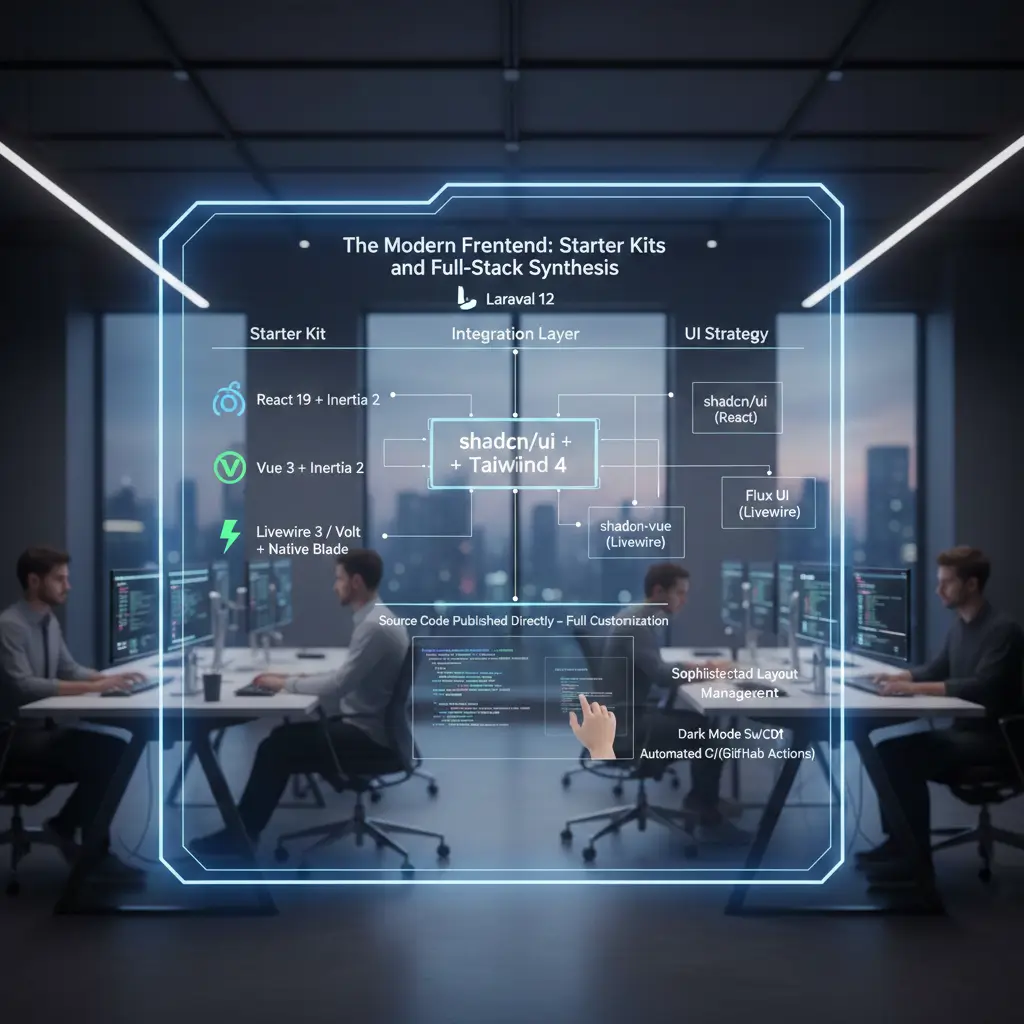
The introduction of new, opinionated starter kits in Laravel 12 represents a strategic re-imagining of the bridge between backend logic and frontend presentation. These kits, supporting React, Vue, and Livewire, are built on the latest industry standards, including React 19, Vue 3, and Inertia 2.
| Kit | Core Framework | Integration Layer | Component Library | CSS Foundation |
| React | React 19 | Inertia 2 | shadcn/ui | Tailwind 4 |
| Vue | Vue 3 (Composition) | Inertia 2 | shadcn-vue | Tailwind 4 |
| Livewire | Livewire 3 / Volt | Native Blade | Flux UI | Tailwind 4 |
The integration of Shadcn-based libraries marks a significant shift in the framework UI strategy. Rather than distributing components as a black-box package, these starter kits publish the source code for UI components directly into the application directory structure. This enables developers to customize the base components, such as buttons, toggles, and modals, to their specific requirements without being limited by an external library API.
These kits are not merely cosmetic updates; they include sophisticated layout management, allowing developers to switch between sidebar, header, and mixed layouts with a single import change. They also ship with built-in support for dark mode, system-level color preferences, and automated GitHub Actions workflows for continuous integration.
One common problem of full-stack development is the problem of type matching between the TypeScript frontend and the PHP backend. The solution to this is provided in Laravel 12 with the introduction of Wayfinder and Ranger. These tools scanned the paths of the application, the controllers, and the validation definitions to create TypeScript.
By making the Laravel application the definitive source of truth for all type definitions, Wayfinder ensures that the frontend always has access to the precise structure of API responses and request validation constraints. When a developer modifies a model or updates a validation rule in PHP, those changes immediately propagate to the TypeScript interfaces, eliminating the “manual translation era” and the production bugs associated with type drift.
The growth of the authentication features of Laravel that comes with the adoption of the WorkOS AuthKit integration is indicative of how much the framework is currently looking at the requirements of large-scale, enterprise SaaS-based applications. The first-party cooperation enables application developers to utilize enterprise-ready authentication functions, which had previously been costly in terms of creation and maintenance.
Key features of the WorkOS-powered starter kits include:
This integration effectively offloads the complexity of user management to a specialized provider, allowing development teams to focus on core business logic while maintaining the highest security standards.
The database interaction layer in Laravel 12 has been refined to handle more complex query logic with less boilerplate. The new nestedWhere() method is a primary example of this evolution, providing a cleaner way to handle grouped logical conditions. In previous versions, deeply nested AND/OR logic required multiple levels of closures, leading to “indentation hell”.The nestedWhere() method allows for a flatter, more readable syntax that maintains the logical grouping required for complex SQL generation.
For developers managing large-scale database architectures, Laravel 12 provides enhanced schema inspection tools. Methods such as Schema::getTables() and Schema::getTableListing() have been updated to support schema-qualified names and multi-schema environments natively. This is particularly relevant for multi-tenant applications where data is distributed across different schemas. The ability to retrieve tables from specific schemas or filter results globally ensures that the framework remains effective as database complexity increases.
Furthermore, the framework support for MariaDB has reached a first-party status, including native CLI support for database management via Artisan. This ensures that MariaDB users no longer have to rely on MySQL-specific workarounds for migrations or schema operations.
The real-time capabilities of Laravel have been significantly sharpened in version 12 through refined WebSocket broadcasting and the maturation of Laravel Reverb. Reverb, a first-party WebSocket server designed specifically for the framework, provides a high-performance, scalable solution for building interactive dashboards, chat systems, and live notification engines.
The integration of Reverb into the Laravel ecosystem allows for:
These improvements ensure that real-time communication is not an afterthought but a core capability of the framework, supported by both local development tools and production-grade hosting environments.
The release of Laravel Nightwatch marks a new era in application monitoring, providing a first-party observability platform built from the ground up for high-volume production environments. Unlike generic monitoring tools, Nightwatch is deeply aware of Laravel internals, including controllers, middleware, jobs, and mailables, providing insights that framework-agnostic solutions cannot replicate.
Nightwatch utilizes a dual-database architecture to separate transactional data from analytical workloads, ensuring that monitoring operations do not impact the application’s primary database performance. It handles billions of events per day using a combination of Amazon MSK (Kafka) for ingestion and ClickHouse Cloud for sub-second analytical queries.
| Feature | Description | Strategic Benefit |
| Request Timelines | Microsecond precision tracing of HTTP requests, queries, and cache hits. | Immediate identification of bottlenecks and N+1 query patterns. |
| Exception Tracking | Real-time logging and grouping of handled and unhandled exceptions. | Faster resolution of production issues through automated issue tracking. |
| Job Monitoring | Deep visibility into queue execution times, retries, and failures. | Improved stability of background processes and scheduled tasks. |
| Agent Ingestion | A low-overhead agent that buffers and batches telemetry data. | Negligible impact on application performance even under high load. |
The Nightwatch dashboard provides a centralized snapshot of an application’s health, allowing teams to collaborate on issues, assign priorities, and track the impact of new deployments in real-time. For enterprises that previously relied on a fragmented stack of monitoring tools, Nightwatch offers a unified, Laravel-native alternative that simplifies the observability stack while increasing the depth of insight.
In addition to the improvements in the architecture of the framework, the debut of the Laravel Cloud, a managed infrastructure service, focused on removing the intricacies of server management and DevOps. Laravel Cloud is a zero-config hosting option that is optimized to run PHP and Laravel, and scales to small sandbox applications or large enterprise workloads.
The pricing model for Laravel Cloud is designed for accessibility and scalability:
Laravel Cloud integrates natively with the framework’s ecosystem, providing managed instances for databases, caches, and WebSockets. The platform also features “application hibernation,” which automatically pauses compute resources when an application is not active, a feature that significantly reduces costs for development and staging environments.
A defining characteristic of Laravel 12 is its status as a “low-impact” release, with the official documentation estimating a migration time of approximately five minutes for most applications. This is made possible by a rigorous commitment to minimizing breaking changes, ensuring that teams can modernize their stack without a costly rewrite.
While the upgrade is largely automated via Composer, several specific changes require manual verification:
The framework also introduces a new secureValidate() method for password validation, simplifying the enforcement of modern security best practices in a single, expressive rule.
The reception of Laravel 12 within the developer community has been largely positive, with many praising the focus on “polish” rather than “hype”. Experienced developers have noted that the framework now feels more predictable and refined once a project moves past the initial setup phase. The transition toward annual releases that act primarily as maintenance and dependency synchronization events is seen as a sign of maturity, allowing businesses to plan their infrastructure budgets with confidence.
Looking ahead toward 2026 and the eventual release of Laravel 13, the ecosystem is increasingly focusing on the integration of Artificial Intelligence. Tools like Laravel Boost and the Model Context Protocol (MCP) server integration are already showing how AI can assist in everything from automated code generation to real-time debugging and performance optimization. The framework is positioning itself not just as a tool for developers to write code, but as an intelligent partner that assists in the creation, monitoring, and scaling of modern web applications.
The strategic value of Laravel 12 lies in its ability to reduce technical debt while simultaneously increasing the capabilities of the application. By integrating first-party solutions for authentication, observability, and hosting, the Laravel team has created a vertically integrated ecosystem that rivals the developer experience of modern JavaScript platforms while maintaining the stability and performance of the PHP engine.
For organizations navigating the complexities of modern web development, the framework provides a clear path forward:
In conclusion, Laravel 12 is more than a framework update; it is a declaration of intent for the future of the PHP ecosystem. It demonstrates that a framework can be both mature and innovative, providing a stable foundation for business-critical systems while aggressively pursuing new technologies that improve the life of the “Artisan”. As web development continues to evolve toward highly interactive, real-time, and AI-assisted experiences, Laravel 12 ensures that the PHP community is not just keeping up but leading the way.

Hassan Tahir wrote this article, drawing on his experience to clarify WordPress concepts and enhance developer understanding. Through his work, he aims to help both beginners and professionals refine their skills and tackle WordPress projects with greater confidence.





 Lifetime VPS Europe
 Lifetime VPS Asia
 Lifetime WooCommerce Hosting
 Lifetime Hosting
 France Lifetime Dedicated Servers
 Germany Lifetime dedicated servers
 Lifetime Game Dedicated Servers
 Chicago, US
 Tokyo, Japan
 Singapore
 Hong Kong
 Seoul, South Korea
 Amsterdem, Netherlands
 London, UK
 Stockholm, Sweden
 Oslo, Norway
 Vienna, Austria
 Zurich, Switzerland
 Sydney, Australia
 Wordpress Hosting
 VPS Hosting
 DDOS Protection
 Submit Ticket
 Full Management
 Guides
 Videos and Podcasts
 Discover Creative Ideas
 MetaAgentOS High-Ticket Support System
 Voxfor Mega Menu
 Voxfor Advanced Price Management For WooCommerce
 Voxfor Secure Live Chat and AI Support
 Voxfor Multilanguage
 Voxfor AI Content Summary


