Technology is changing at a rate that has never been experienced in the world, and the industries are being transformed and the manner in which businesses are being conducted and innovated. Going further into 2026, the wave of new technologies is strong, and it has offered new opportunities to organisations that are ready to be innovative. Artificial intelligence and quantum computing, edge computing and neuromorphic systems represent just a few of the trends in technology that one must learn to remain competitive in an ever-digitized world.
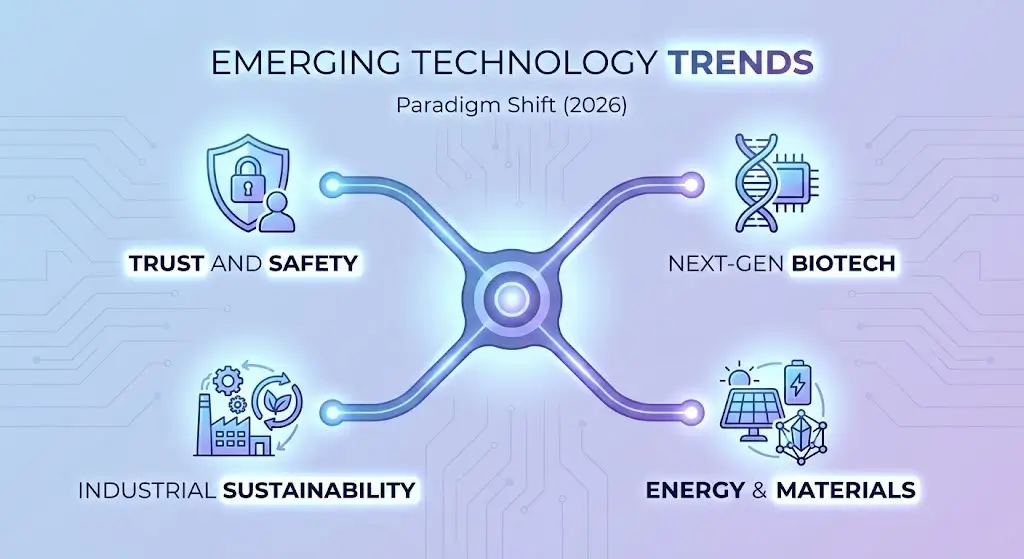
Emerging technologies are the new technologies that are at the transition stage between theoretical studies and real-life applications in the coming three to five years. As the recent research conducted by the World Economic Forum records, the newer technologies of 2026 have four pivotal trends, namely, trust and safety in a connected world, next-generation biotechnologies in health, redesigning industrial sustainability, and integrating energy and materials. These convergent trends are a portent of a paradigm shift in the way technology is used to solve problems that face the world.
There is an acceleration of technology innovation. What used to take decades to shift out of laboratory to the market now only takes years. Those that are able to recognize these trends and to position themselves strategically can gain an enormous competitive advantage that is enormous, whereas organizations that do not recognize the trends run the risk of becoming obsolete.
Generative AI is the prevailing technology trend that is transforming all industries worldwide. This advanced type of artificial intelligence produces extremely advanced and human-like text and image content, as well as audio and sophisticated simulations. Contrary to other forms of AI, which interpret a set of available data, generative AI systems such as GPT and multimodal systems generate novel content and solutions.
Key Advancements in Generative AI:
Generative AI is evolving very fast with various vectors. Large Language Models (LLMs) are increasingly getting advanced, and newer models are capable of reasoning and have fewer hallucinations (incorrect outputs). Multimodal artificial intelligence based on the understanding and production of text, images, audio, and video is becoming the norm instead of an exception.
The democratization of AI is accelerating. Organizations are increasingly creating customized, proprietary AI models trained on their own datasets rather than relying solely on general-purpose models. These organization-specific models outperform general LLMs by aligning precisely with company-specific data, processes, and contexts.
Real-World Applications:
Generative AI is reshaping the way of creating content is created, automating designs, customer service, and interaction. Companies are adopting GenAI across the board in their activities, including product development and customer relationships, as well as streamlining internal processes. By 2026, the use of AI in the workplace will have increased exponentially, and more organizations will implement GenAI-based applications in their departments.
Healthcare AI: AI allows the diagnosis of disease, drug discovery, and individualized medicine. Medical professionals use AI to interpret medical images, forecast patient outcomes and identify new therapies.
Enterprise Integration: Companies are integrating generative AI into existing workflows to improve productivity, automate repetitive tasks, and enhance decision-making capabilities.

Quantum computing is one of the most impressive computations breakthroughs compared to the development of a digital computer. As opposed to the classical computers that manipulate information using binary bits (0s and 1s), quantum computers are based on the principles of quantum mechanics to manipulate information using quantum bits (qubits), which can be in many states at the same time via quantum superposition.
Quantum Capabilities and Implications:
The quantum computers can solve certain problems in an exponential faster rate compared to the classical computers. This is the reason why they are ideal in drug discovery, materials science, optimization problems and complex financial modeling. Nevertheless, quantum computing is equally dangerous in terms of safety; quantum computers have the potential to destroy existing cryptography systems that store important data and blockchain technologies.
Quantum-Classical Hybrid Approach:
Quantum computers are capable of computing specific problems exponentially quicker than classical computers. This is why they are perfect for drug discovery, materials science, optimization problems, and complex financial modeling. Nevertheless, quantum computing is equally dangerous in terms of safety; quantum computers have the potential to destroy existing cryptography systems that store important data and blockchain technologies.
Quantum Cryptography and Security:
The existing encryption is threatened by quantum computers but quantum cryptography can offer a solution to the same. Quantum key distribution is a quantum-mechanical cryptographic method of generating an encryption that is supposedly impossibly hard to decipher. To protect their security infrastructure against the threats of quantum computing, organizations are coming to deploy quantum-safe cryptography to future-proof their systems.
5G deployment has moved from emerging technology to essential infrastructure. The fifth generation of mobile networks delivers significantly faster data speeds (up to 20 times faster than 4G), ultra-low latency (under 1 millisecond), and increased bandwidth capacity.
5G Transformative Impact:
5G speed and reliability enable technologies that were previously impossible. Autonomous vehicles, augmented reality applications, remote surgery, and real-time industrial automation all depend on 5G’s low-latency, high-bandwidth characteristics. Cities are leveraging 5G to build smart infrastructure for traffic management, public safety, and utilities optimization.
6G on the Horizon:
By 2030, 6G technology is expected to push connectivity boundaries even further. 6G will incorporate AI-driven networks and digital twins, enabling even lower latency and higher throughput. The 6G ecosystem is expected to establish new business models and enable advances in smart cities, autonomous vehicles, and immersive experiences.
Market Impact:
The global demand for faster, more reliable communication continues driving 5G adoption and 6G research investment. Industries from healthcare to manufacturing to entertainment depend on next-generation connectivity to deliver innovation and competitive advantage.
Edge computing represents a fundamental shift from the traditional cloud-centric model. Rather than sending all data to centralized cloud data centers for processing, edge computing performs computations on devices or local gateways at or near the data source, the “edge” of the network.
Why Edge Computing Matters in 2026:
Edge computing solves multiple critical challenges that cloud-only architectures cannot address:
Edge Computing Applications:
Smart cities use edge computing to manage traffic in real time and for public safety. Manufacturing facilities use edge computing for predictive maintenance and quality control. Retail environments use edge-powered IoT devices for inventory management and customer analytics. Healthcare systems are using edge computing to monitor patient vitals with sub-second responsiveness.
AI and Edge Computing Convergence:
The combination of AI and edge computing creates exponentially more powerful systems. Edge AI enables visual recognition, behavior-based personalization, predictive maintenance, and energy optimization, all processed locally without relying on cloud infrastructure.
The Internet of Things ecosystem continues to expand dramatically, with billions of connected devices now deployed globally. However, IoT evolution in 2026 is characterized not just by device proliferation but by intelligent integration with other technologies.
IoT Core Technologies:
Modern IoT deployments integrate multiple advanced technologies:
Smart Cities and Connected Infrastructure:
IoT sensors are located all over cities to monitor air quality, traffic flow, utility usage, and public safety. This real-time data allows cities to optimise infrastructure, respond more quickly to emergencies and improve the quality of life for residents. Real time Monitoring with IoT devices at the edge helps municipal authorities to detect spikes of pollution and alert the concerned institutions in real time.
Industrial IoT (IIoT):
Manufacturing and industrial operations use IoT to implement predictive maintenance, quality assurance, and process optimization. Connected machinery provides constant reports on performance, allowing operators to identify problems before failures happen.
Extended Reality (XR) encompasses augmented reality (AR), virtual reality (VR), and mixed reality (MR), technologies that blend physical and digital environments. In 2026, XR has evolved from novelty entertainment to an essential business tool across industries.
Augmented Reality (AR) Evolution:
Advanced AR glasses and improved mobile AR applications are being integrated into consumer and enterprise use cases. AR transforms retail through virtual product visualization, enables real estate agents to showcase property features, and revolutionizes education through immersive learning experiences.
Extended Reality in Manufacturing and Automotive:
The automotive industry is taking advantage of the benefits of XR in the areas of design review, virtual prototyping, and training. Companies such as BMW, Mercedes-Benz and Volvo are using XR to test vehicle designs, test ergonomics and train technicians in controlled digital environments. XR reduces the need for physical prototypes, which helps to accelerate development cycles and reduce costs.
The “industrial metaverse” is maturing rapidly, with companies linking design, production, and logistics data in continuous XR environments. Developers and engineers stand inside digital models together, test visibility, and make real-time decisions without needing physical presence.
XR Market Growth:
The market value of XR devices is predicted to rise dramatically with its value expected to grow by nearly ten times from $28 billion in 2021 to more than $250 billion by 2028. Multiple vendors, including Samsung, Meta and Apple, are working on competing XR platforms and hardware ecosystems.
Augmented Reality (AR) is more focused on this as it is the overlaying of digital information onto the real world using smartphones, tablets, and AR glasses. In 2026, AR is leaving gaming and becoming a serious enterprise and consumer application.
AR Applications Across Industries:
Hardware Advancements:
The development of AR hardware is essential to widespread adoption. Advanced AR glasses are available, better mobile devices and more advanced tracking technology are facilitating the integration of digital information in the physical world.
Autonomous vehicles are at the crossroads of several different converging technologies: 5G connectivity, edge computing, artificial intelligence and sophisticated sensors. Progress in the autonomous vehicle development continues, though regulatory and safety challenges are still present.
Technology Components:
Autonomous vehicles rely on sophisticated sensor systems (LiDAR, radar, cameras), real-time processing (edge computing), AI-driven decision making, and high-speed connectivity (5G). Extended reality platforms help developers test autonomous systems in simulated real-world conditions before deployment.
Current Status and Future Outlook:
While Level 5 fully autonomous vehicles are still being developed, Level 3-4 autonomous functionality is now getting released in production car vehicles. These systems take up specific driving scenarios, but require human intervention in complex situations. As technology matures and regulatory frameworks evolve, there will be increased adoption of autonomous vehicles.
Blockchain technology is yet another application of cryptography that is being developed continuously as the foundation of Web3, and which facilitates decentralized applications, secure transactions, and trustless systems. The combination of blockchain with other emerging technologies creates powerful new capabilities.
Blockchain Applications:
Blockchain Security Challenges:
Blockchain technology is yet another application of cryptography that is being developed continuously as the foundation of Web3, and which facilitates decentralized applications, secure transactions, and trustless systems. The combination of blockchain with other emerging technologies creates powerful new capabilities.
Web3 and Metaverse Integration:
Blockchain technology is yet another application of cryptography that is being developed continuously as the foundation of Web3, and which facilitates decentralized applications, secure transactions, and trustless systems. The combination of blockchain with other emerging technologies creates powerful new capabilities.
Neuromorphic computing is a revolutionary form of computation that emulates the way in which human brains process information. Rather than having separate processors and memory (the conventional Von Neumann architecture), neuromorphic systems have memory where the computation is performed, which is similar to the architecture of the biological brain.
Neuromorphic Architecture Advantages:
Smart Agriculture Application:
Neuromorphic computing holds transformative potential in the agricultural sector, where environmental conditions vary quickly. Smart farms using neuromorphic chips can detect and respond to changes in soil moisture and temperature and the presence or absence of pests with incredible efficiency.
Imagine autonomous drones and ground robots self-orchestrating planting, harvesting, and crop health diagnostics with near-human intuition at a fraction of energy costs. Or greenhouse systems fine-tuned to microclimates, providing each plant with custom-tailored irrigation, light, and nutrients.
Technology Integration:
Advanced materials science, particularly phase-change and ferroelectric devices, is improving neuromorphic chip stability and scalability. As integration of analog neural networks into commercial processors reduces costs and accelerates adoption, neuromorphic computing will emerge as a cornerstone technology for smart systems.
Biotechnology is transforming the world of agriculture with genetic engineering, precision breeding, and new cultivation techniques. The intersection of biotechnology with AI and IoT is a basis for highly optimized food production systems.
Precision Agriculture Technologies:
Sensors monitor soil conditions, weather patterns, and plant health in real-time. AI analyzes this data to optimize irrigation, fertilization, and pest management. This precision approach dramatically increases yields while reducing resource consumption and environmental impact.
Gene Editing and Crop Improvement:
CRISPR and other gene-editing technologies enable the development of crops that are more resilient, more nutritious, and better suited to climate change impacts. Biotechnology accelerates the breeding process, bringing improved crop varieties to farmers faster.
Wearable health technology has come a very long way from simple fitness trackers to complex medical devices. Modern wearables continually monitor heart rate, blood oxygenation, sleep patterns, and other vital statistics. IoT integration with healthcare systems can enable real-time monitoring of health and early detection of health problems.
Medical and Consumer Applications:
Healthcare providers use wearable data to track patient conditions remotely, detect health problems early, and adjust treatment protocols. Consumers leverage wearables to optimize fitness, sleep, and overall wellness. The convergence of wearable technology with AI enables predictive health insights.
AI created and/or changed content in the form of synthetic media is developing at a fast pace. This consists of deepfakes, AI generated video, synthetic speech, and generated images. Although creative opportunities are provided by synthetic media, one wonders whether authenticity, misinformation and ethical application are valid concerns.
Creative Applications:
Entertainment production is using synthetic media for special effects, virtual actors, and all-digital movies. Marketing, AI-generated content takes advantage of personalized advertising. However, synthetic media also opens the door for malicious deepfakes and misinformation, making the demand for robust deepfake detection and authentication technologies.
Digital twins, virtual replicas of physical systems—enable simulation, analysis, and optimization before real-world implementation. Industries from manufacturing to automotive to urban planning leverage digital twins.
Digital Twin Applications:
Robotics is still evolving beyond the manufacturing sector into other industries, such as healthcare, logistics, and agriculture. AI-powered robots are becoming increasingly autonomous, adaptable, and capable of performing complex tasks.
Robotics Applications:
Healthcare robots assist with surgery, rehabilitation, and patient monitoring. Logistics companies deploy warehouse robots for picking, packing, and sorting. Agricultural robots handle planting, harvesting, and crop monitoring. Manufacturing robots perform precision assembly and quality inspection.
AI-powered cybersecurity systems detect and respond to threats faster than traditional security measures. Machine learning algorithms identify suspicious patterns, detect anomalies, and respond automatically to security events.
Security Applications:
Space tourism is transitioning from science fiction to reality. Commercial space companies are beginning to offer civilian flights to suborbital altitudes and eventually to orbit and beyond.
Industry Development:
Robotics is still evolving beyond the manufacturing sector into other industries, such as healthcare, logistics, and agriculture. AI-powered robots are becoming increasingly autonomous, adaptable, and capable of performing complex tasks.
Voice activation has gone from being a novelty to an integral interface throughout devices. Smart speakers, smartphone assistants, and vehicle systems are now based heavily upon natural language processing.
Voice Technology Applications:
Smart homes are managed by voice commands by consumers. Voice ordering is applied in retail settings where they operate to get a quick checkout. The AI voice assistants are used in the customer service systems as 24/7 support. The accessibility functions allow mobility-impaired individuals to use devices by voice.
Green energy technologies, including solar, wind, hydroelectric, and emerging technologies like hydrogen fuel cells, are accelerating toward mainstream adoption. The integration of green energy with IoT, AI, and energy storage enables sophisticated grid management and renewable energy optimization.
Smart Grid Technology:
IoT sensors throughout power grids monitor real-time demand and supply. AI optimizes energy distribution, managing renewable energy variability and predicting demand fluctuations. Energy storage systems (batteries, pumped hydro, compressed air) balance supply and demand.
Spatial computing combines AR, VR, IoT, and AI to create immersive environments where users interact with digital content in physical space. According to Gartner, spatial computing is expected to expand from $110 billion in 2023 to $17 trillion by 2033.
Spatial Computing Components:
The convergence, acceleration and accessibility characterize the technology landscape of 2026. The current technologies, such as generative AI, quantum computing, edge computing, extended reality, and dozens of other technologies that are just becoming technologies, are maturing and expanding opportunities at the same time. Those organizations that comprehend such trends, make strategic investments and put them into practice in a prudent and considered manner, will survive in this swiftly evolving environment.

Hassan Tahir wrote this article, drawing on his experience to clarify WordPress concepts and enhance developer understanding. Through his work, he aims to help both beginners and professionals refine their skills and tackle WordPress projects with greater confidence.





 Lifetime VPS Europe
 Lifetime VPS Asia
 Lifetime WooCommerce Hosting
 Lifetime Hosting
 France Lifetime Dedicated Servers
 Germany Lifetime dedicated servers
 Lifetime Game Dedicated Servers
 Chicago, US
 Tokyo, Japan
 Singapore
 Hong Kong
 Seoul, South Korea
 Amsterdem, Netherlands
 London, UK
 Stockholm, Sweden
 Oslo, Norway
 Vienna, Austria
 Zurich, Switzerland
 Sydney, Australia
 Wordpress Hosting
 VPS Hosting
 DDOS Protection
 Submit Ticket
 Full Management
 Guides
 Videos and Podcasts
 Discover Creative Ideas
 MetaAgentOS High-Ticket Support System
 Voxfor Mega Menu
 Voxfor Advanced Price Management For WooCommerce
 Voxfor Secure Live Chat and AI Support
 Voxfor Multilanguage
 Voxfor AI Content Summary


