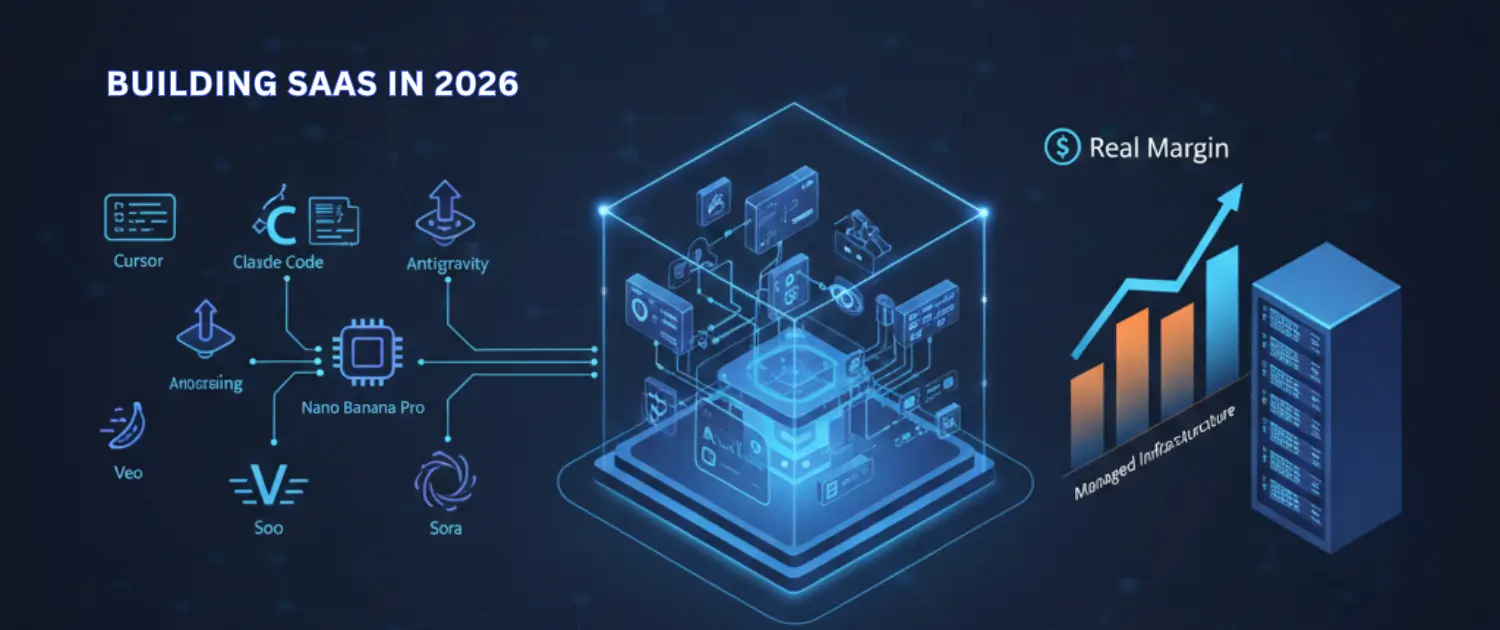
The masks are off. Big tech just showed everyone they own the casino.
Salesforce, Adobe, and every mid-tier SaaS company watched their valuations contract through 2025 and into 2026 as AI agents started automating the exact workflows their software was built to handle. Wall Street calls it the “SaaS-pocalypse” The per-seat pricing model is dying. The white space that fueled 15 years of SaaS growth is largely filled.
Building another seat-based SaaS product in 2026 is like opening a DVD rental store in 2012. The window closed.
What works now: selling services, white-label solutions, and expertise. Not code.
The SaaS market entered what analysts call “AI Creative Destruction” in late 2025. The initial AI euphoria soured as major providers struggled to prove that AI generates net-new revenue rather than cannibalizing existing subscriptions.
Three forces are reshaping the landscape:
The average enterprise already runs well over 100 SaaS applications. The appetite for yet another dashboard is gone.
Instead of spending months building software from scratch, smart businesses take fully built, market-tested products, rebrand them, and start selling immediately.
White-label works because it flips the equation:
The businesses winning right now aren’t building tools. They’re packaging expertise with existing tools under their own name.
In early 2025, Andrej Karpathy posted a simple observation: “There’s a new kind of coding I call ‘vibe coding’, where you fully give in to the vibes, embrace exponentials, and forget that the code even exists.”
A year later, “vibe coding” became the Collins Dictionary Word of the Year.
Industry trackers estimate that a significant share of global code is now AI-generated, up from single digits in 2023. Reports suggest the vast majority of software professionals use AI coding agents daily, and most Fortune 500 companies have adopted at least one vibe coding platform.
You don’t write code anymore. You describe intent. The agent builds it.
GlobalData predicts vibe coding goes fully mainstream in 2026, with next-generation interfaces enabling non-coders to design and market applications that extend beyond conventional software.
These are the tools reshaping how software gets built. Every one of them is production-ready.
The fastest-growing AI coding tool, reportedly valued at around $10 billion. Cursor runs up to 8 parallel autonomous agents that execute complex refactoring, multi-file edits, and testing simultaneously. It supports GPT-4o, Claude Sonnet 4.5, Gemini 2.5 Pro, and GPT-5 beta. Widely adopted across Fortune 500 engineering teams. Starts at $20/month.
Anthropic’s CLI-based coding agent that installs directly on any Linux server and runs natively in VS Code via the official extension. It operates with a 200K token context window full codebase awareness. Features include inline diffs, subagents, plan mode, extended thinking, and MCP server support. Terminal-based, editor-agnostic. Roughly$0.80–$4/hour on API pricing.
The first autonomous AI software engineer by Cognition Labs. Devin 2.0 dropped the price from $500 to $20/month with pay-as-you-go Agent Compute Units. It resolves real GitHub issues end-to-end on SWE-bench and is reportedly being piloted alongside human developers at major financial institutions. Sandboxed environment with shell, editor, and browser.
The leading open-source AI coding agent, formerly OpenDevin. Consistently ranked near the top on SWE-bench benchmarks. Bring your own LLM works with any model. Offers web UI, CLI, SDK, and REST/WebSocket API. Enterprise features include RBAC, audit trails, quotas, and VPC deployment. Available as SaaS or self-hosted.
Full-stack application creation with built-in deployment. The Core plan starts at $20/month with $25 in usage credits. Replit Agent uses effort-based pricing that scales with task complexity. It handles everything from scaffolding to deployment PostgreSQL storage, autoscale, reserved VMs. Best for rapid prototyping and getting from zero to production fast.
Google agentic development platform, launched November 2025. Not just an editor a platform where agents autonomously plan, execute, and verify complex tasks across your editor, terminal, and browser. Agents generate artifacts task lists, implementation plans, screenshots, browser recordings for human verification. Available today in public preview, free for individuals. Runs on MacOS, Windows, and Linux.
The first agentic IDE with the Cascade agent that understands full codebases, plans multi-step edits, tracks dependencies, and iterates until code works. Features include Supercomplete (full function suggestions from project context), built-in previews, beta app deployments via Netlify, and MCP support for external data sources. Also available as plugins for VS Code, JetBrains, Vim, and Xcode.
The developer-first interface for the Gemini API. Build with function calling, video generation via Veo 3.1, voice agents via Live API, and built-in tools including Google Search, Maps, Code Execution, and Computer Use. Features native code editing, starter app templates you can fork and share, and a streamlined path from prototype to production. Free tier available.
| Tool | Type | Starting Price | Best For |
| Cursor AI | IDE (VS Code fork) | $20/month | Parallel agents, maximum autonomy |
| Claude Code | CLI + VS Code | ~$0.80–$4/hour | Linux servers, full codebase awareness |
| Devin | Autonomous SWE | $20/month + ACUs | End-to-end task completion |
| OpenHands | Open-source agent | Free (self-hosted) | Customization, enterprise deployment |
| Replit Agent | Browser IDE | $20/month | Zero-to-production prototyping |
| Google Antigravity | Agentic platform | Free (preview) | Agent orchestration, artifact verification |
| Windsurf | Agentic IDE | Free tier available | Multi-step edits, Cascade workflows |
| Google AI Studio | API platform | Free tier available | Gemini API, multimodal development |
Here’s what the tool lists above don’t tell you: every one of these platforms is available to everyone. Your competitor has access to the same Cursor, the same Claude Code, the same Antigravity.
The differentiation isn’t which agent you use. It’s how you deploy it, secure it, monitor it, and deliver the output as a packaged service to a paying client.
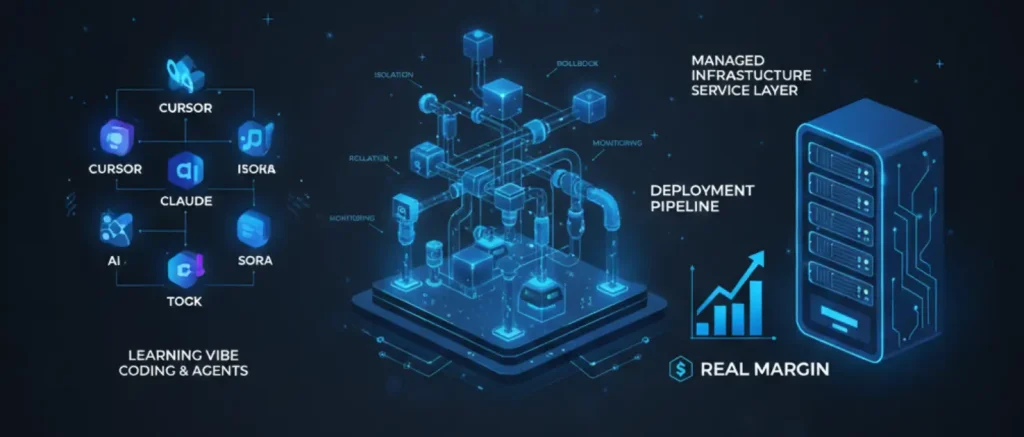
Deployment pipelines. Isolation. Rollback. Governance. Logging. Uptime guarantees. That’s the service layer where margins live and where most vibe coders have zero infrastructure.
Google DeepMind state-of-the-art image generation and editing model, built on Gemini 3 Pro. In head-to-head benchmarks against Midjourney V7 and DALL-E 3, Nano Banana Pro achieved 94% text accuracy, a 12.4 FID score (best in class), and 89% prompt adherence.
What makes it dominant:
Available free in the Gemini app, via the Gemini API, Google AI Studio, and Antigravity. Pricing starts at $0.039/image for standard resolution, $0.24 for 4K.
For anyone creating marketing assets, product mockups, brand visuals, or client deliverables this is the benchmark right now.
Video generation crossed the production-ready threshold in 2025. These tools are what creators and agencies are using today.
The top-ranked model for photorealism with accurate physics simulation and cinematic lighting. Standard mode generates video in roughly 1–2 minutes. Veo 3.1 added Ingredients to Video, Frames to Video, and Extend for shots up to a minute. The companion app Flow includes camera controls, scene editing, and character consistency via reference images.
OpenAI video model with strong contextual understanding and prompt adherence. Character and scene consistency across clips. Built-in editing tools: remix, extend, blend, loop. The social feed enables discovery, remixing, and community engagement.
Ranked#1 for image-to-video generation on the Artificial Analysis benchmark, outperforming even Veo in that category. The standout feature: 2-minute continuous clips while competitors cap at 8–16 seconds. Multi-Element Editor and motion brush for precise granular control.
Camera movement control throughout the scene, motion brush for direction and speed on specific elements, and prompt weighting to define model adherence. Gen-3 Alpha Turbo produces a 5–10 second clip in under a minute. Industry standard for professional motion graphics.
Built for short-form social content TikTok, Reels, YouTube Shorts, ads. The 2.5 engine eliminated the flicker that plagued earlier AI videos, with professional-grade temporal consistency. Integrated sound effect generation that matches on-screen action. Upgraded lip-sync via Pikaformance.
Ranked #2 on Artificial Analysis, above Veo 3 in several categories. Ultra-realistic physics simulation with accurate object interactions, fluid dynamics, and natural motion. Advanced facial recognition and body tracking maintain character consistency across frames. 1080P output, 24–30 FPS.
The first video AI model with native HDR support richer contrast, deeper shadows, brighter highlights. Built on a multimodal reasoning system that understands creative intent. Ray3 Modify lets you transform actor appearances while retaining original motion and timing. Adobe Firefly integration. Latest Ray3.14 is 4x faster and 3x cheaper with native 1080p.
| Tool | Best For | Max Length | Standout Feature |
| Google Veo 3.1 | Photorealism, cinematic | Up to 1 min | Flow app, camera controls |
| Sora 2 | Creative community, social | ~20 sec | Social feed, remix, blend |
| Kling 2.6 | Image-to-video, narratives | 2 minutes | #1 image-to-video benchmark |
| Runway Gen-4.5 | Motion graphics, pro edits | 16 seconds | Camera control, motion brush |
| Pika 2.5 | Short-form social content | 10 seconds | Sound effects, lip-sync |
| Hailuo (MiniMax) | Physics, action scenes | 10 seconds | Cinematic motion engine |
| Luma Ray3 | HDR, actor transformation | 10 seconds | Native HDR, Ray3 Modify |
People are learning vibe coding. People are learning about agents. People are learning names Cursor, Claude Code, Antigravity, Nano Banana Pro, Veo, Sora.
What most of them are not doing is building the infrastructure to run it all.
That’s where the real margin lives. White-label services. Managed infrastructure. Deployment pipelines for agents. Production environments where these tools actually work with isolation, rollback, monitoring, and governance baked in.
Stop building generic SaaS. Start selling the service layer.
The tools are listed above. The market is ready. The only question is whether you package and sell the expertise, or wait for someone else to do it first.
If you’re selling the service layer, you need infra that runs agents reliably queue, isolation, rollback, monitoring. That’s what voxfor.com was built for.

Netanel Siboni is a technology leader specializing in AI, cloud, and virtualization. As the founder of Voxfor, he has guided hundreds of projects in hosting, SaaS, and e-commerce with proven results. Connect with Netanel Siboni on LinkedIn to learn more or collaborate on future project.





 Lifetime VPS Europe
 Lifetime VPS Asia
 Lifetime WooCommerce Hosting
 Lifetime Hosting
 France Lifetime Dedicated Servers
 Germany Lifetime dedicated servers
 Lifetime Game Dedicated Servers
 Chicago, US
 Tokyo, Japan
 Singapore
 Hong Kong
 Seoul, South Korea
 Amsterdem, Netherlands
 London, UK
 Stockholm, Sweden
 Oslo, Norway
 Vienna, Austria
 Zurich, Switzerland
 Sydney, Australia
 Wordpress Hosting
 VPS Hosting
 DDOS Protection
 Submit Ticket
 Full Management
 Guides
 Videos and Podcasts
 Discover Creative Ideas
 MetaAgentOS High-Ticket Support System
 Voxfor Mega Menu
 Voxfor Advanced Price Management For WooCommerce
 Voxfor Secure Live Chat and AI Support
 Voxfor Multilanguage
 Voxfor AI Content Summary


