Lifetime VPS Europe
 Lifetime VPS Asia
 Lifetime WooCommerce Hosting
 Lifetime Hosting
 Lifetime Game Dedicated Servers
 Chicago, US
 Tokyo, Japan
 Singapore
 Hong Kong
 Seoul, South Korea
 Amsterdem, Netherlands
 London, UK
 Stockholm, Sweden
 Oslo, Norway
 Vienna, Austria
 Zurich, Switzerland
 Sydney, Australia
 Wordpress Hosting
 VPS Hosting
 DDOS Protection
 Submit Ticket
 Full Management
 Guides
 Videos and Podcasts
 Discover Creative Ideas
 Cybersecurity Services
 Voxfor Mega Menu
 Voxfor Advanced Price Management For WooCommerce
 Voxfor Secure Live Chat and AI Support
 Voxfor Multilanguage
 Voxfor AI Content Summary
 Voxfor Autopilot

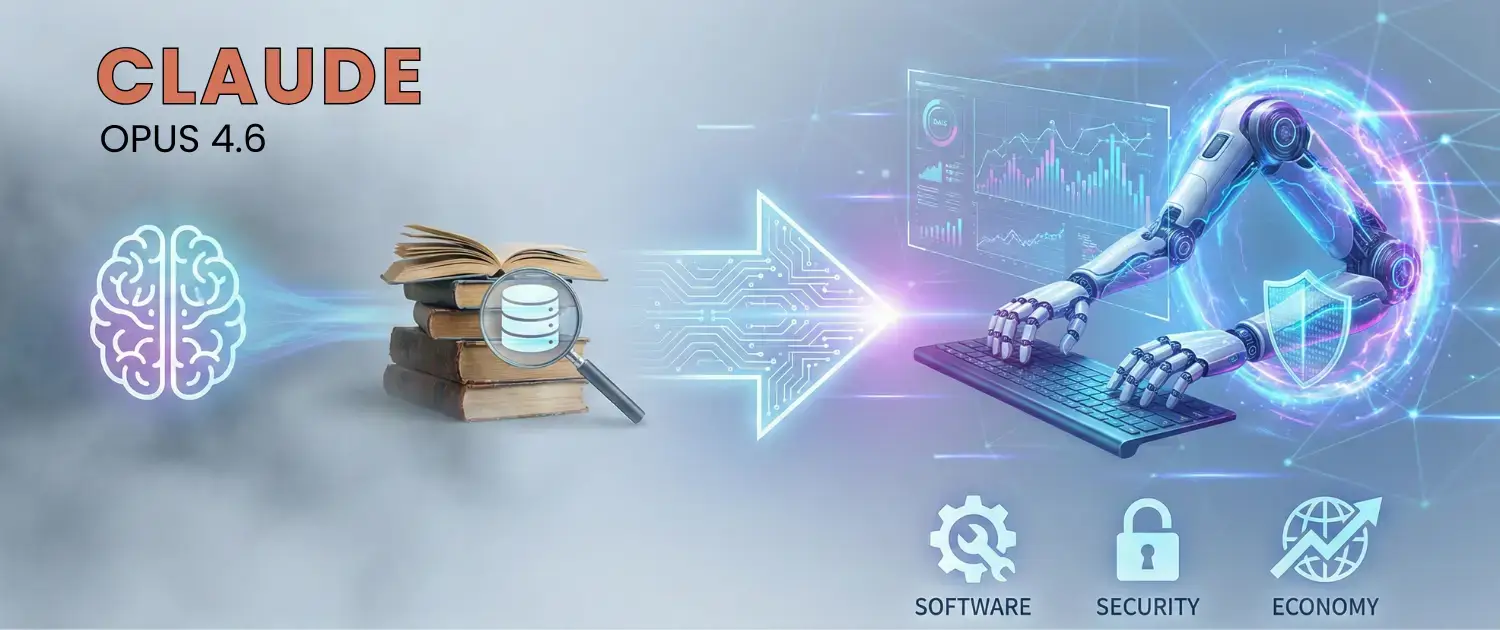
Claude Opus 4.8 is the latest upgrade in Anthropic Opus model family, and it arrives at a time when businesses, developers, content teams, and technical teams are asking for more than simple chatbot answers. They want AI that can reason through long tasks, write and review code, work with tools, understand documents, question weak assumptions, and complete real-world workflows without constantly losing direction.
That is exactly where Claude Opus 4.8 tries to stand out. It is not only about producing longer answers or sounding more intelligent. The bigger story is reliability. Anthropic is positioning Opus 4.8 as a more capable collaborator for complex work, especially in coding, agentic workflows, enterprise analysis, long-context tasks, and professional document creation.
For developers, this release is especially important because Claude Opus 4.8 is designed to perform better in long-running software tasks. For companies, it matters because AI is moving from “ask a question, get an answer” toward “give the model a goal, let it plan, use tools, verify work, and report back.” For VPS users and hosting providers, it also opens an important discussion: while Claude Opus 4.8 itself is accessed through Anthropic and supported cloud platforms, businesses can still use VPS infrastructure to host AI apps, retrieval systems, automation backends, open-source LLMs, APIs, dashboards, and AI-powered development tools.
In simple words, Claude Opus 4.8 is not just another model update. It is part of the bigger shift toward AI systems that can act like serious digital collaborators.
Power Your AI Projects with Voxfor VPS
From Claude API integrations to self-hosted LLM tools, modern AI applications need fast and reliable infrastructure. Voxfor VPS gives developers the control, performance, and uptime required to build, test, and deploy AI-powered applications with confidence.
What Is Claude Opus 4.8?
Claude Opus 4.8 is Anthropic latest Opus-class model, built as an upgrade over Claude Opus 4.7. Opus models are generally aimed at the most demanding AI use cases, including complex reasoning, long-horizon coding, agentic work, technical writing, research, legal analysis, financial document review, and enterprise-grade automation.
The model is available through the Claude API and other supported platforms, and its API model ID is:
claude-opus-4-8
The major idea behind Opus 4.8 is simple: better performance where accuracy, judgment, tool use, and self-checking matter. Many AI models can answer quickly, but complex work requires something deeper. A good AI coding assistant must know when to ask questions. A strong research assistant must know when evidence is weak. A useful business agent must know when to use a tool instead of guessing. Claude Opus 4.8 focuses heavily on those practical improvements.
Key Highlights of Claude Opus 4.8
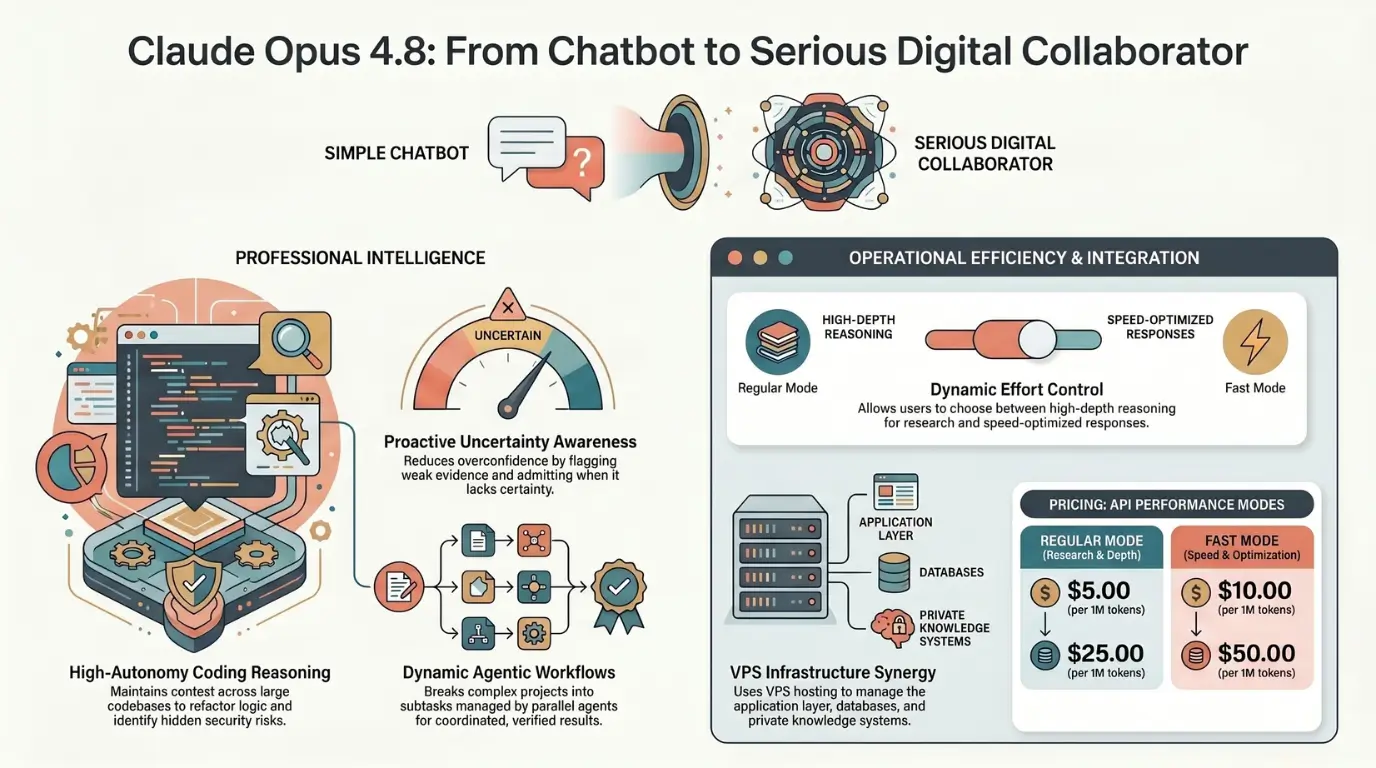
Claude Opus 4.8 introduces several important improvements and platform updates:
- Better coding and software engineering performance
- Stronger agentic task handling
- Improved honesty and uncertainty awareness
- Effort control for choosing response depth
- Dynamic workflows in Claude Code
- Fast mode for higher output speed
- Same regular pricing as Opus 4.7
- Large context support for long documents and complex projects
- Better tool triggering and long-context handling
- Lower prompt cache minimum for developers
These updates may sound technical at first, but they solve very practical problems. Developers do not only need AI to generate code. They need AI to inspect a codebase, understand dependencies, avoid careless changes, catch bugs, and work across multiple files. Business users do not only need summaries. They need accurate document review, better citations, and a model that admits uncertainty instead of inventing confidence.
That is where Claude Opus 4.8 becomes interesting.
Claude Opus 4.8 Pricing Comparison
Insert the pricing comparison chart here.
Suggested caption: Claude Opus 4.8 remains the most powerful option in the current Claude family, while Sonnet and Haiku provide more affordable alternatives for lighter workloads.
Improved Coding Performance
One of the strongest use cases for Claude Opus 4.8 is coding. Anthropic describes it as a model built for complex reasoning, long-horizon agentic coding, and high-autonomy work. That means it is not only useful for writing small functions or fixing simple bugs. It is designed for larger software tasks where the model needs to maintain context, reason through trade-offs, and make careful decisions.
For example, a developer may ask Claude Opus 4.8 to:
- Review a large pull request.
- Migrate an old codebase to a new framework.
- Identify security issues across multiple files.
- Refactor repeated logic.
- Write test cases.
- Debug failing builds.
- Explain unfamiliar architecture.
- Plan a complex feature before implementation.
The difference between a basic AI coding tool and a serious coding collaborator is judgment. A weak coding model may produce confident code that looks correct but breaks hidden logic. A stronger model should pause, ask the right questions, verify assumptions, and flag possible risks before making changes. Claude Opus 4.8 focuses strongly on that kind of behavior.
Anthropic also highlights that Opus 4.8 is less likely to let flaws in its own code pass without comment compared with its predecessor. This is important because one of the biggest risks of AI-generated code is not that it makes mistakes. The real risk is that it makes mistakes confidently and silently.
Dynamic Workflows in Claude Code
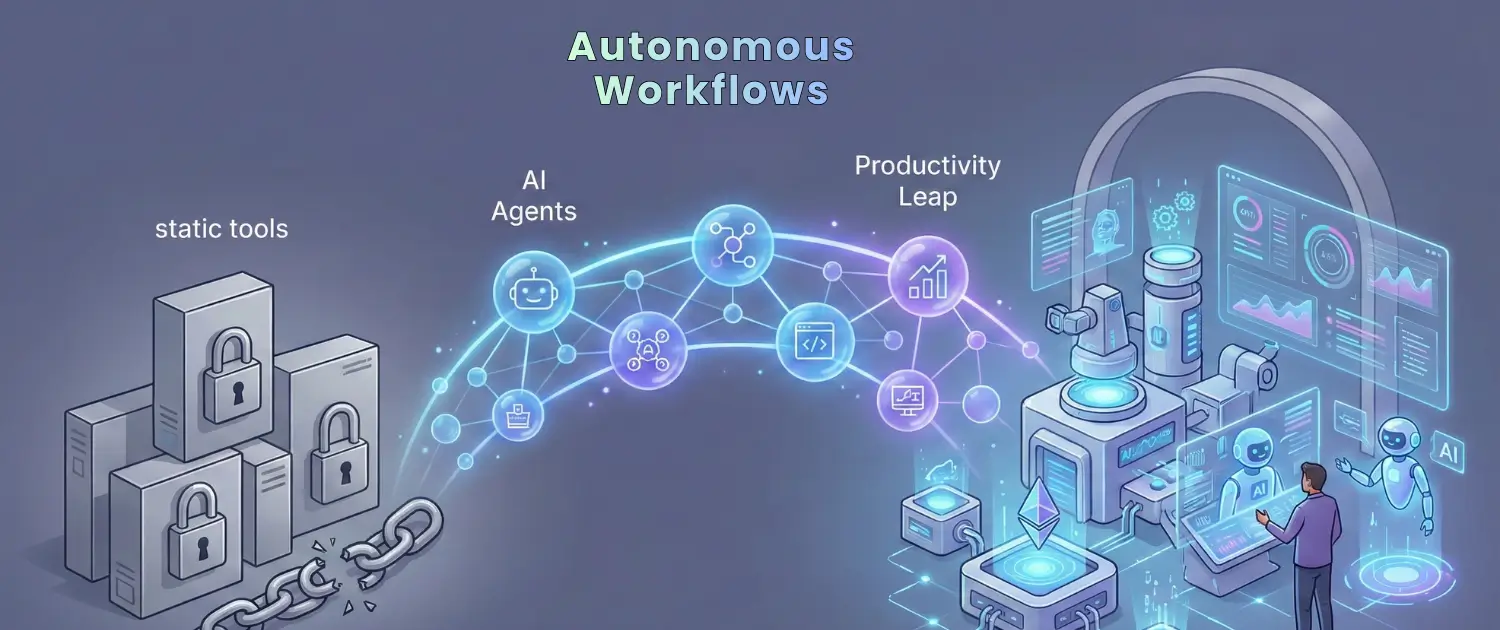
One of the most interesting additions around Claude Opus 4.8 is dynamic workflows in Claude Code. This feature is designed for very large tasks that are too complex for a single linear response.
Instead of trying to solve everything in one pass, Claude can break work into subtasks, run parallel subagents, compare results, verify findings, and then return a coordinated answer. This is especially useful for large engineering projects where the AI has to search across many files or analyze a system from different angles.
Practical examples include:
- Codebase-wide bug hunting.
- Security audits.
- Dead code detection.
- Framework migration.
- Performance review.
- Large refactoring projects.
- Multi-service architecture analysis.
- Critical changes that need independent verification.
This is a big step toward AI development workflows that feel less like “chat with a bot” and more like “assign work to an AI engineering assistant.” It also shows where AI coding tools are heading. The future is not only one model writing one file. The future is AI orchestration, where multiple agent-like processes handle different parts of a large project and then bring the result together.
Choosing Speed or Depth
Claude Opus 4.8 also introduces effort control. This allows users to choose how much effort Claude should put into a task.
For simple tasks, users may prefer a faster answer with lower effort. For complex coding, research, planning, or long-running work, higher effort can produce better reasoning and more careful results. Opus 4.8 defaults to high effort, which is designed to balance quality and user experience.
This matters because not every task deserves the same level of thinking. If you ask for a quick command, you do not want the model to spend unnecessary time and tokens. But if you ask it to plan a full application architecture, review security issues, or analyze a legal document, you want deeper reasoning.
Effort control gives users more flexibility. It also makes AI usage more practical because teams can better manage speed, quality, and token consumption.
Fast Mode: Higher Speed for Time-Sensitive Work
Claude Opus 4.8 also includes fast mode as a research preview on the Claude API. Fast mode is designed to provide higher output speed from the same model at premium pricing.
This is useful for workloads where response time matters. For example:
- Live AI assistants
- Developer tools
- Interactive dashboards
- Internal automation tools
- AI copilots inside SaaS products
- Real-time document review tools
Fast mode will not be the right choice for every situation because it costs more than regular usage. But for businesses where user experience depends on fast answers, it can be valuable.
Better Honesty and Fewer Unsupported Claims
One of the most human-friendly improvements in Claude Opus 4.8 is honesty. AI models often create a problem known as overconfidence. They may say something is complete when it is not. They may claim a fact without enough evidence. They may present an assumption as if it were verified.
Claude Opus 4.8 is designed to reduce that behavior. Anthropic says early testers found that the model is more likely to flag uncertainty and less likely to make unsupported claims. For professional users, this is a major benefit.
In real business work, a model that says “I am not sure” can be more useful than a model that confidently gives a wrong answer. For developers, this means the model may be better at saying when a code change needs more testing. For analysts, it may be better at highlighting weak data. For writers, it may be better at separating fact from interpretation.
This makes Claude Opus 4.8 feel more like a careful collaborator instead of a tool that only tries to please the user.
Long Context and Large Output
Claude Opus 4.8 supports a very large context window on supported platforms, making it suitable for long documents, large codebases, research files, technical documentation, and multi-step conversations.
This is important because modern AI work often involves huge amounts of information. A business may need to analyze multiple PDFs. A developer may need to work across a full repository. A support team may need to feed product documentation into an AI assistant. A legal or finance team may need to review long documents without breaking them into tiny pieces.
Large context does not automatically guarantee perfect answers, but it gives the model more room to understand the task. Combined with better compaction handling and improved long-context quality, Claude Opus 4.8 becomes more useful for serious workflows.
API and Developer Improvements
Claude Opus 4.8 also includes practical changes for developers building AI applications.
One useful update is support for mid-conversation system messages in the Messages API. This allows developers to update instructions during a long-running task without restarting the entire prompt or breaking prompt cache behavior. For agentic systems, this is valuable because permissions, budget limits, environment details, or task instructions may change during execution.
The model also lowers the minimum cacheable prompt length to 1,024 tokens. Prompt caching helps reduce cost and improve efficiency when repeated prompt sections are reused. A lower minimum means more applications can benefit from caching, especially agentic workflows and long-running systems.
Claude Opus 4.8 also continues the move toward adaptive thinking instead of manually configured extended thinking budgets. This means the model can decide when deeper reasoning is needed instead of spending extra reasoning effort on every turn.
Claude Opus 4.8 Pricing
Claude Opus 4.8 keeps the same regular pricing as Opus 4.7:
Input tokens: $5 per million tokens
Output tokens: $25 per million tokens
Fast mode pricing is higher:
Fast mode input tokens: $10 per million tokens
Fast mode output tokens: $50 per million tokens
This pricing makes Opus 4.8 a premium model. It is best used for tasks where quality matters more than raw cost. For simple summarization, short replies, or lightweight automation, a smaller model may be more cost-effective. But for complex coding, high-value analysis, agentic automation, and professional workflows, Opus 4.8 is built for the top end of the model family.
Best Use Cases for Claude Opus 4.8
Claude Opus 4.8 is especially useful for:
- Advanced coding tasks.
- Codebase migrations.
- AI agents.
- Complex research.
- Long document analysis.
- Legal and financial document workflows.
- Enterprise knowledge work.
- Technical writing.
- Debugging and testing.
- Workflow automation.
- High-stakes planning.
- Multimodal document understanding.
- AI-powered developer tools.
It is not always necessary for every task. If a user only needs a quick answer, a lightweight model may be enough. But when the task has many moving parts, requires judgment, or involves professional risk, Opus 4.8 becomes a stronger choice.
Running LLM Workloads on a VPS
A very important point needs to be clear: Claude Opus 4.8 itself is not a self-hosted open-weight model that you download and run directly on your own VPS. It is accessed through supported platforms such as the Claude API and cloud partners.
However, VPS hosting still plays a major role in AI and LLM workflows.
A VPS can be used to host:
- AI application backends
- Chatbot dashboards
- Retrieval augmented generation systems
- Vector databases
- Automation scripts
- API gateways
- Private knowledge-base tools
- Open-source LLMs through Ollama or vLLM
- Monitoring systems
- Worker queues for AI tasks
- Claude API integrations
- Custom AI SaaS products
For example, a business can build a web application on a VPS where users upload documents, the backend processes the files, sends selected context to Claude Opus 4.8 through the API, and returns a structured answer. In this setup, Claude provides the intelligence, while the VPS provides the application layer, security, database, file processing, API logic, and user interface.
On the other hand, if a business wants to run open-weight models directly on its own server, tools like Ollama and vLLM are common options. Ollama is beginner-friendly and useful for experimenting with local models. vLLM is more production-focused and can expose an OpenAI-compatible API for serving models at scale.
Image Suggestion: LLM on VPS Deployment Flow
Insert the LLM on the VPS deployment diagram here.
Suggested caption: A VPS can host the application backend, API gateway, model runtime, monitoring, and storage layer for AI-powered applications.
What Type of VPS Do You Need for LLMs?
The VPS requirements depend on what you want to run.
For a Claude API-based application, you do not need a huge GPU server because the model inference happens on the Anthropic side. In this case, your VPS mainly handles the web application, database, user accounts, API calls, file uploads, and security. A regular VPS with good CPU, RAM, SSD/NVMe storage, and stable networking can be enough.
For self-hosting open-weight LLMs, hardware requirements become more serious. Smaller models may run on a CPU, but performance is usually much better with a GPU. Larger models need more VRAM, more RAM, and faster storage. If the model does not fit in memory, performance can become slow.
A practical setup may look like this:
- Small AI app using Claude API: Standard VPS
- Document chatbot with vector database: VPS with more RAM and NVMe storage
- Open-source 7B model testing: VPS with enough RAM or GPU support
- Production LLM serving: GPU VPS or dedicated GPU server
- High-traffic AI SaaS: Scalable VPS architecture with queue workers, caching, monitoring, and rate limits
This is where hosting infrastructure becomes important. A reliable VPS can help developers deploy AI tools faster, keep applications online, protect data, and manage scaling more professionally.
Why VPS Hosting Matters in the AI Era
AI tools are becoming part of websites, SaaS products, ecommerce stores, hosting dashboards, customer support systems, and developer workflows. But the AI model is only one part of the system. You still need infrastructure.
A VPS gives developers control over:
- Backend logic.
- API integrations.
- Data storage.
- User authentication.
- Security rules.
- File processing.
- Cron jobs.
- Worker queues.
- Logs and monitoring.
- Custom domains and SSL.
- Deployment pipelines.
For example, a company can use a VPS to host an AI support chatbot that connects to Claude Opus 4.8 through an API. The chatbot can answer customer questions, search documentation, escalate difficult cases, and log conversations. The model provides intelligence, but the VPS provides a stable environment where the application lives.
For businesses that want more privacy and control, VPS infrastructure also makes it possible to run open-source LLMs locally, especially for internal tools, private knowledge bases, and experimental workflows.
Claude Opus 4.8 vs Local LLMs on VPS

Claude Opus 4.8 and local LLMs solve different problems.
Claude Opus 4.8 is best when you need frontier-level reasoning, advanced coding ability, strong document understanding, and high-quality responses without managing model infrastructure yourself.
Local LLMs on a VPS are better when you need more control, private experimentation, predictable infrastructure, or offline-style workflows with open-weight models. However, local models require more setup, hardware planning, updates, and optimization.
A smart AI strategy can use both:
Claude Opus 4.8 for complex reasoning and high-value tasks
Open-source LLMs on VPS for internal tools, lightweight automation, or cost-controlled workflows
Vector databases on VPS for retrieval and knowledge-base search
Nginx, SSL, and API gateways for secure deployment
Monitoring tools to track usage, latency, and cost
This hybrid approach is often more realistic than choosing only one path.
Should Developers Upgrade to Claude Opus 4.8?
If you are already using Claude Opus 4.7 for advanced coding, long-context tasks, or AI agents, Claude Opus 4.8 is worth testing. The biggest reasons to try it are better judgment, improved honesty, stronger tool use, better long-context handling, and new workflow controls.
If you are building AI tools for production, the developer updates also matter. Mid-conversation system messages, prompt cache improvements, effort control, and fast mode can help build more flexible and cost-aware AI systems.
For small tasks, you may not always need Opus. But for serious development, professional research, complex automation, or enterprise-grade work, Opus 4.8 is clearly positioned as Anthropic premium general-availability model.
Conclusion
Claude Opus 4.8 is not only about being smarter on paper. Its real value is in how it behaves during difficult work. It is designed to be more careful, more honest, more useful for coding, and better suited for agentic workflows where the model must plan, use tools, verify results, and stay on task.
The release also shows where AI is heading. The next stage of AI is not just chat. It is AI working inside development environments, business systems, cloud platforms, VPS-hosted applications, private dashboards, and automated workflows.
For developers and businesses, Claude Opus 4.8 can become a powerful part of the AI stack. And when combined with reliable VPS infrastructure, it becomes possible to build real AI applications: chatbots, coding assistants, document analyzers, customer support tools, internal knowledge systems, and even self-hosted open-source LLM environments.
Claude Opus 4.8 may be a model upgrade, but the bigger message is clear: AI is becoming infrastructure. And the teams that understand both the model layer and the hosting layer will be in the strongest position to build the next generation of intelligent applications.
About the writer

Hassan Tahir wrote this article, drawing on his experience to clarify WordPress concepts and enhance developer understanding. Through his work, he aims to help both beginners and professionals refine their skills and tackle WordPress projects with greater confidence.