 Lifetime VPS Europe
 Lifetime VPS Asia
 Lifetime WooCommerce Hosting
 Lifetime Hosting
 Lifetime Game Dedicated Servers
 Chicago, US
 Tokyo, Japan
 Singapore
 Hong Kong
 Seoul, South Korea
 Amsterdem, Netherlands
 London, UK
 Stockholm, Sweden
 Oslo, Norway
 Vienna, Austria
 Zurich, Switzerland
 Sydney, Australia
 Wordpress Hosting
 VPS Hosting
 DDOS Protection
 Submit Ticket
 Full Management
 Guides
 Videos and Podcasts
 Discover Creative Ideas
 Voxfor Autonomous AI Workers
 Voxfor Mega Menu
 Voxfor Advanced Price Management For WooCommerce
 Voxfor Secure Live Chat and AI Support
 Voxfor Multilanguage
 Voxfor AI Content Summary
 Voxfor Autopilot
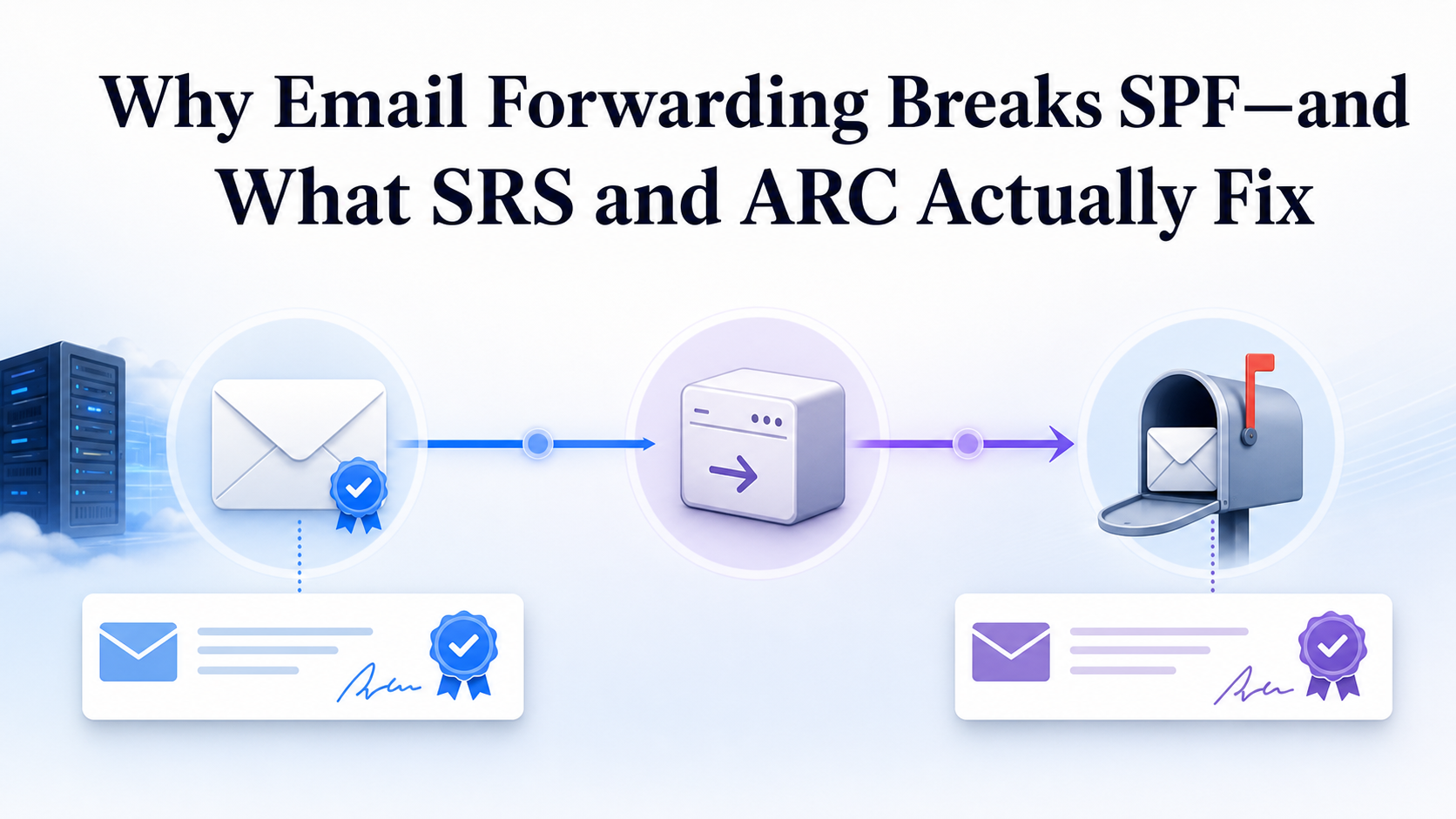
Email forwarding creates a second SMTP delivery. The original sender connected to the forwarding provider, then the forwarding provider connected to the final mailbox. SPF evaluates the server making the current connection, so a message that passed SPF on the first hop can fail on the second even though nobody forged it.
Three controls are often presented as interchangeable fixes, but they protect different evidence. SRS rewrites the envelope sender so the forwarder’s delivery can pass SPF and bounces can return through that forwarder. DKIM can preserve an aligned author signature when the message is not modified. ARC records what an intermediary observed so the final receiver can apply informed local policy. None is a universal “make DMARC pass” switch.
This explanation is for domain owners, mail administrators, help-desk teams and technically curious site owners who can obtain raw message headers. It assumes no prior knowledge of SMTP envelopes: the relevant identities are defined as the message crosses each boundary.
Follow one message across two SMTP connections
Suppose [email protected] sends mail to [email protected], which forwards to a mailbox at another provider. People see one message, but receiving systems see two deliveries.
The direct hop has matching evidence
On the first connection, an outbound server authorized by example.org presents an envelope sender such as [email protected]. The receiving forwarder checks that connecting IP against the SPF policy published for the envelope domain. If the authorization is valid, SPF can pass.
The visible From: field also says [email protected], but SPF does not authenticate that header directly. DMARC later asks whether a passing SPF domain or passing DKIM signing domain aligns with the visible From domain.
Forwarding changes the connecting server
During the second connection, the final receiver sees the forwarding server’s IP. If the forwarder leaves MAIL FROM:<[email protected]> unchanged, the receiver asks whether the forwarder’s IP is authorized by example.org. Usually it is not, because the forwarder is not one of Alice’s outbound systems.
That behavior follows the SPF evaluation model in RFC 7208: the checked identity is the SMTP MAIL FROM domain, or the HELO identity when the reverse path is empty. SPF does not carry a reusable pass token from the first connection.
SPF is correct to distrust the new hop
Authorizing every possible forwarder in the original sender’s SPF record would be both impractical and unsafe. A domain controls its own outbound systems; it does not control every alias, alumni address, help-desk redirect or recipient-side rule that might relay a message later.
Adding the forwarder’s IP to example.org would also authorize that system to use the domain’s envelope identity for unrelated mail. The right repair must be owned by the intermediary that creates the new SMTP connection, not by arbitrary original senders.
DNS availability still matters because receivers must retrieve SPF, DKIM and DMARC records. A temperror caused by lookup failure is different from an SPF fail; operators facing inconsistent authenticated results should first investigate DNSSEC validation failures instead of editing authentication records during a resolver incident.
SRS repairs the forwarding envelope, not the visible author
Sender Rewriting Scheme changes the envelope sender to an address in a domain controlled by the forwarder. Conceptually, the second hop becomes:
Envelope sender domain: forwarder.test (SRS-rewritten)
Visible From domain: example.org
The exact SRS address format depends on the implementation. Its important properties are a forwarder-owned domain, a protected reversible mapping to the original return path and an expiry boundary. The forwarder publishes SPF authorization for its SRS domain, so the final receiver can evaluate the forwarding server against an identity that server legitimately controls.
Microsoft’s SRS documentation also emphasizes bounce handling: non-delivery reports sent to the rewritten address must be decoded and routed back to the original sender. A rewrite that passes SPF but loses legitimate bounces is incomplete.
Why SRS alone does not align SPF for DMARC
DMARC SPF alignment compares the authenticated envelope domain with the visible From domain. After SRS, those domains are normally forwarder.test and example.org. SPF may pass for the rewritten envelope while SPF alignment for DMARC remains false.
That is not a defect in SRS. SRS owns forwarding authorization and return-path continuity; it does not claim that the forwarder became the visible author. The DMARC identifier-alignment rules in RFC 7489 keep those roles separate.
If you operate the forwarder, use a dedicated SRS domain or subdomain with controlled DNS, signing secrets, monitoring and documented retention. Teams that are unsure who may change those records should first establish domain, DNS and hosting ownership because an authentication repair without a named DNS owner is difficult to maintain or reverse.
DKIM can preserve the original author’s aligned proof
DKIM signs selected headers and a canonicalized form of the message body. A forwarder may change the SMTP envelope without breaking DKIM because the envelope is outside the signed message. If the original signature still verifies and its d= domain aligns with the visible From domain, DMARC can pass through DKIM even when forwarded SPF fails or SRS SPF is not aligned.
Preservation has limits. Subject tags, mailing-list footers, MIME conversion, body rewriting and changes to signed headers can invalidate the signature. Even harmless-looking modifications may change the bytes covered by the signature’s canonicalization rules.
Forwarders should therefore avoid rewriting From: or modifying content unless their actual product requires transformation. Original senders need stable signing keys and selectors; Voxfor’s DKIM selector-overlap guide explains how to rotate those keys without making forwarded mail depend on a DNS swap race.
According to RFC 6376, a DKIM pass establishes responsibility for a signed message through the signing domain. It does not prove that every intermediary was benign, nor does it repair a signature after a forwarding system changes covered content.
ARC preserves a chain of observations, not a guaranteed verdict
Authenticated Received Chain lets an intermediary record the authentication results it observed, sign the message as it handled it and seal those records into an ordered chain. RFC 8617 describes this as an authenticated chain of custody.
For a forwarder, an ARC set can say that SPF, DKIM or DMARC had a particular result before later handling changed the evidence. The next receiver validates the ARC chain and decides how much confidence to place in the sealer and the recorded result.
ARC does not change the current SPF result, restore broken DKIM bytes or force DMARC to pass. It supplies signed context to the final receiver’s local policy. A valid ARC chain from an unknown or poorly operated intermediary is not equivalent to a trusted result, and receivers are free to weigh ARC differently.
These controls complement each other: preserve author proof with DKIM where possible, and record trustworthy intermediary evidence with ARC where forwarding changes the path. Neither makes the other redundant.
Choose the control by the broken layer
One message can contain several simultaneous results. Read them as separate claims before changing policy.
| Observed problem | Responsible layer | Control that addresses it | What still needs proof |
|---|---|---|---|
| Forwarder’s IP fails SPF for the original envelope domain | second-hop envelope | SRS plus SPF for the forwarder’s rewrite domain | bounce reversal and expiry work |
| SRS SPF passes but DMARC reports SPF misalignment | author identity | aligned DKIM, if preserved | d= aligns with visible From |
| Forwarder modifies signed content and DKIM fails | message transformation | avoid modification or redesign the intermediary workflow | final bytes and signing policy agree |
| Final receiver cannot see earlier authentication evidence | intermediary custody | ARC sealing | chain validates and receiver trusts the sealer |
| Mail is accepted by the next server but never reaches the inbox | downstream delivery/filtering | trace queue and receiver result | SMTP acceptance is not inbox placement |
The last row matters operationally. status=sent at a Postfix relay proves that the next SMTP system accepted the message, not that a user saw it. Use Postfix queue evidence to separate transport acceptance from later forwarding, filtering or mailbox placement.
Test the path with headers from both routes
Create controlled direct and forwarded deliveries to the same final provider. Use a sender domain you administer, a unique subject marker and an address that does not contain real customer data. Avoid relying on a single provider pair because receiver policy can hide a defect that another destination exposes.
Capture evidence at each boundary
For each copy, save the raw headers and the SMTP or forwarding log entry. Record:
- the connecting host seen by each receiving boundary;
- the envelope sender before and after forwarding;
spf=,dkim=anddmarc=results plus the domains each result evaluated;ARC-Authentication-Results,ARC-Message-SignatureandARC-Sealinstances where present;- final delivery or rejection status, including the enhanced SMTP code;
- whether a controlled non-delivery report returns to the real original sender.
Start reading Authentication-Results from the final provider’s trusted boundary. Message headers can contain older or attacker-supplied fields, so the mere presence of an authentication-looking line is not proof that the receiver trusted it. Return-Path is normally inserted at final delivery and reflects the envelope seen there; compare it with logs rather than treating it as an immutable original header.
Define acceptance before changing policy
A useful forwarding test passes when the direct copy and forwarded copy reach the intended mailbox, the forwarded hop uses an authorized envelope identity, an aligned DKIM signature survives when expected, ARC validates when the forwarder claims to seal it, and a forced bounce reaches the original sender without becoming a backscatter path.
Do not lower a DMARC policy merely to make one test disappear. First locate whether the failing claim belongs to the connection, envelope, signed message, custody chain or mailbox. If delivery itself fails under disk or metadata pressure, Dovecot Maildir inode recovery addresses that storage boundary; authentication changes will not create free inodes.
Common shortcuts that create a different problem
Adding the forwarder to every sender’s SPF: recipients do not control arbitrary senders’ DNS, and broad authorization expands who may use the sender’s envelope domain.
Rewriting the visible From field: this may avoid one alignment result by changing the author identity users see, but it changes reply behavior and message semantics. Mailing lists have distinct transformation requirements; a transparent alias normally should not impersonate the forwarder as author.
Treating ARC as a DMARC override: ARC provides evidence for local policy. A receiver may accept a message because it trusts a valid chain, yet the current DMARC evaluation can still report failure.
Assuming SRS fixes every forward: SRS repairs the envelope and bounce route. Content modification can still break DKIM, and ARC quality still depends on correct sealing and receiver trust.
Testing only inbox arrival: spam placement or acceptance can change without proving the intended identity path. Keep the raw headers, logs and bounce result as the reproducible record.
FAQ: Email forwarding authentication
Why does email forwarding usually break SPF?
SPF checks the IP making the current SMTP connection against the current envelope sender domain. After forwarding, the connecting IP belongs to the forwarder, not the original sender, so the original domain normally does not authorize that second hop.
Does SRS make DMARC pass?
Not by itself. SRS can make SPF pass for a forwarder-controlled envelope domain, but that domain usually does not align with the original visible From domain. DMARC can still pass through an aligned DKIM signature that survives forwarding.
Does SRS change the visible From address?
No. SRS rewrites the SMTP envelope sender used for SPF and bounces. It should not change the message’s visible From header merely to repair forwarding authentication.
Can DKIM survive email forwarding?
Yes, when the forwarder preserves the signed headers and canonicalized body. Changing the SMTP envelope does not break DKIM, but subject tags, footers, MIME conversion or body rewriting may invalidate the signature.
Does ARC override a DMARC failure?
No. ARC signs prior authentication observations and the intermediary chain. The final receiver may use a valid chain from a trusted sealer in local disposition policy, but ARC does not force DMARC to pass or require acceptance.
How can I tell whether a forwarder uses SRS?
Inspect the forwarded copy’s final envelope identity through trusted delivery logs or its Return-Path. An SRS implementation normally uses an encoded address in a domain controlled by the forwarder; confirm that a controlled bounce reverses to the original sender.
Should I weaken DMARC for forwarded mail?
Do not start by weakening policy. Identify whether SPF failed because of the new hop, DKIM broke because content changed, or ARC evidence is absent or untrusted. Repair the responsible layer and test several receiver paths before changing domain-wide enforcement.
Keep the three verdicts separate
Forwarded mail is easier to reason about when every result retains its scope. SPF answers whether the current connecting server may use the current envelope domain. DKIM answers whether the signed message still verifies for its signing domain. ARC answers whether a receiver can validate an intermediary’s chain of authentication observations.
SRS belongs between the first and second answers: it gives the forwarding hop an envelope identity it owns and a reversible return path. A sound deployment proves all four boundaries—connection, envelope, signed content and custody—without pretending that one pass erases the others.