
 Lifetime VPS Europe
 Lifetime VPS Asia
 Lifetime WooCommerce Hosting
 Lifetime Hosting
 Lifetime Game Dedicated Servers
 Chicago, US
 Tokyo, Japan
 Singapore
 Hong Kong
 Seoul, South Korea
 Amsterdem, Netherlands
 London, UK
 Stockholm, Sweden
 Oslo, Norway
 Vienna, Austria
 Zurich, Switzerland
 Sydney, Australia
 Wordpress Hosting
 VPS Hosting
 DDOS Protection
 Submit Ticket
 Full Management
 Guides
 Videos and Podcasts
 Discover Creative Ideas
 Cybersecurity Services
 Voxfor Mega Menu
 Voxfor Advanced Price Management For WooCommerce
 Voxfor Secure Live Chat and AI Support
 Voxfor Multilanguage
 Voxfor AI Content Summary
 Voxfor Autopilot

Quick Answer
Redis is an in-memory data store often used as an object cache for WordPress and WooCommerce. It can speed up repeated database-heavy operations, but it must be configured and monitored correctly, especially on stores with checkout, carts and logged-in users.
Recommended Next Steps
- Use Redis object cache when database queries, admin screens or dynamic store pages become bottlenecks.
- Do not rely on Redis alone; fix slow queries, bloated plugins, weak hosting and cache-exclusion mistakes too.
- For WooCommerce, test cart, checkout, product filters and order admin before and after Redis changes.
Related Voxfor Resources
Redis is an excellent open-source, in-memory data store that has been used as the preferred choice in high-performance caching in current applications. Be it a web application, e-commerce platform, or real-time system, it should not be seen that Redis cannot provide low-latency data access and flexible data structures even in comparison with typical databases. This is a detailed tutorial on the operation of Redis as a cache, its main advantages and why it is a component of your application architecture.
Redis Decision and Testing Checklist
Redis object cache is useful when WordPress repeats expensive database work. It is not a fix for every slow site. Before enabling it on WooCommerce or a membership site, test logged-in flows, cache invalidation and rollback.
| Question | Why it matters | Pass signal |
|---|---|---|
| Is the site database-bound? | Redis helps most when repeated object queries are slowing PHP and MySQL. | Query count or database time drops after object cache is enabled. |
| Does WooCommerce checkout work? | Carts, sessions, coupons, stock and gateways are dynamic. | Cart, checkout, payment callback and order emails work on a test order. |
| Can cache be cleared safely? | Bad invalidation can show stale prices, stock or account data. | The team can flush object cache and confirm fresh data appears. |
| Is Redis private? | Public Redis exposure is a serious security risk. | Redis listens locally or on a private network with firewall restrictions and authentication. |
| Is rollback documented? | Plugin conflicts or memory limits can break pages. | The site owner knows how to disable object cache and remove the object-cache.php drop-in. |
Useful references: Redis security documentation, Redis developer documentation, and the WordPress object cache reference.
WooCommerce Redis QA Before Production
- Create a staging copy with the same Redis object-cache plugin and PHP version.
- Place a test order with a logged-in customer and a guest customer.
- Change product price, stock and coupon rules, then confirm the storefront and checkout show the updated values.
- Test account pages, order history, cart restore, payment webhooks and transactional emails.
- Measure database query time, object-cache hit rate, PHP errors and Redis memory before and after enabling cache.
- Document the rollback command or plugin steps before launch.
What is Redis?

Redis stands for Remote Dictionary Server. It is an in-memory data structure store that keeps frequently used data in RAM instead of reading it from disk for every request. That design can reduce latency for repeated reads when the application uses it correctly.
Redis is coded in C and integrates many programming languages, such as Python, JavaScript, PHP, Java, and others. It is open-source, i.e., its source code is available and maintained by an active developer community.
How Redis Caching Works
Redis operates on a simple yet effective caching principle. When your application needs data, it first checks the Redis cache before querying the primary database. This process follows a predictable pattern that dramatically improves application performance.
The Caching Workflow:
When a user requests data, your application performs the following steps:
- Cache Check – The application queries Redis for the requested data using a unique key
- Cache Hit – If the data exists in Redis, it’s returned immediately with microsecond latency
- Cache Miss – If the data doesn’t exist, the application fetches it from the primary database
- Cache Storage – The retrieved data is stored in Redis with an optional expiration time
- Future Requests – Subsequent requests for the same data are served from Redis without touching the database
This architecture reduces database load, decreases response times, and enables your application to handle significantly more concurrent users.
Important Redis Cache Features
Redis keeps all information in RAM, making access much faster than disk-based storage. The operations are also executed in microseconds and not milliseconds; thus, Redis can perform up to half a million operations every second. This speed difference is critical to the applications that are time-sensitive and need high throughput.
Unlike simpler caching solutions, Redis supports diverse data structures, including:
- Strings – Simple key-value pairs for basic caching
- Lists – Ordered collections for queues and stacks
- Sets – Unordered collections for unique items
- Hashes – Key-value pairs within a key for structured data
- Sorted Sets – Collections with scoring for rankings and leaderboards
- Bitmaps – Efficient binary data storage
This versatility allows you to optimize your caching strategy for different use cases within a single platform.
Key Expiration and TTL
Redis includes built-in Time-To-Live (TTL) functionality that automatically expires cache entries after a specified duration. You can set expiration times using the EXPIRE command or combine value setting with expiration using SETEX. This prevents stale data from accumulating in your cache and ensures automatic memory management.
Example commands:
SET mykey "Hello, Redis" OK
EXPIRE mykey 60
After 60 seconds, the key automatically deletes from the cache.
Pub/Sub MessagingRedis provides publish/subscribe capabilities that enable real-time messaging and cache invalidation mechanisms. When data changes in your primary database, you can publish an invalidation message through Redis Pub/Sub, ensuring all subscribers immediately know the cache is stale.
Persistence Options
While Redis is primarily an in-memory store, it offers optional persistence for data durability:
- RDB (Redis Database) – Point-in-time snapshots saved periodically to disk
- AOF (Append-Only File) – Logs every write operation for high durability
- Hybrid Persistence – Combines RDB and AOF for balanced efficiency and durability
When Redis Helps WordPress and WooCommerce
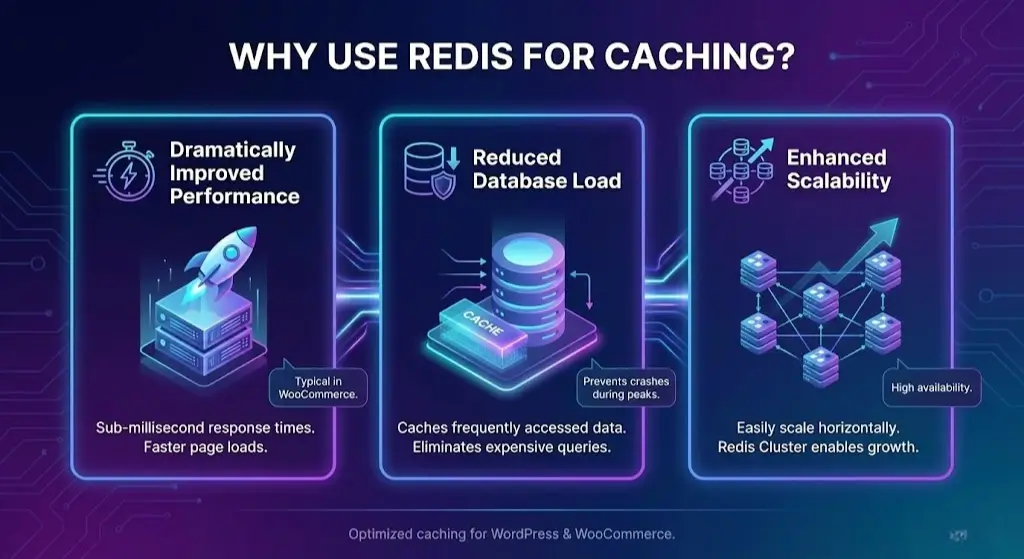
Dramatically Improved Performance
The most compelling reason to use Redis is the performance advantage it provides. By storing frequently accessed data in memory, Redis eliminates expensive database queries. WordPress sites using Redis object caching experience significantly faster page load times, reduced database strain, and improved overall user experience. Redis maintains sub-millisecond performance at up to 200 million operations per second in enterprise deployments.
Voxfor managed WordPress hosting
already includes optimized Redis caching capabilities, making it easy to deploy without additional configuration complexity. Their managed WordPress hosting stack can combine Redis integration with server tuning, cache rules and monitoring so pages respond faster for real visitors.
Reduced Database Load
Each database query takes the server resources and enhances the I/O operations. The caching of query results in Redis will significantly decrease the number of database requests. It is actually necessary, especially in cases of peaks in traffic or concurrency situations, where a database can be slowed down or even crash due to a surge of traffic. Redis has the ability to store repeated query results, so your database is not strained unnecessarily.
WooCommerce hosting that includes Redis support
, you can efficiently cache product queries, category listings, and customer data. This ensures your store maintains better response times during shopping peaks when the cache hit rate is healthy.
Enhanced Scalability
Redis supports horizontal and vertical scaling plans, which are not easily supported by traditional databases. Redis Cluster enables you to spread your data to multiple nodes so that your caching layer can be scaled without the scale of your application. Clustering allows one to keep running, even when nodes are going dead, since replica nodes will automatically be promoted to masters.
For WordPress specifically, Redis object caching allows your site to accommodate increased traffic without compromising performance, making it ideal for dynamic sites with high user interaction.
Provide the flexibility to install and manage Redis exactly as your application needs. Their high-performance virtual private servers offer the scalability required for Redis clusters and advanced caching architectures.
Lower Latency for Critical Operations
Redis provides data in microseconds, which would have taken databases milliseconds to retrieve. This difference in latency is revolutionary when it depends on applications that need to be responsive in real-time, as is the case with gaming platforms, financial trading systems, live analytics dashboards, and so on. The goal is lower response time, but real results depend on application code, network distance, database design and cache hit rate.
Cost Efficiency
By reducing database load and server resource consumption, Redis helps lower overall infrastructure costs. Fewer database operations mean less CPU usage, fewer disk I/O operations, and potentially smaller database server requirements. In enterprise deployments, Redis provides up to 80% cost savings through reduced resource consumption.
Versatile Use Cases Beyond Basic Caching
Redis excels at multiple scenarios beyond traditional object caching:
- Session Management – Store user sessions for fast retrieval and reduced database hits
- Real-Time Analytics – Process streaming data quickly for live insights
- Message Queues – Implement reliable job queues for background task processing
- Real-Time Chat – Build real-time messaging systems with Pub/Sub
- Leaderboards – Create gaming leaderboards with sorted sets
- Geospatial Services – Store and query location-based data
Redis vs. Memcached: Which Should You Choose?
While both are in-memory caching solutions, Redis and Memcached serve different needs:
| Feature | Redis | Memcached |
| Data Structures | Multiple (strings, lists, sets, hashes, sorted sets) | Simple strings only |
| Persistence | RDB and AOF snapshots | No persistence |
| Replication | Yes, with automatic failover | No replication |
| Pub/Sub | Yes, full support | No support |
| Clustering | Yes, horizontal scaling | Limited clustering |
| Transactions | Yes, atomic operations | No transactions |
| Use Cases | Complex data models, real-time apps | Simple caching, high throughput |
| Performance | Sub-millisecond latency | Slightly faster for simple operations |
Choose Redis when you need complex data structures, persistence, replication, or multiple use cases within a single platform.
Choose Memcached when you only need simple key-value caching with maximum throughput and have no persistence requirements.
Redis Eviction Policies and Memory Management
Redis implements eviction policies that determine how keys are removed when memory reaches its maximum limit. The default policy for most deployments is volatile-lru (Least Recently Used for keys with TTL).
Common Eviction Policies:
- LRU (Least Recently Used) – Removes the least recently accessed keys first
- LFU (Least Frequently Used) – Removes the least frequently accessed keys
- TTL-based – Removes keys closest to their expiration time
- Random – Randomly removes keys
Proper eviction policy selection ensures your Redis instance maintains optimal performance as data volume grows.
How to Set Up Redis for Caching
Installation on Ubuntu/Debian:
bash
sudo apt update
sudo apt install redis-server
sudo systemctl start redis-server
sudo systemctl enable redis-server
The installation process is straightforward and takes only a few commands.
Redis Configuration:
Key configuration settings in redis.conf:
- maxmemory-gb – Sets the memory limit for your Redis instance
- maxmemory-policy – Defines the eviction policy when the memory limit is reached
- requirepass – Enables password protection for security
Managed Hosting:
If you prefer a fully managed solution without configuring Redis yourself,
Voxfor managed WordPress hosting
Handles all Redis setup, configuration, and optimization automatically. Their platform combines Redis integration with Redis-aware performance tuning, allowing you to focus on content and business instead of server administration.
Redis Security Practices
Enable Authentication
By default, Redis doesn’t require authentication, a serious security vulnerability. Set a strong password:
text
requirepass YourStrongPasswordHereUse the AUTH command when connecting to authenticate your connection.
Restrict Network Access
Configure your firewall to only allow connections from trusted IP addresses:
bash
sudo ufw allow from 192.168.1.0/24 to any port 6379Do not expose Redis to the public internet without authentication and firewall restrictions.
Update Regularly
Keep Redis updated to the latest stable version to receive security patches and performance improvements.
Cache Invalidation Strategies
Keeping cached data consistent with your primary database is crucial. Cache invalidation determines when cached data is refreshed.
TTL-Based Invalidation:
The simplest approach uses time-based expiration. Set appropriate TTL values for different data types—frequently changing data gets shorter TTLs, stable data gets longer TTLs.
Manual Invalidation:
When critical data changes in your database, immediately invalidate the corresponding cache entry through your application code. This helps users see current information after important data changes.
Event-Based Invalidation:
Use Pub/Sub messaging to trigger cache invalidation when data updates occur. This combines the benefits of both approaches, automatic expiration with immediate refresh on changes.
Version-Based Keys:
Include version numbers in cache keys. When data changes, increment the version number, effectively creating a new cache entry and retiring the old one.
Redis Implementation for WooCommerce Stores
E-commerce platforms benefit tremendously from Redis caching.
Voxfor Elite managed WooCommerce hosting.
Includes pre-configured Redis to accelerate order processing, product lookups, and customer data retrieval. With Redis handling these operations, your WooCommerce store maintains faster responses during busy events when product, category and account flows are tested correctly.
Key WooCommerce caching opportunities with Redis:
- Product Catalog Caching – Cache product details, descriptions, and pricing to reduce database load
- Category and Tag Data – Store category hierarchies and product associations for faster retrieval
- Cart Persistence – Quickly load and save shopping cart data across sessions
- Order History – Load historical orders faster for customers
- Inventory Checks – Cache stock availability data for faster checkout processing
Redis makes your e-commerce shop an uncaged database, which has turned your shop into a high-speed and scalability-oriented program that can satisfy millions of products and simultaneous customers.
Measuring Redis Cache Performance
Monitor these key metrics to optimize your Redis caching implementation:
- Hit Rate – Percentage of requests served from cache vs. database (target: 80-90%+)
- Response Time – Average latency for cache hits (typically microseconds)
- Memory Usage – Current Redis memory consumption vs. maximum configured
- Evictions – Number of keys automatically removed due to memory pressure
- Connected Clients – Number of active connections to Redis
Most managed Redis services and hosting providers provide dashboards for real-time monitoring of these metrics.
Redis Caching with Advanced Infrastructure
For organizations requiring maximum control and performance,
Allows more complex Redis setups, such as cluster deployment, sentinel setups, and user-defined optimization. Their VPS plans can support custom Redis setups when CPU, RAM, storage and monitoring are sized for the workload.
Conclusion
Redis is a widely used caching option for applications that need low-latency data access and flexible data structures. Its combination of in-memory storage, advanced data structures, persistence options, and clustering capabilities makes it suitable for everything from WordPress sites to complex real-time applications.
For WordPress and WooCommerce, Redis should be judged by measurable improvements: lower database time, healthier object-cache hit rates, stable checkout behavior and cleaner server logs.
Voxfor offers several hosting paths where Redis may fit after testing:
- Managed WordPress Hosting
- – Pre-configured Redis with one-click optimization
- WooCommerce Hosting
- – Optimized for e-commerce with integrated Redis caching
- Lifetime VPS Solutions
- – Full control for advanced Redis architectures and custom implementations
To start with, measure the current performance bottlenecks in your application and deploy Redis as your caching layer, by examining the caching requirements of your application. Regardless of whether you opt to use managed hosting or develop your own infrastructure, the performance improvement will be realized immediately. Your users will load faster, interact more effectively and generally become more satisfied. Your infrastructure costs will reduce due to the reduced strain on the database.
About the writer

Hassan Tahir wrote this article, drawing on his experience to clarify WordPress concepts and enhance developer understanding. Through his work, he aims to help both beginners and professionals refine their skills and tackle WordPress projects with greater confidence.
Frequently Asked Questions
What does Redis cache do for WordPress?
Redis stores reusable WordPress object-cache data in memory so repeated database lookups can be served faster. It helps most when database queries are a real bottleneck.
Is Redis safe for WooCommerce?
Redis can be safe for WooCommerce when carts, checkout, account pages, stock changes, coupons and payment webhooks are tested. Bad cache rules can show stale data or break dynamic flows.
Can Redis fix slow hosting?
No. Redis can reduce database work, but slow PHP workers, weak storage, overloaded plugins, poor queries, network latency and uncached checkout paths still need separate fixes.
How do I test Redis before production?
Use staging, enable the same object-cache plugin, test logged-in and guest flows, place test orders, change prices and stock, check errors and compare query time before and after.
What is the difference between Redis and page cache?
Page cache stores full rendered pages for visitors. Redis object cache stores reusable database and application objects that WordPress can request while building dynamic pages.
How do I roll back Redis object cache?
Disable the object-cache plugin or drop-in, flush Redis, confirm the site still loads, then review logs before enabling it again with corrected settings.