 Lifetime VPS Europe
 Lifetime VPS Asia
 Lifetime WooCommerce Hosting
 Lifetime Hosting
 Lifetime Game Dedicated Servers
 Chicago, US
 Tokyo, Japan
 Singapore
 Hong Kong
 Seoul, South Korea
 Amsterdem, Netherlands
 London, UK
 Stockholm, Sweden
 Oslo, Norway
 Vienna, Austria
 Zurich, Switzerland
 Sydney, Australia
 Wordpress Hosting
 VPS Hosting
 DDOS Protection
 Submit Ticket
 Full Management
 Guides
 Videos and Podcasts
 Discover Creative Ideas
 Voxfor Autonomous AI Workers
 Voxfor Mega Menu
 Voxfor Advanced Price Management For WooCommerce
 Voxfor Secure Live Chat and AI Support
 Voxfor Multilanguage
 Voxfor AI Content Summary
 Voxfor Autopilot

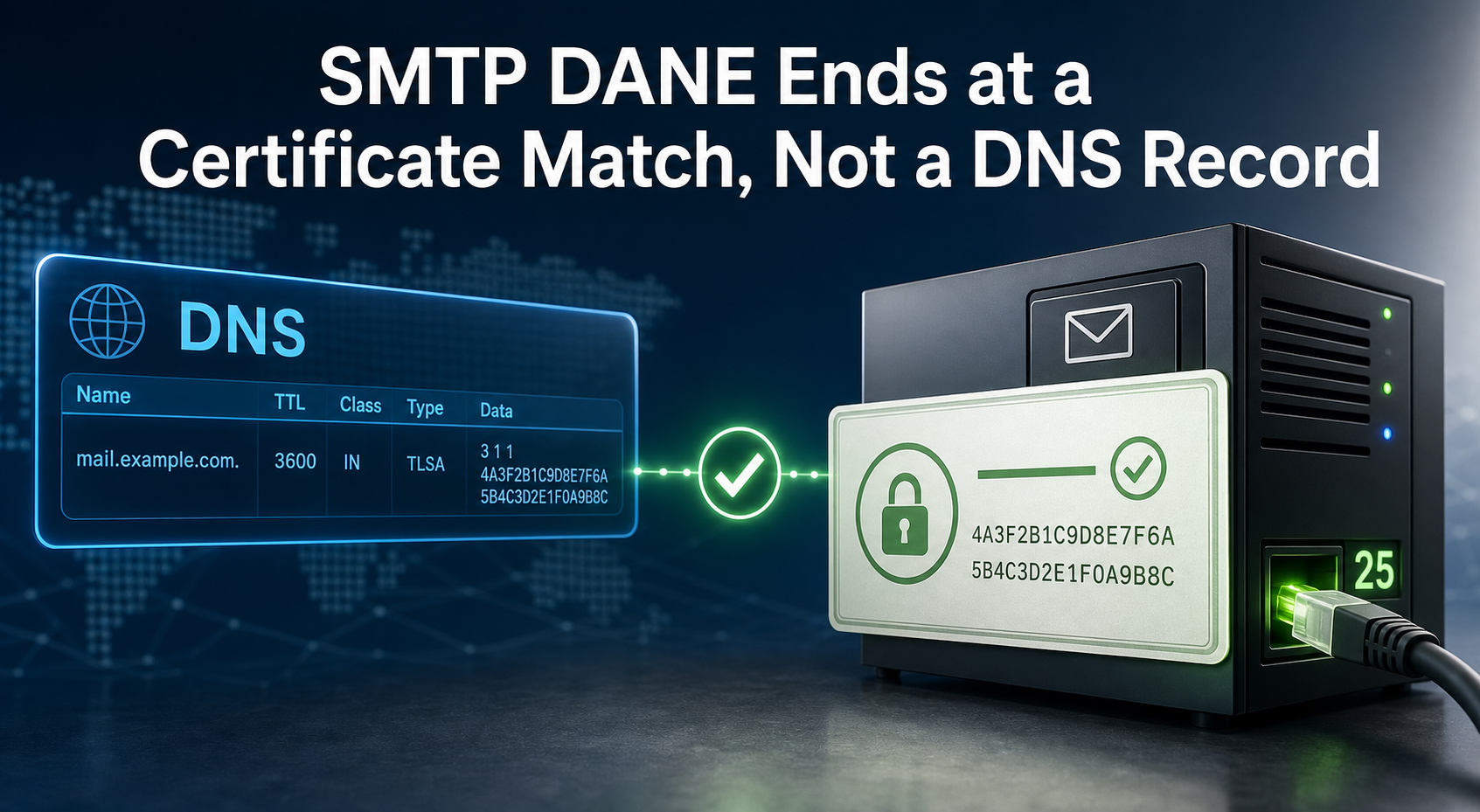
An SMTP server can advertise STARTTLS, complete a TLS handshake, and still present an identity that a careful client must reject. Encryption only proves that a session became unreadable in transit. It does not, by itself, prove that the peer certificate chains to a trusted root, covers the hostname the operator intended to reach, or leaves SMTP usable after the upgrade.
This audit treats those as separate gates. It inventories the endpoint, records the plaintext SMTP capability, enforces chain and hostname validation, reads the certificate actually served, runs two deliberate negative controls, and confirms that EHLO still succeeds inside TLS. The result is a cutover receipt rather than a reassuring screenshot of a padlock.
Reproduction ran on Debian 13.6 with OpenSSL 3.5.6, Node.js 24.18.0, and a loopback-only SMTP fixture on port 2525. That fixture creates a disposable root and a two-day certificate for the reserved name smtp.audit.test. It sends no mail, changes no production MTA, and removes only its marker-owned temporary directory.
Encryption Is Not Authenticated SMTP Identity
SMTP begins as a plaintext application protocol on ports such as 25 and 587. RFC 3207 defines the STARTTLS extension: the server advertises the capability, the client requests it, the server returns 220, and the parties negotiate TLS. After the handshake, the client must discard knowledge learned from the earlier session and issue EHLO again.
That sequence answers an upgrade question, not every identity question. A useful acceptance test needs four independent results:
- The intended SMTP listener advertises
STARTTLSbefore credentials or message content are sent. - The served chain validates against the trust store selected for the test.
- The certificate’s Subject Alternative Name covers the hostname the client is meant to verify.
- SMTP works after TLS, demonstrated by a new successful
EHLOresponse.
OpenSSL’s current s_client documentation matters here because -verify alone is diagnostic: verification errors can be printed while the connection continues. -verify_return_error makes the command stop on an error, while -verify_hostname applies the hostname assertion. A line that merely says the handshake completed is therefore not a pass.
Inventory Every Endpoint You Expect to Trust
Start with the delivery route rather than a hostname copied from a control panel. MX records identify inbound delivery hosts; submission on port 587 or implicit TLS on 465 may use different names, certificates, and load balancers. Record each service separately, including its port, expected verification name, IP family, and observing network.
set -Eeuo pipefail
DOMAIN=voxfor.com
MX=$(dig +short MX "$DOMAIN" | sort -n)
printf 'domain=%s\n%s\n' "$DOMAIN" "$MX"
grep -Eq '^[0-9]+[[:space:]]+[^[:space:]]+\.$' <<< "$MX"
Our tested public lookup returned priority 10 and mail.voxfor.com.. That public fact is only an inventory example; it is not permission to scan or reconfigure the server. For another domain, replace DOMAIN, preserve every returned MX hostname, and add the separately documented submission endpoint.
MX delivery and message submission are different products
For ordinary MX delivery, verify the actual MX hostname reached by the client unless a stronger policy such as MTA-STS or DANE defines a different reference identity. For authenticated submission, verify the hostname configured in the mail client. Do not test example.com merely because it is the address domain if the client connects to smtp.example.net.
Test every relevant backend. A certificate can pass on IPv4 and fail on IPv6, or pass on the first MX while a lower-priority listener serves an expired chain. This is the same reason a TLS renewal endpoint audit must inspect the certificate at the live termination point rather than only the certificate file on disk.
Build a Disposable STARTTLS Listener
One loopback port and one exact directory define the fixture’s ownership boundary. It generates a local root, signs a leaf certificate whose SAN is smtp.audit.test, writes a minimal Node SMTP state machine, and records the server PID. Its marker makes every later block refuse to run against an unrelated path.
set -Eeuo pipefail
LAB=/tmp/voxfor-smtp-starttls-140
MARKER=voxfor-smtp-starttls-lab-140
[[ ! -e "$LAB" ]]
! ss -Hln 'sport = :2525' | grep -q .
install -d -m 0700 "$LAB"
printf '%s\n' "$MARKER" > "$LAB/.marker"
openssl req -x509 -newkey rsa:2048 -nodes -days 2 \
  -subj '/CN=Voxfor SMTP Lab Root' \
  -keyout "$LAB/root.key" -out "$LAB/root.pem" >/dev/null 2>&1
openssl req -newkey rsa:2048 -nodes \
  -subj '/CN=smtp.audit.test' \
  -addext 'subjectAltName=DNS:smtp.audit.test' \
  -keyout "$LAB/server.key" -out "$LAB/server.csr" >/dev/null 2>&1
printf 'subjectAltName=DNS:smtp.audit.test\nextendedKeyUsage=serverAuth\n' > "$LAB/server.ext"
openssl x509 -req -days 2 -sha256 -in "$LAB/server.csr" \
  -CA "$LAB/root.pem" -CAkey "$LAB/root.key" -CAcreateserial \
  -extfile "$LAB/server.ext" -out "$LAB/server.pem" >/dev/null 2>&1
cat > "$LAB/server.mjs" <<'EOF'
import fs from 'node:fs'; import net from 'node:net'; import tls from 'node:tls';
const dir=process.argv[2];
const secure=tls.createServer({key:fs.readFileSync(`${dir}/server.key`),cert:fs.readFileSync(`${dir}/server.pem`)},s=>protocol(s,true));
function protocol(s,encrypted){let b='';s.setEncoding('utf8');s.on('error',()=>{});s.on('data',c=>{b+=c;while(b.includes('\n')){const i=b.indexOf('\n');const q=b.slice(0,i).replace(/\r$/,'').trim();b=b.slice(i+1);if(/^EHLO\b/i.test(q))s.write(encrypted?'250-smtp.audit.test\r\n250-SIZE 10485760\r\n250 HELP\r\n':'250-smtp.audit.test\r\n250-STARTTLS\r\n250 SIZE 10485760\r\n');else if(q==='STARTTLS'&&!encrypted){s.removeAllListeners('data');s.write('220 2.0.0 Ready to start TLS\r\n',()=>secure.emit('connection',s));return}else if(q==='QUIT')s.end('221 2.0.0 Bye\r\n');else if(q)s.write('502 5.5.2 Not implemented\r\n')}})}
const server=net.createServer(s=>{s.write('220 smtp.audit.test ESMTP Voxfor STARTTLS Lab\r\n');protocol(s,false)});
server.listen(2525,'127.0.0.1',()=>console.log('ready=127.0.0.1:2525'));
const close=()=>server.close(()=>secure.close(()=>process.exit(0)));process.on('SIGTERM',close);process.on('SIGINT',close);
EOF
node "$LAB/server.mjs" "$LAB" > "$LAB/server.log" 2>&1 &
echo $! > "$LAB/server.pid"
for _ in {1..40}; do grep -q '^ready=' "$LAB/server.log" && break; sleep 0.05; done
grep -qx 'ready=127.0.0.1:2525' "$LAB/server.log"
kill -0 "$(<"$LAB/server.pid")"
A two-day leaf lifetime is deliberate: this is a lab identity, not a reusable certificate. Keep the root key inside the mode-0700 directory and never install it into the system trust store. Production tests should use the operating system’s existing CA path or the explicit private CA bundle approved for that service.
Read EHLO Before You Upgrade
Before TLS, the receipt proves only the banner and capability of the listener currently owning the address and port. It does not authenticate the peer, so do not send credentials or message data during this stage.
set -Eeuo pipefail
LAB=/tmp/voxfor-smtp-starttls-140
[[ "$(<"$LAB/.marker")" == voxfor-smtp-starttls-lab-140 ]]
OUT=$(printf 'EHLO probe.audit.test\r\nQUIT\r\n' | nc -w 2 127.0.0.1 2525)
printf '%s\n' "$OUT"
grep -q '^220 smtp.audit.test ESMTP' <<< "$OUT"
grep -q '^250-STARTTLS' <<< "$OUT"
250-STARTTLS means the server offered an upgrade in this session. It does not prove that a remote policy requires TLS, that the certificate is usable, or that a downstream relay will accept a message. When a queue incident is already in progress, preserve this transport evidence before following the Postfix queue triage workflow; queue state and certificate identity are different ownership layers.
Make Chain and Hostname Checks Fail Closed
Four often-implicit inputs become explicit in the positive command: protocol upgrade, network endpoint, TLS SNI name, and verification hostname. The lab uses its private CA file. On a typical public Linux host, replace that with the distribution trust path, commonly -CApath /etc/ssl/certs.
set -Eeuo pipefail
LAB=/tmp/voxfor-smtp-starttls-140
[[ "$(<"$LAB/.marker")" == voxfor-smtp-starttls-lab-140 ]]
OUT=$(printf 'EHLO probe.audit.test\r\nQUIT\r\n' | openssl s_client \
  -starttls smtp -connect 127.0.0.1:2525 -servername smtp.audit.test \
  -verify_hostname smtp.audit.test -verify_return_error -CAfile "$LAB/root.pem" \
  -brief -ign_eof 2>&1)
printf '%s\n' "$OUT"
grep -q 'Verification: OK' <<< "$OUT"
grep -q 'Verified peername: smtp.audit.test' <<< "$OUT"
grep -q '^250-SIZE 10485760' <<< "$OUT"
SNI and hostname verification solve separate problems
-servername smtp.audit.test sends SNI so a TLS terminator can choose a virtual certificate. -verify_hostname smtp.audit.test asks OpenSSL to reject a certificate that does not cover that name. Supplying one flag does not imply the other. -verify_return_error then converts a verification defect into a nonzero command result instead of a warning buried above a continuing session.
This distinction is especially useful after renewal: the certificate file may be correct while a proxy, MTA process, IPv6 listener, or secondary node still serves an older object. Postfix’s TLS documentation also emphasizes correct certificate-chain construction and server-side TLS logging, but client-side endpoint verification is what proves the listener presented the expected identity.
Inspect the Certificate the Listener Actually Serves
A successful automated assertion should still produce a human-readable receipt for scope and expiry. Pipe the certificate presented by the live listener into openssl x509; do not inspect only a local PEM path and assume the network service loaded it.
set -Eeuo pipefail
LAB=/tmp/voxfor-smtp-starttls-140
[[ "$(<"$LAB/.marker")" == voxfor-smtp-starttls-lab-140 ]]
FIELDS=$(printf 'QUIT\r\n' | openssl s_client \
  -starttls smtp -connect 127.0.0.1:2525 -servername smtp.audit.test \
  -verify_hostname smtp.audit.test -verify_return_error -CAfile "$LAB/root.pem" \
  -showcerts 2>/dev/null | openssl x509 -noout -subject -issuer -dates -ext subjectAltName)
printf '%s\n' "$FIELDS"
grep -q 'subject=CN=smtp.audit.test' <<< "$FIELDS"
grep -q 'DNS:smtp.audit.test' <<< "$FIELDS"
Record the issuer, SAN, notBefore, and notAfter values in UTC. OpenSSL’s hostname check can fall back to the subject Common Name when a certificate has no supported SAN, while current RFC 9525 service-identity guidance deprecates CN-ID use. This audit therefore does not accept the positive -verify_hostname line alone: the separate field assertion must also find the expected dNSName in SAN. Automate an expiry threshold appropriate to the renewal process, but do not confuse remaining days with trust or hostname coverage.
Run Negative Controls Before the Cutover
A positive-only probe can be accidentally permissive. Two negative controls prove that the command actually enforces the assertions the receipt claims.
First, keep the connection and SNI name correct but ask OpenSSL to verify a hostname the certificate does not cover. Exit status must be nonzero, and the output must identify a hostname mismatch.
set -Eeuo pipefail
LAB=/tmp/voxfor-smtp-starttls-140
[[ "$(<"$LAB/.marker")" == voxfor-smtp-starttls-lab-140 ]]
set +e
OUT=$(printf 'QUIT\r\n' | openssl s_client \
  -starttls smtp -connect 127.0.0.1:2525 -servername smtp.audit.test \
  -verify_hostname wrong.audit.test -verify_return_error -CAfile "$LAB/root.pem" \
  -brief 2>&1)
STATUS=$?
set -e
printf '%s\nexit=%s\n' "$OUT" "$STATUS"
[[ "$STATUS" -ne 0 ]]
grep -qi 'hostname mismatch' <<< "$OUT"
Second, keep the expected hostname correct but validate against an unrelated root. This separates name coverage from chain trust. The unrelated root is created only inside the owned lab directory.
set -Eeuo pipefail
LAB=/tmp/voxfor-smtp-starttls-140
[[ "$(<"$LAB/.marker")" == voxfor-smtp-starttls-lab-140 ]]
openssl req -x509 -newkey rsa:2048 -nodes -days 2 \
  -subj '/CN=Unrelated SMTP Lab Root' \
  -keyout "$LAB/unrelated.key" -out "$LAB/unrelated.pem" >/dev/null 2>&1
set +e
OUT=$(printf 'QUIT\r\n' | openssl s_client \
  -starttls smtp -connect 127.0.0.1:2525 -servername smtp.audit.test \
  -verify_hostname smtp.audit.test -verify_return_error -CAfile "$LAB/unrelated.pem" \
  -brief 2>&1)
STATUS=$?
set -e
printf '%s\nexit=%s\n' "$OUT" "$STATUS"
[[ "$STATUS" -ne 0 ]]
grep -qi 'unable to get local issuer certificate' <<< "$OUT"
If either negative control exits zero, the audit command is not fail-closed and the positive result is not acceptable. Do not weaken production verification to make the test green. Repair the served chain, the client reference hostname, SNI routing, or the selected trust bundle according to the failed control.
Turn the Probe Into an Endpoint Receipt
Run the positive sequence against every endpoint from the inventory and retain one row per address family and vantage point. This matrix keeps a passing primary MX from hiding a failing secondary or submission listener.
| Endpoint and port | Expected name | Required evidence | Reject when |
|---|---|---|---|
| MX host on 25 | Actual MX or policy reference name | STARTTLS, trusted chain, SAN match, post-TLS EHLO |
Upgrade absent, verify error, or SMTP unavailable after TLS |
| Submission on 587 | Client-configured submission name | Same four gates; authentication is tested separately | Certificate covers only the MX name or EHLO changes unexpectedly |
| Submission on 465 | Client-configured implicit-TLS name | Direct TLS without -starttls smtp, then SMTP dialogue |
A STARTTLS probe is used against an implicit-TLS port |
| IPv4 and IPv6 backends | Same documented service identity | Equivalent issuer, SAN, lifetime, and SMTP response | One family serves stale or default certificate |
| Secondary MX or load-balancer node | Its documented reference identity | Same fail-closed command and negative-control behavior | Only the preferred route passes |
Here is the representative receipt from the disposable run:
environment: Debian 13.6; OpenSSL 3.5.6; Node.js 24.18.0; 127.0.0.1:2525 only
plaintext: banner=smtp.audit.test; STARTTLS advertised
positive: TLSv1.3; TLS_AES_256_GCM_SHA384; Verification=OK
identity: Verified peername=smtp.audit.test; SAN=DNS:smtp.audit.test
application: post-TLS EHLO returned SIZE and HELP
hostname control: verify error 62 hostname mismatch; exit=1
chain control: verify error 20 unable to get local issuer certificate; exit=1
verdict: upgrade, trust, identity, and post-TLS SMTP all proved fail closed
cleanup boundary: verified Node process identity plus exact marker-owned directory
Accept an endpoint only when the intended listener advertises or directly provides the correct TLS mode; the fail-closed positive command returns zero; chain validation reports Verification: OK; the verified peer name equals the documented reference hostname; the expected dNSName is explicitly present in SAN; issuer and validity are recorded from the served leaf; a fresh post-TLS EHLO succeeds; both negative controls return nonzero for the expected reason; and every relevant MX, submission, IPv4, IPv6, proxy, and secondary path produces a consistent receipt from a representative network.
These checks prove endpoint identity and SMTP continuity, not successful delivery or inbox placement. If a delivered message later fails body integrity, use the DKIM body-hash diagnosis. If forwarding changes the authentication path, evaluate SPF, SRS, and ARC ownership separately. A healthy TLS receipt should narrow the incident, not absorb unrelated mail controls such as authentication, DKIM, DMARC, and recipient acceptance.
When certificate deployment, MTA configuration, DNS/PTR, and renewal monitoring belong to another team, compare its written duties with the managed mail-server scope before handoff; an undefined owner is itself a failed cutover condition.
FAQ: STARTTLS Trust Versus Delivery
Does a STARTTLS advertisement prove SMTP encryption works?
No. It proves only that the pre-TLS SMTP session advertised the extension. The server can fail after STARTTLS, present an untrusted or mismatched certificate, or stop answering SMTP after the handshake. Require all four positive gates and the negative controls.
Is -servername the same as -verify_hostname?
No. -servername sends SNI to help the server choose a certificate. -verify_hostname checks whether the returned certificate covers the reference hostname. A correct audit usually supplies both, plus -verify_return_error.
Which hostname should I verify for an MX server?
For ordinary MX delivery, start with the hostname in the MX record. A policy such as MTA-STS or DANE can change how a sending MTA establishes acceptable identity or security, so test the policy’s exact reference and enforcement rules rather than inventing a name from the email address domain.
Does Verification: OK prove that email delivery works?
No. It proves the selected trust and hostname assertions for the served certificate. The post-TLS EHLO adds application continuity, but routing, relay policy, authentication, message acceptance, queue processing, and recipient delivery remain separate tests. For local delivery storage failure, the Dovecot Maildir inode workflow starts after transport is known healthy.
Should port 465 use -starttls smtp?
No. Port 465 normally uses implicit TLS from the first byte, so connect with openssl s_client -connect host:465 -servername host -verify_hostname host -verify_return_error. -starttls smtp is for a plaintext SMTP connection that upgrades, commonly on ports 25 or 587.
Must I test every MX host and IP address?
Test every intended service path that can receive real traffic: each MX priority, every load-balancer or regional backend exposed by the service, IPv4 and IPv6, and the separate submission name. Sampling one passing route cannot prove that a failover or alternate address serves the same certificate.
Remove the Fixture and Preserve the Decision
Cleanup first proves that the recorded PID still belongs to the exact Node executable, script path, and lab argument created by the fixture. Only then does it send a signal, wait for the loopback listener to disappear, and delete only that exact directory. A dead fixture needs no signal; a reused PID with different command-line identity makes cleanup fail closed.
set -Eeuo pipefail
LAB=/tmp/voxfor-smtp-starttls-140
[[ -f "$LAB/.marker" ]]
[[ "$(<"$LAB/.marker")" == voxfor-smtp-starttls-lab-140 ]]
PID=$(<"$LAB/server.pid")
if [[ -d "/proc/$PID" ]]; then
  mapfile -d '' -t ARGV < "/proc/$PID/cmdline"
  [[ "$(readlink -f "/proc/$PID/exe")" == "$(readlink -f "$(command -v node)")" ]]
  [[ "${#ARGV[@]}" -eq 3 ]]
  [[ "${ARGV[1]}" == "$LAB/server.mjs" ]]
  [[ "${ARGV[2]}" == "$LAB" ]]
  kill "$PID"
  for _ in {1..30}; do [[ ! -d "/proc/$PID" ]] && break; sleep 0.1; done
fi
[[ ! -d "/proc/$PID" ]]
! ss -Hln 'sport = :2525' | grep -q .
rm -rf --one-file-system "$LAB"
[[ ! -e "$LAB" ]]
printf 'cleanup=owned_pid_stopped_marker_scope_absent\n'
If a reviewed production certificate, listener, SNI map, or trust-bundle change causes acceptance to regress, restore only the previous backed-up object for the affected endpoint, reload the exact owning service with its normal validation command, and repeat the same positive and negative receipts. Do not disable certificate verification, replace the system trust store broadly, remove unrelated certificates, open relay access, or roll back DNS and mail-authentication records that the evidence did not implicate; retain the failed output and change record for the responsible owner. If fixture PID identity does not match, stop and inspect it instead of signaling that process.