 Lifetime VPS Europe
 Lifetime VPS Asia
 Lifetime WooCommerce Hosting
 Lifetime Hosting
 Lifetime Game Dedicated Servers
 Chicago, US
 Tokyo, Japan
 Singapore
 Hong Kong
 Seoul, South Korea
 Amsterdem, Netherlands
 London, UK
 Stockholm, Sweden
 Oslo, Norway
 Vienna, Austria
 Zurich, Switzerland
 Sydney, Australia
 Wordpress Hosting
 VPS Hosting
 DDOS Protection
 Submit Ticket
 Full Management
 Guides
 Videos and Podcasts
 Discover Creative Ideas
 Voxfor Autonomous AI Workers
 Voxfor Mega Menu
 Voxfor Advanced Price Management For WooCommerce
 Voxfor Secure Live Chat and AI Support
 Voxfor Multilanguage
 Voxfor AI Content Summary
 Voxfor Autopilot
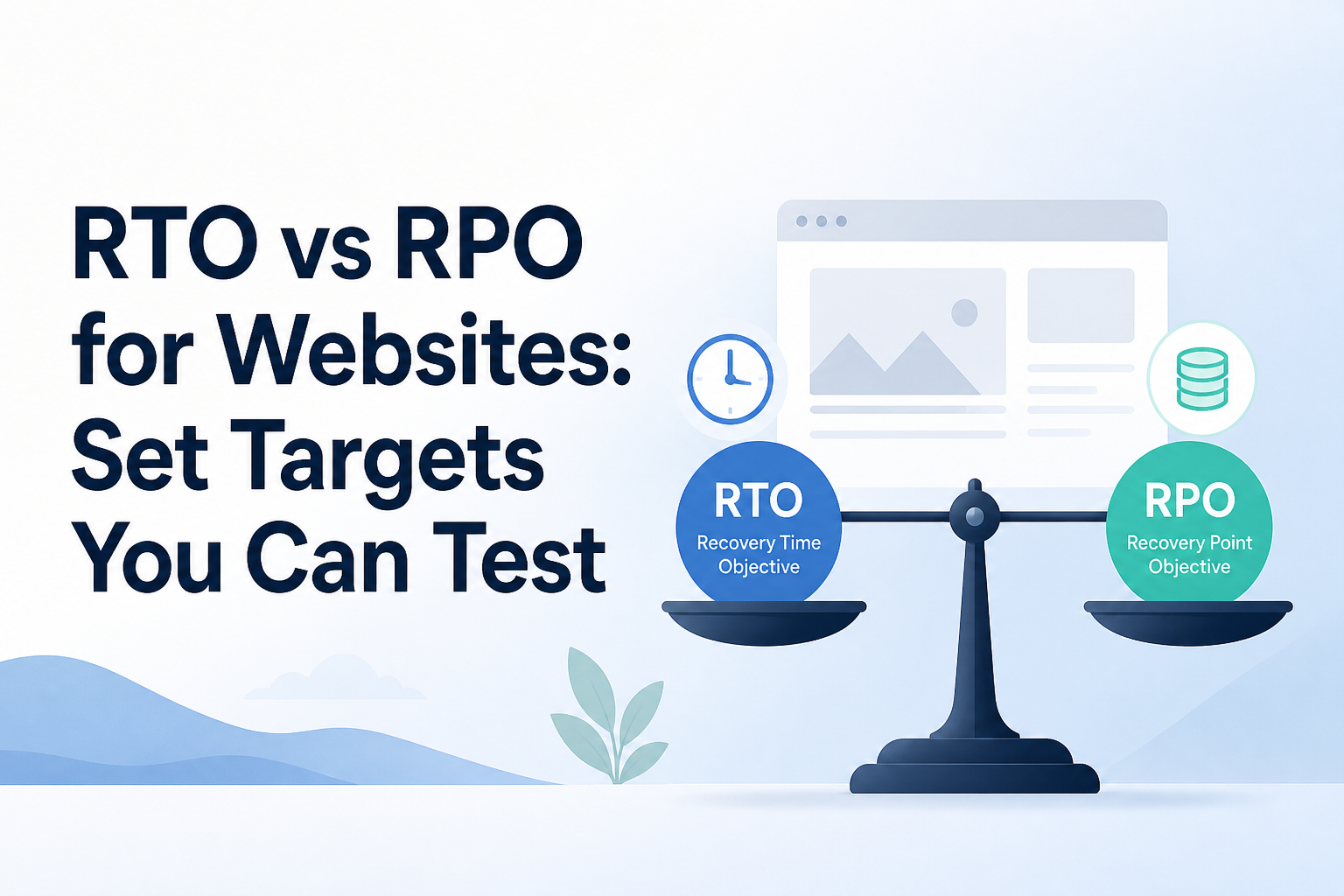
Recovery Time Objective (RTO) is how long your website can remain unavailable after a disruption. Recovery Point Objective (RPO) is how much recent data the business can accept losing. RTO measures restoration time; RPO measures data-loss time. They answer different questions, so a backup schedule cannot define both.
For a small-business website, useful targets begin with customers and operations. Decide how many orders, enquiries or content changes may be re-entered, then decide how long checkout, forms or account access may be unavailable. Only after those limits are explicit should a hosting provider, agency or internal team choose backup, failover and recovery controls.
Two clocks start at the disruption
AWS Well-Architected guidance defines RPO as the acceptable time between the latest recovery point and disruption, while RTO is the acceptable delay between disruption and restoration. Google Cloud uses the same business framing in its disaster recovery planning guidance. Lower values mean less tolerated loss or downtime, but the values do not need to match.
Suppose a store accepts an RPO of 15 minutes and an RTO of two hours. A qualifying recovery may lose up to 15 minutes of orders, yet the team still has two hours to make checkout useful again. Hourly backups cannot meet that RPO, even if restoration takes ten minutes. Continuous replication might meet the data target, yet poor access to DNS, credentials or clean application files can still miss the two-hour RTO.
The word objective matters. Neither number is a guarantee until a representative recovery test demonstrates it under realistic conditions.
Start with business damage, not backup frequency
Picking “one hour” because a plugin runs hourly reverses the decision. NIST contingency guidance begins with business impact and recovery priorities, and AWS recommends setting objectives from workload needs. Ask what becomes unacceptable as time passes.
A brochure site might tolerate yesterday’s content but not a full working day offline. Lead-generation pages may preserve little changing data, while every missed form submission carries value. Stores, memberships and booking systems have moving transactions whose loss can create refunds, customer disputes and manual reconciliation.
Use a simple impact sequence:
- Name the essential customer or staff action.
- Estimate what accumulates during 15 minutes, one hour, four hours and one day.
- Identify the first point where manual recovery is no longer practical.
- Set RPO just inside the acceptable data-loss boundary.
- Set RTO just inside the acceptable service-impact boundary.
Tighter objectives change cost. Voxfor’s VPS total-cost worksheet helps budget extra storage, replication, monitoring, administration and testing instead of treating recovery as a free line on a plan comparison.
One website can need several recovery targets
“Recover the website” is too vague when different components change at different rates. Inventory the surfaces that create business state before assigning one pair of numbers.
| Recovery surface | RPO question | RTO finish line | Dependency to record |
|---|---|---|---|
| Pages, themes and code | How many approved changes can be rebuilt? | Correct public pages load | Repository, file copy, deployment owner |
| Orders, bookings and forms | How many transactions can be reconciled? | One safe new transaction completes | Database, payment/form provider, email |
| Media and customer uploads | How much new material may be re-sent? | Recent files are readable and new uploads work | Object storage, filesystem, permissions |
| DNS, CDN and certificates | How long can traffic use the wrong path? | Intended hostname reaches the recovered origin securely | Registrar, DNS, CDN and certificate access |
External systems deserve explicit boundaries. A payment processor may retain transaction evidence even when the store database is unavailable. Email delivery can continue while the contact-form database copy is stale. DNS failover can move traffic but cannot repair missing application data; Voxfor’s Anycast and GeoDNS failover guide separates traffic-steering failures from workload recovery.
For WooCommerce, loss tolerance should reflect order rate and reconciliation capacity. Voxfor’s backup retention guide for WooCommerce explains why database frequency, off-host copies and restore testing must follow the store’s order-loss boundary rather than a generic daily schedule.
FAQ: Questions that prevent false recovery promises
Is RTO the same as uptime?
No. Uptime describes availability across a measurement period, while RTO defines the restoration target after a qualifying disruption. A site can report high monthly uptime and still miss its RTO during one serious incident.
Does backup frequency equal RPO?
Not automatically. Frequency is one input. A backup must finish, preserve a consistent recoverable state and remain accessible after the incident. Failed jobs, corrupt archives or copies stored only beside the failed server can make the real recovery point older.
Can a website have zero RPO?
Zero RPO requires protection that preserves every committed change across the failure boundary, plus application-consistent recovery. Synchronous replication can approach that goal for some systems, but cost, latency, common-mode failures and corrupted writes still require careful design. Do not promise zero because a dashboard says “continuous.”
Does a faster backup reduce RTO?
A faster backup may create a newer recovery point, which improves RPO. RTO can remain long when the team lacks credentials, clean infrastructure, DNS control, software versions, a runbook or time to validate the application.
Should every website component share one target?
No. Static marketing pages, orders, uploads and external integrations often have different change rates and business impact. Separate targets are useful when they lead to distinct controls and owners; needless complexity is not.
Who owns RTO and RPO?
Business owners approve acceptable impact because they understand customers, revenue and manual work. Technical teams, agencies and providers identify controls and prove whether the targets are achievable. A provider feature cannot silently choose the business tolerance.
How often should recovery targets be tested?
Test after material changes to hosting, application architecture, data volume, DNS, credentials or recovery tooling, and at a routine cadence proportional to impact. CISA advises small and medium businesses to schedule recovery tests and use results to refine RPO and RTO. An untested target is an assumption.
Map each target to a different control set
RPO and RTO overlap in a recovery plan, but they are improved by different levers. Keeping those levers separate prevents buying the wrong feature.
RPO depends on recoverable capture
Backup frequency, database logs, replication and application exports determine how close a recoverable state can be to disruption. Consistency matters as much as recency: files and a database captured at unrelated moments may not represent one valid transaction state.
Copies also need failure separation. A snapshot on the same account, credential set or storage platform can disappear with the event it was meant to cover. Record where copies live, who can delete them, how long they remain and which evidence proves a completed restore.
RTO depends on readiness and decision speed
Restoration time includes detection, decision, access, provisioning, data transfer, configuration, DNS or traffic changes, application validation and stakeholder approval. Faster storage does not solve missing credentials or an unavailable decision maker.
Assign one recovery lead and one business authority. Preserve access to the domain registrar, DNS/CDN, hosting control plane, backup location, password vault and payment or email providers. Voxfor’s managed-versus-unmanaged VPS responsibility map can clarify which server duties move to a provider and which application, data and business decisions remain yours.
Define “restored” as a useful transaction
A homepage returning HTTP 200 is not enough for a store, booking site or membership portal. Stop the RTO clock only at the finish line agreed before the incident.
For a content site, the receipt might require the correct hostname, valid HTTPS, current navigation, one admin login and one safe draft save. A lead site may add a form submission, database receipt and delivered notification. A store normally needs product browsing, cart, checkout in a safe test path, order creation, payment callback handling and confirmation email.
Voxfor’s WordPress migration checklist provides a deeper DNS, SSL, form, checkout, redirect and SEO validation path. Those checks are useful after disaster recovery because both events move a site into a changed environment.
Write the exact finish line beside RTO. Otherwise one person stops the clock when the server boots while another waits for customer transactions to work.
Run one timed rehearsal and keep the receipt
AWS Well-Architected guidance treats testing as part of recovery planning, not an optional audit after implementation. Choose a representative website, restore it away from production and measure the full path.
- Record the chosen recovery point and its timestamp.
- Start the RTO clock at the declared incident or activation point.
- Recover into an isolated hostname or network so identities do not collide.
- Restore application files, data, secrets and required configuration through the documented path.
- Run the agreed representative transaction and dependency checks.
- Stop the clock only when the stated finish line passes.
- Compare recovered data time with RPO and elapsed restoration with RTO.
- Record blockers, owners, corrected estimates and the next test date.
Infrastructure teams needing a deeper example can follow Proxmox restore-drill evidence, where repository verification, isolated restore, application acceptance and measured clocks remain separate proofs.
One successful rehearsal does not prove every disaster scenario. It does replace marketing language and optimistic estimates with a measured baseline.
Price the promise before approving it
Near-zero data loss can require continuous replication, protected logs or synchronous writes. Short restoration can require warm capacity, automated deployment, independent access paths and people available to act. Those controls may be justified for checkout or bookings and wasteful for an archived brochure site.
Compare three values before tightening a target: expected business damage, control cost and remaining risk. If four hours of downtime is tolerable, paying for a five-minute architecture may not be sensible. If 30 minutes of order loss creates irreconcilable customer harm, daily backups are not a valid economy.
Hosting labels do not settle this decision. Ask who detects failure, who declares recovery, which backup and restore actions are included, whether application validation is covered, what dependencies remain customer-owned and what evidence demonstrates the stated time. Microsoft’s continuity model also separates high availability from disaster recovery: fewer ordinary interruptions do not prove a workload can be reconstructed after a major failure.
Leave the meeting with one recovery card: essential transaction, component-specific RPO, useful-service RTO, recovery owner, business authority, artifact locations, required credentials, finish-line tests, last measured result and next rehearsal date. A target becomes a promise only when the controls and the clock agree.