Lifetime VPS Europe
 Lifetime VPS Asia
 Lifetime WooCommerce Hosting
 Lifetime Hosting
 Lifetime Game Dedicated Servers
 Chicago, US
 Tokyo, Japan
 Singapore
 Hong Kong
 Seoul, South Korea
 Amsterdem, Netherlands
 London, UK
 Stockholm, Sweden
 Oslo, Norway
 Vienna, Austria
 Zurich, Switzerland
 Sydney, Australia
 Wordpress Hosting
 VPS Hosting
 DDOS Protection
 Submit Ticket
 Full Management
 Guides
 Videos and Podcasts
 Discover Creative Ideas
 Voxfor Autonomous AI Workers
 Voxfor Mega Menu
 Voxfor Advanced Price Management For WooCommerce
 Voxfor Secure Live Chat and AI Support
 Voxfor Multilanguage
 Voxfor AI Content Summary
 Voxfor Autopilot
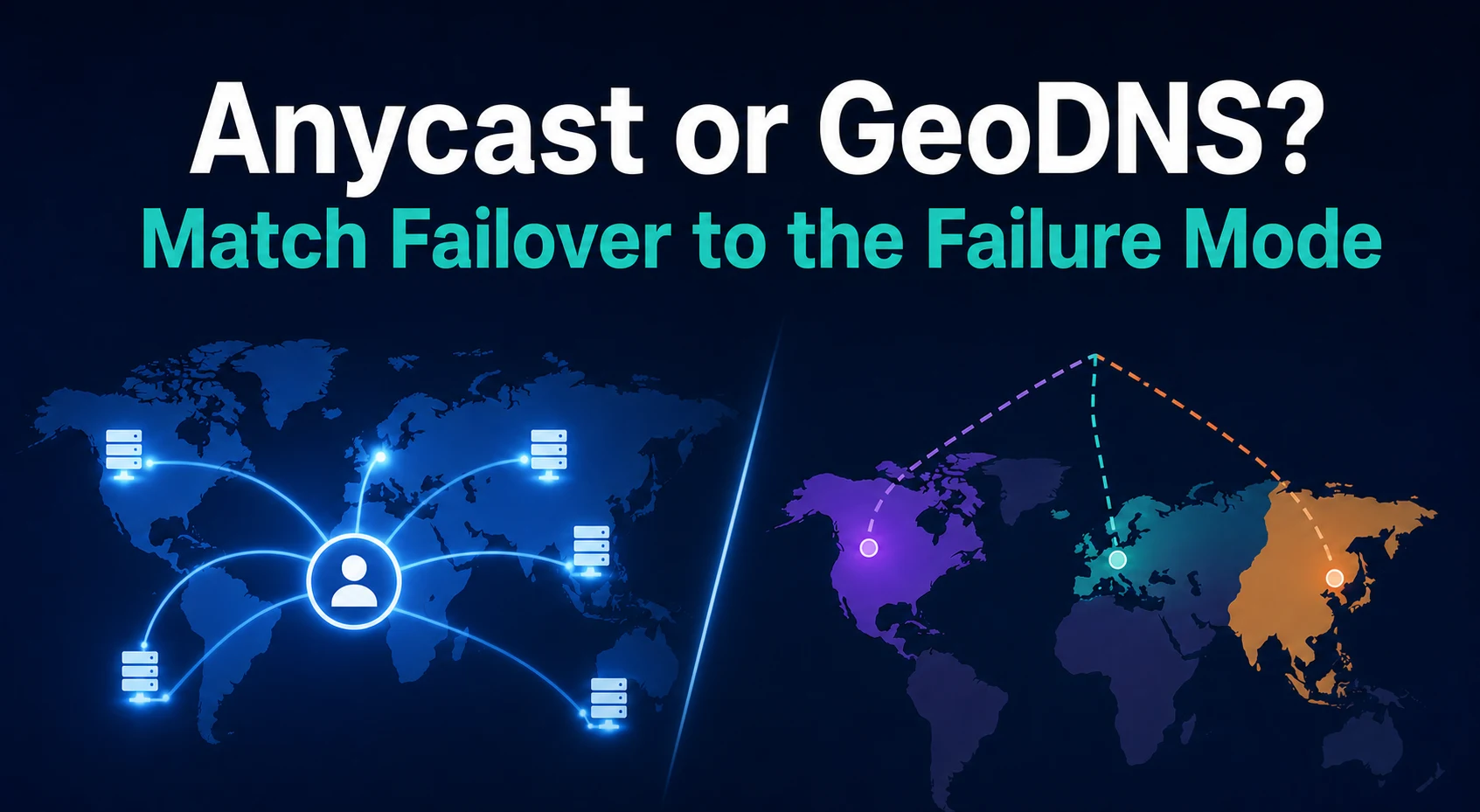
Anycast and GeoDNS are often presented as rival ways to send users toward a nearby server. That comparison hides the decision that matters. Anycast lets network routing choose one of several sites serving the same IP address. GeoDNS lets authoritative DNS choose which address to return for a query. One changes the packet route; the other changes the answer that a recursive resolver caches.
Neither mechanism makes an application highly available by itself. A second VPS can be online while its database is stale, its certificate is wrong, or its payment path cannot accept writes. The right steering layer follows from the failure you need to survive, the state your application carries, and how quickly clients must move.
This decision guide separates four commonly mixed designs: Anycast authoritative DNS, application Anycast, GeoDNS, and managed global load balancing. It then maps them to practical multi-region failure modes without pretending that a low TTL is an instant recovery system.
Four architectures hide behind two familiar names
Start by naming the layer. “We use Anycast” may describe only the DNS provider’s nameservers, not the website address returned to visitors.
Anycast authoritative DNS protects the lookup service
Many DNS providers announce the same nameserver address from multiple locations. A resolver’s query reaches one reachable site according to routing policy. This can make the authoritative lookup service resilient and geographically distributed, while the application record still points to one ordinary origin.
In other words, Anycast DNS does not automatically make the application origin Anycast. The distinction explains why a domain can resolve quickly during an origin outage and still return an error.
Application Anycast keeps one service address
Application Anycast advertises one service IP from several sites. RFC 4786 defines Anycast as making a service address available at multiple discrete locations so routing sends a datagram to one of them. Users keep the same destination IP while the network selects a catchment.
That stable address is attractive for DNS, stateless UDP, edge proxies, and platforms designed to terminate connections across a coordinated global network. It is less forgiving when long-lived sessions can change paths or when regional nodes cannot serve equivalent state. The RFC specifically calls out transaction longevity, state, data synchronization, and location-dependent monitoring as design concerns.
GeoDNS returns regional answers
GeoDNS applies policy when an authoritative server answers a resolver. The policy can consider geography, measured latency, weights, or health, depending on the provider. Different resolvers may receive different A or AAAA records, and those answers remain in cache until their TTL expires.
Amazon Route 53’s geolocation documentation shows both the control and the boundary: operators can map queries to continents, countries, or US states, but unmapped locations need a default record. Location is inferred from DNS-query information rather than from a permanent direct relationship with every end user.
A managed global load balancer can combine layers
Major edge platforms often present one Anycast frontend and make health-aware backend decisions behind it. Google documents global proxy load balancers that use one Anycast frontend address while distributing requests to backends in multiple regions. Similar managed services can add TLS termination, HTTP routing, DDoS controls, and application-aware health checks.
That is not equivalent to advertising a /24 from two rented VPS nodes. Managed Anycast is a service with a control plane, health model, and edge capacity, not merely a routing command.
The failure mode should choose the steering layer
Use the smallest mechanism that can observe and route around the failure you actually care about.
What must survive?

authoritative DNS site failure
    -> provider-operated Anycast DNS

regional application failure, different regional IPs are acceptable
    -> health-aware GeoDNS or DNS failover

one stable public IP, platform owns global edge and connection handling
    -> managed Anycast/global load balancer

policy by country, jurisdiction, tenant, or deliberate region
    -> GeoDNS or Layer 7 steering

database writer loss or stale application state
    -> repair data-plane failover first; steering alone is unsafe
This decision tree deliberately ends with the data plane. If two regions do not have a safe write model, sending traffic to both can convert an availability incident into conflicting orders, lost sessions, or irreversible data divergence.
Choose GeoDNS for explicit regional policy
GeoDNS fits when different regional addresses are acceptable and operators need understandable placement rules. It can direct Europe to one region, keep licensed content inside a territory or shift new lookups away from an unhealthy endpoint. Choose candidate regions from user distribution, jurisdiction, latency and recovery capacity before adding DNS policy.
The tradeoff is cached state. A resolver that already received the old address may continue using it until the TTL expires. Some clients, proxies, and applications cache longer than operators expect. Existing TCP sessions also stay connected to their current address; DNS changes influence new resolution, not packets already in flight.
Choose managed Anycast for a stable edge address
Application Anycast fits best when the edge platform can maintain route advertisements, withdraw unhealthy sites, absorb uneven catchments and keep service behavior equivalent across locations. Regional compute behind that edge still needs equivalent capacity and state; independent server addresses do not form an Anycast system by themselves.
The stable frontend reduces dependence on recursive DNS cache expiry, but it creates different operational work. Operators need catchment-aware probes, route visibility, per-region capacity, and a plan for long-lived flows when routing changes. BGP chooses topological paths, not guaranteed lowest latency or balanced server load; RFC 4786 explicitly warns that topological nearness does not always correlate with round-trip performance.
Use both when they own different jobs
An architecture may legitimately use Anycast for authoritative DNS, GeoDNS for regional application answers, and a managed Anycast proxy inside each answer. The layers are complementary when each has one clear responsibility.
Complexity rises quickly, however. Every extra steering layer adds health signals, caches, logs, and failure interactions. Use a combined design only when a single layer cannot meet a documented requirement such as jurisdictional routing plus rapid edge failover.
Health checks need to test service truth
A TCP handshake on port 443 proves that something accepted a connection. It does not prove the region can serve the workload. Health must represent the minimum safe transaction for receiving traffic.
For a read-only site, that might be an HTTPS endpoint that checks the web process, a required local dependency, and freshness of replicated content. For WooCommerce or another stateful application, a public health endpoint should not create orders, but the internal readiness decision may need database writer identity, queue availability, object storage access, and replication lag within an approved limit.
Route 53 can associate health checks with failover records and stop returning an unhealthy value, according to its DNS failover documentation. Its failover-record reference also warns that the check must target the real endpoint rather than accidentally resolving the same record being controlled, which can produce unpredictable results.
Build health in two stages:
- Local readiness decides whether one regional node should accept traffic.
- External reachability confirms that independent networks can complete the user journey through DNS, TLS, routing, and the edge.
Do not let one provider region monitor itself as the only authority. A regional control-plane outage can make both the service and its local monitoring unavailable in the same way.
TTL is a cache contract, not a stopwatch
DNS failover time is not simply TTL = 60, therefore recovery equals 60 seconds. Detection interval, failure threshold, authoritative update, recursive cache age, client caching, connection reuse, and application startup all contribute.
| Recovery component | What controls it | Evidence to collect |
|---|---|---|
| Failure detection | Probe interval and unhealthy threshold | UTC state-change timestamp from more than one checker |
| New DNS answer | Provider health and routing policy | Authoritative queries against each nameserver |
| Resolver movement | Remaining cached TTL | Answers and TTLs from several public and ISP resolvers |
| Client movement | Local cache and connection reuse | Fresh-process or fresh-network request |
| Application readiness | Data, dependencies, warm-up and capacity | Real read/write-safe acceptance test |
AWS recommends 60 seconds or less for Route 53 records associated with health checks so clients can react promptly, while noting that longer TTLs reduce queries and cost but delay record changes. That is provider guidance, not a universal promise. Reducing TTL increases authoritative query volume and still cannot force every cache or established session to move immediately.
Before a planned migration, lower TTL far enough in advance for the previous, longer TTL to age out. During an incident, changing a record with a previously long TTL does not retroactively shorten copies already cached.
Stateful applications decide whether failover is safe
Traffic steering is the visible part of multi-region design. State is the release gate.
Active-passive is simpler, but promotion must be fenced
One region can own writes while another receives replication and remains out of rotation. On failure, promote the secondary, prevent the old primary from accepting writes, confirm application configuration points to the new writer, and only then steer traffic. Fencing matters more than a fast DNS response because two writable primaries can corrupt the recovery point.
Record the maximum acceptable replication lag and the possible data-loss window. If the recovery objective cannot tolerate that window, the storage architecture must change; Anycast and GeoDNS cannot repair asynchronous replication semantics.
Active-active requires application-level conflict design
Two healthy web tiers do not make the database active-active. Sessions, uploads, queues, scheduled jobs, caches, secrets, and certificate state must either be shared safely or partitioned intentionally. Region-local uploads with no replicated object store are a common example: the second site may pass a homepage probe while customer files remain missing.
Prefer stateless edge work and explicit data ownership. If a workload requires sticky sessions, document whether affinity is kept at the edge, encoded in a token, or removed through shared session storage. Routing changes should not silently move a live user to incompatible state.
Test from catchments, resolvers, and real user paths
One successful request from the operator’s laptop proves only one network path and one resolver view. A useful failover exercise observes the system from several vantage points.
Before the drill, record addresses, TTLs, Anycast catchments or edge identifiers, health status, database role, replication lag, and regional capacity. Then fail one component in a controlled window. Do not begin with a whole-region shutdown when health logic has never been tested at node level.
During the drill:
- query authoritative nameservers directly and compare answers;
- query several independent recursive resolvers and retain TTLs;
- test through networks in at least two target regions;
- open new TCP/TLS sessions rather than reusing one connection;
- verify the application-owned acceptance path, not just a status page;
- inspect whether traffic moved to a region with enough spare capacity;
- confirm the failed site cannot still accept writes;
- restore service and test failback separately from failover.
Anycast monitoring must identify which node answered. RFC 4786 notes that availability depends on client location and that a single monitor cannot observe every catchment. GeoDNS monitoring must retain the resolver used, returned address, remaining TTL, and client region. Without those labels, a green global average can hide one broken country or ISP.
Cost and ownership can reverse the decision
Self-managed global Anycast normally needs suitable address space, routing relationships, route policy, redundant sites, monitoring, and operators comfortable with BGP failure modes. For most small teams, provider-operated edge Anycast is safer than building a global routing system from ordinary VPS instances.
GeoDNS is easier to adopt with independent regional addresses, but its apparent simplicity moves work into DNS policy, health checks, application state, capacity, and drills. Costs include DNS queries and checks, multiple warm regions, replication traffic, log retention, and idle recovery capacity. Managed global load balancers add platform fees and possible vendor coupling while removing much of the routing control-plane burden.
Assign monitoring, patching and recovery to a named operations owner rather than one application developer. Ownership still needs an agreed health definition, data owner, rollback authority and test schedule.
Choose Anycast when a coordinated platform must keep one address and can operate route-aware, equivalent service nodes. Choose GeoDNS when deliberate regional answers and policy control matter more than instant movement of every client. Choose a managed global load balancer when Layer 7 health and a stable edge are required without owning BGP. If data cannot fail over safely, choose neither yet—fix writer control, replication, and acceptance evidence first.
Questions that change the failover decision
What is the main difference between Anycast and GeoDNS?
Anycast lets network routing select a site that advertises the same service IP, while GeoDNS returns different IP addresses according to DNS policy. The better choice depends on whether you need one stable address, explicit regional answers, or application-aware failover.
Does Anycast DNS make the application origin highly available?
No. Anycast authoritative DNS can keep domain lookups available while the returned application origin remains a single point of failure. Application availability still requires healthy regional backends, safe state, capacity, and a working traffic-steering layer.
Is GeoDNS failover instant with a 60-second TTL?
No. A 60-second TTL only limits one part of recovery. Detection thresholds, authoritative updates, remaining resolver cache time, client caching, reused connections, and application readiness can all extend the actual failover time.
When is a managed global load balancer a better fit?
Use a managed global load balancer when the service needs one stable edge address, Layer 7 health checks, TLS or HTTP routing, and provider-operated multi-region failover without owning BGP. The backends still need equivalent capacity and safe application state.
Can Anycast and GeoDNS be used together?
Yes, when each layer has a separate job. Anycast may protect authoritative DNS or provide a stable edge, while GeoDNS applies regional or jurisdictional policy. Combining them without a documented requirement adds caches, health signals, and failure interactions unnecessarily.
Which option is safer for a stateful application?
Neither steering method makes state safe by itself. Before traffic moves, the design must control the active writer, replication lag, sessions, uploads, queues, secrets, and failback. If two regions cannot serve compatible state, steering should wait.
What should a failover health check verify?
It should verify the minimum safe user transaction, not only a TCP handshake or generic status page. Depending on the workload, that can include TLS, application response, required dependencies, writer identity, queue or object-storage access, replication freshness, and spare capacity.
How should multi-region failover be tested?
Test from authoritative nameservers, several recursive resolvers, and fresh client sessions in more than one target region. Record answers, TTLs, catchment or edge identity, application results, capacity, writer state, replication lag, and a separate failback result.