Lifetime VPS Europe
 Lifetime VPS Asia
 Lifetime WooCommerce Hosting
 Lifetime Hosting
 Lifetime Game Dedicated Servers
 Chicago, US
 Tokyo, Japan
 Singapore
 Hong Kong
 Seoul, South Korea
 Amsterdem, Netherlands
 London, UK
 Stockholm, Sweden
 Oslo, Norway
 Vienna, Austria
 Zurich, Switzerland
 Sydney, Australia
 Wordpress Hosting
 VPS Hosting
 DDOS Protection
 Submit Ticket
 Full Management
 Guides
 Videos and Podcasts
 Discover Creative Ideas
 Cybersecurity Services
 Voxfor Mega Menu
 Voxfor Advanced Price Management For WooCommerce
 Voxfor Secure Live Chat and AI Support
 Voxfor Multilanguage
 Voxfor AI Content Summary
 Voxfor Autopilot
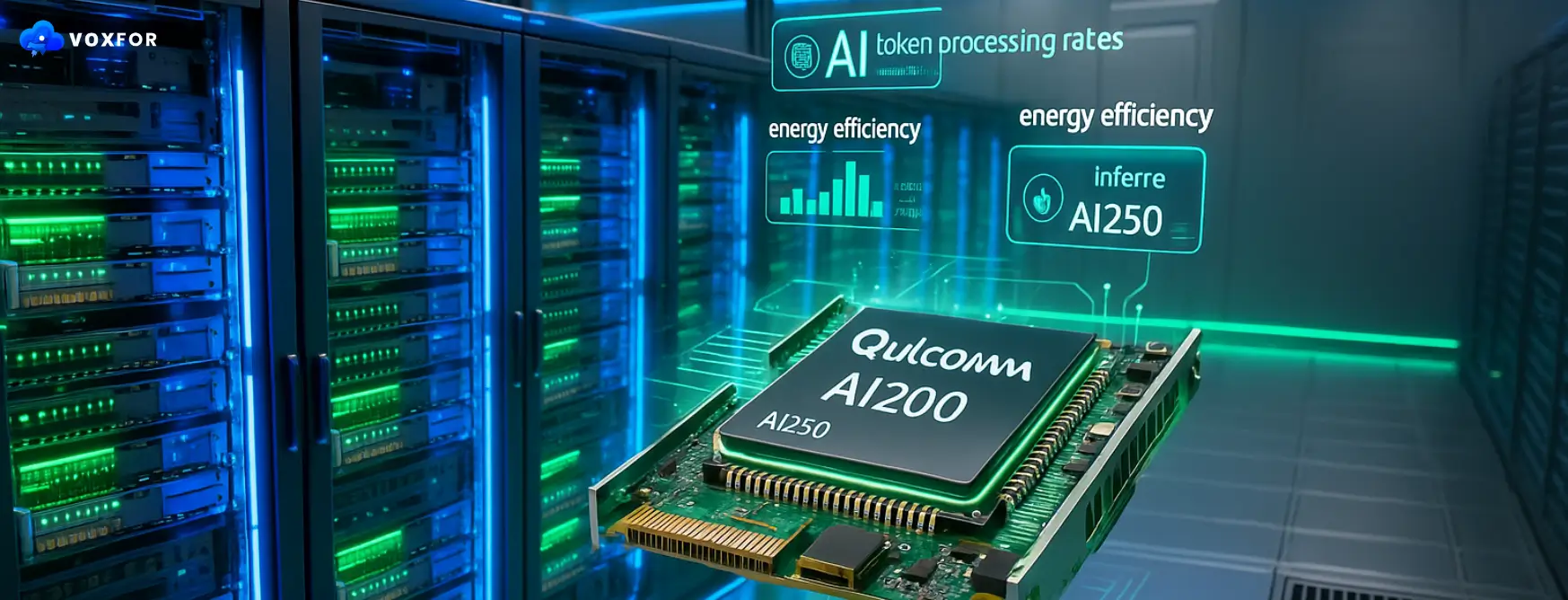
Qualcomm is making a seismic shift in corporate strategy. After decades of dominating the mobile processor market, the semiconductor giant has officially announced its entry into the high-stakes data center AI infrastructure sector, directly challenging Nvidia and AMD with two purpose-built chips designed to capture the rapidly expanding market for AI inference at scale.
Inbound Marketing Strategy
Turn technical readers into inbound marketing growth
Helpful tutorials attract qualified visitors, but reliable hosting keeps those readers engaged. Voxfor VPS gives growing websites the speed, uptime, and control needed to support stronger inbound marketing campaigns.
On October 27, 2025,Qualcomm announced the AI200 and AI250, which represent the company’s most significant diversification move since it acquired Nuvia in 2021. These aren’t incremental mobile upgrades; they constitute a calculated bet that Qualcomm can compete against established players by filling a gap in the current AI infrastructure culture: the exploding demand for energy-efficient inference workloads.
Understanding the Inference Opportunity: Where Real AI Value is Generated
Before diving into Qualcomm’s technical approach, understanding why inference matters is critical. While training large language models captures headlines, requiring enormous computational resources to develop new AI capabilities, the real money in AI lies in inference, the phase where deployed models deliver predictions and generate responses at scale.
Every time you ask ChatGPT a question, inference happens. Every product recommendation you receive, every email spam filter decision, every autonomous vehicle decision—all inference. Unlike training, which is a one-time event per model, inference runs continuously, scaling with user demand. This means inference consumes substantially more energy and operational resources over time.
“The biggest problem is on the inference side, because inference consumes all the time,” explains Vincent Caldeira, CTO APAC at Red Hat, noting that inference scales directly with utilization. For data center operators managing millions of simultaneous AI requests, the economics of inference efficiency become the central business driver.

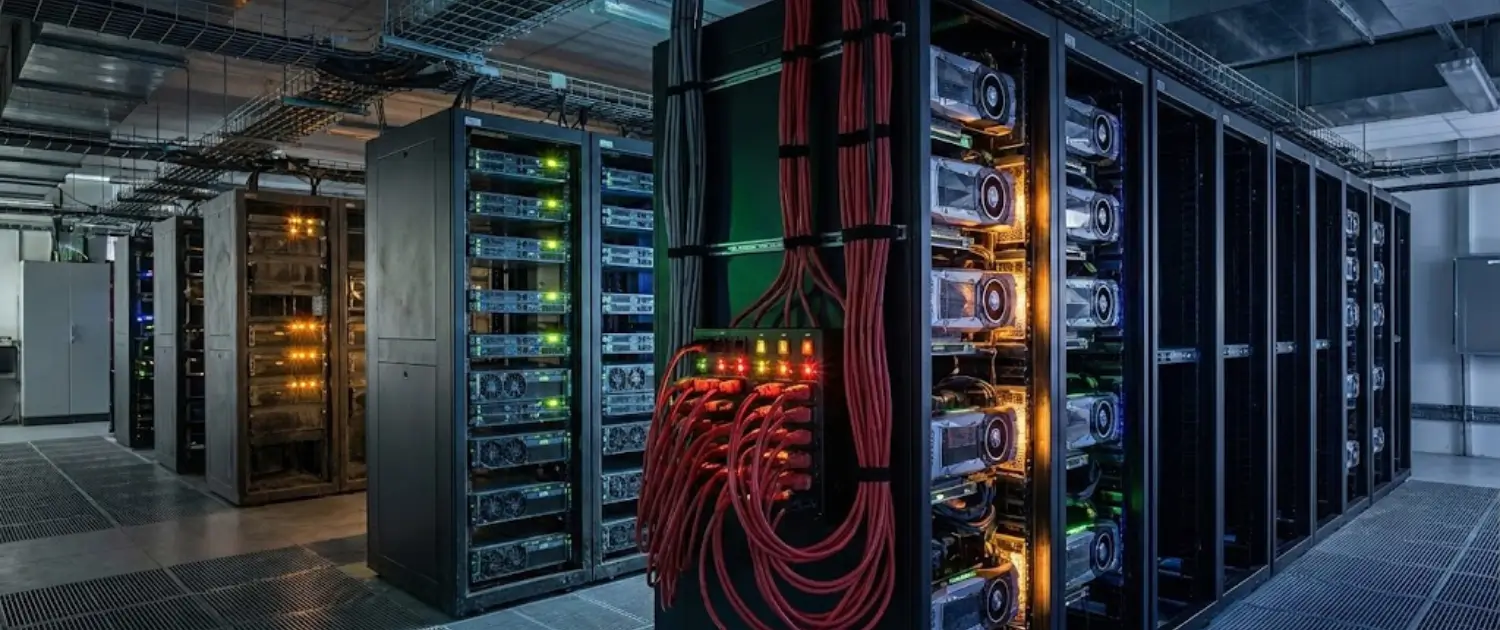
Modern day data center server racks in blue, with AI and GPU hardware for large-scale AI inference and processing.
Qualcomm’s Strategic Pivot: Adapting Mobile Technology for the Data Center
Qualcomm’s path into data centers began not with blank-slate chip design, but with an elegant adaptation. The company recognized that its Hexagon neural processing units (NPUs), the specialized AI accelerators embedded in Snapdragon smartphone processors since 2019, provided a proven foundation for scaling.
The Snapdragon 8 Elite Gen 5, Qualcomm’s flagship smartphone processor built on 3-nanometer architecture, includes a Hexagon-based NPU with 20 specialized cores capable of processing up to 220 tokens per second while consuming minimal power. This efficiency on mobile devices demonstrated the architecture’s potential when properly scaled.
Rather than build a completely new architecture, Qualcomm has taken the Hexagon architecture and conceived it for deployment at rack-scale. The AI200, due in 2026, will utilize 768GB of LPDDR5 memory – a deliberate change that represents a significant divergence from Nvidia’s course. LPDDR5, the memory standard that has been tested in mobile across the past 10 years, has lower power and a low cost compared to traditional DDR5 and could provide Qualcomm data center AI solutions with a better total cost of ownership for inference workloads.
The Training vs. Inference Divide: Why Specialization Matters
This is the point at which Qualcomm’s strategy fundamentally differs from Nvidia’s. Nvidia’s Blackwell GPUs are designed for both training and inference, and so are not necessarily optimized for either. On the other hand, Qualcomm has made the conscious decision to only target inference.
This specialization allows radical improvements in efficiency. Training advanced AI models requires flexible computation capabilities and massive memory bandwidth for processing a diverse set of data. Inference by contrast, is a predictable process: load pre-trained model parameters, process user input, generate output. It’s computationally less challenging but it occurs all the time.
“The technical advantage stems from a reengineered memory subsystem that offers over a tenfold enhancement in memory bandwidth compared to current Nvidia GPUs,” according to analysis from Forbes. But the difference is more nuanced: instead of competing on sheer computational power, Qualcomm is competing on efficiency-per-dollar and efficiency-per-watt.
Research indicates that properly optimized AI inference can reduce total energy consumption by up to 73% compared to unoptimized baselines. Qualcomm’s AI-specific architecture aims to capture much of that efficiency gain through hardware design rather than requiring software-level optimization.

Qualcomm AI200 and AI250 chips are designed for data center inference deployment.
LPDDR5 Memory Architecture: The Cost Advantage
While Nvidia’s premium GPU solutions feature specialized High Bandwidth Memory (HBM), Qualcomm chose to scale LPDDR5—the low-power memory technology proven in smartphones. This architectural decision has profound implications for the total cost of ownership.
LPDDR5 delivers up to 51.2 GB/sec of memory bandwidth at a much lower power consumption level than DDR5’s equivalent level of performance. In data center use cases, where thousands of inference chips are running 24/7, this power efficiency is a direct power efficiency that equates to operational power efficiency. Based on testing by the company’s division Micron in particular, LPDDR5X showed more than 75% lower memory power consumption than traditional approaches.
The AI200 allows 768GB of total system memory to be attached to each chip, a huge amount of memory developed specifically for serving large language models where parameter storage becomes the biggest bottleneck in inference. And finally, the AI250, which is launching in 2027, is the first system to be based on near-memory computing, bringing to the market a new memory architecture with a generational step in effective memory bandwidth and a drastic reduction of the required power consumption.
Rack-Scale Deployment: Competing at System Scale

Qualcomm isn’t selling individual chips; it’s selling complete inference systems. Both the AI200 and AI250 are packaged as accelerator cards and full-rack solutions, with individual racks consuming 160 kilowatts of power. This consumption level matches or exceeds contemporary Nvidia GPU rack deployments, but with fundamentally different architectural characteristics.
A fully configured Qualcomm rack, equipped with up to 72 chips working collectively, creates a unified inference engine designed to serve billions of token predictions efficiently. Unlike Nvidia’s ecosystem, which requires separate host CPUs to manage GPU communication, Qualcomm’s integrated Oryon Arm processors within the AI200 and AI250 packages could potentially eliminate host CPU requirements.
For hyperscale operators—AWS, Google Cloud, Azure, and enterprise data centers—this means the ability to mix and match components. “Our goal has been to ensure our clients have the flexibility to either purchase everything or opt for a mix-and-match approach,” stated Durga Malladi, Qualcomm’s general manager for data center and edge.
Humain Partnership: Validating the Market Opportunity
Qualcomm’s announcement didn’t come in isolation. Simultaneously, the company revealed a landmark partnership with Humain, a Saudi Arabia-based AI company backed by the Public Investment Fund. Humain is committing to deploy 200 megawatts of Qualcomm AI200 and AI250 capacity starting in 2026.
To contextualize: a 200-megawatt deployment at 250 watts per system would represent approximately 800,000 individual AI200 units. The economic implications are staggering—at an estimated pricing of around $4,000 per card, this partnership alone could represent over $3 billion in hardware revenue plus additional billions in cooling, networking, and infrastructure.
More importantly, Humain’s commitment validates that the market sees differentiation in Qualcomm’s inference-specific approach. Humain will integrate its ALLaM Arabic language models with Qualcomm’s architecture, creating what the companies describe as the world’s first fully optimized edge-to-cloud hybrid AI system.
For Saudi Arabia specifically, this partnership advances national AI ambitions under the Vision 2030 economic diversification program, positioning the Kingdom as a global AI inference hub. The geographic and economic implications extend beyond technology—they signal a shift in where AI infrastructure is being deployed and who controls these critical resources.
The Challenge: Breaking Through Nvidia’s Ecosystem Moat
Yet Qualcomm has stiff headwinds. Nvidia has invested fifteen years to creating the CUDA software ecosystem which has become the de facto standard for GPU programming. Data scientists, AI researchers and development teams have collectively sunk enormous resources into CUDA-optimised code, frameworks and practices.
Qualcomm focuses on compatibility with major AI frameworks (PyTorch, TensorFlow, and others) and boasts of one-click infrastructure deployment. But ecosystem switching is more than a technical compatibility it involves retraining teams, validating performance, managing migration risks, and overcoming organizational inertia.
Further, there are still integration issues. Qualcomm’s chips need to be compatible with the existing orchestration tools, security infrastructure and operations practices. In a data center where there are hundreds of thousands of servers, any incompatibility is exponentially more expensive to enterprise data center operators.
Cost Efficiency in the Long Term: The Total Cost of Ownership Argument
This is where Qualcomm’s strategic positioning becomes relevant. While Nvidia commands over 90% of the current GPU market share, driving its valuation beyond $4.5 trillion, this dominance rests largely on training capabilities, where Nvidia’s engineering excellence is undisputed.
Specialization is beneficial in inference, particularly for large-scale inference for commodity workloads such as language model serving. According to industry analysis, custom AI chips tuned for a particular workload offer cost efficiency improvements of 40-60% compared to general purpose GPUs. Other optimization technologies yield a 10-20% reduction in operational costs by energy efficiency alone.
This makes a strong business case for Qualcomm’s pitch to cloud providers: deploy Qualcomm AI200 and AI250 solutions for the inference workloads where performance-per-watt and performance-per-dollar is better than anything else but reserve Nvidia GPU for the training workloads where GPU excellence is still unequalled.
Energy Efficiency: The Regulatory and Economic Imperative
AI data center power consumption is hitting critical levels worldwide. Rack densities currently exceed 250 kilowatts and new generations are falling towards 130 kilowatts per rack. At such densities, conventional air-cooling is physically impossible.
Energy consumption represents the largest variable cost in AI infrastructure operation. For a data center running 30,000 GPUs over four years, energy costs often rival hardware acquisition costs. Qualcomm’s energy-efficient approach, particularly when deployed at Humain’s 200-megawatt scale, could translate to tens of millions of dollars in annual operational savings.
As regulatory pressure increases for data center carbon footprints and energy costs continue to fluctuate, the company that has better energy efficiency has a permanent competitive advantage.
Technical Specifications and Performance Roadmap
The AI200 launches in 2026 with the architectural innovations discussed above. The AI250, coming in 2027, introduces what Qualcomm describes as a “generational leap in efficiency”—utilizing near-memory computing architectures and delivering greater than 10x higher effective memory bandwidth with much lower power consumption.
Qualcomm has pledged to a year on year improvement cadence, which is indicative of a serious long-term commitment to the data center market. This follows industry trends, where chip manufacturers usually roll out iterative improvements every year.
The AI250’s near-memory computing architecture suggests Qualcomm may be exploring High Bandwidth Flash (HBF) technology, where flash memory and logic dies stack together, providing memory density without the cost penalties of traditional HBM. If implemented, this could position Qualcomm’s solutions as the most cost-efficient for models too large to fit in traditional DRAM.
Who Wins? Implications for the Competitive Landscape
The fact that Qualcomm entered the market doesn’t automatically reduce Nvidia’s hegemony – it actually splinters the market. Nvidia remains trained, CUDA ecosystem lock-in, and will most likely grab high premium inference workloads which need maximum flexibility. AMD acquires a competitor for inference acceleration, but also faces additional price pressure.
The real winner might be cloud service providers and enterprise operators. Increased competition drives innovation, lowers prices, and enables more heterogeneous infrastructure strategies. Instead of accepting Nvidia’s one-size-fits-all approach, operators can now deploy Qualcomm for inference and Nvidia for training—optimizing both workloads.
For Qualcomm specifically, it is a matter of execution for success. The company has to prove that AI200 and AI250 perform as they promised, make desired power efficiency gains and integrate smoothly into current data center operations. Missing these targets could be catastrophic following public commitments to big partnerships.
The Broader Shift: From GPU Monoculture to Heterogeneous AI Infrastructure
Qualcomm’s announcement reflects a broader industry trend toward specialized silicon. Google’s TPU, Amazon’s Trainium and Inferentia chips, and emerging competition from Intel all signal that the era of GPU monoculture is ending.
The future of AI infrastructure will likely include heterogeneous deployments: GPUs for training and complex inference, specialized accelerators for inference at scale, edge processors for on-device AI, and increasingly, domain-specific chips for particular workloads.
For Voxfor readers focused on AI infrastructure trends, Qualcomm’s move signifies that the semiconductor competition for AI is only intensifying. The companies that secure partnerships with major AI adopters like Humain, integrate successfully with cloud providers, and deliver on efficiency promises will reshape the AI hardware landscape.
Qualcomm is betting that years of mobile processor expertise, combined with strategic focus on the inference opportunity, can create a meaningful foothold in one of technology’s most competitive arenas. Whether that bet succeeds depends on factors beyond engineering—regulatory approval, partner commitment, software ecosystem development, and ultimately, the market’s willingness to adopt an alternative to the Nvidia standard.
The AI chip competition has entered a new phase. Qualcomm’s entry proves that competing against Nvidia is possible, but the challenge has only just begun.
About Author

Netanel Siboni is a technology leader specializing in AI, cloud, and virtualization. As the founder of Voxfor, he has guided hundreds of projects in hosting, SaaS, and e-commerce with proven results. Connect with Netanel Siboni on LinkedIn to learn more or collaborate on future project.