Lifetime VPS Europe
 Lifetime VPS Asia
 Lifetime WooCommerce Hosting
 Lifetime Hosting
 Lifetime Game Dedicated Servers
 Chicago, US
 Tokyo, Japan
 Singapore
 Hong Kong
 Seoul, South Korea
 Amsterdem, Netherlands
 London, UK
 Stockholm, Sweden
 Oslo, Norway
 Vienna, Austria
 Zurich, Switzerland
 Sydney, Australia
 Wordpress Hosting
 VPS Hosting
 DDOS Protection
 Submit Ticket
 Full Management
 Guides
 Videos and Podcasts
 Discover Creative Ideas
 Voxfor Autonomous AI Workers
 Voxfor Mega Menu
 Voxfor Advanced Price Management For WooCommerce
 Voxfor Secure Live Chat and AI Support
 Voxfor Multilanguage
 Voxfor AI Content Summary
 Voxfor Autopilot
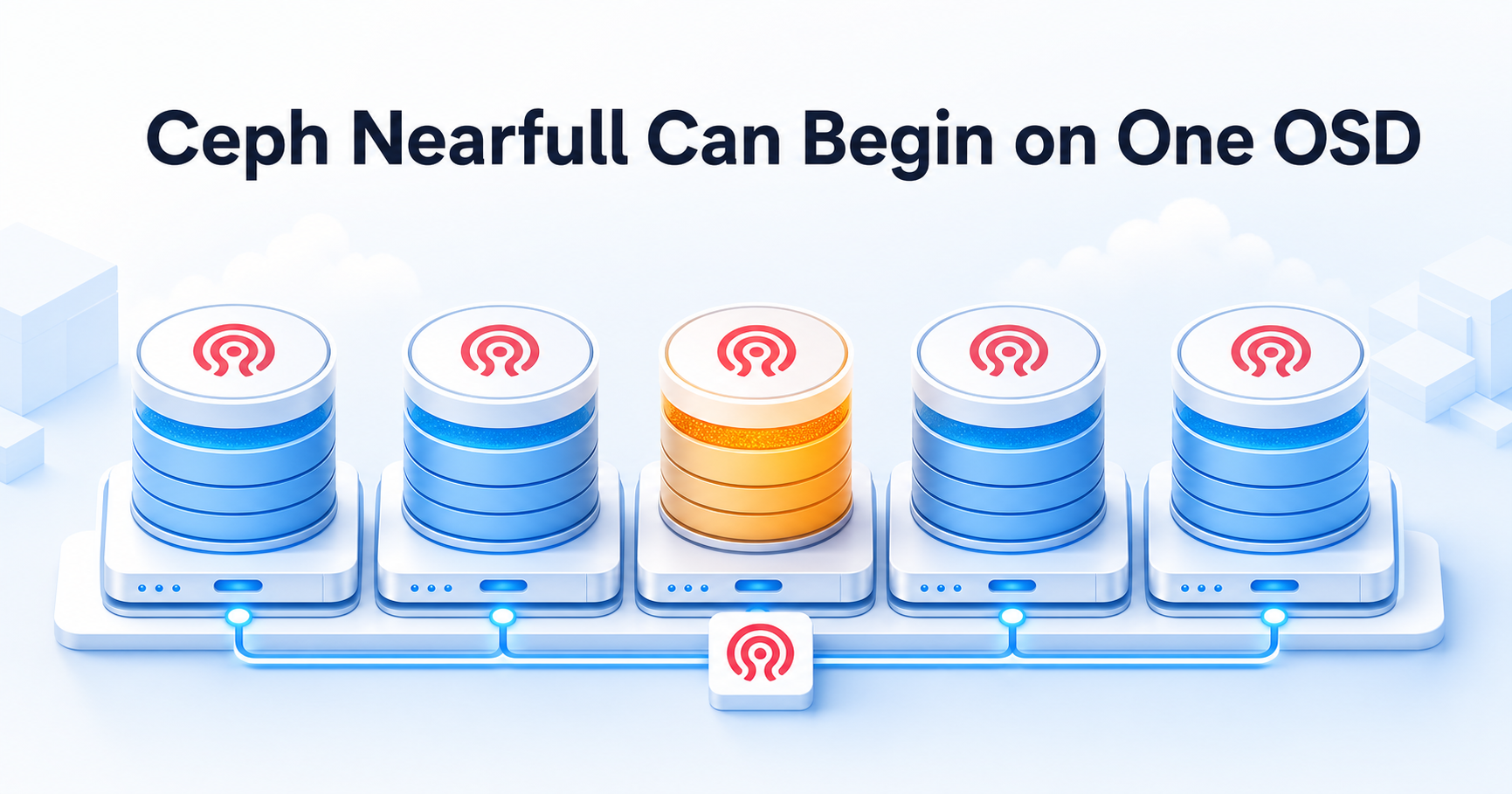
A Ceph cluster can report OSD_NEARFULL while its aggregate raw-use percentage still looks comfortable. Fullness belongs to the individual OSD boundary, not to the cluster average. One device above the configured nearfull ratio is enough to raise the health check, even when most peers retain substantial free space.
That difference changes the capacity question. Instead of asking only “How full is Ceph?”, ask which eligible OSD is fullest, how much room its failure domain retains, and whether a replacement destination can accept backfill. A percentage that looks safe before an OSD failure may be too high after Ceph needs to place another replica.
One maximum can invalidate a comfortable average
Consider ten equal-size OSDs. Nine are 69% used and one is 86% used. Their simple average is 70.7%, yet the 86% OSD can cross a live 85% nearfull boundary. Aggregate RAW USE communicates fleet consumption; it cannot describe this local maximum.
The same arithmetic becomes more consequential inside CRUSH. If the fuller OSD belongs to a device class or rack with no alternative destination below backfillfull, space elsewhere in the cluster may be ineligible for the affected pool. Usable recovery capacity is constrained by placement rules and failure domains, not merely by raw bytes on every disk.
Current Ceph health-check documentation separates three controls. OSD_NEARFULL warns, OSD_BACKFILLFULL prevents new backfill from using an overfilled destination, and OSD_FULL applies the full boundary. Placement Group state definitions identify backfill_toofull when a selected destination is already beyond its backfillfull ratio.
Five measurements define the real headroom
Capacity review needs five related measurements rather than one dashboard percentage:
| Measurement | Decision it supports | Blind spot if omitted |
|---|---|---|
Maximum OSD %USE |
Finds the device that crosses a ratio first | Cluster average hides the outlier |
| Spread among comparable peers | Separates placement skew from uniform growth | Unlike sizes or classes distort comparison |
| Live nearfull/backfillfull/full ratios | Shows warning and movement boundaries | Copied defaults may not match the cluster |
| Eligible bytes inside the CRUSH rule | Tests whether affected pools can move | Free space outside the rule cannot help |
| Failure-domain reserve | Estimates room after a host or OSD loss | Present health hides the next recovery need |
Read them from one UTC snapshot so the OSD map does not change between observations:
incident_dir="/root/ceph-capacity-$(date -u +%Y%m%dT%H%M%SZ)"
install -d -m 0700 "$incident_dir"
date -u --iso-8601=seconds | tee "$incident_dir/time.txt"
ceph -s > "$incident_dir/status.txt"
ceph health detail > "$incident_dir/health-detail.txt"
ceph osd df tree > "$incident_dir/osd-df-tree.txt"
ceph osd tree > "$incident_dir/osd-tree.txt"
ceph df detail > "$incident_dir/df-detail.txt"
ceph pg stat > "$incident_dir/pg-stat.txt"
ceph osd dump > "$incident_dir/osd-dump.txt"
ceph balancer status > "$incident_dir/balancer-status.txt"
From osd-dump.txt, record the live ratios and flags. noout, nobackfill, norecover, norebalance, or pause can intentionally suppress movement. A flag with an active maintenance owner is different from forgotten state, so do not clear it merely because an alert is visible.
Compare OSDs only inside a meaningful peer group: same device class, intended CRUSH role, similar capacity, and eligibility for the same pools. A small SSD database/WAL device and a large data OSD do not become peers just because both appear in one tree.
Each fullness state removes a different option
Nearfull is not a write outage by itself. It is a warning that a specific OSD has crossed the monitor’s nearfull ratio. The cluster can still be active+clean, but that state proves current placement—not spare capacity for a future failure.
Backfillfull changes what Ceph can do next. An OSD above this ratio is not accepted as a backfill destination. When a PG reports backfill_toofull, data movement is waiting on the selected destination’s capacity boundary. Calling that condition “slow recovery” misses the constraint.
Full is the later protection boundary. Treating these ratios as three cosmetic alert levels is unsafe because the middle threshold protects room for redistribution. Raising it spends space that Ceph may need precisely when an OSD or host disappears.
Exact values are configuration and distribution decisions. Read the live cluster instead of copying defaults from another Ceph release or vendor-integrated platform. Managed products may also require their own supported command path for ratio changes.
Match the response to the capacity shape
Skew among healthy comparable OSDs
When one OSD is materially fuller than comparable peers, review PG placement, CRUSH capacity weight, override reweight, device class, and recent topology changes. The cluster may have enough eligible bytes but an uneven map.
Use non-mutating evaluation before moving data:
ceph balancer status
ceph balancer eval
ceph osd test-reweight-by-utilization --no-increasing
ceph progress
The Ceph balancer module can optimize PG placement automatically or under supervision. Ceph control-command guidance distinguishes temporary override reweights from CRUSH weights that express device capacity. Do not combine OSD override reweights with an active balancer: current Ceph guidance requires override values to stay at 1.0000, recommends the default upmap mode when no clients predate Luminous, and notes that the balancer optimizes PG shard counts rather than actual byte utilization. Review proposed OSD and PG movement before applying a reweight, and preserve every before-value needed for rollback.
One class, host, or rack lacks eligible room
Similar utilization across an entire CRUSH subtree points away from one-device skew. Verify the pool’s CRUSH rule, failure-domain type, device-class filter, and whether expected peers are both up and in. Space in another class or outside that rule cannot receive the affected replicas.
Ceph OSD troubleshooting guidance places monitor quorum and network checks before a narrow OSD diagnosis. During movement, apply workload discipline from Voxfor’s RAID recovery latency budget. A capacity correction that drives foreground storage latency outside its service objective needs a lower movement rate or a better maintenance window.
Comparable OSDs are uniformly close to the boundary
Even placement means balancing cannot manufacture free bytes. Data deletion must use the owning application or a supported Ceph interface with snapshot, retention, and replica consequences understood. Never delete files directly from an OSD data directory.
New capacity must join the correct CRUSH rule and failure domain before it helps affected pools. When the shortage is real bytes rather than mapping skew, capacity planning must compare additional storage nodes by disk layout and network throughput, as well as CRUSH failure-domain placement. Budget replicas or erasure-code overhead, BlueStore metadata, expected growth, and failure recovery.
Voxfor’s optimizer working-space model illustrates the same wider principle: live data can fit while required maintenance movement does not. Ceph needs eligible destinations with room to accept backfill after a fault.
Protect the recovery contract while space moves
Three shortcuts change risk without correcting the underlying capacity shape:
- Raising ratios first delays or suppresses a boundary but adds no bytes and fixes no placement.
- Lowering pool
sizeormin_sizechanges durability or write availability rather than capacity ownership. - Marking a healthy full OSD
outcasually can evacuate data toward peers with even less safe margin.
Before risky movement, ensure recent recovery artifacts match the workloads using Ceph. Proxmox operators should preserve a verifiable guest-consistency backup contract instead of assuming every completed VM archive is application-consistent.
Local storage faults also change the decision. If a nearfull OSD reports filesystem or block errors, preserve kernel and device evidence, then follow Voxfor’s ext4 fail-closed repair workflow where that filesystem owns the failing path. Rebalancing around a failing device and repairing an overfilled but healthy map are different incidents.
A temporary ratio change is defensible only when affected PGs, eligible destination bytes, projected movement, workload impact, rollback values, and the next durable capacity action are documented. The threshold change itself is never the acceptance result.
FAQ: Ceph fullness decisions
Can one OSD trigger Ceph OSD_NEARFULL?
Yes. Ceph evaluates the nearfull ratio for individual OSDs. One OSD above the live threshold can raise OSD_NEARFULL while cluster-wide raw use remains lower.
Is cluster RAW USE enough to diagnose nearfull?
Cluster RAW USE is not enough because it is an aggregate. Diagnosis needs maximum per-OSD utilization, peer spread, CRUSH eligibility, failure-domain reserve, PG state, and live ratios.
What does backfill_toofull mean?
backfill_toofull means a PG is waiting because its selected destination OSD exceeds the backfillfull ratio. It identifies a destination-capacity block, not merely slow copying.
Should I raise Ceph full ratios to clear the warning?
Do not raise ratios before proving placement ownership and recovery headroom. Higher ratios spend destination margin; they neither move data nor add capacity.
Is reweight-by-utilization a permanent capacity design?
reweight-by-utilization changes OSD override reweights and is distinct from CRUSH weights that represent device capacity. Treat it as a measured placement control, test proposed movement, and retain rollback values.
Does active+clean prove enough free capacity?
active+clean proves current PG replicas are complete and serving at that moment. It does not prove enough eligible space exists to backfill after an OSD or failure-domain loss.
Turn recovery into a capacity policy
After any correction, recalculate the same five measurements: maximum OSD use, peer spread, live ratios, eligible bytes, and failure-domain reserve. PGs should leave backfill_toofull or recovery_toofull, no new OSD should cross a higher boundary, client latency should remain inside budget, and temporary flags or overrides need owners plus removal times.
Capacity policy should define two triggers. An imbalance trigger starts placement review when comparable OSD spread becomes abnormal. An expansion trigger starts procurement or data-lifecycle work while every relevant failure domain still has room for the next expected recovery. Keeping those triggers separate prevents balancing tools from being used against true exhaustion.
Ceph nearfull is resolved when every affected placement rule retains measurable recovery space—not when a warning disappears from one ceph -s screen.