 Lifetime VPS Europe
 Lifetime VPS Asia
 Lifetime WooCommerce Hosting
 Lifetime Hosting
 Lifetime Game Dedicated Servers
 Chicago, US
 Tokyo, Japan
 Singapore
 Hong Kong
 Seoul, South Korea
 Amsterdem, Netherlands
 London, UK
 Stockholm, Sweden
 Oslo, Norway
 Vienna, Austria
 Zurich, Switzerland
 Sydney, Australia
 Wordpress Hosting
 VPS Hosting
 DDOS Protection
 Submit Ticket
 Full Management
 Guides
 Videos and Podcasts
 Discover Creative Ideas
 Cybersecurity Services
 Voxfor Mega Menu
 Voxfor Advanced Price Management For WooCommerce
 Voxfor Secure Live Chat and AI Support
 Voxfor Multilanguage
 Voxfor AI Content Summary
 Voxfor Autopilot
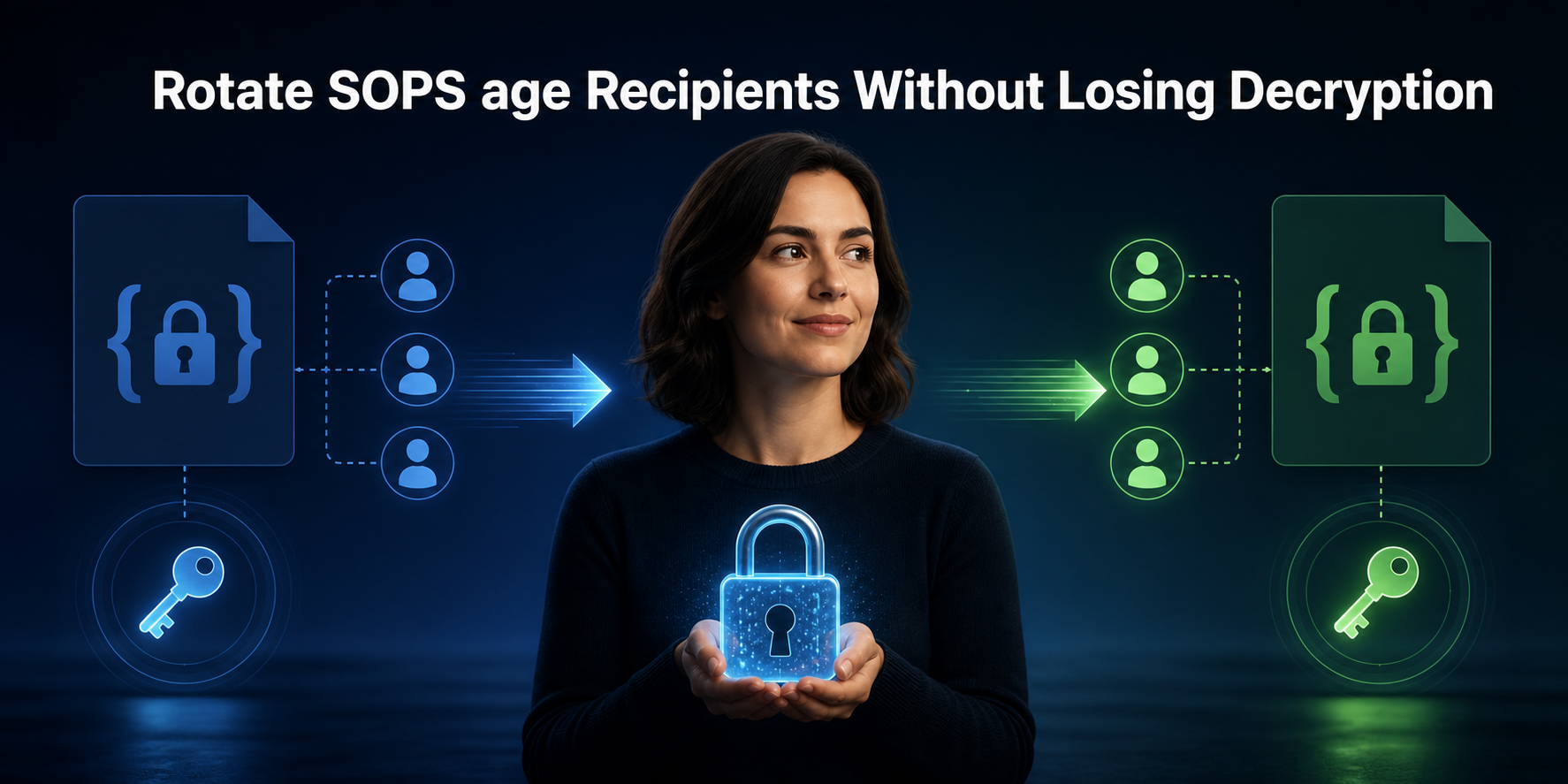
Changing an age recipient in SOPS is an access migration, not a one-command key swap. A safe rotation keeps the existing identity usable while the replacement is added, proves the replacement across every encrypted file, removes the retired recipient, rotates each file’s data key after removal, and additionally replaces the credentials stored inside the files when the old identity may have exposed them.
Three different objects are involved. An age identity is the private key held by a person or automation system. Its public recipient appears in SOPS metadata. A separate data encryption key protects the document values. Finally, database passwords, API tokens, and other payload credentials are the secrets the document contains. Confusing those layers can leave a former key holder authorized or can expose newly changed credentials to an identity you meant to retire.
The workflow below pins SOPS 3.13.3 and age 1.3.1. Its shell continuations, newline escapes and filename patterns have been corrected; repeat all positive and negative controls in your isolated environment before relying on the result. The acceptance contract covers two encrypted YAML files in four states: old identity only, old-plus-new overlap, new identity only, and exact ciphertext rollback. Require unchanged plaintext hashes, one new recipient in each file, two old-identity rejections, and removal of only the guarded disposable directory.
Know Which Rotation You Are Performing
SOPS provides two related operations. sops updatekeys synchronizes the recipients recorded in an encrypted file with .sops.yaml; adding a recipient can rewrap the existing data key without changing every encrypted value. sops rotate, by contrast, generates a new data key and re-encrypts the document values. Current SOPS key-management documentation recommends updatekeys for recipient changes and documents an additional data-key rotation after removing a compromised key.
| Change | What it modifies | When it is enough |
|---|---|---|
add a recipient with updatekeys |
who can unwrap the current file data key | planned overlap while the old identity remains trusted |
remove a recipient with updatekeys |
who is listed in current SOPS metadata | synchronization step after all files and consumers pass; not a complete offboarding endpoint |
run rotate --in-place |
document data key and encrypted value material | after recipient removal so the retired holder does not retain the prior data key boundary |
| replace payload credentials | database passwords, API tokens, certificates, or other actual secrets | when the old identity may already have read those values |
Removing a recipient with updatekeys stops current ciphertext from wrapping its data key for that identity, but it is not a complete revocation boundary by itself. A former holder may have retained the prior data key, ciphertext, clone, commit, artifact, or plaintext. After any recipient removal, rotate each file’s data key. After suspected exposure, complete that recipient and data-key cutover first; then rotate every payload credential the old holder could have learned.
The overlap principle resembles the pattern in measured SSH host-identity cutovers, but the trust direction differs. SSH host keys prove a server to clients. An age identity lets its holder unwrap SOPS data keys. Treat the two pages as separate runbooks.
Freeze Scope, Recovery, and Pass Criteria
Before editing .sops.yaml, identify the files and consumers in scope. Include encrypted YAML, JSON, dotenv, and binary files selected by every creation rule—not just files matching the name used in a tutorial. Locate CI jobs, Flux or other GitOps controllers, developer workstations, break-glass storage, and scheduled automation that currently provide an age private identity.
Write a secret-free acceptance contract:
- the inventory contains the expected number of SOPS files and no unclassified encrypted file;
- a recoverable copy of the current ciphertext and
.sops.yamlexists outside the working tree; - every current file decrypts with an authorized old identity before the change;
- every current file decrypts with the new identity during overlap;
- after retirement, every file decrypts with the new identity and rejects the old one;
- decrypted content hashes match the pre-change baseline;
- SOPS metadata contains only the intended recipient set;
- downstream consumers load the new identity before the old one is removed;
- cleanup cannot touch an unbounded path.
Hash receipts do not prove that a baseline was trustworthy. They prove only that the same plaintext crossed the access migration. If repository files need broader tamper detection, establish a separate known-good file-integrity baseline and keep its approval process outside the host it measures.
Acquire Current Tools and Open a Guarded Lab
The commands in this article form one sequential shell session. They use a temporary path, synthetic values, and private identity files with mode 0600. Do not paste production credentials into the fixture. The release pages for SOPS 3.13.3 and age 1.3.1 are the authority for the tested artifacts; recheck current releases and checksums when reproducing later.
set -euo pipefail
umask 077
unset SOPS_AGE_KEY SOPS_AGE_KEY_CMD
LAB=$(mktemp -d -p /tmp sops-age-rotation.XXXXXXXX)
BIN="$LAB/bin"
REPO="$LAB/repo"
KEYS="$LAB/keys"
BACKUP="$LAB/ciphertext-before"
install -d -m 0700 "$BIN" "$REPO" "$KEYS" "$BACKUP"

curl -fsSLo "$BIN/sops" \
  https://github.com/getsops/sops/releases/download/v3.13.3/sops-v3.13.3.linux.amd64
curl -fsSLo "$BIN/age.tar.gz" \
  https://github.com/FiloSottile/age/releases/download/v1.3.1/age-v1.3.1-linux-amd64.tar.gz

printf '%s  %s\n' \
  e5bec3346a873ae91d871550f3e698c1aad962aff462a080e40f25fde17fef6b "$BIN/sops" \
  bdc69c09cbdd6cf8b1f333d372a1f58247b3a33146406333e30c0f26e8f51377 "$BIN/age.tar.gz" \
  | sha256sum -c -

chmod 0700 "$BIN/sops"
tar -xzf "$BIN/age.tar.gz" -C "$BIN"
export PATH="$BIN:$BIN/age:$PATH"
sops --version | head -n 1
age-keygen --version
Checksums in a copied article age quickly. If the release version changes, do not keep the version and replace only a hash until verification turns green. Select the intended platform asset from the official release, obtain its published digest through the same release record, and review the current key-management behavior before changing production files.
Create Two Identities and an Encrypted Baseline
The fixture covers two files so repository-wide selection is real rather than assumed from one happy path. Both payloads are synthetic. Private age identities stay under $KEYS, outside $REPO; only public recipients enter .sops.yaml. The official SOPS age identity guide documents SOPS_AGE_KEY_FILE, the default lookup paths, and multiple recipients.
age-keygen -o "$KEYS/old.agekey"
age-keygen -o "$KEYS/new.agekey"
chmod 0600 "$KEYS"/*.agekey
OLD_RECIPIENT=$(age-keygen -y "$KEYS/old.agekey")
NEW_RECIPIENT=$(age-keygen -y "$KEYS/new.agekey")

cat >"$REPO/app.enc.yaml" <<'YAML'
database:
  host: db.internal.example
  username: lab_app
  password: synthetic-app-password-v1
service:
  token: synthetic-service-token-v1
YAML

cat >"$REPO/worker.enc.yaml" <<'YAML'
queue:
  endpoint: queue.internal.example
  username: lab_worker
  password: synthetic-worker-password-v1
YAML

cat >"$REPO/.sops.yaml" <<EOF
creation_rules:
  - path_regex: '.*\.enc\.yaml$'
    age: >-
      $OLD_RECIPIENT
EOF

for file in "$REPO"/*.enc.yaml; do
  SOPS_AGE_KEY_FILE="$KEYS/old.agekey" \
    sops --config "$REPO/.sops.yaml" encrypt --in-place "$file"
done
cp -p "$REPO/.sops.yaml" "$REPO"/*.enc.yaml "$BACKUP/"
Keep the recovery copy where an accidental Git operation cannot modify it. A repository backup protects encrypted files but should not silently collect private age identities. When the Git platform itself is part of the risk, use Forgejo restore rehearsal guidance to separate repository data from application metadata and prove both planes before a crisis.
Prove the Starting State Before Adding Access
An overlap is useful only when the baseline is known. Capture a deterministic list, decrypt every file with the current identity, save a plaintext hash without saving plaintext, and prove the replacement identity is not already authorized. The negative test matters: a new key that unexpectedly works may already be present through another key group, environment variable, default identity file, or external identity command.
find "$REPO" -maxdepth 1 -type f -name '*.enc.yaml' -print0 \
  | sort -z >"$LAB/encrypted-files.list0"

[[ $(tr -cd '\0' <"$LAB/encrypted-files.list0" | wc -c) -eq 2 ]]
: >"$LAB/plaintext-baseline.sha256"
while IFS= read -r -d '' file; do
  base=$(basename "$file")
  SOPS_AGE_KEY_FILE="$KEYS/old.agekey" sops decrypt "$file" \
    | sha256sum | sed "s#  -#  $base#" >>"$LAB/plaintext-baseline.sha256"

  if SOPS_AGE_KEY_FILE="$KEYS/new.agekey" sops decrypt "$file" >/dev/null 2>&1; then
    printf 'unexpected baseline access: %s\n' "$base" >&2
    exit 1
  fi
done <"$LAB/encrypted-files.list0"
Use the same explicit identity source throughout the test. If the shell also has SOPS_AGE_KEY, SOPS_AGE_KEY_CMD, SSH identities, or a default SOPS age key file, a failure test can pass for the wrong reason. In CI, inventory those sources without printing private material.
Add the New Recipient and Test the Overlap
Do not delete the old recipient first during a planned migration. Add both public recipients to the applicable creation rule, use one currently authorized identity to synchronize every file, then test every file independently with old and new private identities.
cat >"$REPO/.sops.yaml" <<EOF
creation_rules:
  - path_regex: '.*\.enc\.yaml$'
    age: >-
      $OLD_RECIPIENT,
      $NEW_RECIPIENT
EOF

while IFS= read -r -d '' file; do
  SOPS_AGE_KEY_FILE="$KEYS/old.agekey" \
    sops --config "$REPO/.sops.yaml" updatekeys --yes "$file"
  SOPS_AGE_KEY_FILE="$KEYS/old.agekey" sops decrypt "$file" >/dev/null
  SOPS_AGE_KEY_FILE="$KEYS/new.agekey" sops decrypt "$file" >/dev/null
done <"$LAB/encrypted-files.list0"
Commit boundaries should reflect operational decisions. A planned team migration can use one reviewed overlap commit, deploy the new identity to every authorized consumer, collect positive receipts, and only then prepare a retirement commit. Avoid leaving an indefinite dual-recipient state merely because both keys work.
CI runners deserve their own acceptance line. Self-hosted GitHub Actions runner guidance matters here because a runner can execute repository code and read deployment secrets. Load the new identity through the platform’s protected secret mechanism and test an authorized decryption job before removing the old value. Never print the identity, decrypted file, or environment dump into logs.
Retire the Old Recipient, Then Rotate the Data Key
Once every required consumer passes with the new identity, remove the old public recipient from .sops.yaml. For any retirement, follow the documented order: synchronize the recipient removal first, then rotate the data key. If the key was compromised or potentially exposed, only afterward change actual credentials inside the documents. Rotating the data key while the retired recipient is still present can wrap the replacement data key for the identity you meant to exclude.
cat >"$REPO/.sops.yaml" <<EOF
creation_rules:
  - path_regex: '.*\.enc\.yaml$'
    age: >-
      $NEW_RECIPIENT
EOF

while IFS= read -r -d '' file; do
  SOPS_AGE_KEY_FILE="$KEYS/new.agekey" \
    sops --config "$REPO/.sops.yaml" updatekeys --yes "$file"
  SOPS_AGE_KEY_FILE="$KEYS/new.agekey" sops rotate --in-place "$file"
done <"$LAB/encrypted-files.list0"

: >"$LAB/plaintext-final.sha256"
while IFS= read -r -d '' file; do
  base=$(basename "$file")
  SOPS_AGE_KEY_FILE="$KEYS/new.agekey" sops decrypt "$file" \
    | sha256sum | sed "s#  -#  $base#" >>"$LAB/plaintext-final.sha256"

  if SOPS_AGE_KEY_FILE="$KEYS/old.agekey" sops decrypt "$file" >/dev/null 2>&1; then
    printf 'retired identity still works: %s\n' "$base" >&2
    exit 1
  fi

  recipients=$(grep -Ec '^[[:space:]]+recipient:' "$file" || true)
  [[ "$recipients" -eq 1 ]]
  grep -Fq -- "$NEW_RECIPIENT" "$file"
  ! grep -Fq -- "$OLD_RECIPIENT" "$file"
done <"$LAB/encrypted-files.list0"

find "$REPO" -maxdepth 1 -type f -name '*.enc.yaml' -print0 \
  | sort -z >"$LAB/encrypted-files-final.list0"
cmp "$LAB/encrypted-files.list0" "$LAB/encrypted-files-final.list0"
diff -u "$LAB/plaintext-baseline.sha256" "$LAB/plaintext-final.sha256"
The following is the expected secret-free receipt format, not output automatically emitted by the commands. Record each count from the assertions in your own run. Recipient fingerprints, if recorded, are hashes of public recipients, not private key material.
sops_version=sops 3.13.3
age_version=v1.3.1
sops_checksum=pass
age_checksum=pass
encrypted_files=2
baseline_old_decrypt=2/2
baseline_new_rejected=2/2
overlap_old_decrypt=2/2
overlap_new_decrypt=2/2
final_new_decrypt=2/2
final_old_rejected=2/2
final_new_only_metadata=2/2
plaintext_hashes_unchanged=2/2
rollback_old_decrypt=2/2
rollback_new_rejected=2/2
verdict=pass
cleanup=pass
One green deployment is not repository coverage. Fail the change if the post-cutover file list differs from the declared inventory, a file lacks the expected recipient, plaintext hashes diverge unexpectedly, or any retired identity still decrypts. When applications use shared upstream credentials, consider adopting per-consumer credential boundaries so a future leak can revoke one workload without forcing every client to change simultaneously.
Roll Back Only Within the Trust Boundary
A ciphertext rollback is appropriate for an operator mistake only while the old identity remains trusted. Restoring pre-change SOPS files reauthorizes every recipient contained in that backup. Do not use this rollback after suspected compromise. In compromise response, recover with a surviving trusted identity or offline break-glass path, complete the removal, and rotate payload credentials.
cp -p "$BACKUP/.sops.yaml" "$REPO/.sops.yaml"
cp -p "$BACKUP/app.enc.yaml" "$REPO/app.enc.yaml"
cp -p "$BACKUP/worker.enc.yaml" "$REPO/worker.enc.yaml"

for file in "$REPO"/*.enc.yaml; do
  SOPS_AGE_KEY_FILE="$KEYS/old.agekey" sops decrypt "$file" >/dev/null
  if SOPS_AGE_KEY_FILE="$KEYS/new.agekey" sops decrypt "$file" >/dev/null 2>&1; then
    printf 'rollback recipient mismatch: %s\n' "$file" >&2
    exit 1
  fi
done

[[ "$LAB" == /tmp/sops-age-rotation.* ]]
rm -rf -- "$LAB"
[[ ! -e "$LAB" ]]
Production recovery should preserve an evidence bundle before cleanup: version and checksum receipts, file inventory, old/new public recipient fingerprints, success and rejection counts, plaintext hash comparison, commit IDs, consumer acknowledgments, and the operator who authorized retirement. Keep private identities and decrypted values out of that bundle.
Finish the retirement review against the complete declared file inventory. Every file should decrypt with the new identity, reject the retired identity, list only the intended public recipients, and preserve its approved plaintext hash. Confirm that downstream consumers have loaded the new identity, rollback remains limited to a still-trusted key, and cleanup removed the guarded lab path.
For production repositories, rehearse the repository change like any other stateful migration. Terraform-to-OpenTofu readiness guidance illustrates the same discipline—back up current state, prove compatibility before the destructive boundary, and keep a tested return path—without implying that infrastructure state and SOPS ciphertext are interchangeable.
FAQ: SOPS age Recipient Rotation
What is the difference between sops updatekeys and sops rotate?
sops updatekeys synchronizes the file’s recipients with .sops.yaml; sops rotate generates a new data encryption key and re-encrypts document values. Adding a trusted recipient usually starts with updatekeys. After removing any recipient, synchronize removal first and then rotate the data key; compromise additionally requires rotating payload credentials the old holder may have read.
Can an old age identity decrypt a file after its recipient is removed?
It should not decrypt the new file version once every matching SOPS file has been synchronized and verified. The identity may still decrypt older commits, backups, artifacts, or copies that retain its recipient metadata, so removal cannot revoke historical access retroactively.
Must I rotate the passwords and tokens inside SOPS files too?
Rotate payload credentials when the retired identity may have been exposed or its holder may have read them. Finish recipient removal and data-key rotation first; otherwise newly issued credentials could be encrypted while the compromised recipient still has access.
How do I prove every encrypted file received the new recipient?
Freeze a null-delimited inventory before the change, process that exact list, compare it after the change, inspect each file’s public recipient metadata, decrypt each file with the new identity, and require the old identity to fail. A successful test on one representative file is not repository coverage.
Should overlap and retirement be separate Git commits?
For a planned migration, separate reviewed commits make the decision boundary visible: first add and deploy the new identity, then remove the old one after consumers pass. During active compromise, minimize exposure time and follow an incident-controlled sequence instead of waiting for a routine deployment cadence.
What if the old age identity is the only key that can decrypt the repository?
Use it in a controlled environment to add a verified replacement before deleting anything. If the only identity is already lost, SOPS cannot recover the file data key from ciphertext alone; restore a protected identity backup or recover the plaintext from another authorized system.
Does changing a Flux or CI secret update SOPS file recipients automatically?
No. Updating a controller or CI secret changes which private identity that consumer holds. The encrypted files must separately contain the corresponding public recipient, and both the repository update and downstream deployment must be verified before the old identity is removed.
Close the Rotation with an Access Receipt
A SOPS age rotation is complete when the team can answer five questions from evidence: Which files were in scope? Which consumers accepted the replacement? Can the replacement decrypt every current file? Does the retired identity fail everywhere it should? Were actual payload credentials rotated when historical access made that necessary?
Record those answers without recording the secrets themselves. That receipt turns a recipient edit into an auditable access transition—and gives the next operator a precise starting point instead of another untested key file.