 Lifetime VPS Europe
 Lifetime VPS Asia
 Lifetime WooCommerce Hosting
 Lifetime Hosting
 Lifetime Game Dedicated Servers
 Chicago, US
 Tokyo, Japan
 Singapore
 Hong Kong
 Seoul, South Korea
 Amsterdem, Netherlands
 London, UK
 Stockholm, Sweden
 Oslo, Norway
 Vienna, Austria
 Zurich, Switzerland
 Sydney, Australia
 Wordpress Hosting
 VPS Hosting
 DDOS Protection
 Submit Ticket
 Full Management
 Guides
 Videos and Podcasts
 Discover Creative Ideas
 Voxfor Autonomous AI Workers
 Voxfor Mega Menu
 Voxfor Advanced Price Management For WooCommerce
 Voxfor Secure Live Chat and AI Support
 Voxfor Multilanguage
 Voxfor AI Content Summary
 Voxfor Autopilot
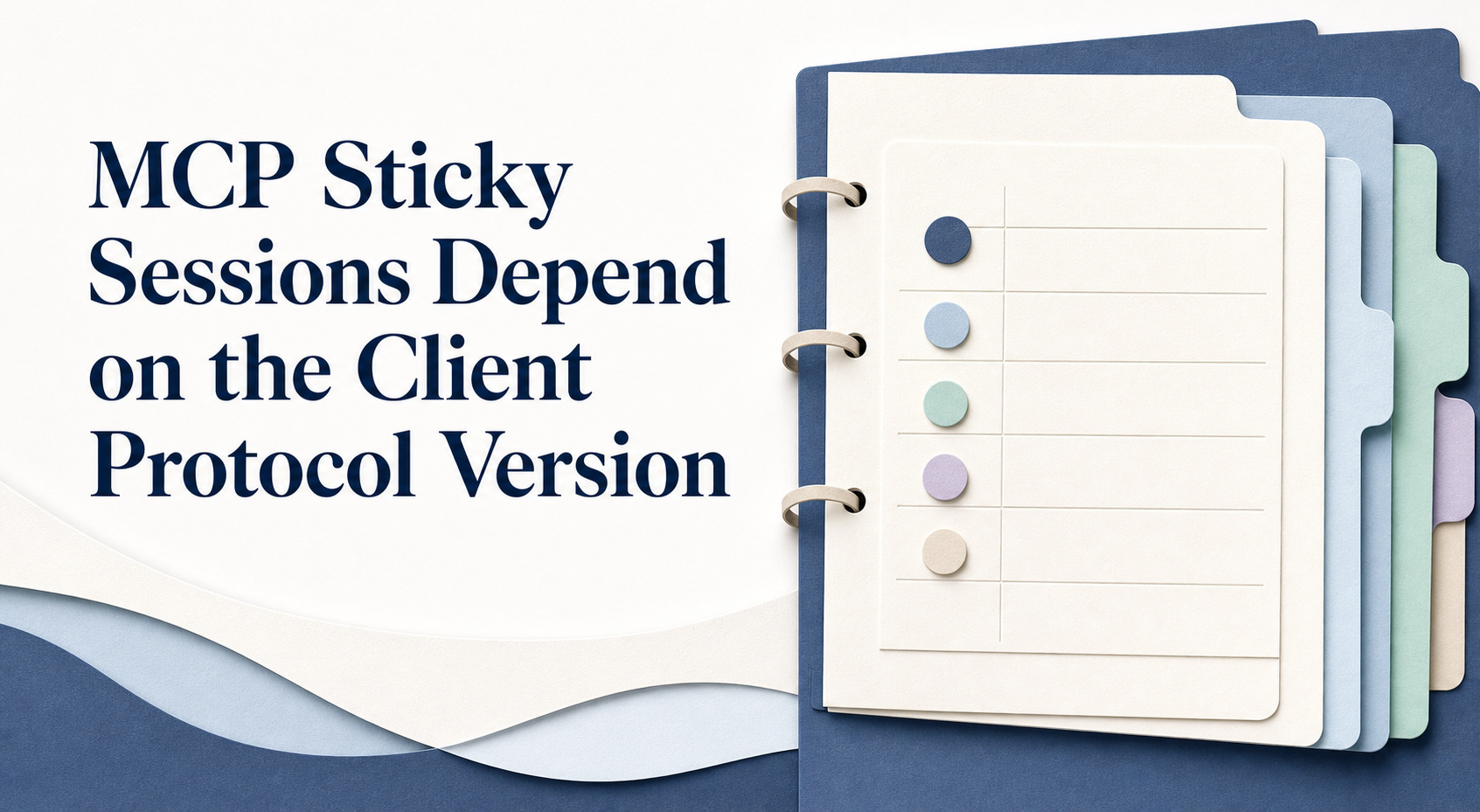
Sticky sessions are not a universal MCP requirement anymore. A remote Model Context Protocol client speaking 2026-07-28 sends self-describing requests that may reach any compatible replica, while a 2025-era Streamable HTTP client can still depend on Mcp-Session-Id and server-local session state. Removing affinity before identifying which contract is on the wire can therefore fix scaling for one client and break another.
That version boundary matters more than the load-balancer brand. Operators should classify traffic first, keep legacy sessions inside a known compatibility lane, and let verified 2026 requests use ordinary round-robin routing. Existing teams starting from secure MCP server hosting can treat this page as the migration and fleet-design layer rather than another installation guide.
The protocol version became an infrastructure contract
On July 28, 2026, MCP moved from a bidirectional stateful core to a stateless request/response core. The official release announcement says the new revision retires the initialize/initialized exchange and Mcp-Session-Id; protocol version, client identity, and capabilities travel with each request instead. It also adds Mcp-Method and Mcp-Name headers so gateways can route and authorize without parsing every JSON body.
Stateless at the protocol layer does not mean memoryless tools. It means transport state is no longer the hidden place that connects calls. When a tool needs continuity, the server can mint an explicit, scoped handle and require later calls to return that handle as a tool argument. That state can live in a database, object store, or another durable owner selected for the application rather than inside whichever worker answered first.
Deployed clients and SDKs may still follow the earlier contract. Under the 2025-06-18 Streamable HTTP specification, a server may return a cryptographically secure session identifier with the initialization result. After receiving it, the client must include that identifier on later HTTP requests. A worker that never created or cannot resolve the session may legitimately reject the request.
Two simplified wire receipts show why one routing rule cannot safely describe both generations. The modern request follows the current Streamable HTTP specification, including its required transport headers and self-describing body metadata:
HTTP/1.1 200 OK
Mcp-Session-Id: 7ad1e4d0-legacy-session
Content-Type: application/json
POST /mcp HTTP/1.1
MCP-Protocol-Version: 2026-07-28
Mcp-Method: tools/call
Mcp-Name: search
Authorization: Bearer <access-token>
Content-Type: application/json
Accept: application/json, text/event-stream
{
"jsonrpc": "2.0",
"id": 41,
"method": "tools/call",
"params": {
"name": "search",
"arguments": {"q": "capacity report"},
"_meta": {
"io.modelcontextprotocol/protocolVersion": "2026-07-28",
"io.modelcontextprotocol/clientInfo": {
"name": "ops-client",
"version": "4.2"
},
"io.modelcontextprotocol/clientCapabilities": {}
}
}
}Mcp-Session-Id creates routing history in the first receipt. The second request carries enough protocol context for any compatible replica to evaluate it. Do not infer either behavior from the endpoint name /mcp alone.
The routing headers are mirrors, not a second authority: the body remains the source of truth. A compliant server must reject a missing, malformed, or mismatched MCP-Protocol-Version, Mcp-Method, or applicable Mcp-Name with HTTP 400 and the JSON-RPC HeaderMismatch error (-32020). A gateway may use those headers for routing and observation, but it must not treat unvalidated mirrored values as independently trustworthy for authorization.
Inventory real clients before changing affinity
A safe migration begins with evidence from the edge and server, not an SDK package version copied from a deployment file. Record the normalized protocol version, presence of Mcp-Session-Id, method and tool-name headers, authenticated client identity, selected backend, status, and request ID. Never log bearer tokens or complete tool arguments.
Useful fields for one observation window are:
MCP-Protocol-Version, including missing or unsupported values;- whether
Mcp-Session-Idarrived, without recording the raw identifier; - whether
Mcp-MethodandMcp-Namearrived where the 2026 contract requires them; - backend replica and deployment revision;
- HTTP status, latency, and a trace/request correlation ID;
- client application name from verified metadata when available.
Treat a missing version as unknown, not modern. The edge should follow the server SDK’s documented negotiation and rejection behavior instead of silently assigning the newest contract. Unknown traffic belongs in a compatibility lane until a controlled probe proves otherwise.
Client-side operation matters too. AI agent VPS workspace design helps separate agent persistence, approvals, and tool access from the transport migration itself. Upgrading a server does not prove every desktop, gateway, automation, and embedded agent has upgraded its MCP client.
Route each deployment shape by its actual state owner
The correct balancing decision follows two questions: which protocol contract is the client using, and where does state needed by the next call live? The 2026 changelog removes protocol-level sessions, but it does not make an application database, job record, upload, or user workflow disappear.
| Observed traffic and state | Safe routing posture | Failure the posture prevents |
|---|---|---|
Only verified 2026-07-28 requests; every replica can resolve explicit application handles |
Plain round robin across compatible healthy replicas | Unnecessary affinity and uneven replica use |
| 2025 sessionful clients; session lives only in one process | Learned affinity that maps returned session IDs to their issuing worker, or one legacy replica | 404/session-not-found responses after a request lands elsewhere |
| 2025 clients; session data is deliberately shared and concurrency semantics are tested | Multiple legacy replicas may route through the shared session owner | Split or stale session state caused by pretending local maps are shared |
| Mixed 2025 and 2026 clients | Separate endpoints or version-aware pools, with legacy behavior preserved and modern traffic allowed to round robin | A global affinity toggle that helps one generation and harms the other |
| 2026 transport with application state still hidden in worker memory | Redesign state ownership before claiming horizontal safety | Tool calls succeeding on one replica and losing context on the next |
Legacy affinity needs more than hashing an incoming session header. The initialization request does not yet carry the identifier that the server will return. A correct implementation must learn the response-to-worker association, encode a trusted routing hint, or use shared state. If the edge cannot do that safely, one bounded legacy replica is more honest than a nominally redundant pool that loses sessions.
Capacity planning should preserve two separate pools during the overlap. Match compute capacity for MCP replicas to measured request concurrency, streaming duration, CPU and memory per replica, then reserve enough headroom for one pool to absorb a rollback. Stateless routing improves distribution; it does not erase tool execution cost.
Move useful state into explicit, scoped handles
Hidden transport sessions made cross-call state convenient but coupled application behavior to one connection or worker. The 2026 model asks the application to name that state. A tool might return analysis_handle, upload_id, or approval_request_id, and later calls present it explicitly.
An operationally useful handle should be:
- opaque and unguessable rather than a sequential database key;
- bound to the authenticated subject, tenant, and allowed operation;
- short-lived when the workflow is temporary;
- revocable and auditable;
- safe under retries and duplicate delivery;
- resolved through a store every healthy replica can reach;
- excluded from ordinary logs when it grants access or reveals sensitive workflow state.
Explicit does not mean client-trusted. A server must re-authorize the handle on every use and reject cross-tenant or expired references. The handle represents continuity; it is not proof that the caller may act.
Gateway design should keep model-provider credentials, MCP access tokens, and downstream API credentials in separate trust boundaries. AI gateway key separation provides a useful parallel: centralizing one credential class must not turn the gateway into a pass-through for every downstream secret.
Authorization remains a per-request decision
Round robin is safe only when every replica applies the same authorization policy. The current MCP authorization specification requires bearer authorization on every protected HTTP request, audience validation for the intended MCP resource, and rejection of invalid or expired tokens. A connection that authenticated earlier is not a substitute for validating the current request.
The 2026 revision also hardens authorization discovery and issuer handling. During migration, keep policy, keys, clocks, resource identifiers, and supported scopes synchronized across the modern pool. Otherwise, load balancing exposes disagreement as alternating 200, 401, or 403 responses even though routing itself works.
For observability, aggregate only decision-safe dimensions: issuer identifier, audience result, scope decision, protocol version, method/tool, replica, and status. Bearer tokens, authorization codes, refresh tokens, complete tool arguments, and explicit state handles should remain out of routine logs.
Roll out the modern pool as a compatibility migration
Changing every backend at once hides whether a failure belongs to protocol support, state ownership, authorization, or routing. Use a staged release with one rollback boundary at each step.
- Freeze an evidence window. Record current protocol-version shares, session-header use, backend distribution, latency, and errors.
- Create a modern pool. Deploy replicas that explicitly support
2026-07-28, share necessary application state, and enforce identical authorization policy. - Keep legacy traffic isolated. Preserve the existing 2025 endpoint or affinity path until named clients have passed compatibility tests.
- Send controlled modern probes. Exercise discovery when used, representative read tools, one bounded write tool, explicit-handle continuation, retry behavior, and an authorization denial.
- Increase modern traffic by known client. Do not route anonymous percentages of an unclassified mixed fleet merely because aggregate error rate is low.
- Restart or remove one modern replica. A following request using the same explicit handle must succeed on another healthy replica.
- Retire legacy routing only after coverage is proven. Keep a dated inventory of remaining client owners and a tested restoration path.
Edge changes deserve the same discipline as application releases. Practices from reload-safe reverse-proxy changes apply here: validate configuration before reload, preserve established connections where the proxy supports it, and prove the intended route after the change rather than treating a successful reload as acceptance.
Rollback is a routing decision, not a data rewind. Sending known modern clients back to a compatible legacy lane may restore service, but explicit state created only in the new design must remain resolvable. Test that boundary before production traffic creates irreplaceable work.
FAQ: MCP load balancing during the transition
Do MCP 2026-07-28 servers need sticky sessions?
MCP 2026-07-28 does not require sticky sessions at the protocol layer because it removes Mcp-Session-Id and makes requests self-describing. Applications still need an explicit shared owner for state that must survive across calls or replicas.
Can 2025 MCP clients use plain round-robin load balancing?
Sessionful 2025 clients can use round robin only when every backend can resolve the same session state with tested concurrency semantics. If session state remains in one process, use learned affinity or keep that compatibility lane on one replica.
Does stateless MCP prevent tools from keeping workflow state?
Stateless MCP does not prevent workflow state. A server can return an opaque handle from one tool call, store the associated state in a durable scoped owner, and require later calls to present the handle explicitly.
How should a load balancer distinguish legacy and modern MCP traffic?
Use the normalized MCP-Protocol-Version and a controlled endpoint or client inventory to choose a compatible pool. Missing or unsupported versions should follow documented negotiation or rejection behavior, not be silently treated as 2026-07-28.
Must an MCP access token be checked on every request?
Yes. Protected HTTP requests must carry bearer authorization, and each MCP replica must validate token validity, intended audience, and required scope for the current request. Session affinity never replaces per-request authorization.
Close on one request reaching any healthy replica
The strongest acceptance test is not a balanced connection chart. Send a verified 2026 tool call, retain its explicit application handle, remove or restart the replica that answered, and continue the workflow through another healthy replica. Then repeat an unauthorized request and confirm every replica rejects it consistently.
Keep legacy proof separate: a 2025 client should retain its session through the declared compatibility path until that client’s owner upgrades. When both receipts pass, operators can remove affinity deliberately instead of guessing that a new SDK made the old contract disappear. Browse Voxfor AI hosting research for adjacent agent, model, and infrastructure decisions after the routing boundary is stable.